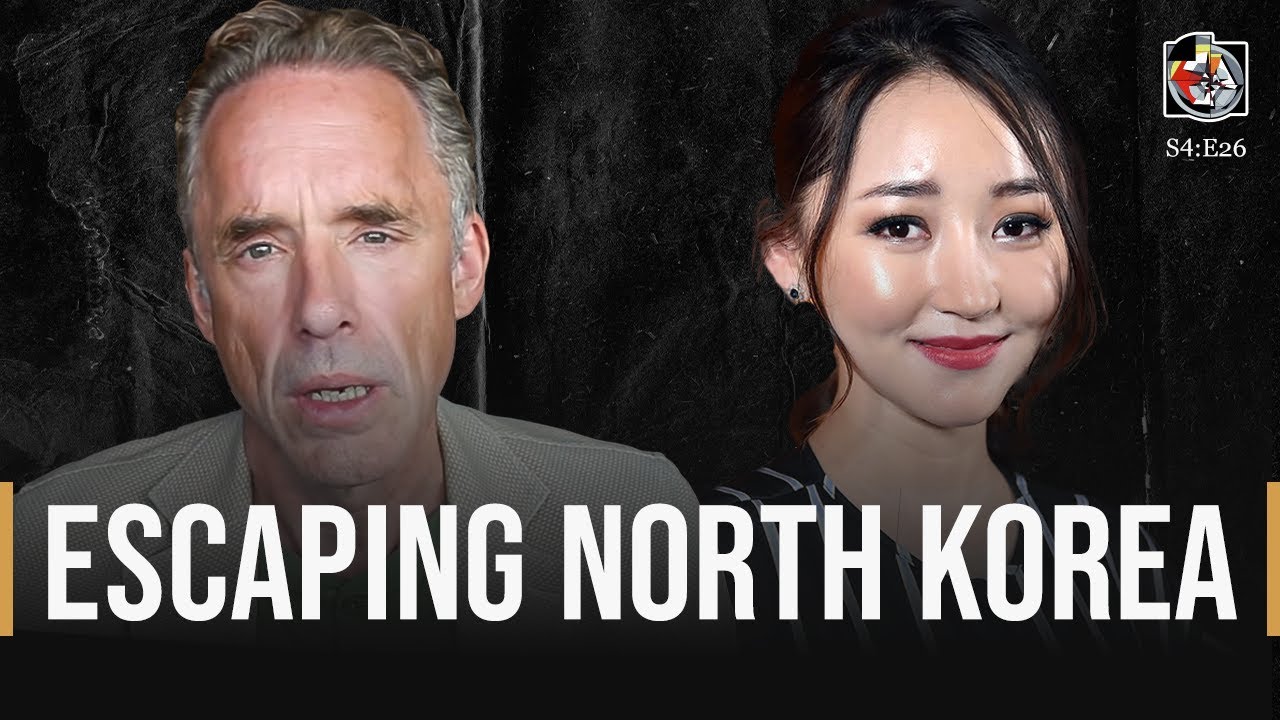
Jordan Peterson Explains Why Being Calm Is More Mysterious Than Being Anxious and the Price of Consciousness
Enjoying this? Share it with someone who needs to see it.
Up Next
The Dark Reality of Elite Power Structures: Sex Magic, Occult Rituals, and Pedophile Networks
16:32
Father Josiah Trenham on How Marriage Became the Cornerstone of Civilization and Why We Must Reclaim It Now
1:40:05
17-Year-Old British Activist Young Bob Debates LGBT Rights and Traditional Values in Manchester Street Confrontation
14:39
Jordan Peterson Explains Why Being Calm Is More Mysterious Than Being Anxious and the Price of Consciousness
Jordan Peterson explores the hypothalamus as the control center for human motivation and behavior, challenging conventional psychological thinking by asking not why people are anxious, but why they are ever calm. He traces the evolutionary journey from unconscious animal existence to self-conscious human life, examining the Genesis story as a profound metaphor for the acquisition of higher consciousness and moral knowledge. Peterson discusses how the discovery of time, self-awareness, and mortality fundamentally altered human existence, creating what Nietzsche called the crisis of nihilism when traditional belief systems collapse, and how reciprocity forms the foundation of all human morality.
The Hypothalamus Controls Everything You Think You Control
The hypothalamus is a major system and when push comes to shove, it's the thing that's in control. One of the ways of thinking about the way that you organize your life is that the hypothalamus controls the major motivational systems. Those are the things that people would think about as drives, although they're not drives, they're too complicated to be drives. Then there are other systems that come up later that govern emotion like anxiety and a different system that governs pain. Partly what you're trying to do as you organize your life is to make sure those systems stay shut off.
You think, well, I'm in control. It's like, well, no, you're not. You just satisfied all the things that could take control from you and so now you have a modicum of choice. Basically what you're doing when all these things have had what they need is you're running around exploring. That's also another one of these circuits because the hypothalamus governs exploration.
Why Are People Ever Calm? That's The Real Question
Psychologists often get things backwards and they ask silly questions like why are people anxious? That's a stupid question. Why are people ever calm? That's a question. Because why are you anxious? Well, think of all the terrible things that can happen to you and they will happen to you even worse and there isn't anything you can do about it. Why aren't you quaking in your boots just sitting there? Well, that's a mystery.
Here you are in your normal state. It's like, well, no, this is not a normal state. People have been trying for 7 million years as people to create a situation so complex and comfortable that a couple hundred of you can sit here without having your hypothalamus driving you towards something and actually just listen to something for a few hours. That's not normal. That's so staggeringly abnormal that it's a miracle.
The typical person for most of human history was hungry, man. And that's not the same as what you experience. Some of you have probably been hungry in your life, but you're hungry when you haven't had anything to eat for 20 days. Then you're hungry. The same goes for thirst and cold and all the things that we're just never exposed to. So we think civilized people are all calm and nice and easy to get along with. Yeah, well, you have absolutely everything you need all the time. And that makes you as easy to get along with as any completely insane primate ever gets.
The Rest Of The Brain Organizes The Hypothalamic Sub-Personalities
You might say, well, if you can survive with just the vital elements, what good is the rest of the brain? The answer is, well, if you're thirsty, the hunger system isn't going to be able to take care of that. You're hungry now and you're angry now, perhaps. You can move through those states. You watch that in two-year-olds. It's partly why they're so fun to be around. First of all, they're really excited and they're running around playing, and then they trip, and then they're crying like mad, and then you poke them, and they laugh, and then they want something to eat, and then they fall asleep. They're just run by their hypothalamus and it's really fun to see because they're so alive and so enthusiastic and spontaneous, but they're completely clueless.
You take one of those creatures to the mall and leave it there and it's just not happy at all. The reason for that is it doesn't know how to sequence any of its actions. It runs through these states of need, but it isn't complicated enough to figure out how to address those needs in any consistent sense across multiple environments in a social world. You need the rest of your brain for that.
That fits in with the Piagetian ideas that what you're doing is you're taking these micro-personalities that are basically instantiated within the hypothalamus and then you're organizing those into more and more complex games and you need the cortex to do that because the cortex is partly what enables you to think about time. The hypothalamus is a here and now thing. The hypothalamic cat lives in the present. There's the present and that's it.
The Trade-Off Between Transcendence And Functionality
One of the things that happens to people if they take amphetamines or if they take psychedelic drugs is that some of the inhibitory control, some of the more complex control systems that are cortical shut down and so then they enter a state where it's all now. The now just comes at people in that state. It's a transcendent experience, but of course, despite that, you're not functional. In some sense you trade that transcendent relationship with reality for a narrow functionality and that's too bad and that's life, but it's a trade-off.
You're organizing these sub-personalities and you're using your cortex to do that because you don't just have to think about eating, you have to think about how am I going to get the food? When is the food going to come? How am I going to cook the food? What about all the other people that want to eat? How do we regulate that in our family? And then how do we regulate that with the fact that we also need to sleep and we need to work and we need to get along with other people and we need to have something interesting to do. It's ridiculously complicated.
There's no end to the complication because maybe you're just solving the problem for you and your two. Or maybe you're trying to work it out within your family. Then you solve the family problem but then you got the tribe problem and maybe you can solve that to some degree but then you have the broader political problem. There's an infinite number of problems that crop up for you to solve. So there's plenty for you to do with your big cortex.
The Discovery Of Time And The Burden Of The Future
We paid a big price for that thing because once we discovered time we could make a bargain with the future, which is basically what you do when you regulate your behavior. You're making a bargain with the future. You say to yourself, if I forego so and so now, then later it'll pay off. That's real useful. You can conceptualize the future and you can conceptualize the future as something you can bargain with. But there's a lot of cost to that. One is you don't get to do just what you want right now. And of course that sucks. It's partly why people drink alcohol.
Alcohol is disinhibiting. It stops you from thinking about—it actually doesn't stop you from thinking about the future, by the way. It stops you from caring about what you think about the future. And that's just as good. And so then you can go out and have fun because fun is impulsive and often extremely dangerous because the long-term consequences can be really devastating. But it's a real pain to keep yourself controlled all the time because you're foregoing direct reward constantly.
It's part of the reason why people in heavily industrialized complex countries aren't necessarily happy. It takes a lot of grinding away to keep all the machinery that keeps all of this in place going. Tigers aren't tearing you apart, but by the same token, you have to be unbelievably disciplined and ready to act constantly to keep everything that's so complex around you working. And that's not necessarily fun.
The Garden As A Metaphor For Psychological And Cultural Order
You're always in a situation. When are you in a garden? One answer could be when you're in a beautiful house, or in a beautiful hotel, or in a well-functioning institution, or in a city that's working. But I could also say you're in a garden when your conception of the world is sufficient that when you enact it, it allows the world to be fruitful. That's a garden, too. Your internal psychological structure, the conceptions that you use, they're obviously analogous to culture, but they're also analogous to a garden in that way. And like culture, they can be disrupted.
You know what it's like when people say this all the time, I wish that hadn't happened. What they mean by that is, geez, I was in a pretty good place before that event occurred. A big moral error can really do that to you. You do something that you really think is stupid, and you're just shattered, really. Sometimes shattered enough to develop post-traumatic stress disorder.
The Serpent, The Fruit, And The Opening Of Eyes
You can't get rid of the snakes. That's the first idea in the story. Well, then the issue is, what do you do with the snakes? God basically didn't really tell them not to interact with the snakes, and he put a snake in there. I think it's partly because in a sense it's not possible to create a garden without having a snake in it because you can't keep everything out. It's not possible.
The snake comes along and it says, well, if you do this thing that God forbade, a lot of wonderful things will happen. The serpent said unto the woman, ye shall not surely die, for God knows that in the day you eat thereof then your eyes will be opened and you will be as gods knowing good and evil. What can we conclude from that? Well, the first thing is that their eyes were closed because if they weren't closed, then how could they be opened? And the second thing is they didn't know the difference between good and evil.
That explains the whole ashamed, naked, and not ashamed issue because if your eyes are closed, that's irrelevant. And if there's no moral knowledge, there's obviously no shame. What's happening here is that there's a very profound distinction being made between the before fruit-eating state of being and the after fruit-eating state of being or the before fruit-eating and snake-interacting mode of being and the after fruit-eating and snake-interacting mode of being.
From Unconsciousness To Self-Consciousness
It's reasonable to think of that on a historical timeline. Those are two of the major forces that shaped our evolutionary history. And the idea that things were different before that and after that is a perfectly reasonable presupposition. Something put us on the path to very, very rapid cortical development. Vision is certainly one of those factors. The fruit-eating element, well, that's where we have color vision.
The next thing is, there's no moral knowledge. That's interesting because it implies that there's some tight link between having your eyes closed and not having moral knowledge. To have your eyes closed is to not be able to see. So there's a kind of unconsciousness about it. When the woman saw that the tree was good for food and that it was pleasant to the eyes, and a tree to be desired to make one wise, she took of the fruit thereof and did eat and gave also unto her husband with her and he did eat. And the eyes of both of them were opened and they knew they were naked, and they sewed fig leaves together and made themselves aprons.
That's quite an interesting sequence of events. They're tempted by this thing that's subtle and dangerous. And the consequence of the temptation is the ingestion of something, the incorporation of something with transformative properties. And the transformation is profound. What happens is they open their eyes. That's coming to consciousness. That's exactly what that is. When a kitten opens its eyes, it finally enters the world. So people had their eyes closed before this event. They weren't conscious in the same way.
The Knowledge Of Death And The Birth Of Morality
If you're self-conscious, you know where your boundaries are because what's inside the boundary is you and what's outside isn't you. But then there's other boundaries that you have. There's a temporal boundary. There's the time when you weren't and there's the time when you won't be. So there's a boundary in space, but there's a boundary in time. And that means that as soon as you become self-conscious, you know that you're going to die.
That's the tight link between the fruit of the tree of knowledge of good and evil and death in the Old Testament or in the Genesis story. You might say, well, you were going to die before. Fair enough, but there's a big difference between the death of a self-conscious entity and death. In the one case, it's a natural process, that's natural death. In the other one, it's a catastrophe of being for the self-conscious individual.
The other thing that happens is in the Genesis story that discovery is portrayed as a permanent rift in the structure of being. That's why it's such a deep sin. All of a sudden, everything is different, and it will never be the same again, no matter what happens. You might say, well, obviously God was an enemy of higher consciousness. There's lots of interpretations of Genesis that took exactly that stance. God was an enemy of higher self-consciousness. He wanted things to remain in an unconscious paradise, and that it was human unwillingness to behave and curiosity that has sent us to the problem that we're in, and that's actually a catastrophe.
Nietzsche And The Crisis Of Nihilism
Nietzsche wrote: The end of the moral interpretation of the world, which no longer has any sanction after it has tried to escape into some beyond, leads to nihilism. All lacks meaning. The untenability of one interpretation of the world, upon which a tremendous amount of energy has been lavished, awakens the suspicion that all interpretations of the world are false.
It's a brilliant observation because his point is—I've seen this in fundamentalist Christians, for example, who I've taught in the past. I have a very biological view of things, and these people, I met more of them when I was in the United States, they were more intelligent than they were wise, meaning the constraints within which their intellect was forced to operate, which would be the Christian fundamentalist constraints, were not sophisticated enough to encapsulate their intellect. They were too smart for their own theories. They come to university and be exposed to ideas that were outside the scope of Christian fundamentalism, would just blow their fundamentalist presuppositions into bits. And so then, of course, they fall into nothing.
But Nietzsche says it's even worse than that. It's not only that you fall into nothing, it's that once one of your systems of belief has been destroyed, you also learn that systems of beliefs themselves are unreliable. So you can't just move easily from one to another because it's like you're in a boat and it's sunk, and now you know that if you jump to the next boat, that boat could also sink. So it's not only that your boat has sunk. It's now you know that all boats can sink. That's part of the position of the modern person as far as Nietzsche was concerned, is that every one of us knows, at least in principle, that all the boats that we want to jump into could potentially sink. Nietzsche saw nihilism as the inevitable consequence, the inevitable rational consequence of that realization.
The Influence Of Nietzsche On Modern Thought
Nietzsche was a very, very influential person. He influenced Heidegger and Heidegger influenced Binswanger and Boss, but Nietzsche also influenced Jung as much as Freud did and Jung spent his whole career trying to solve the question that Nietzsche posed. One of the questions was: we must experience nihilism before we can find out what value these values really have.
The collapse of a belief system makes all the values within it no longer tenable. That's the meaning of Nietzsche's statement that God is dead. He said if you take the central axiom out of a system of belief, you can't hold on to all the things that were derived from that axiom.
The Foundation Of Western Values And Natural Rights
In modern Western law, there's a presupposition and the presupposition is that in some weird sense, everyone is equal before the law and that even applies to someone who's a murderer. You're a murderer and it's known, you have to be treated with respect by the legal system and that's a very strange thing. It's a miracle that something like that ever emerged because it's so unlikely.
You might ask, well, what is the idea that everyone has worth before the law grounded in? Where does that idea come from? It comes from the idea of natural rights that we have natural rights. Where did the idea of natural rights come from? Then you're starting to move beyond the realm of rational philosophy because natural rights, the idea of natural rights has been an idea that has been emerging for thousands and thousands of years.
It's grounded in Christianity at least to the degree that one of the things that distinguishes Christianity is the idea that there's a universal faith and that everyone, whether they're in that faith or not, has intrinsic value. Natural rights are grounded in the idea of the intrinsic value of the soul. And then that's grounded in the idea that consciousness itself participates in creation. That's an idea that's embedded in Genesis and also in most creation stories.
When you get rid of the religious underpinnings which ground the entire system in a kind of dream-like mythology, when you get rid of that, there's no reason that what's left over rationally can survive. You can see that if you look at what happened in the 20th century because there were at least two major challenges to the civilizations that evolved. And they weren't only Christian or Jewish civilizations, the same thing happened in China.
The 20th Century As Proof Of Nietzsche's Warning
There was a replacement of these evolved moral systems that emerged over a tremendous amount of time that no one rationally created. Once people started to criticize them and to destroy the axioms on which they were built and moved them aside, then there was a gaping hole left. And the hole was filled most particularly either by Nazism, which spread like mad throughout Central Europe, or by Communism, which still possesses China.
Even though China came from a historical culture that was substantially different from that of Western Europe, once rationality emerged to the point where it could be used as a critical force, which happened in Europe, that spread like mad and it undermined the societies of China just like it undermined the societies of the West.
Russia's Sudden Enlightenment And The Bolshevik Revolution
Russia was really the last country that underwent the transformations that were associated with the Enlightenment. When Tolstoy was a young person in the late 19th century, he said he could literally remember when the announcement spread through his school that God was dead. The Western Europeans had been working on that idea for a couple of hundred years with the dawn of scientific thinking. But the Russians were very backwards in some sense, and they were never affected by the conflict between rationality and religion until it happened all at once.
It happened all at once at the end of the 19th century, and the consequence of that—it's complicated—but the consequence of that was that the monarchy exploded, and then the consequence of that was that the Russians were left with nothing. And the consequence of that was the Bolshevik Revolution. And then that was what started the entire Soviet nightmare.
You see very frequently that when a society loses its grounding in its historical truths, that it turns to something as an alternative. You see the same thing happened in Quebec. Because Quebec didn't undergo the modern transformation until the late 1950s. It was probably the last European society to go through the Enlightenment Revolution, because the Catholic Church was an incredibly dominant force in Catholic Quebec until the late 1950s.
Quebec's Rapid Secularization
The average family size during that time must have been in the neighborhood of 10 children. And then all of a sudden in the late 1950s, the Quebecers just lost their Catholicism. It was just gone. And now for example, the Quebecois have the lowest marriage rate in the Western world and one of the lowest reproduction rates as well.
There was a Gallup poll that was conducted about 10 years ago. I don't know if this information has ever been made public, but there was a Gallup poll that indicated that if you were a Catholic who had lost your faith, so you left the church, you were 10 times more likely to be a separatist. You can see the consequence of it is that if one belief system disappears, well, nihilism is one possibility, but another possibility is that you just adopt the next thing that's close that gives you structure. And nationalism of course is one of those things.
Being As A Play Rather Than A Collection Of Phenomena
Your being is more like a play than it is like a collection of objective phenomena. Then what happens is the play itself, like a Shakespearean play, becomes a more accurate representation of being than a scientific description does. It's because it accounts for behavior and because it plays out the consequences of behavior from the subjective perspective because a good play elicits the sort of passions and emotions and motivations that are subjectively experienced that actually characterize your life as you live it.
The play, a novel, a book, a story is an abstracted representation of reality that's subject to just as much rigor in terms of conception as a scientific description of a given thing. And it's also real. Well, it depends on what you mean by real. Because we already found out what the scientists think of as real, but there's lots of arguments about that because I might say, well, I would judge what you consider real by watching how you behave, not by listening to what you say about the structure of the world. And that's an existential perspective as well.
The Undeniable Reality Of Subjectivity
I would note that regardless of what all of you might say about what you believe about the nature of reality, it's certainly the case that you're going to act as if your own perceptions, your own subjectivity is real. For example, if something hurts you, you can think all you want about how pain is not objective, but that's not going to get you out of the painful situation. And you're still going to configure your behavior so that you're going to do everything you can, even involuntarily, so that you will work to avoid that pain. So you're stuck with acting as if your subjectivity is real.
That happens at such a deep level that it supersedes your consciousness. Like if you put your arm on a burning stove, you're going to take your arm away from that before you even think about it. So the reality of your subjectivity is so deep that you don't even necessarily have a choice about it.
How To Behave Is The Fundamental Problem
One of the things that I've wondered for a long time is what happens if you take this sort of idea seriously, that you need the knowledge that is constituted in stories because it tells you how to behave and because you need to know how to behave because that's actually one of the fundamental problems of life. It might even be the most fundamental problem of life. From a scientific perspective, the most fundamental problem is what are things made of? How do they interrelate? But just because that's a very well stated problem and just because we've been able to produce profound and differentiated answers to it does not necessarily mean that that is the problem that almost everyone faces and it seems to me it's especially the case with people at your age. What am I going to do? Seems to me to be the fundamental problem.
If the answer to that is, well, there's no real guidance for that, it's just something you have to figure out for yourself, then that's the sort of thing that makes you question the utility of knowledge per se and I think it's a weak answer and I also think it's a wrong answer. There's no shortage of information about how to behave and there's no shortage of information about what happens if you break the rules of behavior. Now, there's arguments about what those rules are and there's no doubt that they differ contextually. But something can differ at one level of analysis and be the same at another.
Piaget And The Foundation Of Morality
Languages are like that. I mean, we all speak a language. The languages are different, but they're all languages, which means they differ at one level of analysis and they are common at another. And how to act is like that, too. I think Piaget is particularly useful for thinking about that. Because Piaget is the thinker who I think has done the most work in trying to understand how it is that there might be a basis for what constitutes morality.
Piaget starts with the Shakespearean conception fundamentally. He believes that how to act is the problem. We're embodied creatures and we're very mobile and we're very good at manipulating the world. We're very good at communicating and so any psychology that doesn't take into account the nature of our embodiment is a very weak psychology.
Piaget basically says, well, look, you come into the world with some potential for action. It's kind of minimal, but it's enough to get you going. It's enough to kick start you in a sense. And then as you organize your body and you're doing this neurologically sort of from the spine up, the manner in which you organize your capability for action and perception is continually modified by your social interaction with other people. So your socialized being is built right into your motor circuitry. It's a pattern. It's not even a conception, it's a pattern.
Reciprocity As The Foundation Of All Morality
When you're breastfeeding, you have to do it in a manner that allows your mother to tolerate you. And so something even something as simple as the first ways that you use your lips and your mouth and the way that you express your emotions is immediately going to be modified by the necessity of social interaction. And social interaction can't just proceed any old way. If we have a relationship and it becomes seriously non-reciprocal, you're a fool if it's non-reciprocal in your direction. You're a fool to stay with it. There's something that's roughly like the expectation of 50/50. And that's well established empirically with experiments that you wouldn't expect to turn out that way.
Those are the trading experiments. The deal is we'll play, the three of us will play. So I have $100 and you can have as much of it as you want, but you have to give him some and he has to accept your offer. What's been found everywhere is that people roughly center around 50/50. Even if the amounts are quite high and even if the people to whom the money is being offered are very poor. In fact, the poorer the people are to whom the money is being offered, the more likely they are to tell you to go to hell if you're not being fair.
That's built-in and you think about that. It doesn't take much more than that for morality as a system to get going. If the rough expectation is reciprocity where that's possible, then deviations from that reciprocity are going to be punished very harshly. Right there you have the grounds for the emergence of a complex system of human interactions that's by no means arbitrary. It might be altered to some degree by the particularities of the local environment. There's no doubt about that. But something can have a fundamental pattern and still be capable of a large number of variants.
Video Transcript
The hypothalamus is a major league system and when push comes to shove, it's the thing that's in control. And one of the ways of thinking about the way that you organize your your life is that the hypothalamus controls the major motivational systems. We just talked about those and so those are the things that people would think about as drives, although they're not drives, they're too complicated to be drives. And then there's other systems that come up later that we'll also talk about that are that govern emotion like anxiety and uh and a different system that governs pain. Partly what you're trying to do as you organize your life is to make sure those systems stay shut off. And then you think, well, I'm in control. It's like, well, no, you're not. You just satisfied all the things that could take control from you and so now you have a modicum of choice. You can And basically what you're doing when all these things have had what they need is you're running around exploring. You know, and that's, you know, that's also another one of these circuits because the hypothalamus as I already said governs exploration. So, a lot of See, uh psychologists often get things backwards and they ask silly questions like why are people anxious? That's a stupid question. It's how people Why are people ever calm? That's a question. Because of like, why are you anxious? Well, hmm, think of all the terrible things that can happen to you and they will happen to you even worse and there isn't anything you can do about it. It's like, why aren't you quaking in your boots just sitting there? Well, that's a mystery. You know, and then well, you know, here you are in your normal state. It's like, well, no, this is not a normal state. People have been trying for 7 million years like as people to create a situation so complex and comfortable that a couple hundred of you can sit here, you know, without having your hypothalamus driving you towards something and actually just listen to something for a few hours. That's not normal. That's so staggeringly abnormal that that, you know, it's a miracle. The The typical person, like And And for most of human history, it's like you were hungry, man. And that's not the same like you people Well, some of you have probably been hungry in your life, but I mean What's the longest Is there someone here who's gone without food for more than 1 day? Okay, has anybody here gone without food for more than a week? Okay. Okay. How about 3 days? Okay. So, like, are you hungry? No. You know, you're hungry when you haven't had anything to eat for 20 days. Then you're hungry, you know, so And the same goes for thirst and cold and all the things that we're just never exposed to. So, you know, we think civilized people are all calm and nice and easy to get along with. It's like Yeah, well, you know, you have absolutely everything you need all the time. So, you And that makes you as easy to get along with as any completely insane primate ever gets. So, Okay. So, the rest You might say, "Well, God, if you can survive with just the vital elements, what good is the rest of the brain?" And the answer is, "Well, if you're thirsty, uh let's say you're angry. The hunger system isn't going to be able to take care of that, right? So, you're hungry, okay, that works. You're angry, that works. But then you have another problem, which is you're hungry now and you're angry now, perhaps. You can move through those states. You watch that. You see that in 2-year-olds. It's partly why they're so fun to be around. It's like, first of all, they're really excited and they're running around playing, and then, you know, they trip, and then they're crying like mad, and then you poke them, and they laugh, and then they want something to eat, and then they fall asleep, and you know, they're just They're just running they're run by their hypothalamus and it's really fun to see because they're so alive and so enthusiastic and spontaneous, but they're completely clueless. It's like you take one of those creatures to the mall and leave it there and it's like it's just not happy at all. And the reason for that is well, it doesn't know how to sequence any of its actions, right? It it it runs through these states of need, but it isn't complicated enough to figure out how to address those needs in any consistent sense across multiple environments in a social world. You need the rest of your brain for that. And so and that again fits in with the Piagetian ideas that what you're doing is you're taking these micro-personalities that are basically instantiated within the hypothalamus and then you're organizing those into more and more complex games and you need the cortex to do that because the cortex is partly what enables you to to think about time. You know, because the hypothalamus is it's a it's a here and now thing. Like the the hypothalamic cat lives in the present. There's the present and that's it. You know, you probably get some sense of that. Like there are one of the things that happens to people if they take amphetamines or if they take psychedelic drugs is that some of the inhibitory control some of the more complex control systems that are cortical shut down and so then they enter a state where it's all now. And you know, the now just comes at people in that state. It's it's a transcendent experience, but of course, you know, despite that, you're not functional. And so in some sense you trade that transcendent relationship with reality for a narrow functionality and that's too bad and that's life, but you know, it's it's it's a it's a trade-off. So anyways, you're organizing these sub-personalities and you're using your cortex to do that because, you know, you don't just have to think about eating, you have to think about how am I going to get the food? When is the food going to come? How am I going to cook the food? What about all the other people that want to eat? How do we regulate that in our family? And then how do we regulate that with the fact that we also need to sleep and we need to work and we need to get along with other people and we need to have something interesting to do and like it's ridiculously complicated. And it really doesn't be There's no end to the complication because you know, maybe you're just solving the problem for you and your two. Or maybe you're trying to work it out within your family. Well, then that's sort of like the crumb brothers. They never get out of their family because they just never come to a arrangement that works well enough so that they can, you know, in some sense move into the broader world. Then you solve the family problem but then you got the like the tribe problem and you know, maybe you can solve that to some degree but then you have the broader political problem. It's like, you know, there's an infinite number of problems that crop up for you to solve. So there's plenty for you to do with your big cortex. You know, and we paid a big price for that thing because once we discovered time you know, we could make a bargain with the future, which is basically what you do when you regulate your behavior. You're making a bargain with the future. You say to yourself, "If I forego so and so now, then later oh, it'll pay off." And that's real useful. You can conceptualize the future and you can conceptualize the future as something you can bargain with. But there's a lot of cost to that. One is you can't you don't get to do just what you want right now. And of course that sucks. It's partly why people drink alcohol. You know, because alcohol is disinhibiting. It stops you from thinking about It actually doesn't stop you from thinking about the future, by the way. It stops you from caring about what you think about the future. And that's just as good. And so then you can go out and have fun because fun is, you know, impulsive and often extremely dangerous because the long-term consequences, you know, can be really devastating. But, it's a real pain to keep yourself controlled all the time, you know, because you're foregoing direct reward >> [snorts] >> constantly. You know, I think it's part of the reason why people in heavily industrialized complex countries aren't necessarily happy. It's like, you know, it takes a lot of grinding away to keep all the machinery that keeps all of this in place going. You know, so you aren't getting typhoid and, you know, tigers aren't tearing you apart, but by the same token, you have to be unbelievably disciplined and ready to act constantly to keep everything that's so complex around you working. And that's not necessarily fun. So, you're always in the in in a situation, and then this is occurs across multiple levels of analysis because I could say, "Well, when are you in a garden?" And one answer could be, "Well, when you're in a beautiful house, or in a beautiful hotel, or in a well-functioning institution, or in a city that's working." But, I could also say you're in a garden when your conception of the world is sufficient that when you enact it, it allows the world to be fruitful. That's a garden, too, right? Because so, your internal psychological structure, the conceptions that you use, first of all, they're obviously analogous to culture, but they're also analogous to a garden in that way. And like culture, they can be disrupted. So, you know what it's like, people they say this all the time, "I wish that hadn't happened." And what they mean by that is, "Geez, I was in a pretty good place before that event occurred." You know, and a big moral error can really do that to you, you know, you do something that you really think is stupid, and you know, you you're just shattered, really. Sometimes shattered enough to develop post-traumatic stress disorder. So, you can't get rid of the snakes. That's the first idea in the story. Well, then the issue is, well, what do you do with the snakes? Well, God basically told even Adam not Well, he didn't really tell them not to interact with the snakes, and he put a snake in there. I think it's partly because in a sense it's not possible to create a garden without having a snake in it because you can't keep everything out. It's not possible. Okay, so the snake comes along and it says, >> [snorts] >> "Well, if you do this thing that God forbade, a lot of wonderful things will happen." Well, this is where it gets gets extraordinarily complicated, you know. >> [snorts] >> Let me finish this this part of the story and then we'll go back. The serpent said unto the woman, "Ye shall not surely die, for God knows that in the day you eat thereof then your eyes will be opened and you will be as gods knowing good and evil." Okay, so what can we conclude from that? Well, the first thing is is that their eyes were closed because if they weren't closed, then how could they be opened? And the second thing is they didn't know the difference between good and evil. Okay, so that explains the whole ashamed, naked, and not ashamed issue because if your eyes are closed, well, that's irrelevant. And if you know, if if there's no moral knowledge, there's obviously no shame. So, what's happening here is that there's [snorts] a very um profound distinction being made between the before fruit-eating state of being and the after fruit-eating state of being or the before fruit-eating and snake-interacting mode of being and the after fruit-eating and snake-interacting mode of being. And I think it's reasonable to think of that on a historical timeline. You know, that that is one of the major Those are two of the major forces that shaped our evolutionary history. And the idea that things were different before that and after that is a perfectly reasonable presupposition. Something put us on the path to very, very rapid cortical development. Vision is certainly one of those factors. So, and the fruit-eating element, well, that's where we have color vision. So, and it isn't obvious exactly what that did, but it did a lot of things. So, and then the next thing is, well, there's no moral knowledge. Now, that's interesting because it implies that there's some tight link between having your eyes closed and not having moral knowledge. So, to have your eyes closed is to not to be able to see. So, there's a kind of unconsciousness about it. And when the woman saw that the tree was good for food and that it was pleasant to the eyes, and a tree to be desired to make one wise, she took of the fruit thereof and did eat and gave also unto her husband with her and he did eat. And the eyes of both of them were opened and they knew they were naked, and they sewed fig leaves together and made themselves aprons. Okay, so that's quite an interesting sequence of events. So, they're tempted by this thing that's subtle and dangerous. And the consequence of the temptation is the ingestion of something, the incorporation of something with transformative properties. And the transformation is profound. What happens is they open their eyes. Well, that's coming to consciousness. That's exactly what that is. You know, when a kitten opens its eyes, it finally enters the world, you know? So, people had their eyes closed before this event. Well, so they weren't they weren't conscious in the same way. And that would account for the unity of experience. They're not separated from They're not separate beings on the ground of existence. That's one way of thinking about it. They have the same kind of life as animals do, you know? They're They're just unconscious or at least non-self-conscious entities of nature. There's no nakedness. There's no knowledge of good and evil. I mean, do you you don't blame a lion for eating it for eating a sheep. Well, they used to eat they Yeah, they used to eat sheep in the Middle East. Right? You you don't think that's an evil You don't think of the lion as evil. You just think that that's what lions do. Now, if someone comes along and steals your sheep, well, that's a whole different issue. All of a sudden there's a moral issue that's overlaid upon that and you say, well, you might say, well, why is all of a sudden there a moral issue? And then the the answer to that would be, well, the person either does know the difference between good and bad or should know it. You know, and if he says, well, I'm just acting like a lion, that's just there's just not going to No one's going to accept that as an excuse. And the reason for that is there's a basic assumption that there's something that you know that lions don't. And then why? Well, it's cuz your eyes are open in a different way. Okay, well, that seems to be reasonable. So, they open their eyes and bang, they know they're naked. Now, that's an interesting juxtaposition. Okay, so let's say you develop a higher form of consciousness and that makes you self-conscious. So, there's two things happening here. There's an elevation of consciousness, but out of that springs self-consciousness. And then you go to think, well, what does self-consciousness mean exactly? Well, cuz you're not fully self-conscious and the reason you're not fully self-conscious is cuz you don't know everything about yourself, right? So, you're you're ignorant of a lot of your own being, but there's a lot of your being you're not ignorant about. Well, A, you can identify yourself as an individual. So, you've got the in identify yourself in the mirror trick down, which is kind of a standard trick for animal self-consciousness, but that's only the beginning. It's the bare beginnings of self-consciousness. If you're So, if you're self-conscious, you know where your boundaries are because what's inside the boundary is you and what's outside isn't you. But then there's other boundaries that you have. There's a temporal boundary. There's There's the time when you weren't and there's the time when you won't be. And so, there's a boundary in space, but there's a a boundary in time. And that means that as soon as you become self-conscious, you know that you're going to die. And so, that's the tight link between the fruit of the tree of knowledge of good and evil and the and death in the Old Testament or in the in the Genesis story. So, and you might say, "Well, you were going to die before." And fair enough, but there's a big difference between a death the death of a self-conscious entity and death. In the one case, it's a natural process that you know, that that's natural death, let's say. In the other one, it's a it's a catastrophe of being for the self-conscious individual. You know, and so, the other thing that happens is in the Genesis story that that discovery is portrayed as a permanent rift in the structure of being. That's why it's such a deep sin. It's like all of a sudden, everything is different, and it will never be the same again, no matter what happens. You know, and you might say, "Well, obviously God was an enemy of higher consciousness." It's like, "Well, there's lots of interpretations of Genesis that took exactly that stance." Said, "Well, God was an enemy of higher self higher consciousness." He wanted things to remain in an in an unconscious paradise, and that it was human um unwillingness to behave and curiosity that God has sent to the problem that we're in, and that's actual actually a catastrophe. You know, and then other people who were sort of high that had more say admiration for the illumination and self-consciousness elements said that the thing that tempted human beings was a greater god than the god that originally did the creation. That was a Gnostic idea. You know, so the serpent there becomes a an an agent of of revelation in the sense, you know? The end of the moral interpretation of the world, which no longer has any sanction after it has tried to escape into some beyond, leads to nihilism. All lacks meaning. And he says, the untenability of one interpretation of the world, upon which a tremendous amount of energy has been lavished, awakens the suspicion that all interpretations of the world are false." So, it's a brilliant observation because he his point is I've seen this in in fundamentalist Christians, for example, who who I've taught in the past, cuz I have a very biological view of things, and these people, I met more of them when I was in the United States, they were more intelligent than than they were wise, meaning the constraints within which their intellect was forced to operate, which would be the Christian fundamentalist constraints, were not sophisticated enough to encapsulate their intellect. They were too smart for their own theories. So, they come to university and and and be exposed to ideas that were outside the scope, say, of Christian fundamentalism, would just blow their fundamentalist presuppositions into bits. And so, then, of course, they fall into nothing. But Nietzsche says it's even worse than that. It's not only that you fall into nothing, it's that once one of your systems of belief has been destroyed, you also learn that systems of beliefs themselves are unreliable. And so, you can't just move easily from one to another because it's like well, you're in a boat and it's sunk, and now you know that if you jump to the next boat, that boat could also sink. So, it's it's not only that your boat has sunk. It's now you know that all boats can sink. And so, that's part of the position of the modern person as far as Nietzsche was concerned, is that every one of us knows, at least in principle, that all the boats that we want to jump into could potentially sink. And so, Nietzsche saw nihilism as the inevitable consequence the inevitable rational consequence of that realization. Now, I told you guys before, Nietzsche was a very, very influential person. He influenced influenced Heidegger and Heidegger influenced Binswanger and Boss, but Nietzsche also influenced Jung as much as Freud did and Jung spent his whole career trying to solve the question that Nietzsche posed. One of the questions was because we must experience nihilism before we can find out what value these values really have. So, the collapse of a belief system makes all the values within it no longer tenable. That that's the meaning of Nietzsche's statement that God is dead. He said if you take the central axiom out of a system of belief, you can't hold on to all the things that were derived from that axiom. So, here an example is this. So, for example, in in modern Western law, there's a presupposition and the presupposition is that in some weird sense, everyone is equal before the law and that's predicated on the idea that not even applies to someone who's a murderer. For you're a murderer and you and it's known, you have to be treated with respect, you know, you have to be treated with respect by the legal system and that's a very very strange it's a miracle that that something like that ever emerged because it's so unlikely. So, then you might ask, well, what is the idea that everyone has worth before the law grounded in? Where does that idea come from? It comes from the idea of natural rights that we have natural rights. And then you might ask, well, where did the idea of natural rights come from? Well, then you're then you're starting to move beyond the realm of rational philosophy because natural rights, the idea of natural rights has been something that has been an idea that's been emerging for thousands and thousands of years. You know, it's it's grounded in Christianity at least to in the in the map it's grounded in Christianity to the degree that one of the things that distinguishes Christianity is the idea that there's a universal faith and that everyone, whether they're in that faith or not, has intrinsic value. And so natural rights are grounded in the idea of the intrinsic value of the soul. And then that's grounded in the idea that consciousness itself participates in creation. And say that's an idea that's embedded in Genesis and also in most creation stories. So when you get rid of the religious underpinnings which which which ground the entire system in in a kind of dream-like mythology, when you get rid of that, there's no reason that what's left over rationally can survive. And and and you can see that if you look at what happened in the 20th century because there were at least two major challenges to the to the civilizations that evolved. And they weren't only Christian or Jewish civilizations, the same thing happened in China. There there was a replacement of these evolved moral systems that emerged over a tremendous amount of time that no one rationally created. Once people started to criticize them and to destroy the axioms on which they were built and moved them aside, then there was a gaping hole left. And the hole was filled, well, it was filled most particularly either by Nazism, which you know, spread like mad throughout Central Europe, or by Communism, which still possesses China. So, you know, even though China came from a from a from a historical culture that was substantially different from say that of Western Europe, once once once rationality emerged to the point where it could be used as a critical force, which happened in Europe, that spread like mad and it it undermined the societies of China just like it undermined the societies of the West. I mean Russia, you can read you can read this if you read Tolstoy for example. In Tolstoy's Confessions, Russia was really the last country that underwent the the transformations that were associated with the Enlightenment. So when Tolstoy was a young person in the late 19th century, he he said he could literally remember when the announcement spread through his school that God was dead. Now, the the Western Europeans had been working on that idea for a couple of hundred years, you know, with the dawn of the dawn of scientific thinking. But the Russians were very backwards in some sense, and they never they never they were never affected by the conflict between rationality and religion until it happened all at once. And it happened all at once at the end of the 19th century, and the consequence of that it's complicated. But the consequence of that was that the monarchy exploded, and then the consequence of that was that the Russians were left with nothing. And the consequence of that was the Bolshevik Revolution. And then that was what started the entire Soviet nightmare. You see very frequently that when a society loses its grounding, say in its historical truths, that it turns to something as an alternative. You see the same thing happened in Quebec. Because Quebec didn't undergo the modern transformation until the late 1950s. It was probably the last European society to to go through the Enlightenment Revolution, because the Catholic Church was an incredibly dominant force in in in in Catholic Quebec until the late 1950s. And the average family size during that time must have been in the neighborhood of 10 children. And then all of a sudden in the late 1950s, the Quebecers just lost their Catholicism. It was just gone. And now for example, the the Quebecois have the lowest marriage rate in the in the Western world and and one of the lowest reproduction rates as well. And there was a Gallup poll that was conducted I heard about this about must be 10 years ago now. I don't know if this information has ever been made public, but there was a Gallup poll that indicated that if you were a Catholic who had lost your faith, so you you left the church, you were 10 times more likely to be a separatist. So you can see see the the consequence of it is is that if one belief system disappears, well, nihilism is one possibility, but another possibility is that you just adopt the next thing that's close that gives you structure. And and nationalism of course is one of those things. Your your being is more like a play than it is like uh like a collection of objective phenomena. And then what happens is the play itself, like a Shakespearean play, becomes a more accurate representation of being than a scientific description does. And it's because it plays out it's because it's because it accounts for behavior and because it plays out the consequences of behavior from the subjective perspective because a good play elicits the sort of passions and emotions and motivations that are subjectively experienced that actually characterize your life as you live it. So what that means is the play, a novel, a book, a story is an abstracted representation of reality that's that's subject to just as much rigor in terms of conception as a scientific description of a given thing. And it's also real. Well, it depends on what you mean by real, right? Because we already found out what the scientists think of as real, but there there's lots of arguments about that because I might say, well, you I would judge what you consider real by watching how you behave, not by listening to what you say about the structure of the world. And that's an existential perspective as well. And so then I would note that dis- regardless of what all of you might say about what you believe about the nature of reality, it's certainly the case that you're going to act as if your own perceptions, your your own subjectivity is real. So for example, if something hurts you, you can think all you want about how pain is not objective, but that's not going to get you out of the painful situation. And you're still going to configure your behavior so that you're going to do everything you can, even involuntarily, so that you will work to avoid that pain. And so you're stuck with acting as if your subjectivity is real. And that happens that happens at such a deep level that it supersedes your consciousness, right? Like if you if you put your arm on a burning stove, you're going to take your arm away from that before you even think about it. So the reality of your reality in some sense of your subjectivity is so deep that you don't even necessarily have a choice about it. So So one of the things that I've I've wondered for a long time is what happens if you take this sort of idea seriously, you know, that that you need the knowledge that is constituted in stories because it tells you how to behave and because you need to know how to behave because that's actually one of the fundamental problems of life. It might even be the most fundamental problem of life. If, you know, from a scientific perspective, the most fundamental problem is what are things made of? It's something like that. How do they interrelate? But just because that's a very well stated problem and just because we've been able to produce profound and differentiated answers to it does not necessarily mean that that is the problem that almost everyone faces and it seems to me it's especially the case with people at your age. It's like, well, what am I going to do? Seems to me to be the fundamental problem. And so, and if the answer to that is, well, there's no real guidance for that. It's just something you have to figure out for yourself, then, you know, that's the sort of thing that makes you question the utility of knowledge per se and I think it's a weak answer and I also think it's a wrong answer. There's lots of There are lots of There are There is no shortage of information about how to behave and there's no shortage of information about what happens if you break the rules of behavior. Now, there's arguments about what those rules are and there's no It's no doubt that they differ contextually. But just something can differ at one level of analysis and be the same at another. Languages are like that, right? I mean, we all speak a language. The languages are different, but they're all languages, which means they differ at one level of analysis and they are common at another. And how to act is like that, too. I think Piaget is particularly useful for thinking about that. Because Piaget is the thinker who I think has done the most work in trying to understand how it is that there might be a basis for what constitutes morality. You know, and and Piaget starts with with the Shakespearean conception fundamentally. He believes that how to act is the problem and you know, we're embodied creatures and we're very mobile and we're very good at manipulating the world. We're very good at communicating and so, any psychology that doesn't take into account the nature of our embodiment is a very weak psychology. And Piaget basically says, well, look, you know, you come into the world with some potential for action. It's kind of minimal, but it's enough to get you going. Right? It's It's enough to kick start you in a sense. And then as you organize your body and you're doing this neurologically sort of from the spine up as we discussed, the the manner in which you organize your your capability for action and perception is continually modified by your social interaction with other people. So So it's you So your your socialized being is built right into your motor circuitry. It's a It's a pattern. It's not even a conception, it's a pattern. So for example, when you're breastfeeding, you have to do it in a manner that allows your mother to tolerate you. And so something even something as simple as as the first ways that you use your lips and your mouth and and the way that you express your emotions is is immediately going to be modified by the necessity of social interaction. And social interaction can't just proceed any old way. Right? So if if we have a relationship and it becomes seriously non-reciprocal, you're a fool if it's non-reciprocal in your direction. You're a fool to stay with it. You know, there's something that's roughly like the expectation of 50/50. And that's well exper- that's well established empirically with with experiments that wouldn't you wouldn't expect to turn out that way. So those are the trading experiments and I told you about them, I think, if I remember correctly. So the deal is we'll play, the three of us will play. So I'm going to I have $100 and you can have as much of it as you want, but you have to give him some and he has to accept your offer. So I've got 100, how much are you going to give him? 30. 30. Would you take that? No. Okay. Okay. Now, so so what what's been found everywhere is that people roughly center around 50/50. And so even if the amounts are quite high and even if the people to whom the money is being offered are very poor. In fact, the poorer the people are to whom the money is being offered, the more likely they are to tell you to go to hell if you're not being fair. And so that's and that and you see and that's built-in and you think about that. Like it doesn't take much more than that for morality as as a system to get going. So if the rough expectation is reciprocity where that's possible, then deviations from that reciprocity are going to be punished very harshly. And so right there you have the grounds for the emergence of a complex system of human interactions that's by no means arbitrary. Now, it might be you know, altered to some degree by the particularities of the local environment. There's no doubt about that. But something can have a fundamental pattern and still be capable of, you know, a large number of variants. So