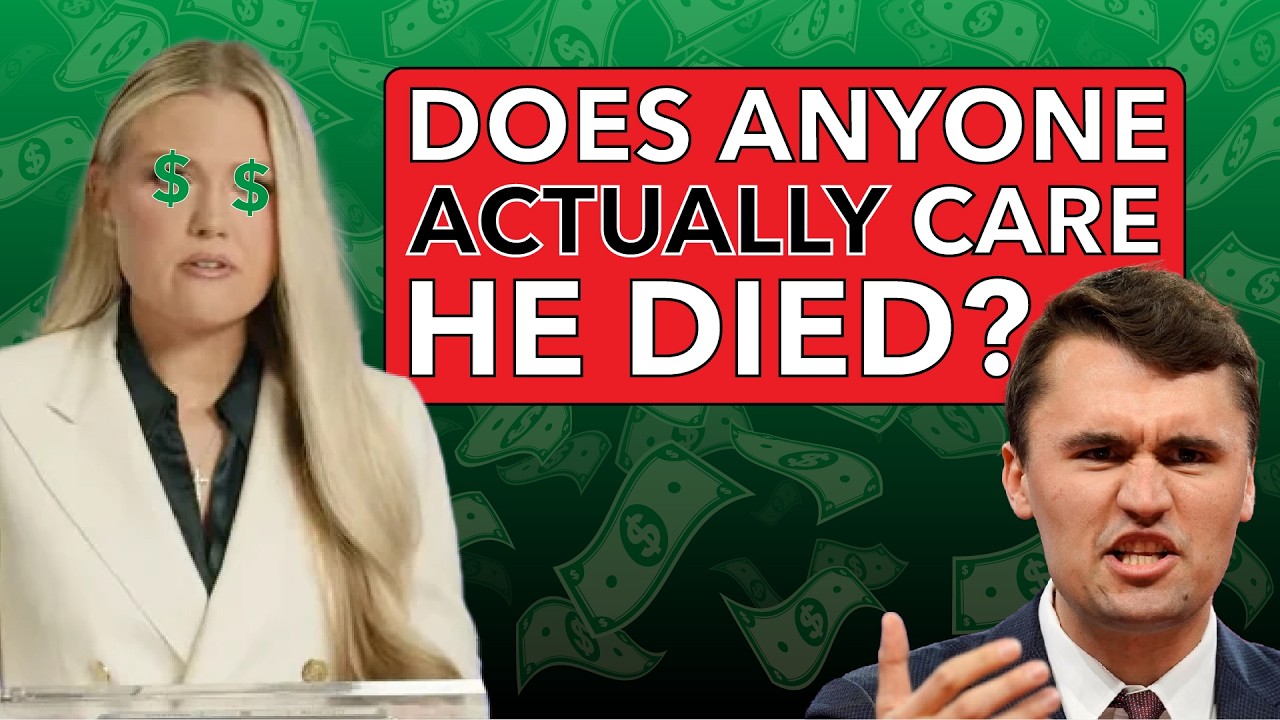
Liberal Archie Mackintosh Who Debated Charlie Kirk Says His Assassination Exposed a Darker Truth
Enjoying this? Share it with someone who needs to see it.
Up Next
Officer Tatum Defends Stephen A. Smith's Refusal to Apologize for Supporting Charlie Kirk After His Death
12:11
Bari Weiss and Ben Shapiro Mourn Charlie Kirk After Assassination at Utah Valley University
1:24:32
How the Media Treats Political Violence Differently Depending on the Victim's Ideology
20:18
Liberal Archie Mackintosh Who Debated Charlie Kirk Says His Assassination Exposed a Darker Truth
I debated Charlie Kirk at the Cambridge Union and found none of the hatred I'd been warned about, only a man willing to listen. His assassination and the celebration that followed it from mainstream liberal voices, not just extremists, revealed something about censorship, political violence, and the left's relationship with debate that I can no longer ignore. I lay out why silencing opponents doesn't defeat hate, why Tyler Robinson's attack backfired on his own cause, and why Donald Trump's own words at Charlie's memorial service are more revealing than anyone seems to realize.
I am a liberal, and I mourn Charlie Kirk. I miss him. Yes, I disagreed with plenty of his views, but I also believe the world would be a much better place if there were more Charlies in it. It's a privilege to have people around who you disagree with, who you strongly disagree with, people who offend you. That is how you learn, how you stress-test your ideas, how you find out how robust your beliefs really are. To quote Christopher Hitchens: "Don't take refuge in the false security of consensus." That is a value liberals especially, the so-called side of tolerance, should be embracing wholeheartedly. Instead, after Charlie Kirk's tragic assassination, what we saw online was people saying he deserved to die, that he'd "live by the sword, die by the sword," and telling his widow it was God's plan. I've already gone on radio and television to talk about my experience debating Charlie, my thoughts on him, and on his death. As much as his death fills me with sadness and shock, it has uncovered something deeper, something sinister that, with no exaggeration, actually terrifies me.
I met Charlie Kirk in May when he came to the Cambridge Union, and I was one of the students who debated him. Before that, I didn't know much about him. I put him in the same camp as commentators like Matt Walsh, Ben Shapiro, and Steven Crowder, and from the way people around me described him, I expected some kind of crazy right-wing radical. But when I actually debated him, he matched my respect. He really listened. We got somewhere. We had a productive conversation. I did not see the hateful man other people had warned me about.
How Fans Actually Responded
What genuinely shocked me was how his fans online responded. Sure, his editing team posted a couple of out-of-context "gotcha" clips on Instagram, and under those I was met with plenty of distasteful comments about my hairstyle. But when he posted the full video of our debate, the response was the total opposite. There was overwhelming support from Charlie's fans in the comments. Many expressed surprise that a liberal Charlie was debating had listened to him and treated him with respect, that they respected that, thought I was thoughtful, and that for the first time they'd disagreed with Charlie and agreed with his opponent.
This illustrates something fundamental about human nature: if the mind can find an excuse to disregard a piece of information or an opinion that challenges an existing worldview, it probably will. Raising your voice, showing emotional reactivity, repeating pre-prepared talking points without listening to what your opponent is saying, all of that just signals to your opponent that you lack confidence in your own case. Otherwise, you wouldn't be afraid to engage in open, honest, respectful debate.
Why Name-Calling Doesn't Change Minds
Many liberals argue that someone like Charlie Kirk, if he's spreading hate and misinformation, shouldn't be allowed a platform and should be silenced. The first point worth making is that I've seen a lot of people call Charlie racist, sexist, and transphobic, with very few actually making a solid argument to back it up. Name-calling is a tempting way to dismiss people you disagree with, but it doesn't make them listen. It just wins praise from people who already agree with you. If you actually want your opponents to think differently, you have to treat them with respect, patience, and honesty. That is how you get them to listen. Make a good argument if you're that confident in your beliefs. I disagreed with Charlie on plenty of topics, but I don't find him to have been a hateful person.
Hate as a Pathogen: The Case Against Censorship
What about cases where someone clearly is being hateful? Shouldn't they be silenced? The answer is no. Hate doesn't spread like an indiscriminate virus infecting anyone it touches. It preys on people who are already vulnerable: those suffering from frustration, loneliness, a loss of identity. Censoring speech doesn't cure those vulnerabilities. Instead, it drives hateful conversations underground, where, out of sight, they become sharper, more radical, and more dangerous.
In the short run, censorship probably slows the spread of hate.
But it also stops that hate from being exposed to challenge and opposition.
Hate festers when it's hidden, and that is when it becomes truly destructive.
Wouldn't you rather be able to see hate, track where it is, and address it at the root causes? Using the pathogen analogy, real immunity comes from education, from building strong communities, from teaching people critical thinking. Exposure builds resilience. Watching hateful ideas get broken down through argument reduces the chance of anyone taking those ideas on. In this analogy, censorship is the lockdown strategy: it temporarily slows and delays the spread, but it also gives the pathogen more opportunity to mutate into something deadlier, and you don't want a deadly pathogen loose in a population with very little resistance built up. When hate becomes symptomatic, spilling out into violence, that is when we quarantine, when we come down hard with the law. Otherwise, we should let society strengthen its immune system through open debate, tackling ideas directly instead of trying to silence them, and instead work to remove the root problems that hate feeds on.
Why Governments Are Tempted to Censor
Think about that for a moment, and it becomes obvious why governments are so drawn to censorship. The frustration, the loneliness, the resentment, the lack of identity that hate tends to feed on is, in most cases, rooted in problems in society that a government itself has caused. A government faced with two options, either put real effort into fixing the root problems or simply silence the people complaining because a minority of them are complaining in a hateful way, will usually know which one is easier. That is exactly why we can't allow governments to censor speech.
Tyler Robinson and the Irony Nobody Noticed
Despite efforts from some on the left to paint Charlie Kirk's killer as a right-wing Trump supporter, the evidence suggests Tyler Robinson was a liberal who killed Charlie Kirk because he disliked his views. That is a heartbreaking, horrific act of violence, and it doesn't paint a pretty picture for the tolerant left. In itself, though, I don't think this says anything particularly new about liberal ideology. Political violence is sadly common at both ends of the spectrum. What is new, and what deeply alarms me, is that the irony of carving "hey fascist, catch" onto a bullet casing intended to kill a political opponent was lost not just on Charlie's assassin, but on many mainstream liberal individuals who mocked and celebrated his death.
These are not extremists. These are mainstream, left-leaning individuals who have otherwise been taught to believe that silencing your opposition is morally virtuous. There are videos of students literally jumping and cheering moments after the bullet struck Charlie's neck. In reality, history has repeatedly shown that this kind of violence doesn't prove your case. It just signals to your opposition that you don't have one to make. Tyler Robinson has only strengthened Charlie's image as a political figure and handed conservatives one more reason to retreat into an echo chamber of their own.
Trump's Words at the Memorial Service
This was made evident at the highest level of government when, at Charlie Kirk's memorial service, Donald Trump said: "He did not hate his opponents. He wanted the best for them. That's where I disagreed with Charlie. I hate my opponent, and I don't want the best for them. I'm sorry. I am sorry, Erika."
Sit with that for a moment. The president of the United States openly said, in public, that he hates his opponents and does not want the best for them. That's half of America he's talking about.
A Call for More Debate, Not Less
Things are clearly not going well, whether in America or here in the UK, where people are now arrested and imprisoned just for liking or sharing social media posts that someone might find offensive. As a liberal, my message is this: we need more Charlie Kirks in this world. We need more open debate. We need to embrace challenging and questioning our own beliefs. To identify what is false, we have to practice the ability to question and test what is true, even and especially when it makes us uncomfortable.