Megan Basham Exposes The Third Way Gospel Coalition Model That Embraced Democrats But Rejected Charlie Kirk
Enjoying this? Share it with someone who needs to see it.
Up Next
Allie Beth Stuckey Defends Biblical Marriage and Abortion Ethics Against Twenty Liberal Christians in Intense Dialogue
1:40:34
Candace Owens Says She's Grateful for 'The Squad' Because They Prove Her Point About the Left
0:50
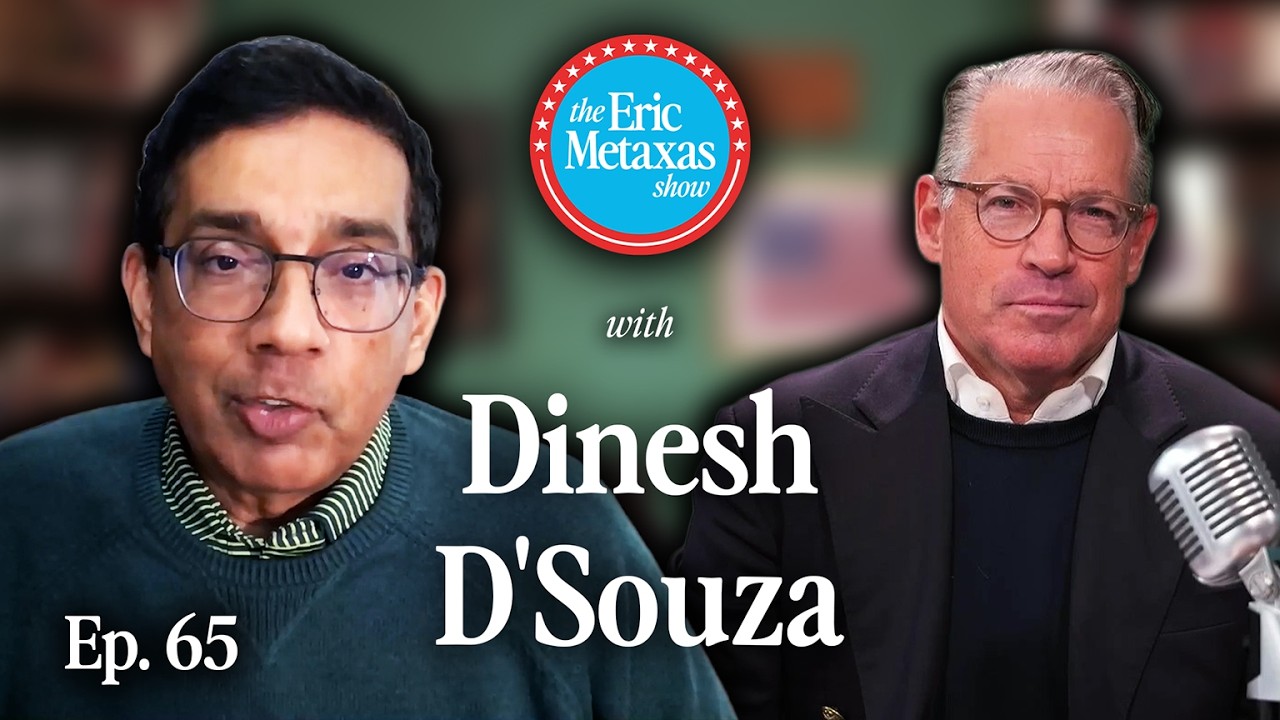
Eric Metaxas and Dinesh D'Souza Expose Tucker Carlson and Candace Owens' Troubling Shift on Israel and Anti-Semitism
34:15
Megan Basham Exposes The Third Way Gospel Coalition Model That Embraced Democrats But Rejected Charlie Kirk
Megan Basham reveals how major evangelical institutions like The Gospel Coalition welcomed soft progressives and Democratic operatives onto their platforms while refusing to engage with unapologetically conservative voices like Charlie Kirk. She examines the Tim Keller third-way model that once claimed the gospel transcends politics, arguing it has become a cover for pushing leftward while silencing conservative Christians. As the Democratic Party has shifted toward cultural Marxism and radical positions on abortion and gender, Basham documents a massive exodus of young Christians rejecting this muzzled approach. She exposes the uncomfortable reality that these institutions will platform Democratic activists but won't touch Trump-supporting conservatives, revealing a pattern that speaks volumes about whose politics are truly acceptable in evangelical spaces.
Megan Basham identifies a troubling pattern within major evangelical institutions: they readily welcomed soft progressives and Democratic operatives while refusing to engage with unapologetically conservative voices. She points to specific examples, noting that figures like Michael Wear, a member of the Obama administration, and Justin Giboney, a Democratic activist with the AND Campaign, received platforms at institutions like The Gospel Coalition and Together for the Gospel (T4G). Meanwhile, Charlie Kirk—an unapologetic conservative and Trump supporter—was treated as untouchable.
This selective acceptance reveals what Basham calls the fundamental dishonesty of the third-way approach. These institutions claimed political neutrality while consistently favoring one side. You could be a soft progressive, a political agnostic, or even a hard Democrat like Pastor Charlie Dates of Chicago, whose family members work for the Democratic Party. The only political viewpoint explicitly unwelcome was the Charlie Kirk perspective: conservative, pro-Trump, and unashamed about it.
The Tim Keller Model and Its Fatal Flaw
The third-way approach finds its roots in Tim Keller's ministry model, which presented the gospel as transcending political categories. Keller would frame issues by saying the left represents license (particularly sexual license) while the right represents moralism or pharisaism. In this framework, Christians should reject both extremes in favor of the gospel's grace-centered approach.
As Eric Metaxas notes from his experience attending Keller's church in the 1990s, this model had validity when addressing the culture wars of that era. Keller was trying to reach urban New Yorkers who had been turned off by figures like Jerry Falwell. The framework worked when he presented theological categories—grace versus works-righteousness, or the prodigal son versus his judgmental brother.
However, the fatal flaw emerged when this theological framework was applied directly to politics. The model suggested that just as the gospel transcends theological extremes, it also transcends political positions. This created a false equivalence: these people say slavery is wrong, these people say slavery is right, and the gospel doesn't take a position. Or: these people oppose abortion, these people support abortion, and the gospel remains neutral. But as Metaxas emphasizes, the gospel absolutely does take a position on murdering the unborn.
When the Democratic Party Changed Everything
Whatever merit the third-way approach once had evaporated as the Democratic Party underwent a dramatic ideological shift. Metaxas draws the distinction clearly: when the Democratic Party was represented by figures like Richard Gephardt, Gary Hart, Michael Dukakis, or Tip O'Neill—when there were still pro-life Democrats and a Democratic president signed the Defense of Marriage Act—the claim of moral symmetry between parties had some legitimacy.
But the party transformed. Today's Democratic Party, represented by figures like Mandani and Alexandria Ocasio-Cortez, has moved toward cultural Marxism. It has made transgender ideology, abortion access, and the celebration of sexual perversion part of its official platform. These aren't debatable policy positions like immigration or climate change—they represent fundamental moral issues.
Basham notes the tortured analogies that emerged as third-way advocates tried to maintain their model despite this shift. They would say Republicans protect the unborn while Democrats have compassionate immigration policies, therefore both represent pro-life positions. But as she points out, immigration policy is debatable; murdering unborn babies is definitively not pro-life. The equivalence doesn't hold.
The critical failure, according to Metaxas, was that many of these pastors fell in love with the third-way model because it had been effective. When the world changed—when the Democratic Party deliberately chose to go hard left—they couldn't let go. They simply pretended the left hadn't gone Marxist rather than adapting their approach to the new reality.
The Elephant in the Room: Black Protestant Democrats
Basham identifies an uncomfortable reality driving much of the third-way persistence: black Protestants overwhelmingly support the Democratic Party, which is now the party of death. This creates enormous tension within evangelical institutions. The question becomes whether Christians can continue giving moral legitimacy to the Democratic Party simply because their black brothers and sisters still support it.
This discomfort manifests in the ongoing debates within evangelical spaces, particularly following two significant deaths: Tim Keller and Charlie Kirk. Their passing has forced a reckoning about which model is appropriate for this era. Basham reports seeing a massive exodus of young Christians who reject the third-way approach that muzzles them on important policy issues. They no longer believe it's legitimate.
Meanwhile, the institutions heavily invested in Keller's model—whose personalities, platforms, and organizational structures were built on it—remain committed despite changing circumstances. This has created an increasingly tense standoff between the established institutional leadership and a younger generation demanding the freedom to speak clearly on moral and political issues.
What the Third Way Really Is
Basham clarifies a fundamental category confusion: the third way isn't actually a way of doing politics. It's a way of doing evangelism. These institutions weren't claiming neutrality because they believed it was the right political approach to civic responsibility. They were claiming neutrality to ensure they could win over Democrats and people in progressive cities who trend toward that ideology.
This distinction matters because it reveals the true motivation. The third way was designed as an evangelistic strategy, not a principled political stance. But in practice, it became a tool for silencing conservative voices while platforming progressive ones—all while claiming to be apolitical.
Rethinking the Prodigal Son Analogy
The prodigal son parable was central to Keller's third-way presentation. He would position the wayward son (representing the left's embrace of license) and the judgmental brother (representing the right's moralism) with the gospel as the gracious father welcoming the repentant son home.
But as Basham notes, citing her friend Joe Rigney, this analogy no longer fits the current moment. Today's situation would be more like the prodigal son showing up and saying, "Hey dad, I'm not going to stop my sexual perversion. Now give me the ring and give me the inheritance." There's no repentance, no recognition of wrong, just a demand for acceptance and affirmation while continuing in rebellion.
Moreover, the son in today's version demands that refusing to affirm his lifestyle makes you a bad Christian. The claim is that true Christian superiority means not taking a position, not being clear about what the Bible demands regarding justice and mercy. This represents a complete inversion of the original parable's meaning.
The Scam Behind the Apolitical Claim
Metaxas summarizes the whole enterprise as ultimately a scam. By claiming to be apolitical or above politics, these institutions were actually pushing against anything conservative. They would say what they really care about is evangelism, so anything not "gospel-centric"—as they defined it ten minutes ago—is out of bounds and overly political.
He acknowledges that many leaders earnestly believed this was the way forward, an effective approach to preaching the gospel and being effective as Christians. They deserve credit for sincerity even while being absolutely wrong. But there's a separation between those who were bought and paid for by large secular foundations and those who were simply influenced by big personalities and adopted their framework.
The result is the same either way: a system that claims neutrality while systematically excluding unapologetic conservatives, welcomes soft progressives and hard Democrats, and uses the language of gospel-centricity to silence Christians who want to speak clearly on the moral issues of the day.
The Exodus and What Comes Next
Following Charlie Kirk's assassination, people began openly recognizing what hadn't been discussed before: the third-way institutions would not touch someone like him with a ten-foot pole precisely because he was unapologetically conservative and a Trump supporter. This recognition has accelerated the exodus Basham describes.
Young Christians are rejecting the empty model that doesn't speak to their time. They're leaving institutions that claim to be above politics while clearly favoring one political perspective. They're demanding the freedom to be clear about what Scripture teaches on the pressing moral questions facing the nation.
The debate continues, uncomfortable and heated, because the institutional leaders remain heavily invested in the third-way model. But the ground is shifting beneath them as a new generation refuses to accept the muzzled approach to Christian engagement with culture and politics that characterized the Keller era.