Michael Shellenberger Explains Why the Most Compassionate People Engage in the Greatest Cruelty in San Francisco
Enjoying this? Share it with someone who needs to see it.
Up Next
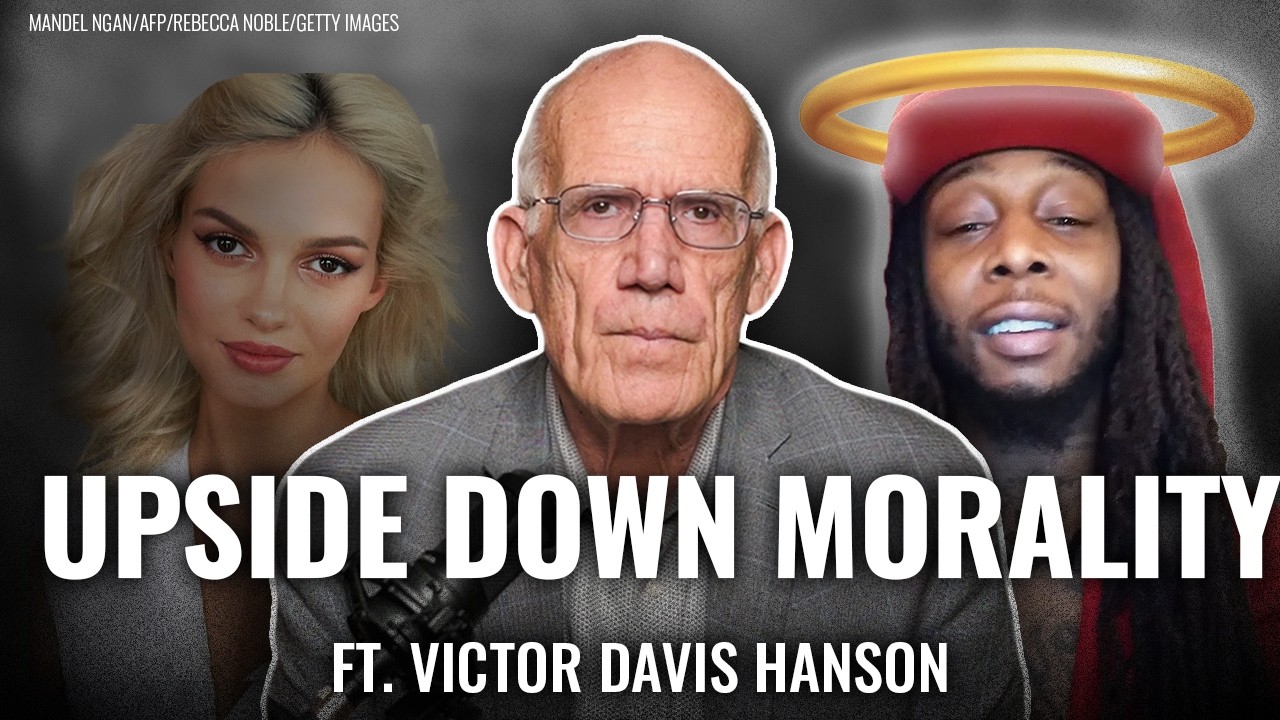
Victor Davis Hanson Exposes Upside Down Morality: When Society Excuses Victimizers and Ignores Victims
7:54
Candace Owens Masterfully Confronts Woke College Students Who Challenge Her on Identity Politics and Religious Symbols
8:12
The Makers Versus Takers: Why Elon Musk Represents Innovation While Elizabeth Warren Embodies Government Overreach
6:01
Michael Shellenberger Explains Why the Most Compassionate People Engage in the Greatest Cruelty in San Francisco
Michael Shellenberger breaks down the confusing landscape of modern political terminology, explaining the difference between leftists, liberals, and progressives. Drawing from his book on San Francisco, Shellenberger reveals a disturbing paradox: the city's most compassionate advocates have created conditions where vulnerable people suffer psychiatric disorders on the streets, where women experience near-universal sexual assault, and where broken bodies are left untreated in the name of freedom. He traces how progressivism rejected all traditional values except caring, leading to censorship justified by protecting feelings and policies that affirm mental illness rather than treat it. The conversation explores how classical liberalism inverted into illiberalism, and why some of his strongest free speech allies now come from the radical left rather than mainstream liberals.
When asked to clarify the distinction between leftists and liberals, Michael Shellenberger tackles one of the most confusing aspects of modern political discourse. The terms have become so muddled that their traditional meanings barely apply anymore.
Shellenberger points out that in many ways, liberals now occupy positions on the political right, particularly when it comes to protecting freedom of speech. Classical liberalism, tracing back to the traditional French Parliament after the French Revolution, placed advocates of free speech on the left and supporters of censorship on the right. That dynamic has completely reversed in contemporary politics.
A personal example illustrates this confusion perfectly. After the Colorado Supreme Court ruled that Trump could not be on the ballot, Shellenberger called his parents to discuss the decision. His father, whom he describes as a leftist, argued that Trump should be allowed on the ballot. His mother, a liberal, took the opposite position. The traditional left-right framework simply fails to explain these alignments.
Unlikely Allies on Free Speech
Shellenberger has discovered some of his strongest allies on free speech issues come from the radical left rather than the liberal left. Figures like Glenn Greenwald, Matt Taibbi, Aaron Maté, and critics of American imperialism in the Chomsky wing have proven more reliable defenders of open discourse.
The categorization of these figures presents its own complications. Glenn Greenwald, for instance, gets labeled conservative despite his radical left origins, except when it comes to Israel. The traditional political spectrum struggles to contain these evolving positions.
Even Noam Chomsky, icon of the radical left, offered a powerful defense of free speech that Shellenberger paraphrases: it's a disservice to the survivors of the Holocaust to censor in their name. Shellenberger notes that historical research reveals the Weimar Republic engaged in censorship against Nazis. The American view, by contrast, holds that it's better to let Nazis speak so they can be argued against and disagreed with, recognizing that even they have human rights.
The MSNBC Left and the Crackdown on Speech
The people demanding greater crackdowns on speech and restrictions on democracy, Shellenberger observes, come not from the radical left but from what he calls the liberal left or the MSNBC left. This represents a fundamental bastardization of the term liberal itself.
By definition, someone against free speech, who wants opponent candidates removed from ballots, who supports deplatforming and internet censorship cannot accurately be called liberal. The word liberal derives from liberty, from freedom, from individual rights. Yet people describe others as super liberal when they mean super pro-censorship, anti-free speech, pro-lockdown, and pro-mandate.
This inversion has created confusion about how terms are understood across the political spectrum. In conservative and right-wing circles, leftists are viewed as pro-censorship and anti-free speech, while liberals are seen as more reasonable and allied with conservatives on these issues. The terminology has become almost entirely detached from its historical meaning.
Progressives: Compassion as Cruelty
Shellenberger offers progressives as the term that best captures this political grouping, using it almost synonymously with woke. After wrestling with terminology for his book on San Francisco, he and his colleagues initially considered the subtitle "Why the Left Ruins Cities." They changed it because moderate Democrats who still identify as part of the left also want better responses to urban problems. They landed on progressives instead.
Progressives, according to Shellenberger, tend to support censorship and affirming psychiatric disorders. They operate in the grip of victimhood ideology, which he identifies as the central animating force behind the progressive movement, from Elizabeth Warren to AOC.
Drawing from psychologist Jonathan Haidt's work, Shellenberger explains that progressivism essentially rejects all traditional values except one: caring. In the name of caring, progressives will deprive people of free speech rights to protect others from hurtful things. Caring becomes the rationale for censorship and illiberal policies.
San Francisco: Where Compassion Becomes Cruelty
The heart of Shellenberger's book explores a disturbing paradox: in San Francisco, the most compassionate people engage in the greatest amounts of cruelty. He discovered psychotic people, the deeply mentally ill, and severely addicted individuals on the streets, vulnerable and naked. Women experiencing homelessness who are usually addicts or dealing with mental illness face sexual assault at essentially 100% rates.
When Shellenberger interviewed women on the street, every single one reported multiple sexual assaults. He found a man with a broken hip left on the street. He encountered people in terrible situations who desperately needed hospital care. Yet the most compassionate people insisted these vulnerable individuals should just do whatever they want.
This amounts to affirming a psychiatric disorder on the streets. The seed of destruction lies within compassion itself when it becomes untethered from other values. Shellenberger references Hegelian philosophy: things become their opposite, the seed of destruction embedded in the thing itself, the yin and yang where destruction comes from within.
Both compassion and liberalism must exist in relationship to other values. When caring becomes the only value that matters, it produces outcomes that are anything but caring.
Witnessing San Francisco's Decline
A visitor to San Francisco in 2019 describes seeing things never witnessed in dozens of countries and hundreds of cities worldwide. After traveling extensively through Europe, Africa, and the Middle East, nothing prepared this observer for what San Francisco presented.
Returning in subsequent years, including a visit that involved a 10-mile walk through the city from the Tenderloin to downtown to Market Street, the assessment was that conditions had deteriorated. The city had become more of a dead zone, perhaps never fully recovering from the shutdowns. Despair was the word chosen to describe it.
The most striking aspect was the consistent refrain from long-time residents: it didn't used to be like this. Ten, fifteen, twenty years ago, San Francisco was beautiful, clean, and free from these problems. The transformation represents a cautionary tale about what happens when compassion detaches from all other values, when caring becomes the singular virtue justifying any policy, no matter how destructive the results.










Comments
Be the first to comment on this video.