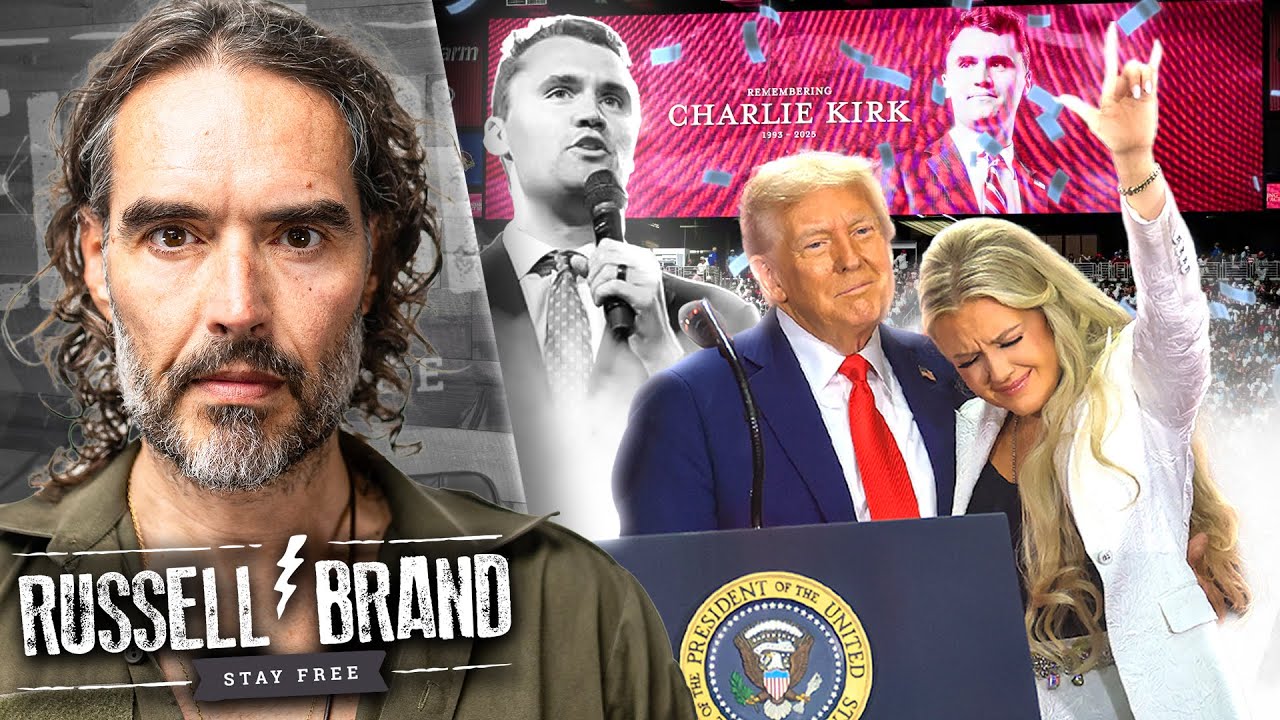
[Applause] [Music] Ladies and gentlemen, >> Russell Brandussy theorist >> trying to bring real journalism to the American people. >> Hello there, you're awakening wonders. Thanks for joining me today for Stay Free with Russell Brand on Rumble. If you're watching me anywhere other than Rumble, like X or YouTube, click the link in the description and get Rumble Premium. You get additional content not just from me, but from Crowder and Mud Club and Tim Cast and many of Rumble's premium content creators. We're still in a sense, I suppose, analyzing the murder of Charlie Kirk and the subsequent consequences and conversations. In a way, it's no different than any other artifact that takes place now in the ubiquitous ongoing public square. An event occurs, there's possibly a genuine reaction potentially. There's our unconscious reactions to things. Let me give you a personal example. How can I objectively respond to the murder of Charlie Kirk without on secondary ulterior and not even properly recognized or understood levels thinking will this affect me? Is this good for me? Is this bad for me? While successively and simultaneously being hit by waves of oh my god he's like his ch his children were there that day. So all of us are kind of trying to work out whether it's a good thing or a bad thing. And I guess that's why you obviously it's a bad thing, but like when um you hear people say dumb stuff, like I feel like Destiny said some dumb stuff and people on the left now are scrutinizing the motivations of the asalent in order to uh I suppose legitimize maintaining their own position. Look, here's something I do know quite a lot about addiction. And when you're dealing with a drug addict, you get a sense of whether or not the drug addict actually wants to stop taking drugs or wants to legitimize carrying on with their addictive behavior. And as a person that's in recovery, I have an obligation to help people get clean from drugs and alcohol. And I've over the 22 and nearly 23 years that I've been free from drugs and alcohol learned to detect whether or not someone is serious about stopping or really they just want the problems to stop. And what I feel that we're experiencing as a culture now are various invitations to embrace some pretty significant and serious change. But those in the consequences of accepting those invitations are so radical that many people won't want them. And that's why we live in an age of hypocrisy and contradiction. Principles are everything. So I think it's possible to approach free speech from the left or from the right. But if your position on free speech alters, that means it's probably not a principle and it never was a principle. you were probably just using an opportunity to defend your position and pursue an objective. And over the course of the show today, that's what we're going to be discussing, people's unconscious motivations. Remember that while I'm here now talking to you, I've got all of my various challenges in life. I'm defined by my challenges as a husband and as a father. And I know that unless my primary challenge is the maintenance of a connection with God and thank the Lord I now accept someone else's definition of what God is rather than my own. If there's one fundamental difference between being a new age believer and a Christian, it's that I no longer provide the explanation for what belief in God looks like, for what a spiritual program of action would seem like to the outside. Because I remember one of my really beloved friends I used to make content with at the near very near the beginning of my career, my beloved friend Matt Morgan, he used to say, "You talk all the time about communism and socialism and sharing and revolution, but you're probably one of the most selfish people I've ever known in my life." And I just think that guy's got a point, you know, because like most addicts, I'm pretty selfobsessed. And the journey of faith for me has been about altering the monologue of my internal life. I.e., you know, it's sort of like a dialogue. You know, you shouldn't have done that. You shouldn't have said that. Why don't you do that? I wonder if that's going to happen. It's kind of like a dialogue, but both voices are me. But it's becoming a dialogue between me and you'll know as a Christian Christ like I feel him and hear him within me. And my hope is that eventually it will become a monologue again and it will just be him. He must become greater. I must become lesser is how that is described in scripture. With that said, let's have a look at some of the various insights and hot takes on the brutal murder of a 31-year-old man who's the product of some contrary and contradicting ideas, a traditionalist, a conservative, and a Christian who was a very much a product of modern media. Let's look at how that's being used by the right. Let's have a look at how it's being used by the left. Let's have a look at how content creators are exploiting it. Let's have a look at the impact that it's having in the political space because in a way now there's Charlie Kirk's death as it will appear to his widow Erica and his children the impact of which obviously be felt over many years and then there's the separate Charlie Kirk's death that is just an object it's just an object a machine uh Gutierz and Doo the sort of post structuralist French philosophers would say that it's just like a a machine now Charlie Kirk's death can just operate in all sorts of directions. Let's have a look at some of that. Um firstly, I want to look at this um this mainstream comedian Jimmy Kimmel. Now, when I used to live in Los Angeles and be promoting movies and that had a very different kind of life that was focused on what I would call a paganized culture where I worshiped my own sexuality. I worship my own personal power and identity. Uh Jimmy Kimmel was a person I liked. And when I say that, I'm not even trying to be derisory about Jimmy Kimmel. remember thinking this person is a nice guy like I like him and like you know to give you sort of a more contemporary iteration of that idea I recently yesterday in fact spoke to Nick Fuentes for the first time while I was looking at and talking to Nick Fuentes that interview will be here on Rumble tomorrow I was thinking how's this guy like an anti-semite or whatever he's like seems really like a nice person and when I eventually asked him about Israel and Judaism that's What I was in particular focusing on who are we really are is anyone if you drill down do you this is probably a pretty fundamental thing that I had I had this conversation with Bnee Brown a long time ago when I was doing that kind of content I was in that kind of world she's very brilliant person Bnee Brown and we talked about do you and this is a question I would ask of you let me know in the comments and chat do you believe people are trying their best and do you believe that people are fundamentally good or not what do you think and Bnee Brown said that when she was a social worker she said that sometimes she would go and visit houses of people and they were neglecting their kids and she was like no these people can't be doing their best. They're making too much of a mess of it and but over time she came to accept that they probably are. EMTT Fox the brilliant Christian analyst uh cites a potentially apocryphal tale about a Quaker who when encountering a newcomer to his town gets this question. Hey, I don't know what you call a Quaker, mate. Is what I'd call him. Oi, mate, what are the people like in this town where we live in? And the Quaker goes, "Well, what were the people like in the town you just come from?" They are horrible, mean people. He goes, "You'll probably find the people around here like that as well." And then moments later, another person approaches the Quaker goes, "I heard what you said, but I really like the people around here. I think they're really cool and everything." And he goes, "What did you think of the people in the town you just came from?" He goes, "I like them as well." He goes, "Yeah, you will find it so wherever you go." Because perhaps on some level the external reality that we experience is an expression of something within us. The kingdom of heaven is within. Seek thee first the kingdom of heaven and all righteousness will be granted unto you. If I can put myself in alignment with core spiritual values inwardly, then my relationships, even with people I disagree with or people that may wish me harm, will become lessons and opportunities. If I'm not able to do that, I'm going to be in a pretty hideous fight that won't really lead to anything of value. That said, let's have a look at Jimmy Kimmel and let's in good faith see where he's going with his I guess it's commentary on Charlie Kirk's murder. Let's have a look. I'm not saying that you couldn't do comedy. I the other day went to Washington DC to participate in a Mahar event. Uh I'm a big supporter of Secretary Kennedy and of Dr. and people that I believe this is why I believe and I pray this is the case that they have identified that you are not going to make America healthy unless you take on the interests of big agriculture, big food and big farmer and the lobbying and donor interests that ensure that policy in these areas can never significantly change whether you vote for Donald Trump, Adolf Hitler, Karl Marx or Princess Diana as long as those institutions remain in place then you'll get the same kind of policy around agriculture food farmer. Uh well, certainly you'll have significant resistance if you're trying to change it as I believe Secretary Kennedy is. In fact, I see that he is. You see that he is too, right? So, uh when I was there, I was doing like a little talk at a convention. And just as I started talking, someone like walked right behind me and it's someone I knew, like someone who works with Secretary Kennedy, and I goes, "It's bit of a sensitive time uh for people speaking in public." Yeah. Just walk right behind me in my peripheral vision, like in the immediate aftermath of Charlie Kirk's death. So, it's not a joke. It's a reference to it. I could tell you that the room were not like, "Oh, how do we feel about this?" None of us really know how to feel. But as the brilliant uh Irish poet WB Yates said, the like what is it? The best of lost all conviction and the worst of full of dreadful certainty. The opposite of uh the opposite of faith is not certain. The opposite of faith is not certainty. That's what I had. Let's let's get let's have a look at this. Let's have a look at this WB Yates poem. See if this is of any use to you. Um the second coming. This is called the second coming by WB Yates. Brilliant Irish poet. Turning and turning in the widening gire. The falcon cannot hear the falconer. Things fall apart. The center cannot hold. Mere anarchy is loosed upon the world. The blood dimmed tide is loosed and everywhere the ceremony of innocence is drowned. The best lack all conviction while the worst are full of passionate intensity. Surely some revelation is at hand. Surely the second coming is at hand. The second coming. Hardly are those words out when a vast image out of spiritus mundi troubles my sight. Somewhere in sands of the desert, a shape with lion body and the head of a man, a gaze blank and pitiles as the sun is moving its slow thighs, while all about it real shadows of the indignant desert birds. The darkness drops again. But now I know that 20 centuries of stony sleep were vexed to nightmare by a rocking cradle. And what rough beast its hour come round at last slouches towards Bethlehem to be born. I like um pitiles and blank as the sun. pagan godlessness, just bright might and white light without Christ, without love, without sacrifice, pitiles, the desert birds. But the antichrist may occur if we don't make a manger and a cradle in the low place. If we're unable to welcome in the low place, the place among the beasts, the stable, we don't make a place there for the return of Christ, something else is coming. Let me know in the comments and chat who you think's coming down the pike, baby. Cuz I can feel it pretty strongly. So, um, let's look at this Charlie Kirk thing, man. Not Charlie Kirk, um, Jimmy Kimmel. We hit some new lows over the weekend with the MAGA gang desperately trying to characterize this kid who murdered Charlie Kirk as anything other than one of them and doing everything they can to score political points from it. In between the fingerpointing there was uh grieving on Friday. The White House flew the flags at half staff which got some criticism but on a human level you can see how hard the president is taking this. >> My condolences on the loss of your friend Charlie. I ask sir personally, how are you holding up over the last day and a half, sir? I think very good. And by the way, right there you see all the trucks. They just started construction of the new ballroom for the White House, which is something they've been trying to get, as you know, for about 150 years. And it's going to be a beauty. Yes. He's at the fourth stage of grief, construction. Demolition. Construction. This is not how an adult grieavves the murder of someone he called a friend. This is how a four-year-old mourns a goldfish. Okay. So, in a way, if you look at that, you know what uh Jimmy Kimmel's perspective is on the right, which we knew anyway. We come to Jimmy Kimmel knowing that he is understandably an advocate for what we would call the modern iteration of the Democrat party. This is a Democrat party that's not about the rights of working people. This is a Democrat party that doesn't care about taking on corporations. This is a Democrat party that's not interested in marshalling Americans towards freedom against the interests of global corporations. It's not a Democrat party that wants people to find Divinity. It's a Democrat party that altered its trajectory and its legislature in order that it could form comfortable relationships with big business. Think for a moment about the moment uh the instance where Bernie Sanders was in that Senate financial hearing with Senator Robert Kenned excuse me Secretary Robert Kennedy and Kennedy said you lot are taking money like um who's the lady Pocahontas Elizabeth Warren you've taken money you've taken money off you've taken money off big farmer we're all taking money off big farmer we're all taking that's what we do we take money from big farmer so they're not even pretending ending anymore. So what I suppose with the any news are calls an opportunity to do this even when it's frivolous trivial things is an opportunity to look at what are the what are we actually saying what are we actually discussing here we're discussing now at this point this is it I'll tell you if you want to know it's this centralized institutions of propaganda cannot control information anymore that doesn't mean all of the information that you get outside of centralized institutions of propaganda ander is reliable. It just means it's not sanctioned. So you might have people on the left saying a lot of stuff that's not sanctioned and people on the right saying a lot of stuff that's not sanctioned. Malcolm LLan, the famous uh I guess you'd call him a philosopher and cultural analyst said the medium is the message. He said that at a time that the prevalent forms of media were print and television, centralized media organizations that were controlled by a handful of individuals like your TV networks and print media now and mine in my country, whether it's Rbert Murdoch who owns the Times or whoever you you can have a look at a list of who owns ultimately owns and controls um MSNBC or whatever they're rebranding it as now. you'll find it's just a handful of individuals and that they're partnered with various corporations commercially and that they're own parts of or they're part of larger conglomerates. So the medium is the message means if it's on TV, the message is going to be about centralized control. We need to control whole populations. We need to make them buy certain food. We need to them to vote for certain political parties. We need them to ignore certain problems and pay attention to other matters. That's the message. And that's the medium. Now the medium is the message means oh no by giving everybody a device which means they can intercommunicate and we can potentially control them once we master AI surveillance and censorship during the brief window before they crack that there is the possibility for us to intercommunicate. But because and there's no nice way of saying this we're [ __ ] dumb. We're arguing with one another about stupid stuff instead of recognizing we could bypass the centralized systems of control. And until we realize that and act upon it, we may as well not have these cuz you're spending all your time masturbating either physically or mentally instead of awakening. But that's just what I think. Let me know what you think in the comments and the chat. We got plenty of content for you today. Uh let me know how you're feeling, guys. I'm talking to you, Trip E88, and UCMC Advanced and God Rules It All and all my friends over on Locals like Lily Farm Girl and Happy Cappy and all of you really. Let's have a look at what um Don Lemon says. Uh he says here now, I can tell from the title of these clips, Don Lemon claims MAGA doesn't really care about Charlie Kirk, just clicks. Well, how who do you think Don Lemon is really talking to when he says that? He's talking to Don Lemon. Don Lemon doesn't really care about Charlie Kirk. He cares about clicks. That's all. And guess what? Russell Brand wouldn't care about Charlie unless for Christ. Without Christ, all I'll care about is, well, I've seen me. I saw me before Christ. I saw what I was doing. All I wanted to do was in a sort of a groping and empty hollow shallow abyss looking for the formation and shadow of the cross. And let me tell you without clear connection to him it will take extraordinary forms out there. Mostly the false high poles and idols. You will find it in pagan goddesses which you know in gods uh is just really an expression of you might say lower even though you know it's not necessarily lower forms of energy sex and drugs and rock and roll. Let's have a look at Don Lemon literally accusing of other people of what he's probably I'm guessing because I've not seen the clip yet doing himself. >> The thing that is so obvious about it and I think this so disgusting is that you don't really care. You don't really care about Charlie Kirk. What you care is that this is a moment that you can use to to for clicks to boost your podcast or your streaming show or your radio show or your television show or your news show or your >> it goes through his mind in that moment. Oh no, am I doing that? Am I doing that? or your um um MAGA bonafites with the MAGA group or your political stripes that you can improve it or you can have a moment where you're crying in front of the cameras. You gather all the reporters at the at the capital and you go and it's your fault and it's your fault and it's the left and whatever. It's insane. Listen, we're going to talk about the news coverage of um Tyler Robinson is the name of the murderer. We're going to look at some of the coverage because I feel like some people are almost trying to romanticize him. Uh, but first we're going to have a message from one of our partners. Stay with us cuz it's probably pretty funny. I've been making pretty good adverts lately. Let's have a look. What makes Balance of Nature unique? So many things. Let me count the ways. Their supplements are the result of years of research and are manufactured under current good manufacturing practices with regular third party lab testing. They never add sugar or anything artificial. Any sugars occur naturally. How many more times? Hey Russell, are there enough phytonutrients in those >> phytonutrients? If that's what you want, these are the phytonutrients for you. Balance of Nature delivers the phytonutrients that naturally occur in 47 whole fruits, vegetables, spices, and fibers. Their fruits and veggie supplements include 31 colorful ingredients like mango, pineapple. We've got phytonutrients coming out of our wazoo, which some people say is dangerous. Phytonutrients and and you know, as I said, all these vegetables and stuff. I can't emphasize the success of this product. Four whole fibers, psyllium husk, flax seed, monk fruit, apples. Plus, by the way, 12 aromatic spices such as cinnamon, turmeric, and cardamom. One for each disciple. You got to get them. Take them with water. True. And mix them into food or drink. Balance of nature supplements are vegan, kosher, right, Isaac? Gluten-free. They've got it all. If you're taking Balance of Nature, the easiest way to stay consistent is by becoming a preferred customer. That means, that's right, recurring income. Sign up to it so you don't even get to think that stuff's coming to your door whether you like it or not. You're something shop automatically every 28 days. Just try canceling this stuff. You can't. You'll be buying this when you're long dead like a voter in Chicago. No reordering, no running out, no hassle. The best part, preferred customers always get the lowest price we offer. Plus, free shipping every single month. It just shows up your door right when you need it. Oh, hello you. So, if you're in it to save money, stick to your routine and take the guesswork out of it. Becoming a preferred customer is the best way to go. Sign up with the code Russell. That's my name. Two S's, two L's. Go to www.balancature.com and sign up as a new preferred customer with code Russell to get 35% off your first order, plus free fiber and spice supplement. But god's sake, hurry. This offer is only available while supplies last. That's true of all offers, of course. Once you're out of supplies, you can't where would you get it? Now, back to the content. Now, listen. You lot, tell me um what do you want us to talk about? There's so much we can talk about. uh the you might call it legacy media framing the murderer of Charlie Kirk in the s most favorable and romantic terms. That does seem pretty interesting. We've got a lot of stuff on Epstein and the UK and free speech and how like people are flipping sides over free speech again and I know that I'm going to definitely do that free speech stuff. Um so but will you lot tell me in the chat like you lot on locals what do you talk about most of all see no free says let's talk about me. Well, I have done that, but there's not so much I can say about you to be honest, is there? Remember, we got Nick Fuentes coming on the show um tomorrow. I've taped it already. And it's pretty good. I think it was What's good about it is it's a conversation. Like, can you imagine these days being able to talk to people that have like opposing views on a variety of subjects and it not go insane? Like, I watch Piers Morgan clips. You Does anyone watch the whole show? God, can who could watch a whole show of anything these days? Wouldn't it probably kill you? But like I watch it sometimes, it seems like it's designed around generating conflict. Well, I don't think that's going to help. I don't think that's going to help either. So, tell me you guys what you want. Uh, first, while you're doing that, while you're telling me what you want to watch on the Rumble Stream, remember, get Rumble Premium if you don't have it yet. Um, I'm going to tell you as best as I can why there is this ex sort of sentimental reporting about Tyler Robinson who I think um where's the most recent stuff that we had in the WhatsApp like you know that I asked put in that's about like the suicide stuff and all of that. Um you just tell me what number it's on after I get into this. Okay. Um Tyler Robinson confesses shooting uh in messages to my love. Let's have a look at that. I'm sorry, these just a load of text messages that I'm never going to be able to, you know. Okay, so that's these text messages. Let's let's have a look at ABC talking about the in somewhat sentimental terms I understand the murder. >> We have seen uh an alleged murder with such specific text messages about the alleged murder weapon, where it was hidden, how it was placed, what was on it, but also it was very touching in a way that I think many of us didn't expect. That's a weird thing to highlight. >> Didn't expect a very intimate portrait into this relationship between the suspect's roommate uh and the suspect himself with him repeatedly calling his roommate who was transitioning uh calling him my love and I want to protect you my love. Um so it was this duality of someone who the attorney said not only jeopardized the life of Charlie Kirk and the crowd but was doing it in front of children which is one of the aggravating circumstances of this case. And on the other hand, he was, you know, speaking so lovingly about his partner. So a very interesting and as Pierre said, riveting press conference. David, >> it was Let's have a look at this. Montal William, >> there are people who are trying to pigeon hole this as a leftist thing and a right thing. And what we're really talking about, hear me cuz I'm going to throw you when I say this. We're talking about a love torn child, a kid. This is probably his first real relationship and somebody was disparaging the person that he loved. He sat on that building for 30 minutes before he took the shot. Why did he wait until the first word trans came up? Then he took the shot. >> You think he heard it? You could He could hear it. >> I think he could hear it. I >> Oh my god. He can't hear from up there up on a roof doing that sniping. It's interesting that you I suppose in a way what we should be doing is the opposite of what's happening. Be compassionate towards the people we disagree with and not fetishize what we already believe. >> You could hear it. I think he also I don't believe he was motivated politically. I think this was motivated emotionally. I think >> that's interesting because in a way those taxonomies the categories of emotional and political and religious they can all be dissected and disintegrated if you have a good enough analytic and a clear enough objective. For example, if you think right now there will be some people are really really furious and probably if they had the time and the ability to reflect on what they were feeling, you would locate various islands of grief and pain in your own life that had been lit up in the circuitry of your consciousness and your spiritual life by this event like it like how a light switch works. You press the button, the circuit is completed, the light lights up. So when a button is pushed in you like if you've imagine this imagine that you're so certain that like a saint if you're a saint you're St. Francis you're St. Paul, you're one of the many great saints and someone dies. You may feel compassion, even sympathy for the people that have died, but you are certain that God is real. That the sensory reality that we occupy temporarily is secondary to the great spiritual life. Now, I don't know Charlie Kirk well. I interviewed him. He interviewed me. I spoke to him a few times and I was sort of fascinated by him is what I would say. What I sense though is that Charlie Kirk does have a deep and abiding faith in Christ and would be willing to die for what he believes in. his emphasis and like his emphasis on the political aspects of conservatism and the deployment of Christian principles in political in a political context is an area where I would disagree with him. But what I agree with agreed with him on strongly and agree with anyone on is that the spiritual life is real and what we're living in is an expression of God. And if you don't return to God regularly, you'll make God out of sort of temporary passing stuff like dear old Montel Montel Williams there. Let's have a look at another story for a minute. Now over in the UK, things are falling apart. Although there's a lot of optimism and hope primarily coming out of nationalism and right-wing patriotism and the protest that center on the flag which sort of seem to have as their central motif and explicitly have anti-migration sentiments. We sent our beloved reporter my friend Joe McCann to we didn't send him anywhere. He was already in the UK. We just give him a camera uh and said we film this stuff. And what I was struck by when watching that content was that there were among the patriotic protesters that day there was quite a lot of goodwill and good feeling and something that I've always hoped for whether I had been using the language and the colors of the left or right. A sense that you're really representing the will of the people. The will of the people. The will of the people under God. Because the will of the people could become a very desperate and appalling thing actually if misguided and misdirected. So which generally it is the thing that's exciting about it for me at least is that the UK whether you're approaching it from a leftwing perspective or a right-wing perspective is falling apart. Everyone is in absolute alignment when it comes to their perspective on Kama. The number of people that have got delightful chants and songs that center on Kama being a a wanker is a near miracle and certainly a joy to behold. But at the heart of the British establishment now are serious serious problems. K Dama was the head of the Crown Prosecution Service and had, as I understand, a pretty close relationship with MI5. The person that was being proposed as Britain's ambassador to your country, America, Peter Mandlesson. He's been a acolyte around power for a long, long time. He was there with Tony Blair. He was advocating for war. He was helping to sex up dossier. He was helping to ensure that Iraq could be invaded and that people believed there were weapons of mass destruction. He's been sacked on numerous occasions, usually in some way connected to dishonesty. So the idea that Kia Starmmer wouldn't know that Peter Manderson had a close friendship to, drum roll please, Jeffrey Epstein is ridiculous, outrageous, impossible. And yet that's what Karma has claimed. Is it possible that K star with his deep establishment ties, he's the prime minister and before that he's the head of the CPS and before that he was the leader of the opposition getting well involved in ensuring that the MI5 could facilitate the removal of the previous leader of the Labour party Jeremy Corbyn a kind of old school leftist anti-establishment leftist such a thing still exists you know is it possible that he wouldn't know about Peter Manderson's connection to Epstein so Epstein whether you're in your country the United States or in mine the United Kingdom continues to be a kind of scab that if picked at reveals the pus and disease within the body politic because surely the challenge is this. It ain't confined to any individual nation. That was always the problem. There's a kind of global imperialism masked by nation that's able to maneuver regardless of who's in government. That's what we were discussing before people started to get all distracted by you know their own side winning. So this uh let's have a look at Kia Starmer saying he didn't know that Peter Manderson was friends with Jeffrey Epstein. Then we will look at various other people pretending it's impossible for them to know. Uh and uh let's have a look here. This is from a legacy media newspaper um from the times apparently again owned by one media baron again aligned with the same sort of global corporatist interest that we spend a lot of our time talking about. Karma offered Lord Manderson his full backing in the Commons despite knowing the foreign office was investigating a leaked cache of emails between him and convicted pedophile Jeffrey Epstein. Starmmer does not appear to have asked for details of the emails or the investigation before defending the former ambassador to the hilt at prime minister's question time. And that's like, you know, when you see Trump there getting questions, even though Manderson publicly warned hours earlier that very embarrassing messages, they're embarrassing. He's chatting with a pedophile. Starman knew. I'm a bit embarrassed. I've been chatting to a pedophile for ages. And yeah, that is embarrassing. I mean, I suppose a pedophile is still a child of God and you know, worthy of forgiveness. But what you got to point out is that dear old Peter, all of these people in the upper echelons of power, look at what's going on with them. Why are they all so friendly with Peter? What's going on? What is this? Is it just a coincidence? Is it like, you know, like if you went to one geographical neighborhood, you'd expect everyone to support a particular football or baseball team? Cuz it seems like these lot can't get enough pedophilia. Starman knew about the foreign office investigation. He knew that Manderson said the emails were about to come out, yet for whatever whatever reason, he decided not to ask further questions and went out to defend Manderson. almost makes me like karma more because he didn't go listen you're looks like you might be somehow affiliated with sexual malpractice and pedophilia I got to distance myself from you a little bit I got a country to run but he didn't do that why would that be let's have a look at karmama defending those allegations and ver or you know defending that decision because there aren't no allegations against mand just the punishment is he can't be ambassador to the United States of America let's get into this story because it's connected to Epstein it's connected to global power is connected to deception. It's important to appreciate what happened when and I understand that obviously the post the diplomatic post of America really important post and Peter Mandlesson before he was appointed went through a due diligence process that's the propriety and ethics team uh went through a process and therefore I knew of his association with Epstein um but had I known then what I know now I'd have never appointed it. >> I known then what I'd known now. I'd never appoint a pal of a pedophile. I just thought he was pals with a pedophile, but not in a deeply entrenched way. You can hang out with pedophiles, you know, and not get dragged into their pedophilia. You could just be chatting about other stuff like weather or sports memorabilia. Just because someone's friends with a pedophile, don't go around judging that poor old [ __ ] He may be that he was just hanging out sharing candy and you know maybe a sucker. There's no reason that to think that necessarily that these people that keep getting arrested for pedophilia are involved in I don't know deepseated satanic adrenochrome shipping occultist power. They might have only been watching pedophilia videos on the internet for I don't know something like half an hour. Why would we condemn these poor souls? Back to you kid. never appointed him because what emerged last week, >> we're leaving YouTube now. Click the link in description. Come watch us on Rumble, baby. >> Cuz what emerged last week were emails, Bloomberg emails, which showed that the nature and extent of the relationship that Peter Mandlesson had with Epstein was far different to what I had understood to be the position when I appointed him. On top of that, what the email showed was he was not only questioning but wanting to challenge the conviction of Epstein at the time. Uh that for me went and cut across











Comments
Be the first to comment on this video.