Up Next

Amanda Seales Debates 20 Black Conservatives on Reparations, Systemic Racism, and Black-on-Black Crime in America
1:31:43

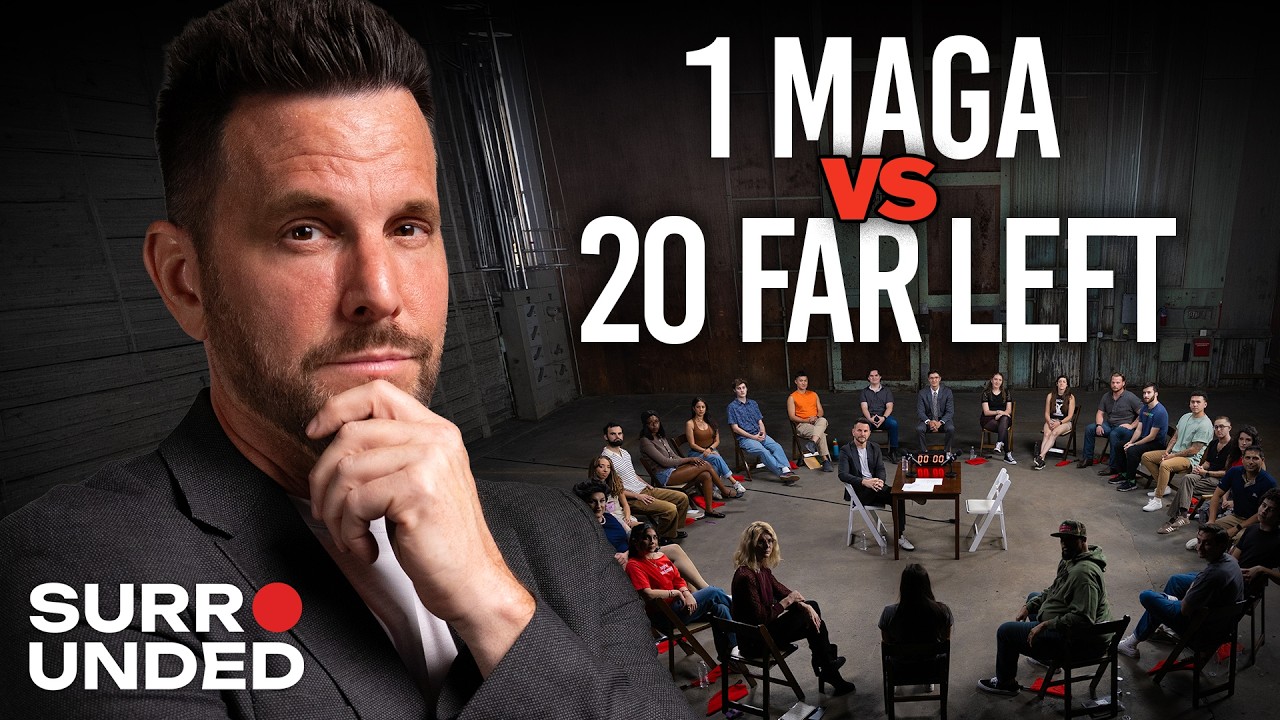
Dean Withers Debates 20 Trump Supporters on Racism Character and Whether Kamala Harris Would Be Better President
1:42:42
Why I Won't Fly My Flag at Half-Mast for Charlie Kirk Despite His Assassination
12:03
Sam Cedar Debates 20 Conservatives on Trump's DEI Orders Wealth Inequality and Christian Nationalism
Sam Cedar, host of the Majority Report, enters a room filled with 20 conservatives to debate some of the most contentious issues in American politics. From Trump's executive orders rescinding DEI policies to the future of Social Security, the morality of religious fundamentalism in government, and whether voting for Trump serves anyone beyond billionaires and Christian nationalists, Cedar challenges conservative perspectives on economic policy, cultural values, and the role of government. The debates reveal deep philosophical divides about discrimination, taxation, family structure, and what America's identity should be.
Sam Cedar Takes On 20 Conservatives in Fiery Debate
Sam Cedar, host of the Majority Report, steps into a room surrounded by 20 conservatives to debate critical issues facing America. Cedar opens with a controversial claim: Trump's attack on DEI hides his real goal, which is to give corporations more power. The conservatives push back immediately, arguing that DEI has devolved into unfair hiring quotas rather than genuine protections for accessibility and non-discrimination.
The debate quickly escalates as Cedar explains that DEIA (Diversity, Equity, Inclusion, and Accessibility) in government agencies is not about quotas but about protections within organizations. He argues that it means paying interns so not only wealthy families can afford to have their children do internships, and putting out job notices in different communities so opportunities are widely known. Conservatives counter that while they don't oppose accessibility, DEI has been abused in practice, pointing to examples in California where actors claim they were told "we do not want white men."
Cedar emphasizes that Trump's rescission of DEIA orders is part of a larger strategy to demoralize government agencies and give corporations more power. He explains that agencies exist to prevent corporations from externalizing costs onto society—like dumping chemicals in rivers instead of disposing of them properly, which privatizes profits while socializing costs through public health consequences.
Religious Fundamentalism and Theocracy in American Politics
The conversation shifts dramatically when Cedar introduces his next claim: unless you're a billionaire, a religious fundamentalist, or a xenophobic nationalist, voting for Trump was a mistake. A conservative immediately asks Cedar to define what benefits religious fundamentalists would get from a Trump administration. Cedar points to attacks on trans rights, restrictions on women's reproductive freedom, enhanced RFRA (Religious Freedom Restoration Act) provisions that could allow pharmacists to refuse providing birth control, and the funneling of public education money into religious schools.
One conservative challenges Cedar's atheism and argues that morality without a religious foundation reduces to mere preference. Cedar, identifying as a reformed Jew without strong belief in God, argues that he has a humanist foundation for morality based on minimizing suffering. The conservative presses him: if society decided tomorrow that trans people don't deserve rights, would that be morally acceptable under Cedar's framework?
Cedar clarifies he's not talking about the validity of religious doctrine but rather about religious doctrine supplanting democracy in civil society. The conservative argues that religious doctrine is itself democratic, reasoned over and discussed just like any ideology. But Cedar maintains that figures like Pete Hegseth, who has made inflammatory statements about Muslims and is now in charge of the largest military in history, represent a problematic fusion of Christian nationalism and government power.
Women's Rights Gender Roles and Abortion
A female conservative enters the debate arguing that the liberal world order needs to be thrown away completely and Christian nationalism would be a good alternative. She points to high suicide rates, millions of children dying by abortion, and declining birth rates as evidence of a "culture of death." When Cedar asks if she wants to outlaw abortion, she answers yes without hesitation.
Cedar and the conservative establish their fundamental disagreement: she believes women shouldn't be "thrown into the workforce" and questions whether women should be allowed to divorce without their husband's consent. Cedar pushes back, asking if she gets to decide what the culture should be. She responds that America already has a dominant culture rooted in European and Christian values and identity, and the problem is that society no longer expects people to assimilate to it.
This leads to perhaps the most revealing exchange of the debate. When Cedar suggests this amounts to advocating for a dominant white European culture, the conservative doesn't shy away, stating explicitly that America is rooted in European identity and Christian values. Cedar identifies this as xenophobic nationalism, to which she responds by asking what's wrong with having a coherent culture that everyone should be part of.
Social Security Healthcare and Economic Policy
Cedar pivots to his claim that the GOP will destroy Social Security and healthcare. A young conservative immediately questions why Social Security should continue to exist at all, calling it an "albatross around our generation's neck." Cedar explains that Social Security keeps two-thirds of the elderly out of poverty and functions as social insurance protecting people who don't have enough money to survive at the end of their lives.
The conservative argues that with a ratio of workers to retirees declining and the country over $30 trillion in debt, Social Security represents a fundamental spending problem. Cedar counters that Social Security cannot legally contribute to the deficit, explaining that by statute it pays for itself. If nothing changes, the 6.2% that employers and employees pay will fund 78% of benefits starting in 2033.
Cedar identifies the real problem: the Social Security cap at $176,000 means someone making $100,000 pays $6,200 per year while someone making $4 million also pays only $6,200. Raising or eliminating the cap would solve the shortfall, but conservatives resist this as punishing success. The conservative argues people should save for their own retirement rather than relying on government, but Cedar points to the failure of the 401(k) experiment since the Reagan era and the 30,000 people who used to sleep on New York City streets before Social Security existed.
Another conservative brings up the Kansas experiment under Governor Sam Brownback, where Arthur Laffer's tax-cutting theories were implemented with disastrous results, destroying the state's education system by 2016. Cedar uses this as evidence that tax cuts don't necessarily increase revenue, while conservatives point to increased revenue during the Trump administration as proof they do.
Trump's Tax Cuts and Wealth Inequality
In the final section, Cedar claims Trump's policies make the rich richer and the working class poorer. A conservative challenges him to specify which policies, and Cedar lists tax cuts for the rich, tariffs that will increase prices, attacks on government agencies that protect consumers and workers, and anti-union policies.
The conservative defends the Tax Cuts and Jobs Act of 2017, citing IRS data showing the middle and lower classes saved 3-4% on their taxes while billionaires only saved 2%. The conservative also notes the child tax credit doubled from $1,000 to $2,000 per household. Cedar responds that while the immediate effects may have appeared beneficial, expanding these tax cuts creates wealth disparity over time. When wealthy people get tax cuts, they invest that money and it grows without them working for it, accelerating inequality.
Cedar argues that the greatest economic expansion in American history occurred during the 1940s, 1950s, and 1960s when the top marginal tax rate was 90% on income over $470,000 (in 1955 dollars). Conservatives counter that this comparison ignores the post-World War II industrial boom and America's unique position as the only major economy not devastated by the war. They also point to Nordic countries that had to reverse high taxation policies after running through their economic surpluses.
Throughout the debate, Cedar emphasizes that government programs like the expanded child tax credit in 2021 cut child poverty by 45% in a single year, demonstrating that government intervention can work. Conservatives maintain that this represents an unsustainable welfare state, with government spending now comprising 38% of GDP—the highest since World War II.
Video Transcript
like what's the problem with xenophobic nationalism don't you think that's better for Americans in general xenophobic nationalism is better we should have a coherent culture everyone should be a part of the same culture which do you get to choose what the culture is we already have a dominant culture I mean look I got to be honest with you like I you and I have a fundamental disagreement we will never see eye to eye on this hi I'm Sam Cedar host of the majority report today I am surrounded by 20 conservatives my first claim is Trump's attack on Dei hides his real goal which is to give corporations more power all right sorry s worries all right um I think I have a slight issue with the the back end of the premise I guess Trump's attacks on Dei being a real goal to you know give corporations more power I'd rather Center the conversation around the Democratic you know especially as conservatives the issues that people have with Dei and why I believe Trump would you know want to support the the the issues that you know people are voting for him for I mean I'm talking about his his whole attack on Dei it's actually deia right you know that uh in government agencies the a being for accessibility right yeah and I think the the attack on Dei isn't an attack on people's protections it's it's on the other on the other end of the spectrum right wanting to end Dei doesn't want to end protections for someone being disabled someone being you know inaccessible to get into a job it rather wants to deinen divize corporations to push them to hire these people on unfair bases right okay but de a is not about um uh quotas or anything like that it is about protections for people within these organizations or to make sure that you have different communities uh that have the opportunity to apply to these things so it can mean within government agencies it means things like let's pay interns so that not only wealthy people can have their kids do internships in these agencies or let's let's put out notic around different parts of town metaphorically speaking so that people know this job exists right this is where it begins but this isn't the ultimate goal that conservatives have an issue with conservatives don't have an issue with trying to spread job applications to poorer communities Dei requirements government agency problem because the problem with deia is the there may not be like perceived actual number quotas but that's what it devolves into and especially with corporations evidence of that I mean sure we can look at corporations that are are uh government agencies that are hiring people on not true proper basis we can even look at we can even look at you have any evidence that that's happening yeah even the dnc's uh nomination of Kamala as president this year there was no reason to nominate Cala as she wasn't democratically selected she wasn't she was she didn't go through a single primary none of these things you're saying that Cala was uh the vice president of the United States after the president drops out two months before uh the convention you think that's a Dei she wasn't H every Presidential nominee is democratically selected to be the nominee for that party primaries prior to 1972 this isn't this isn't before 197 understand but what did you you think you were going to run primaries in those two months I mean Joe Biden should have dropped out three years ago well sure but even before when Kamala was running in primary she didn't she wasn't the next man up there none of this she wasn't the next person she was the vice president right of course but she wasn't in Prima but listen aside from I would have uh might have wanted a different candidate as well but that has nothing to do with Trump resending orders that basically say you need to search for a wide range of candidates not necessarily give any different benefits but you need to make sure different communities uh uh have access to the awareness of this job you need uh you you need in your office accessibility for people who have physical handicaps if you have uh of uh of folks who identify as uh you know as trans you need to make it at least hospitable and not this is all non-discriminatory stuff that's what this is all you're cherry-picking the portions of Dei that even conservatives don't have issu conservatives don't have issues with making work the whole Dei apparatus within our government was a fun of doing exactly what I said had nothing to do with quotas it is unfortunate that those things get taken out and there might not have been specific trying to take out with it's trying to take out people getting jobs that don't deserve those jobs people getting pushed into positions they qualification there is no evidence of what you just said happening in these government agencies that's not true at all I mean I'm not going to we're not allowed to sit here and have notes and numbers to pull up for you you can't one example you can't ask me to pull up numbers when I'm not you know I'm not able to sit here and look on a computer for you but these are problems that conservatives sorry you've been voted out please return to your [Applause] seat see you okay so um I think the roots issue with Dei isn't uh what the previous gentleman was trying to point conservatives aren't necessarily uh have issues with those things like accessibility to people who uh might need help the issue is and I kind of uh refer to this before when you have agencies and systems what tends to happen when you have uh government overreach big government is that agencies and systems get abused and I think unequivocally Dei was heavily abused in practice it was great in theory it's idealistic which is sure uh sure is fine that a lot of people can get behind but it was abused in a lot of ways when you have uh actors like we're in California right now when you have actors uh white male actors who are being told we do not want white men we do not we're not going to cast any white men we only want this particular kind of uh gender race right that is an abuse of a system it's no longer fair but more about just perpetuating one aspect of you know visual compelling aspects because at the end of the day what's going to happen is companies are going to say well we want to look the most diverse and and and what that is it's it's moral grandstanding it's say because we have more black women we're better we sell better soda like that I got that is not well this is this is that's that's getting a little far field from from what Trump's Dei orders are but I can tell you as somebody who was a sitcom actor uh in the 90s I would walk into a room and everybody I would see would look like me and I was doing uh second position which doesn't even exist anymore where you do two pilots a year and I was looking around basically every part of television when I was a kid I was centered in some fashion it was either uh this is about my mother or this is about my father or someone like me was centered so you know we can argue as to whether or not uh uh Hollywood is overcorrected in some fashion but on a governmental level the deia uh directives that agencies were following for the past four years it's nothing I don't know what what you mean by abuse on it but it there is no evidence that it was an affirmative action program in those instances it was about anti-discrimination you cannot discriminate against these people and you want to open up opportunities for a broad swath of people again the internship is like one of the most material things that that exist there where the idea that you need to pay interns and that's important because you want lowincome people to have the same sort of like opportunities to see these things as wealthy people you know my kids can maybe afford to do an internship for the summer instead of going to get it a job I I so I think What's happen is we're talking about two different things because well but I'm talking about Trump's deia recision is a way of basically driving people out of these agencies making it a you're saying you're saying Trump specifically and I understand why you're saying Trump but I think the American people as a whole have kind of and I won't say cuz obviously it's not 100% but a majority of the American people have kind of rejected de because I don't think a majority know what de a is that that may be the case but again my point is we're talking about abuse of a system what you're talking about is not necessarily what was happening what what people were seeing were hey because you're white you can't do this and and liberals like do this thing where they create systems and then they like they created the whole idea of woke and then they backed away and then conservatives say woke and then they're like we don't know what woke is they created a Dei Biden literally said Camala Harris is being chosen because she is a black woman and then all of a sudden democrats for the rest after that said that's not why she was chosen even though Biden literally said that and then we have this cognitive we have this cognitive dissonance as if we're not living in reality Biden wanted to make sure that there was some that that there was an opportunity for a black woman to be his vice president without so so why so why did Democrats move away from that say no it wasn't because she was a black woman my my point is my point it's not because she's a black woman you but that's what they said I I can agree that it's not because she's a black woman but that's what they said why did they say no because there were plenty of black women right like he could have picked anybody but he picked specifically her you're positing the idea that there wasn't a black woman who would have been qualified for that position and I don't believe that say no that's not what conservatives aren't saying that there aren't because again in even in the Republican party right now and in Trump's cabinet there are people of color that Democrats pre pretend don't exist like JD Vance's wife and there's JD Vance's wife is not in the cabinet no but but but if if if JD Vance was a was a Democrat his wife would be laed all over everything because of her you know listen I'm not here to defend the Democratic democrat's choice on every policy but the there is one party in this country that is identitarian there is one party that is represented and it is homogeneous and it is the Republican Party 85% of Republicans are white that and that's just the reality of people don't NE but but here's the thing you said even if even if let's just say okay that's true 80% of Republicans are white does that mean that they're less moral that they're that they can't R they can't run an Effective Government what does race have to do what does race have to do hold on what does have to say my vice president is going to be a white because they all knew it was going to be this is the premise of Dei what does race have to do with running an Effective Government what does race have to do if let's say de on on the on the micro tell you right now on the M micro McDonald's I'll tell am I going to get better nuggets listen I'll ask you a question if the if the cashier is Black or White what does that have to do I'll tell you I'll tell you what it first of all deia means that if you come into this agency or Corporation you're not going to be discriminated against because you don't look like everybody else or you don't have the same like physical abilities as everybody else or you may require handles on the bathroom or whatever it is that's what deia does but does it make a government better if there's a broad representation of the people it's supposed to govern without a doubt without a doubt correct me if I'm wrong corre and you guys can correct me if I'm wrong don't regardless of Dei don't we already have things in our Constitution that protect people's rights protects people no we don't do we or do we not no we do not tell me tell me what what what what what what protects people from discrimination in housing and in work in hiring or getting loans it's all statutes it's all statutes and in these government agencies there was nothing except for that order that's why Trump just rescinded it I'mma tap out because I think someone else I think someone else has a better uh can defend that point specifically uh better than me all right please return to your seat [Applause] hi hi good how you doing okay when it comes to Dei essentially if a person was not racist he would hire someone regardless right so why would we need a policy to protect a person if we've moved past racism so would you consider yourself racist wait are you suggesting we've moved past racism would you consider yourself racist I consider myself and sometimes I practice I think we all practice like some form of uh you know white supremacy I think actually like we all do to some degree well I'm I'm glad that you're saying that so I guess going to the LGBT topic it seems like it's very prevalent for you as an issue do you it seems like a big issue I mean the Republican Party spent literally hundreds of millions of dollars demonizing trans people well the reason why they've done something like that and I think you're misconstruing the narrative haven't demonized them they simply want protections back for their own children because children are being stripped away from their par their own children children are being stripped away from their parents yes due to AB uh 954 they've now included gender identity as a premise to remove and strip parental rights for children who who maybe they are rejecting their gender ideology but you'd be okay with parents who agree with their their children's doctors to provide gender affirming care I do not agree with that do you I I believe that parents and doctors can make those decisions if with the kids if a child can't smoke drink or have sex before the age of 18 they should not be able to consent to a sex change now in terms of a Dei initiative in terms of a Dei initiative the reason why there's military bans on trans women and trans men is because they do not have the ability to cooperate at a mental capacity when they're constantly undergoing hormone treatment as well as depression pills as well as different mood stabilizer pills and so when you go out to combat do you really think you're going to bring an ice cooler pack with your uh whether that be hormone estrogen or whatever it may be while you're about to shoot someone of the opposing uh War well the executive orders that Trump gave were deia uh orders that had to do with agencies that have nothing to do with the military yes they do yes they absolutely do the FDA they just they just they just revoked the ability of the Air Force to teach Air Force members about the Tuskegee Airmen what are what are we talking about here okay well honestly like they're rewriting history well that's your perspective right but at the end of the day if a person to air man we can all agree existed right just listen to this if if you were racist right and you were an employer and if you wanted to absolutely be racist and excise that you would I think Dei sort of prevents people from seeing the reality if a person truly wanted to to hire you based on your intellect based on your skill set they would Dei essentially provides tax cuts for the end of the year when you create your tax returns they give you a tax credit for hiring someone who is black or a person of color I don't know if you knew that in these agencies in agencies and private uh uh private government agencies they don't get tax cuts for for hiring people I want the other thing I want to kind of state here is that I've realized that a lot of the times with the Liberals is that you guys push for for example for Dei and people of Latino Or Hispanic descent and a lot of the times what you don't realize is you're actually doing more harm than good by putting them in positions where you make them believe that it's based on the color of their skin it's based on Dia does not is not it's based on Dei emphasizes color skin color physical attribut it says that your the people who work in your agency it is about it's about anti-discrimination discrimination against what against people who may have different uh uh cultural mores may have different but that's irrelevant to a job right it should be based on Merit and that is the emphasis people get hired as a merit but if you're if you're if the de the de a I'm talking about Trump's recision of these Reed a tax c as an employer wouldn't you hire a person of color dude if if you could pay them less listen we're talking about government agencies that do not get tax cuts they don't they government agencies they don't no these yes they do they absolutely do I'm talking about every every private and public sector gets tax cuts when you hire a person of color government agencies don't pay taxes government agencies operate on are funded by the government that is not true that is not true and you know what I think I think the whole jxap POS of this entire conversation what month is this this is uh January okay so we can agree on that the FDA does not pay taxes it does not get a tax cut because it doesn't pay taxes de i a MH forces them as an agency to say if you have a job opening you must do your best efforts to make sure that every I like that a buzz word you must do your best effort I love that buzz word pause because you feel like you have to you're pressured to yes you shouldn't be pressured to hire someone based on skin color no not to hire someone on skin colored but put up notice about about what what the that the job exists make sure that you put it in different communities so that you have as wide an application pool as possible and therefore you get tax cuts all right at the end of the year when you file taxes you get a tax cut for hiring someone who speaks a different language or different skin color I don't know how to respond to [Applause] that how you doing uh so I I want a little bit more clarification cuz I don't even know if we got it yet on which part uh benefits corporations like from your perspective okay so agencies the the US government agencies the vast majority of them what they function to do is inhibit corporations uh from essentially externalizing their costs onto Society sure so the you know the the example would be you know I used it before but it's it's a good one uh I'm making Teflon C8 for instance okay and C8 is supposed to be burned because instead of like a deposited because it's a forever chemical and I can go out and instead of burning it it's too expensive to burn it I'm going to dump it into a river and a and the EPA comes in and says like you can't do that we're going to find you you're not allowed to do this but what the compan is doing when they do that is they're going to take the profits that come with lowering their cost by dumping it into the river and those costs are then born by everybody who lives around that River they're going to get cancer they're going to get gastrointestinal whatever it is and Society Bears the cost of that can you connect the dots for me though because it sounds like we're talking about something completely different and so the deia stuff is just the beginning of demoralizing these uh these agencies and trying to to wreck them from the inside it's all part of like Russell votes thing the OM the whole schedule F where they get rid of civil servants and and they demoral people and they don't want them to be able to function so so then would you agree if this is about demoralizing I mean over 75 million people voted for Trump right he won the popular vote do you not think that in part you even said yourself that Americans don't really know what deia is according to your definition of it the government's definition of it okay well I would argue that the average American is demoralized by what they've seen the way that the government goes about their Dei policies and the military and other organizations not just a military please return to your seat hey before we go any further we want to take a moment to say thanks so much to straight arrow news for powering the fact checks in this video straight arrow news is an app and website that is on a mission to raise the bar on journalism in a time of media bias and mistrust their team of journalists believe that unbiased news should be the standard and not just the exception so they report down the middle with facts delivering news without bias filter or spin plus their media tool allows you to discover news that's being under reported or not even reported at all by different sides of mainstream media that's why we're so happy to be partnering with straight arrow news the work they're doing gives us a complete picture of the news straight from our phones and tablets with their app go to s.com surrounded or click the link in the description to check it out by clicking that link you're not just supporting this channel you're also supporting a group of journalists that are raising the bar on news and focusing on serving you unbiased straight facts thanks again to straight arrow news for partnering with us on this episode now let's get into it my next claim is unless you're a billionaire a religious fundamentalist or a xenophobic nationalist voting for Trump was a mistake okay so let's tackle one aspect religious fundamentalists what what benefit would religious fundamentalists get and also can you define what is a Rel religious Fundamentalist maybe you could say more of like a a Christian nationalist okay uh in this instance but things like you know uh uh the attacks on on trans folks the attacks on a woman's right to choose uh the idea that we're going to get stuff like uh an enhanced rifra which is going to mean that if you're a uh a pharmacist and you don't want to provide um birth control you may not have to um don't you think you're assuming that if you want you if you believe that uh public education uh we should take that money and and pour it into religious schools you're going to you're going to get a benefit out of a trump Administration but don't you think you're assuming that uh the vast majority of Americans who are moderates what do you think you're going to get out of the Trump Administration economic relief that's that's that was what kind of economic relief they're going to cut Social Security you're going to have to pay for your parents they're going to cut uh um the the when they when they go after the agencies like they're going after right um and this is outli in Project 2025 Russ VA who's going to be the uh om head he was the OM head the first time around he wrote all the book on this stuff well you bring up when you cut when you cut agencies and go after them and you fire all the inspector generals so that they're not being able to make sure that the agencies are working who do you think profits from that it's corporations they're going to go after agencies make sure your food is is is uh is is not full of botulism that your air is not uh full of mercury that your water is not full of uh of C8 this is what they're going to do agencies exist to curb corporations from externalizing their costs and privatizing their profits so it may be cheaper for a company uh to dump their chemicals into a river than it is for them to dispose of it in a safe way and so they get the profits from that but the costs are borne by Society they're born by Society in the form of like people get cancer they're born by Society in terms of like we've got to do the cleanup that's what agencies do pause you've been voted out by the majority please return to your seat that's [Applause] good hey it's nice to meet you nice to meet you okay so I would like to touch on the uh religious fundamentalist aspect are you an atheist I'm a reformed Jew I don't I my I don't have a a a strong belief in the existence of God but I don't think that religion in and of itself is bad okay so what's wrong with religious fundamentalists so like when you said you said trans rights and women's rights or something like that well I the problem I have with religious fundamentalists and really more I guess it's really uh uh theocrats is that they want to impose their uh morality that comes from their religion on the rest of us and I don't I I don't but morality from your view is going to be a preference right it's not morality it's a preference what's uh so morality without a foundation is going to reduce you to a preference well I have a foundation for my morality which is what it's a humanist vision of of what basically uh creates as little suffering as possible for as many people okay so you're like a consequentialist um utilitarian I uh I I don't really uh bother myself with with being a consequentialist or utilitarian it's always going to reduce you to a preference so if you say that killing is wrong and I say it's right you would really have no contention with that well no I I I I don't uh base my understanding of Civil Society on religion and so we have a civil society we have laws that we have decided as a as a society in a democratic way and for some people it's okay for it to be informed by their religion that's okay perfect so if tomorrow Society comes together and we say hey trans folks don't deserve rights you would be okay with that no I I would I would I would be against it but I mean it would be it would be morally right under your view not morally right no no no I'm not talking about morals here okay so here here's where I'm getting to right um religious uh foundations provide an ethical framework for one to live their life off I believe you can have an ethical framework without if we take the is view to its logical ta end to its extreme view you have low reproductive birth rates um you have a reproductive dead end so uh two men together can't reproduce unless they have to take from a healthy straight couple um religion provides this Foundation where you do prioritize a nuclear family so do you have a problem with uh with the gay people being married it's not that I have a problem I just don't see a justification for why they ought to be gay outside of it just feels good can you give me another justification for it well I think maybe that's the way they were born okay uh what what about pedophiles are they born that way uh they may be yeah okay so should we let a pedophile off the hook since they are born that way no I think we as a society has de should Implement duties to prevent them from acting on that innate urge correct well I think between consenting adults it's a different thing then okay so you're okay with a 45-year-old dad with a 19-year-old daughter as well incest no if they two if they consent you're okay with that no I think Society has also determined that it's like it's not beneficial there's duties and obligations that we have so religion provides those duties life isn't about freedom and exercising what you want I mean well you want to impose your religious no because you just admitted you just admitted we need duties we need we have responsibility as a society to keep us functioning to keep us thriving your leftist view the liberal view doesn't provide anything besides it just makes me feel good religion does so what's your argument what's my argument as to why I don't want uh religion to well because the other first of all I don't think that you have have uh uh the right to Corner what God is telling us is right or wrong and there are differences between religions and so my argument is you know like you're not going to uh uh uh keep Halal or kosher right I mean I don't believe that someone has a corner on on on on religious truth and the reason why we have a democracy is because we didn't want a king and the kings came from the idea that their God said that they're the who's supposed to be king and so we can disagree on this I don't want to live in a country that is ruled by religious fundamental if I do you have no issue with that and no no no and this is why I say under Trump yes you have won yes you have a you have a Christian nationalist uh uh uh and and so so I I I concede the point that under Trump your Christian nationalism has gained an advantage under this sorry we're going to have more kids we're going to have less abortions we're going to have more family we're going to have stable family households sorry about better education people gay people should be out they should be straight they should be straight women should be secondary to their husbands women should submit to the husbands that doesn't mean that doesn't mean they are slaves it doesn't mean they it means they are protected let me ask you let me ask you should women be drafted should women be drafted think if they're equal should they I think this is the vision that you have and I think Trump supports it I think the Christian nationalist has throughout his government are all going to work towards your vision and my hope is that when people look at this they say hey wait a second I don't want my life to be dictated by the notion of of a a Christian nationalist prescription now you may win out I mean certainly like if you look at a country like Iran they have a theocracy there and that and and it apparently that's you know good for them if they want it my final point is my final point is whenever we see people live out Christian values to its full extent we see a great society when we see people deviate from that that's where all the problems arise I think you are at home in the Trump uh Trump you've been voted out please return to your [Applause] seat sorry guys uh I think I have an issue with the implications of the prompt I mean of course I'll I'll stick on the religious fundamentalism I think it's unfair to view Christianity separated from the ideology that Christianity informs right you have an ideology that you vote upon because you view it to be the truth that benefits everyone in a society that's how a democracy works I as a Christian have an ideology that informs my opinions and I believe that it is the most moral and correct way for a society to function so I think if we put religious fundamentalism in a box where you say any any moral implications that I draw from this you know religion is unable to be voted upon unable to be pushed onto you because simply it's a religion is unfair to view it that way religion is an ideology like all ideologies are you know it's you have you vote away I don't mind you I I I don't I don't dispute the idea that you could have a religious ideology and want to see it imposed upon uh others um and it's not inconsistent with my claim my claim is is that Donald Trump is ushering in uh an element of Christian theocracy that that you know I can't remember his name Alia and and and you may are be excited about but I'm not excited about it I don't think the vast majority of Americans are but maybe I'm wrong I mean I don't think this country was set up to be a theocracy sure and I find it problematic that it will be but others will be happy about it I think it's unfair as well to label any morals that comes from religion inherently immediately the ratic like having having a theocracy is something different than having I think Love Thy Neighbor is a good precept and I don't know that we should necessarily legislated but I I think it's a good precept I think there are things from religion that are good I interviewed be Desman tutu uh years ago who said that you know religion can be uh you know is Like a Knife it can be used to spread butter it could be used to stab people but that doesn't mean that I want religious Doctrine to be uh the same as our as the law of the land we have a democracy and it was founded on trying to to get out from type some type of like religious oppression which means a one religion shouldn't dominate uh in this country that's my my sense yeah and I see that but I think I have an issue with where you would perceive religious Doctrine is derived from right a guy doesn't at least in in Christianity a guy doesn't go in a room and come out and say that he is a secret message from God that everyone now has to follow religious Doctrine is is gred over it's reasoned over the same way any ideology is is discovered I'm not talking about the validity of religious Doctrine I'm talking about religious Doctrine become supplanting uh democracy in civil society and I'm saying that religious doctr Doctrine is democratic inherently and and in the way that you well I mean look we can have a debate as to whether or not women should be subservient to to men uh I I don't think they should be and in a democracy I don't think it's healthy right but when you said earlier with him that someone shouldn't have a I don't know the exact word like a Chokehold on what is you know religious truth and what isn't religious truth that's not how religious truth itself works and that's not how religious truth is brought to the political table to have that work either right I don't know when Pete heith is in a bar yelling you know uh we're going to kill all Muslims well that's I mean well yeah but now he's in charge of the largest military in the history of the world I I think and he is informed by his Christian nationalism I I think that's a problem don't disagree on pause pause you've been voted out by the majority return to your seat okay so elazar um mentioned his views on gay marriage and I saw that you believe that uh essentially conservatives don't believe that gay marriage should be allowed I want to ask everybody in this room is there any law or legislation that Donald Trump has passed to prohibit same-sex marriage in the last four years okay is there anyone in here who would potentially oppos to people kissing in public that are of the same sex you could raise your hand if you want kissing yes in public in public kissing in public no no law against it just your just your own opinion okay so these are all people's opinions right the same way you have your opinions about Christians is the same way these people are no I don't have a problem with Christians well you do not believe that theology should be at its um as a we should not have a theocracy correct and so what I'm saying is I think that Christianity I'm a Catholic I think that Christianity is I think fundamentally very important to instill family values in myself as well as every person who wants to have children now let's talk about I'm okay with that too let's talk about order one uh 14,1 66 that is an executive order that Donald Trump just imposed on identifying what is male and female so I personally believe as as well as many transsexuals uh friends of mine believe that a uh woman is a biological female as well as a man being a biological male you are assigned what you are at Birth you are not assigned your gender later on what you choose to express is something that is similar to wearing a similar to what you decide to put on your face and I don't think there should be laws or legislations dictating people or imposing laws to um manipulate children for example to castrate their bodies at at such a young age there 50% of children you know how many children uh are treated uh over the past five years let's say I think it was from 2018 to 22 there was a study that just came out from Harvard do you know how many children received uh gender firm care but uh broken down into um puberty blockers and then give me the numbers you tell me I'm curious well I'm curious because you're bringing it up no I have the numbers okay tell me I do but I'm curious if you know tell me what the numbers I promise to tell you after you tell me what you think it is I'm not going to I'm not going to play because I have a feeling think no no I am playing this game because I think you think it's much higher when you tell me that kids are being castrated know you don't really know what these numbers are and I do know these numbers okay well I can tell you this much it was reported that scientifically every single child who has received gender forming care about roughly 50% of them regret it and 50 50% of them are suicidal because of it they're actually more depressed because of it how many of those kids how many a psychologist way how many over the course of 5 years well tell me you tell me tell me just give I know what you're trying to do you're trying to put me in this Chokehold of like I got you no no this is definitely a gotta moment because I'm suggesting to you that you think this problem is much bigger than it is a huge problem medic you know medical covers in trans women I understand that one one person has had that that surgery I don't understand how my taxes should go for an inmate prisoner who wants to transition well I think because we got to do healthare uh for for prisoners you don't consider real Health has imposed 2.6 kids over 5 years of pu is a lot of children just how including gender identity gender identity to allow children to be separated from their parents just due to not affirming their gender identity but here's the point listen uh Trump is how is he hurting these people he just rescinded the ability of the Labor Bureau to investigate discrimination in workplace are you for Trans people being discriminated workplace never being discriminated are you for Trans people being discriminated with passionate about that question and can I can I answer it mhm okay so I believe that affirmative action should be it's not affirmative action oh then what is it it's antidiscrimination that's not saying have to hire trans people it's saying you can't fire someone you find out they're trans okay well hold on a minute so when you when you hire someone or when you interview someone for example you are supposed to interview them based on their knowledge and their work ethic not based on sex I'm not saying on their sexual you allowed to fire them if you find out they're trans if you need to if you need to then you should if you need to then you should what we have a disagreement I don't believe people should be discriminated against pause and that's not discrimination it's based on your knowledge not what you sleep with not who you sleep with just saying Hi Sam so I actually think that this liberal world order needs to be thrown away completely and I think Christian nationalism would be a good alternative um what we're seeing right now is just congratulations yeah and thank you and yeah I think um what we're seeing right now it is a culture of death this is the most suicidal generation ever we have millions of children dying by abortion um people aren't even reproducing we're not even we don't even have like a should we should we mandate people reproduce no I don't think we need to mandate we can just stop them from killing their kids there are you want to Outlaw abortion yes yes I mean this is we have a fundamental disagreement on this and my claim was that if you voted for Trump um it would be to your benefit if you want to Outlaw I benit I think it would benefit everyone yeah I disagree I think that uh that women should have the right to choose I think that it would benefit everyone to bring back the family unit to stop having woman just thrown into the workforce maybe we shouldn't allow women to choose to divorce unless their husband say it's okay I mean I I don't really believe in divorce in general so like sure all right I mean this this I think though reinforces my point that uh that if you are it would be better for society better for everybody in society and same with xenophobic National like what's the problem with xenophobic nationalism don't you think that's better for Americans in general xenophobic nationalism is better we should have a coherent culture everyone should be a part of the same culture we should have a similation which do you get to choose what the culture is we already have a dominant culture based European and Christian values and identity that is a dominant culture it's rooted in European identity why so so your argument is that has been the dominant culture and we're not letting people assimilate to that we're saying you should keep your culture and this is why our culture is so divided your argument is that Trump is good for those who want a a dominant white European culture I mean that is what America is it's rooted in European identity and Christian values that's what it has been you like would you really disagree with that what what is it then if that's not the identity of America what well I think the identity for the majority of time America's been a country you don't think that's been the identity well actually uh no I think actually the the the identity of America has been uh you know For Better or For Worse a Melting Pot in that regard yeah yeah maybe since like the 1960s even then like even we had this idea of a Melting Pot literally means assimilation too it means melting it means you're assimilating to the dominant culture is that not what melting means and now instead we're saying there's something wrong with xenophobia culture no I mean look I got to be honest with you like I you and I have a fundamental disagreement we will never see ey to eye on this it's a choice and people I think what you're expressing though is really what the the the Trump uh uh movement at its heart is about and I think that's problem I disagree I don't think Trump's like anywhere close to being a Christian nationalist that's ridiculous like Trump's basically a Democrat from like 15 years ago when it comes to social is you don't think that he's conservative enough for you oh definitely nowhere close no he's not xenophobic enough for you no he's trying to pour a bunch of h-1bs are you kidding right oh so you want to get them out too yeah no I I mean I I think you're making my argument for me all right well I'm just saying he's not even my next claim is the GOP will destroy Social Security and Healthcare nice to see you uh so what if Social Security should go away that's my question to you because Social Security keeps two-thirds of our elderly out of poverty and not only does it keep our elderly out of poverty it's a it's a it's essentially a social insurance program that protects you if at the end of your life you don't have enough money to survive right now do you know that it's also the AL Tross around our generation's neck no it isn't okay so let me just explain this well you're going to back to lecturing about social security we don't what we're talking about social security is one of the top three funded uh Social Security is almost the biggest thing that our government does exactly and we are more than 30 trillion in debt of our well first of all Social Security cannot contribute legally to the deficit because they don't even account it in in the federal deficit every year we have funding when Social Security started in 1936 you have more workers than retirees because people haven't entered into retirement by 1970 it was at 3.5 to1 now it's at 2.5 to1 but productivity has increased during that time so the amount of money paid into social security has been up there the reason why we are running out of money just for the trust fund not for Social Security like I say if we do nothing with Social Security now it is statutorily unable to contribute to the debt the math is right there the reason why the trust fund is running out is because wealth inequality has hoarded so much money above the cap you don't think it's because the government does a terrible job managing their money they have a huge spending problem and they go look at all this money we have for Social Security that's earmarked for 60 years from now that we're just going to spend on some 30 years ago they predicted this this is an Actuarial Table accountants sit there and look at at it this is a very easy math problem accountants in the government are always right right that's totally the thing that you're saying that they're always correct about money right that's why we have a $40 trillion debt problem the problem isn't the math with the 40 trillion debt problem it's the you have tax it's the spending problem I totally agree with you which I would argue as part of why Social Security is gone in the whole so already that's not that's simply not true oh okay so we're out of money from the social social security bucket no no no statutorily by that I mean by law Social Security pays for itself if we do nothing we do nothing the 6.2% that your employer and your employee pays into it will pay out 78% of benefits starting in 2033 why is it going down if everything's so much better why is it only 78 if we raise the cap there's a cap right now at $176,000 so for instance if you make $100,000 you pay $6 6,2 $6,200 into that a year a year if you make $4 million do you know how much money you pay into that Social Security $6,200 and so why should it why should why should wealthy people hang on why should wealthy people pay a higher percentage no they should pay the same percentage 6.2 on $400,000 $6.2 on a million doar and why should they pay even more money at all because because they make more money again you fundament you fundamentally have this idea that because somebody okay you have an idea that because somebody makes more money money that that's fundamentally wrong right no no I don't think it's fundamentally wrong I think that they should pay more taxes into it now I do think as a society we should we should not allow billionaires so for they can pay more taxes generally but the highest tax rate in the greatest expansion of our econ hang on does a billionaire get more money from Social Security when they if they went to go take it than than I would of course they pay more I'll tell you why because if you it is a it is a social insurance program that keeps you from being in poverty when you're a senior and the reason why I think billionaires should pay more taxes than other people even even a higher percentage is because it works better for society the greatest expansion we've had in this country in terms of economics and the least amount of wealth disparity was in the 40s and 50s and 60s in this country do you know what the top marginal rate was it was high do you know I don't know the exact number but if you made over $470,000 in 1955 every dollar you would make above that was taxed at 90% so I have a question 90 cents on every dollar was taxed above 470 so if we had the in which is Wild by the way but uh it's also the greatest expansion we had of the economy you can you can expand for a time and then you see places uh you see like Nordic countries that were like oh let's tax tax the hell out of our rich people right and then they go whoops we messed up we can't actually live off of our terrible we basically are able to live off our economic boom that they had between like the 40s and the '90s and then we have to revert all of that because we made a terrible choice and we were able to have a party for 50 years until we realize we ran through all the money that capitalism got us so let me ask you real quick so the average you the average person right they right now they fundamentally look at Social Security young people like me and they go I'm going to have that money sitting waiting for me when I when I retire since you're opinion is whatever works best for the average person is better wouldn't you rather shift towards something that I would agree with which is getting people that are 19 20 years old into funding their own retirement rather than relying on other people to fund it for them like the 401K sure not just a 401k any other type of re agree with that Social Security was set up as part of a three-legged stool where back in the day when I was a kid we had defined uh benefit uh pensions where you know how much money you would get out that all shifted in the 80s to Define cont contribution where you know how much you put in the 401K started during that Reagan Era it has been a disaster because the fact of the matter For Better or For Worse people just don't save in the way that you're talking about it would be nice if if the if the government were changing the mindset and actually pushing that cultural shift towards we're not just going to hand you money when you're 65 you have to plan for experiment with that the government affecting the cultural mindset and it failed we've had a 40-year experiment of everybody you know what my you know my parents say social security you know what grandparents say they go well I'm just waiting for my soci social security check to come in rather than I have $800,000 waiting for me because I thought about it when I was 19 and 20 because I didn't have this grab bag of money waiting for me you're assuming that you're assuming that I try and tell my kids we agree so we agree we should get rid of Social Security and phase it out well no so we should phas out how would you listen to this idea you phase out Social Security to where people who have 5 years left before they retire get 100% of the benefits and then people like me who have 40 years until we retire I'm not going to get it I'm going to get screwed either way you really you really think I'm going to get Social Security I guarantee you at the very least you're going to get 78% of your benefits but that's awesome I'll get i'll get $9,000 a year that's great in calling for our government to increase the cap in fact get rid of the cap then your grandkids will get so scared I would much rather I would and again maybe we'll just disagree but I would much rather result to hey 20-year-olds please save for your own retirement invest for your own retirement because the government is bad at dealing with money and what happens don't rely on them what happens if what what happens if those 20-year-olds don't listen to you the same thing that happens if a 20-year-old just doesn't go and get a job because I tell them to they're going to have a problem but that's not my fault no I got news for you it's not your fault but there used to be in New York City 30,000 people sleeping no one in this room was alive before Social Security we've all lived under this just like the just like the uh Inc been the most successful government program in the history of our government program things that are successful don't just start to die out and end up in not dying out it's the grab bag of money the massive excess that was there in the early years because of the 42 to1 benici was it wasn't a massive excess in 1930 42 to1 is a massive weren't that many people who had entered into the Social Security program and the fact that in 1970 it was 3.5 workers to one now it's 2.5 but productivity has increased it I've told you why the Social Security trust fund is running out it is because of wealth disparity billionaires hiding and hoarding their money above the the cut off line which is 176,000 that's the cap if you the cap your grand billionaires aren't keeping billion under their mattress they're investing it back they're just putting it into some stock market or they're just looking around what do you think 401K IR relies upon it relies on the stock market and things like that 401k relies on the stock market and I knew people who were retiring in 2008 when the stock market tanked and they got screwed that's a whole that's a whole other problem I would argue that's largely driven by the government being once again terrible with policy ining bad economic social security is there regardless of what happens with the stock market you've been voted out by the majority please return to your [Applause] seat Micah hey Micah good to meet you nice to meet you there's uh an idea that you that you have that basically government can kind of fix all these problems right if you didn't say for retirement well then the government can just come in swoop in and save you from that well not swoop in it starts on literally the day you get your Social Security sure sure sure it swoops in once you retire right once you can once you right right exactly um and so you you believe this idea basically that government is an effective organization which it just time and time again if you look at history that's proven to not be true when you're hidden at retirement you don't know this is an insurance program that's it it's an insurance program and it basically says you're insured against eating cat food when you're 65 and it works it works no it it doesn't you should have well one you should have your own personal how doesn't it work how doesn't it work well I mean we've already discussed the the details of how it is just completely failing as a program like how is it failing because I'm not going to receive any Social Security I've already told you right now I know I'm not going to rehash out that debate the main the main issue numbers you've just been told this and you know why you've been told it is because they want to raate it to give tax cuts to rich people that's why so are you saying T there are the the Trump tax cuts were only for rich people you're saying no no I'm not saying they're only for rich rich people benefited more from it than than uh low-income people and I would say what do you mean benefited more from that because we already went over the percentage numbers and we know that's not true M they don't need the money as much and they don't need it what are you talking about these these rich people are the people that are investing in smaller businesses these are the people that are giving other people jobs to allow them to provide for their fam [Applause] pause what's up hey good to be back nice to see you okay yeah nice to see you too I want to zoom out a little bit okay so obviously you're you're pinpointing on Social Security and there's a reason for that and healthcare too oh okay but Social Security is the is the program that you very concerned about and that Medicare I'd love love a Medicare for all program but go ahead yeah so I think the reason you're focusing in on Social Security precisely is because Social Security is the most successful in a shadow of social welfare pro programs and government spending that it's it's like the Democrat it's also the biggest bucket money is the biggest bucket but the Democrats have these social programs and the defens at spending and it's just never ends It's never enough money so you're focusing on Social Security because it is the Su the the one successful child but you're IGN ignoring all the social welfare the social welfare state that we' become social social security and Medicare and Medicaid make up over like a right so 70% of our 70% of our federal spending is mandatory that you're right it's Social Security Medicare Medicaid interest on debt 8% of our who work paying for that so the Democrats run on this uh essentially they want a welfare state so yes Social Security might help a lot of people but it's like we're in we're closer to a welfare state than we've ever been 38% of our the GDP in the US is uh government spending that's the highest since World War II so us conservatives we're trying to tell you like you guys are fiscally really irons worried about the tax cuts and what that does to the debt and deficit the tax cuts increased Revenue no yes I want to tell you about Kansas okay tell me about Kansas uh Sam Brown back in 2012 brought in Arthur laugher you know the laugher curve right that's the the argument that if you cut taxes you're going to get more Revenue it d that's exactly what happened destroyed Kansas by 2016 Republican legislature raised taxes again they destroyed their education system is against you my look upas during the Trump Administration they sent Sam Brown back they made him the ambassador of Faith because they didn't want this guy around you want tax Rich you should vote Republican because they pay more in taxes in under Republican it was the same as it was the same as Trump look at the US look at the US the numbers OB best year Federal Income revenue is is pales in comparison to Trump's worst year do do you get what I'm saying does does more taxes equate necessarily equate to more Revenue yes no that is that's where you're wrong so if you look at tcja and I'll say the numbers again the top 1% paid more more into the system GDP grew wages grew 3% year-over-year under tcja so when you're saying tax are rich like it sounds like you're actually a republican you you're you're no you're you're confusing causation with correlation because uh uh because Obama's uh economic recovery was way too slow and I agree with you on that way too slow way too slow when you have tons of stimulus what you're doing is you're creating the Great Depression for the bottom 90% all the assets inflate so who does that benefit your policies benefit the 1% inflation disproportionally benefits the 1% it's an immoral tax on the poor and and that's exactly what happens when they inflation was not a function of monetary stimulus it absolutely was they increased the money supply by $6 trillion I understand they did that I understand they did that and they could pull it back in taxes with the wealthy they they if they wanted to you're making an argument for higher taxation do you think taxing people makes the country wealthier is that what you think does it make the country do taxes make us wealthy is that government ta increasing taxes are you are we now more wealthy do you think that the only the only way you the only way you create wealth is by if you if you tax and spend government stimulus can yes increase GDP of course is GDP wealth is GDP wealth if we import 10 million immigrants and our GDP goes up are we now wealthier if the if the housing costs more if if CPI goes up because there's more people I understand inflation is under control and we haven't pulled that money off the table right but I'm just saying that what inflation is back because we had a problem the welfare state makes us all poorer that's that's yes it does and you can comp people want to come here for Economic Opportunity we don't want handouts we want opportunity that's why that's why as an immigrant that's why my family came here we left the Socialist Paradise it's garbage the people that come here want Economic Opportunity and you're stifling that you're undermining capitalism in the free markets with your utopian Vision there is no free market well there's not anymore no there's but there used to be that is the that is the that is what makes America the greatest America is the greatest econom of the marketer had was when we had 90% tax the numbers are against you 1940 1950 1960 the highest top marginal tax and we had when fredman predicted stock inflation in the 70s with your social welfare we had OPEC shock that drove inflation way up and that was a function of of OPEC but in the 1940s 1950s and 1960s highest top marginal tax rate was 90% indal inequality indust great compression more people eny World War II Industrial Revolution we were producing we were producing more than every other country country we were it's because we were producing more than every other country that's what creates doing that with a 90% tax rate on the wealthiest L when and when and when rean came in and brought it down the top one % paid more can you believe that do you know that federal income tax you you wait wait wait you know federal income tax it was when it was established you're talking about the laugher curve and I'm tell look here's here's my last claim when federal income tax in 1913 when it was established was only targeted at the people making 100,000 and over now we don't even know most people don't even know that it's just a base tax why because the projections that they had of taxing the rich didn't work out like they thought because it doesn't work out there's a ton of loopholes the rich are not the rich are smart like the rich people are smart so focus on our top marginal rate still produced an effective tax rate that is double what it is today 50% does not create more wealth more taxes do notate I mean by wealth I mean wealth is very simple it's production of goods and services that's what is that's whatat tax money people think money is money buys wealth creates less wealth inequality and then you have wealth that is shared by more people rather than being in the hands of of of a of a plutocracy or a plutonomy and and then you get stuff like an we've seen what happens when you punish your top producers over and over again they leave they stop producing the government the the cap a myth no it isn't you the economy guess what happens next where wait wait when did this happen in the country when we had a 90% Happ in every socialist country this is the Socialist Playbook they're like they come in and they're like guys this is not a socialist country and I'm not calling for socialism to have high it is more socialist than ever before we have more social welfare GDP I I'll say it again 38% of government spending of of GDP is government spending we are more we have more social welfare programs and look at what happens but how come we have all these programs and uh the black community is still living in poverty what programs are you talking about that are geared towards the black we during during in 2021 we did ex we expended hold on in 2021 what do you mean what program 20 is enough when is it you have the richest country in the world we offer way you guys think is just insane to me like in let me just finish this in 2021 we extended the child tax credit which is basically a payment $300 per social welfare we cut child poverty in one year by 45% by 45% but because no Republican would join uh the Democrats and Kristen Cinema and Joe Mansion voted against this provision in Bill back I'm talking 2021 from 2021 to 2022 we cut child poverty in this country by 4% look I feel like when I look at it guarantee you I will give you my phone number you call me if I was wrong all right we'll call we'll call I'll do it off camera and and you will see that we cut child poverty in a year by 45% I look and I'll look into your claim all right guys all right we'll talk my next claim is Trump's policies make the Rich richer and the workingclass poorer hello sry hey nice to meet you nice to meet you okay so do you mind if I ask what policies and specific are you referencing to tax cuts uh for the rich I think his idea of tariffs on uh on countries in the way that he's talking about will make people poor I think all the work that they're doing in terms of attacking the government agencies make people poor uh because you know when you get agencies that are supposed to protect us from corporate interests they will externalize their cost those corporations instead of actually assuming themselves so their profits are made on the backs of of all of us whether it's our health uh our our protection from consumer uh rights worker rights his anti-union policies will make us poor so real quick I'm I'm going to touch on one of the things that you said now there was a lot to unpack there but a lot of policies yeah we'll start at the very beginning you talked about taxes let's talk about in his first term uh the tax cutting jobs Act of 2017 uh there are a couple things in that specific policy that actually do benefit the middle class and the lower class more than the top 1% so you mentioned taxes right but in that uh from the IRS data that came out uh the middle class and lower class uh got affected I think they ended up saving like three to 4% on their taxes on their tax cuts whereas the billionaires only save 2% so if we're talking an actual dollar am sure the billionaires saved more but they also make a lot more right also the billionaires don't really care about an extra Grand or two in that specific policy the child tax credit doubled from $11,000 per household to two no billionaire cares about an extra Grand in their pocket but I can guarantee you the working class does so how would you rebuttal that I would say uh in terms of the the taxes themselves well the the policies that Trump wants to pursue this time are to expand those taxes for uh for for wealthy folks and uh over time what starts to happen is you have this wealth disparity and as the wealth disparity increases it becomes harder for for working people essentially to keep up things become more expensive you get inflationary pressures when you have people with more money we have more and more billionaires than we did four years ago and a large part of that was obviously covid but a large part of it is also money starts to accelerate once you like you say when a when a millionaire gets a tax cut for a couple of grand or 60 Grand or or or $500,000 at the end of the day they end up investing that and ends up growing because they're not out there working for their money their money is just uh is is doing all the work okay so yeah I mean I think we can agree with you on that when it comes to you know billionaires and Millionaires and there being a wealth Gap uh in our country right I don't think Republicans or liberals would disagree on that but I think where we will fundamentally disagree is under Trump right the stat show that take-home pay was higher for the middle class and the lower class inflation was
Related Books
Browse Conservative Books