South Africa's Collapse From Apartheid to Equity: A Warning to the Western World
Enjoying this? Share it with someone who needs to see it.
Up Next
Stefano Forte Visits South Africa's White Cross Monument to Document Farm Murders and Genocide Warnings
2:15
Donald Brown's Journey Into South Africa's Most Dangerous Township Reveals a Nation's Struggle and Hope
16:17
President Donald Trump Confronts South African President with Evidence of White Farmer Killings in Oval Office
9:06
South Africa's Collapse From Apartheid to Equity: A Warning to the Western World
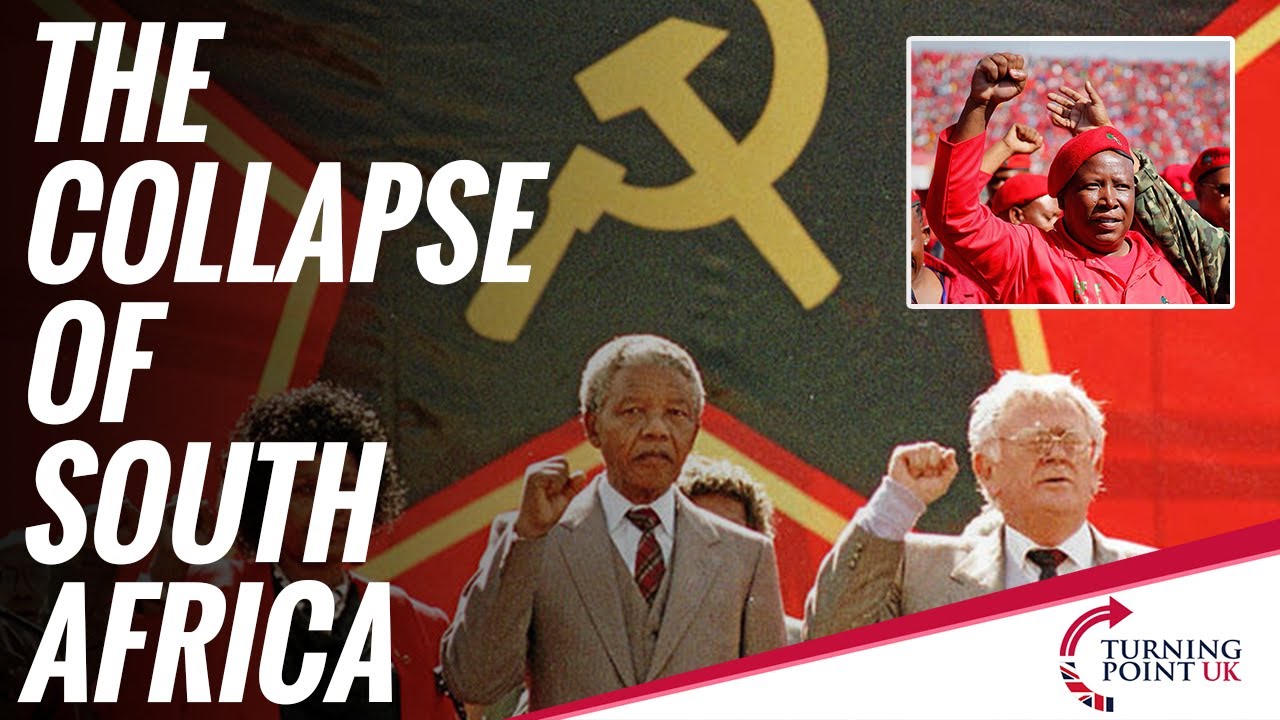
South Africa once looked like a developed European nation with world-class infrastructure, a strong mining sector, and cosmopolitan cities. Thirty years after the fall of apartheid, the country faces rolling blackouts, unsolved murders, brain drain, and economic collapse. The promise of national reconciliation has been replaced by grievance and victimhood. What went wrong? South Africa didn't replace apartheid with a colorblind society based on equal rights and merit. It replaced one form of racial politics with another. The collapse of South Africa serves as a stark warning to the West, where the same ideas, equity above equality, identity over merit, grievance over forgiveness, and racial preference over colorblindness, are spreading through institutions.
Each cross represents a farmer murdered in South Africa. Dozens of white farmers are murdered every year, and few of these crimes are ever solved. But it's not just farmers who are suffering. South Africa used to look like a developed European country with world-class infrastructure, a strong mining sector, and an educated professional class. Cities like Cape Town and Johannesburg were cosmopolitan symbols of modernity and opportunity.
Today, 30 years after the fall of apartheid, South Africa's energy system is so run down that the country implements rolling blackouts. Corruption and cronyism thrive. Most murders go unsolved. Businesses are strangled by racial quotas that entrench in law discrimination against the white minority. Most educated people are leaving. The promise of national reconciliation has been replaced by grievance and victimhood.
A Personal Connection to South Africa's Tragedy
The narrator's father grew up in Rhodesia and spent his teenage and university years in South Africa. While a student at the University of Cape Town, he campaigned against apartheid, including participating in the purple rain march where protesters were sprayed with purple dyed water cannons so police could identify and arrest them. He was smuggled out in the boot of a journalist's car.
He, like millions of black and white South Africans alike, genuinely believed in the promise of a new South Africa built on equality of opportunity and dignity for all. When Nelson Mandela walked free after 27 years in prison, millions of people around the world believed they were watching the birth of a new nation that could overcome its painful past and prove racial reconciliation was possible.
Unfortunately, 30 years on, that's not what happened. South Africa did not replace apartheid with a colorblind society based on equal rights, merit, and the rule of law. It replaced one form of racial politics with another. That is why the collapse of South Africa is a warning to the West. The same ideas that destroyed it are spreading through Western institutions: equity above equality, identity over merit, grievance not forgiveness, state control over private enterprise, and racial preference over colorblindness.
The Dream of Reconciliation
To understand what went wrong, we need to wind back the clock about 30 years. Apartheid was a reprehensible system that denied basic rights to millions of people on the basis of race. When it ended in 1994, there was a genuine opportunity to choose equality before the law, reconciliation, and a future where race was irrelevant rather than essential to who a person was.
For a brief moment, it looked like that might happen. Nelson Mandela spoke about forgiveness and embraced his former oppressors with grace. He knew that if South Africa was built on revenge, it would collapse before it even began. Archbishop Desmond Tutu, a prominent Anglican bishop and anti-apartheid campaigner, helped establish the Truth and Reconciliation Commission to set the record straight on the evils of apartheid and then help the country move forward.
He said the people of South Africa initiated the Truth and Reconciliation Commission, eschewing revenge and violence in favor of truth and forgiveness and ultimately the reconstruction of their country. That was the dream.
The Dark History of the ANC
But that dream didn't last because underneath the language of reconciliation, the African National Congress—Nelson Mandela's political party and the governing party of South Africa since the fall of apartheid—had a much darker history and a much more radical ideology than many people in the West wanted to believe. Eventually, the party's moderates were replaced with a corrupt race-based ruling class that has run South Africa into the ground.
Contrary to the sanitized history taught in schools, the ANC wasn't simply a civil rights movement. Nelson Mandela helped found its armed wing known as MK, meaning Spear of the Nation. It was inspired by revolutionary movements like Fidel Castro's 26th of July movement in Cuba. Mandela studied guerrilla warfare and drew his ideas from Marxist revolutionaries like Mao Zedong and Che Guevara.
MK was initially presented as separate from the ANC to protect their public image, but over time it became widely understood as the armed wing of the ANC. MK claimed only to target public infrastructure, but in reality their loose definition of legitimate targets included collaborators such as local counselors, witnesses in trials against ANC members, and suspected informers.
One example of their terror was the Church Street bombing in 1983 that killed 19 people and wounded 217. A total of 71 people died in such attacks directed by Mandela's group between 1976 and 1984. Of these, 52 were civilians and 19 were security force members. The ANC and Nelson Mandela remained on US terror watch lists until 2008.
Many of the ANC's early members were white communists. Mandela himself was also linked to the South African Communist Party, even sitting on its central committee in the 1960s, although this was never publicly acknowledged until after his death. The ANC's worldview was never simply about equal rights. It was deeply shaped by revolutionary politics, Marxism, and the idea of racial struggle. They believed political power could be used to remake society from the top down.
Violence Against Their Own
The violence wasn't only directed at the apartheid state. The ANC often used violence against its own supporters who it suspected of collaborating with the government. One of the most brutal ways this was done was through necklacing, where a tire would be filled with petrol and placed around the victim's neck, then set on fire.
Winnie Mandela, Nelson Mandela's wife, infamously spoke in support of this practice, saying, "With our boxes of matches and our necklaces, we will liberate this country." In 1991, she was convicted of kidnapping and being an accessory to assault over the abduction and brutal beating of Stompie Seipei and other boys. Her prison sentence was later reduced on appeal to a fine and a suspended sentence.
When she appeared before the Truth and Reconciliation Commission in 1997, she dismissed the allegations as absurd. But the commission found that the abduction had been carried out on her instructions. She had participated in the assaults, resisted efforts to secure their release, and helped cover up what happened to the boys by claiming Seipei fled to Botswana. In reality, he was murdered.
The case became even more sinister because the doctor who examined Stompie's body was then shot dead at his medical practice. Winnie Mandela's former associate testified before the Truth Commission that she was involved in the murder of the doctor to cover up the death of Stompie Seipei. Winnie's main accuser, her former associate Katiza Cebekhulu, was imprisoned and tortured by the ANC in Zambia. He subsequently sought asylum in the UK.
This is not ancient history. This is part of the moral foundation on which the new South Africa was built. While Nelson Mandela himself often restrained the worst instincts of the ANC, including those of his wife, once his moral authority faded, the movement increasingly returned to what it knew best: racial grievance, centralized power, and revolution.
From Equality to Equity
The great tragedy of post-apartheid South Africa is that it had a chance to become a genuinely non-racial democracy. Instead, equality gave way to equity. Equality means equal treatment under the law. But equity means the state engineers outcomes between groups. Equality means every citizen has the same rights, whereas equity says the government can discriminate in order to achieve racial targets. Equality is about opportunity while equity is enforced representation.
South Africa has become one of the clearest examples in the world of what happens when equity becomes the organizing principle of a country and how it will destroy that country. Ironically, under the banner of dismantling apartheid, South Africa has created an enormous system of race-based laws and preferential treatment.
The Employment Equity Act and BBE
The two major pillars used to enforce this system of racial discrimination are the Employment Equity Act and the Broad-Based Black Economic Empowerment Act, known as BBBEE.
The Employment Equity Act applies to any business with more than 50 employees. It prohibits unfair discrimination on the basis of race, but then it says that affirmative action does not count as unfair discrimination. Employers must develop an equity plan to show how they will reach racial equity targets. The plan must be submitted to the Department of Labor.
The department has the power to investigate whether workplaces reflect the demographic makeup of South Africa—80% black, 8% colored, and 7% white. They can also impose equity targets on the private sector. If it's found that a business isn't meeting these targets, they can be fined 10% of their annual turnover. That's enough to bankrupt a business.
There are 57 individual laws in South Africa which require board members or staff of government bodies or government grant recipients to represent the national demography proportionally. In effect, this means black Africans, being the demographic majority in South Africa, must make up the majority of all government boards.
Then there's the Black Economic Empowerment Act. Private companies are given a score based on the race of its owners. For example, a level one firm is 100% black-owned. Level two is 51% black-owned. A business must be level one or two, or solely or majority black-owned, to win any government contracts or tenders.
It got worse. In 2017, the ANC government amended the Procurement Act to require that any business wanting to win government tenders must be a level one BBBEE company. In other words, only private companies solely owned by blacks could receive government contracts. The regulations were successfully challenged in court, not because they were manifestly discriminatory, but because the ANC didn't follow the correct process to make the amendments. No doubt the ANC will try to push for this again if their incompetence doesn't stand in the way of their own racism.
Rather than protecting minorities from discrimination, South African law has created a legal regime that permanently discriminates against minorities. No actual discrimination against black South Africans has to be proven. You get fined for simply not having the right racial mix in your organization. The fines are enough to ruin a private company.
Discrimination in Practice
The result is the white minority is actively excluded and discriminated against in economic life. For example, in September 2022, DISCHEM, a publicly listed South African pharmaceutical company, circulated an internal memo saying there was a complete ban on promoting white people inside the company because they were at risk of not fulfilling their equity targets.
The Brain Drain
One of the most predictable consequences of this system has been massive brain drain. When skilled people are told their future is limited because of their race, they will simply move elsewhere. South Africa has lost around 1 million people to immigration, most of them educated professionals.
This is affecting everyone, not just the white minority. When doctors leave, patients suffer. When engineers leave, infrastructure fails. When entrepreneurs go, jobs disappear. This is one of the central lessons of South Africa: you cannot punish competence and merit forever and expect a country to keep working. Eventually, the people who know how to keep the lights on will leave, and then the lights go out.
The Collapse of ESKOM
Nothing symbolizes South Africa's decline more clearly than ESKOM, the state-owned electricity company. It supplies 95% of South Africa's power and is the largest energy producer in Africa. Under ANC rule, ESKOM has become a monument to state corruption, incompetence, and mismanagement. The government failed to build new generation capacity when it should have. Major projects suffered massive delays and cost blowouts, and maintenance was neglected for years.
In 2023, President Cyril Ramaphosa declared a national state of disaster over the electricity crisis, saying it was an existential threat to the economy and social fabric. As a result, the country had rolling blackouts lasting for up to 8 hours per day, 300 days a year. How could businesses possibly operate in such an environment?
State Capture: The Gupta Brothers
But ESKOM was only one part of a much larger story. Monopolistic state-owned enterprises from energy to airlines provided fertile ground for state capture, primarily from the Gupta brothers and other corrupt ANC cronies. Under Jacob Zuma, South Africa experienced what became known as state capture, and the central figures in the story were the Gupta brothers.
The Guptas moved from India to South Africa after the fall of apartheid. Over time, they built extremely close ties with Jacob Zuma and his family. Their influence became so notorious people started calling the alliance the Zuptas. The Zondo Commission laid out in extraordinary detail how the South African state had been captured and plundered by this family in collaboration with the ANC.
The commission found that there was a scheme by the Guptas to capture ESKOM, install the Guptas' selected officials in strategic positions within ESKOM as members of the board, the committees of the board and the executives, and then divert ESKOM's assets to the Guptas' financial advantage. Central to the Guptas' scheme of state capture was President Zuma, who they must have identified at a very early stage as someone whose character was such that they could use him against the people of South Africa, his own country and his own government, to advance their own business interests. President Zuma readily opened doors for the Guptas to go into the state-owned enterprises and help themselves to the money and the assets of the people of South Africa.
This is the real deep state: takeover of government by private interests and political insiders for the purpose of corruption. It's estimated that corruption cost South Africa 1 trillion rand during Jacob Zuma's 9 years as president. The Guptas, along with Zuma's son, fled to Dubai in 2018 and have never faced justice.
The Breakdown of Law and Order
Then there is the complete breakdown of law and order. There are on average 63 murders per day in South Africa, and 90% go unsolved. The narrator shares that their uncle was murdered by a group of teenagers because they wanted to steal his bike. That is how cheap life is in South Africa. Despite the whole thing being caught on CCTV, no one was ever charged or convicted.
Farm Attacks and Violence
The culture of violence and impunity is being felt on farms too. Last year, there were 184 farm attacks and 29 murders. The number of attacks has come down in recent years simply because local farmers have taken security into their own hands.
Dr. Gregory Stanton, the founder of Genocide Watch, has warned that the attacks on farmers look like the beginning of a genocide. "We are worried that there are organized groups that are in fact doing that planning. We raised South Africa from stage 5 to stage 6. When Julius Malema began to go around singing the 'Shoot the Boer' song again, it became clear to us that the youth fleet was in fact this kind of organization. It was planning this kind of genocidal massacre and also forced displacement of whites from South Africa."
He went on to say the style of attacks are similar to what was seen in Rwanda and Burundi, where victims were tortured, their bodies desecrated, and sometimes nothing was even stolen. Many of these attacks are too horrific to talk about. But one example that shows the terror farmers are living with is the case of a 70-year-old farmer. Attackers came to her farm, tied her up with chains, and poured boiling water over her face. In another case, an 89-year-old woman, Elizabeth Lee, was beaten to death with a chair by a 15-year-old. Attackers have used guns, knives, shovels, screwdrivers, and even sheep shears to carry out these brutal attacks.
The South African government, as well as much of the mainstream media, wants to deny that there is a targeted terrorization of white farmers. But it's hardly plausible that the calls to commit violence against Boers or white farmers are having no effect.
Julius Malema and Calls for Violence
Julius Malema is the leader of the EFF, a left-wing political party. He has been seen leading hundreds of people in a chant to "Kill the Boer, kill the farmer, shoot to kill."
Incredibly, the former president of South Africa defended the chant, saying, "It's actually not meant to be taken literally. It's a chant. When you say kill the farmer, kill the Boer, the ANC policy was forever against the killing of civilians. There's no MK soldier who's going to go and kill a farmer, a Boer, kill a farmer. No, it's a chant to motivate people. It was never taken literally."
The issue has been highlighted, and of course it's been dismissed as a conspiracy theory. But it's true that farmers are being killed. They happen to be white, but whether they're white or black makes no difference. White farmers are being brutally killed and their land is being confiscated in South Africa. The newspapers and the television media don't even talk about it. If it were the other way around, it would be the only story they talk about.
It's true that black farmers are also targeted and the breakdown in law and order is affecting people of all races, but it's also undeniable that there has been a campaign of vilification against farmers who are generally white, and they have experienced brutal violence that is under-reported and downplayed by the government.
The Decline of Johannesburg
No city exemplifies South Africa's decline quite like Johannesburg. It was once a beacon of development and economic opportunity, but over the last 15 years, before and after photos show the decline it's gone through.
Three main factors have combined to bring this once great city to its knees:
Mass immigration, absorbing 300,000 people per year into the city from failing rural areas and other less developed African countries like Mozambique and Zimbabwe
Corruption and incompetence that has eroded its infrastructure—the city loses 35% of its water before it reaches a tap simply because of decrepit and rundown pipes
Political paralysis with nine mayors in 8 years, and the ANC's dominance has been declining but no clear opposition has managed to take over
The result is that the upper class is essentially building a parallel society while the poor get poorer. Over 60% of Johannesburg's middle and upper class now rely on private security firms rather than the police. Generator sales in South Africa have increased by 200% between 2020 and 2024.
The people without that money are left with what remains of the original infrastructure in 2025. That means a rail network that once carried 600,000 commuters a day back in 2008 now carries just 14,000. This is a warning: mass immigration, government incompetence, and political fragmentation will send a nation down the road of Johannesburg, where the arc of history doesn't bend towards justice and prosperity, but towards decline.
Is There Hope for South Africa?
The question is, is there hope for South Africa? Is there a path to rooting out corruption, building a functioning justice system, and most importantly, rejecting the racist ideology of equity that punishes merit and excludes the white minority?
Maybe. Support for the ANC is at its lowest level in history. The moderate center-right party, the Democratic Alliance, has overtaken it as the most popular party for the first time. In the 2021 local elections, the ANC won less than 50% of the vote for the first time since the end of apartheid.
Saving South Africa will require wholesale political change, but also deep philosophical and moral change. They must once and for all reject racialism and return to the nobler aims of the anti-apartheid movement—that South Africa might become a nation where you are judged by your character and your merit, not your race.
They must encourage merit by dismantling the system of laws that impose racial quotas on government and private enterprise. They need to invest heavily in police to restore faith in the justice system.
A Warning to the West
The worry is that across the West, pushes for diversity, equity, and inclusion, reparations, and demands to hand back indigenous land echo the same grievance politics and desire for Marxist socialist redistribution that has led to South Africa's collapse. No one's lives have ever been improved through these policies. Everyone has simply become poorer.
The obsession with race, the hatred of excellence, the suspicion of success, the belief that history justifies permanent discrimination, the weakening of national identity and social cohesion, the rise of political fragmentation, and the corruption of state—this is the future the West must desperately avoid. Otherwise, South Africa's present could become our reality.