Staxioms and Kai Debate Left-Wing Violence Versus Right-Wing Violence at Turning Point USA Event
Enjoying this? Share it with someone who needs to see it.
Up Next
The Soy Pill Examines Charlie Kirk's Life, Views, and the Reactions to His Assassination
21:42
Rebecca Watson Refuses to Mourn Charlie Kirk and Explains Why That Is an Act of Empathy
22:23
Brett Cooper Exposes Hollywood's Double Standard on Violence After Charlie Kirk Assassination and Show Cancellations
19:53
Staxioms and Kai Debate Left-Wing Violence Versus Right-Wing Violence at Turning Point USA Event
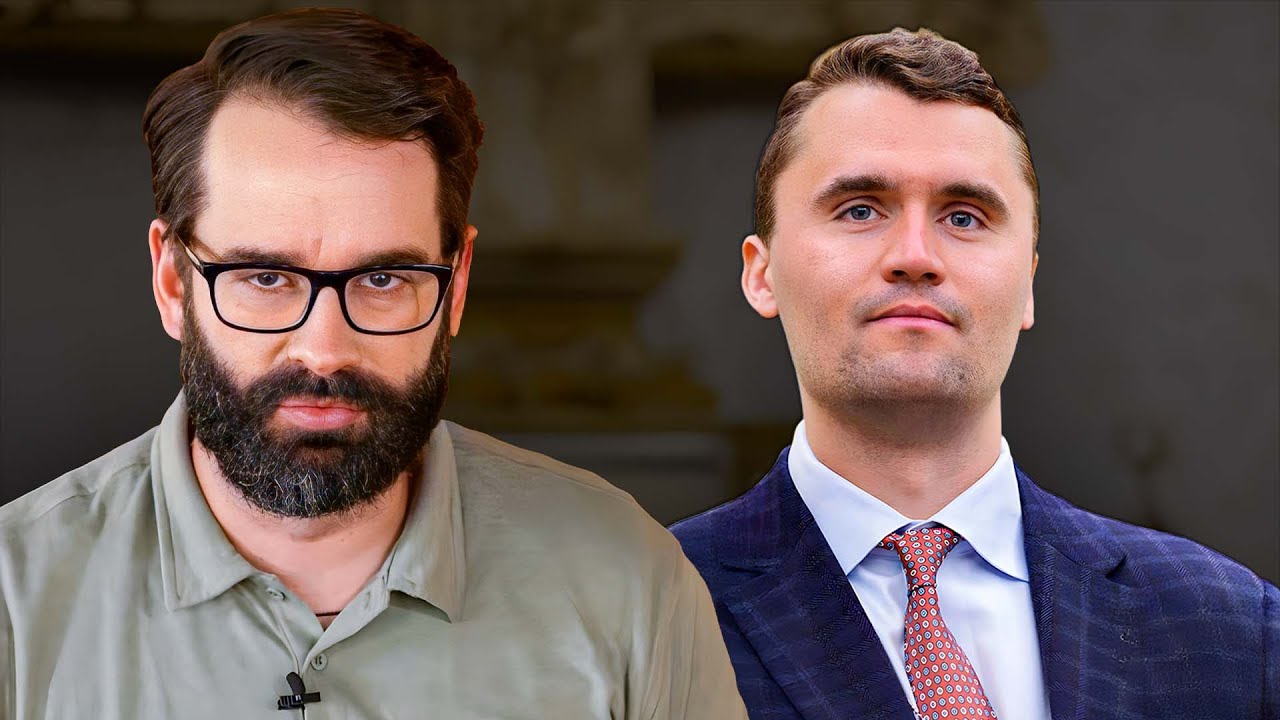
Staxioms aka Hunter Kozak and Kai Schwemmer face off in a debate examining political violence in America, exploring whether the left or right poses a greater threat. The two debaters dissect statistics showing Americans vastly overestimate their opponents' support for violence, analyze rhetoric from political leaders including Donald Trump and Joe Biden, and grapple with controversial questions about punching Nazis, January 6th pardons, and whether conservative values inherently lead to fascism. What starts as a statistical argument quickly becomes a deeper conversation about empathy, condemnation, and how political rhetoric shapes real-world violence.
Setting the Stage for a Debate on Political Violence
The debate begins with introductions as Staxioms (Hunter Kozak) takes the Democrat side and Kai Schwemmer represents the Republican perspective. After some lighthearted banter about positioning on stage and Kai joking about needing a new suit after gaining weight during a mission, the two debaters settle into their positions to discuss left-wing violence versus right-wing violence.
Staxioms opens by referencing a striking statistic: only 4% of Americans actually support political violence, yet Democrats believe 40% of Republicans support it, and Republicans believe 40% of Democrats do. He emphasizes that most people in the audience, regardless of political affiliation, want conversation and debate rather than violence. However, he notes one sour moment when another participant, Soy pill, refused to shake hands with Kai, which both debaters agree does nothing to improve political relations.
The Statistical Battle Over Violence
Staxioms presents what he claims is the consensus of research: that the ratio between left-wing to right-wing violence is approximately 10 to 1 in favor of right-wing violence being more prevalent. He offers to skip detailed discussion of the studies if Kai will concede this point and move on to discussing rhetoric instead.
Kai pushes back, arguing that the methodological flaws in these studies are severe. He contends that many studies include domestic violence committed by people who once had right-wing associations, don't account for property destruction like the burning of Teslas across the country, and often work with sample sizes too small to be statistically significant. He compares it to having ten friends who all agree with you, suggesting the research is inherently biased.
Staxioms clarifies that sample size isn't relevant because the studies aren't polling people but rather examining actual incidents and lethalities. He concedes that the statistics he's using do ignore arson and property damage, acknowledging that left-wing activists may burn more buildings. However, he argues that when it comes to actual murders, which he considers the most important measure of violence, right-wing perpetrators are responsible for more deaths. He states he would rather talk to a left-wing person who burns down a building than a right-wing person who thinks it's acceptable to murder people.
The Problem of Empathy and Condemnation
Kai rejects the framing that property damage doesn't matter and argues that there are indeed left-wing people who are okay with murdering people or at least dismissing and tolerating it. He points to his own experience as a member of The Church of Jesus Christ of Latter-day Saints, noting that he frequently sees leftists respond to violence by saying things like "it was really sad what happened in Grand Rapids, Michigan, but we should remember that Mormons aren't Christians."
He describes this pattern as the left's way of dealing with political violence, particularly around incidents involving figures like Charlie Kirk. According to Kai, leftists acknowledge that violence is bad but then immediately add qualifiers that strip victims of human empathy. He argues that lack of empathy for suffering and loss is a major red flag for future violence, even more so than support for red flag laws themselves.
Kai brings up the punching of Richard Spencer as an example, challenging Staxioms to name how many people he knows who condemned that act of violence. This transitions the debate into a discussion about rhetoric and accountability.
Leadership Rhetoric and Accountability
Staxioms argues that the key difference isn't what random people online say, but what political candidates and leaders do. He distinguishes between "losers online" making violent statements and actual political leaders endorsing or failing to condemn violence.
As an example, Staxioms cites Cesar Sayoc, a Trump supporter who in 2017 mailed 16 pipe bombs to Democratic politicians and journalists. When asked about the incident, Donald Trump said there was no blame and that he didn't blame himself or anyone else. Staxioms finds this response abhorrent and contrasts it with the behavior of Democratic lawmakers, whom he says consistently condemn violence from their side.
Kai responds by pointing to January 6th, which he describes as "the thing that is often referenced by leftists to be the most violent case of right-wing extremism in recent history." He notes that Trump came out about a week after the protests saying the violence was abhorrent, that he condemned it outright, and that violence had no place in public policy. However, he acknowledges that Trump did pardon many January 6th participants, including 600 people convicted of assaulting police officers.
The Pardon Debate
Kai pivots to argue that even with all of Trump's pardons to date, they don't reach half of those issued by President Biden, which number around 4,000. Staxioms counters that the nature of the pardons matters, not just the quantity, and that Biden's pardons were primarily for non-violent offenders.
When Kai asks if Staxioms has looked at every case of the 4,000 Biden pardons, Staxioms responds that the plurality were drug offenders, specifically federal marijuana users or distributors. He argues there's a significant difference between pardoning people for marijuana possession and pardoning someone like Ross Ulbricht, whom Trump pardoned despite Ulbricht being the leader of the largest black market in America and being convicted for smuggling children and distributing serious drugs.
Staxioms defends marijuana pardons as reasonable, suggesting "it's pot, we could chill a little bit." This prompts Kai to joke that marijuana is the number one gateway drug, which clearly doesn't land well with the audience. The two debaters banter about being "soft on crime" before returning to the core issue.
ICE Raids and Due Process
Kai challenges Staxioms on what he believes has led to attacks on ICE and Border Patrol agents. Staxioms, while not condoning the attacks, argues they stem from infringement of due process and the detention of U.S. citizens. He references a New Yorker piece that found 170 U.S. citizens being held in ICE facilities, which he finds completely unacceptable.
The conversation shifts back to rhetoric, with Kai pressing the point that the left never needs to stake a claim in these debates. He argues that leftists can distance themselves from Biden's actions while Trump supporters are expected to defend everything Trump does. He repeatedly brings up the cultural acceptance of "punching Nazis" on the left.
The Nazi Punching Phenomenon
Kai makes an interesting argument about the asymmetry of rhetoric. He notes that while right-wing people do call their political adversaries Nazis or compare them to Hitler, there's never a corresponding influx of violence from the right against supposed Nazis. He argues this reveals something important: when right-wing politicians use extreme language, there isn't a cultural perception that makes their supporters act on it the same way.
In contrast, Kai argues there is a cultural perception of right-wingers as Nazis and fascists that creates an environment where violence becomes more acceptable on the left. He challenges Staxioms to think of anyone who has been punched because Donald Trump called them a fascist.
Staxioms responds by bringing up Cesar Sayoc again, noting that he sent pipe bombs to people at the RNC and DNC. There's some confusion about which incident they're discussing, but Staxioms clarifies he's talking about the 2017 or 2018 case where Sayoc targeted Nancy Pelosi and journalists critical of Trump.
Walking the Line Between Truth and Violence
Staxioms makes a personal statement that captures the core tension of the debate. He says he personally believes Donald Trump is a fascist and that many Trump supporters hold fascist ideologies, but he also believes in debate and conversation rather than violence. He condemns all those who say violence is the answer, arguing it ruins what democracy and America are built on.
Kai seizes on this, pointing out the problem: Staxioms is calling Trump a fascist to an audience where a significant percentage of strong progressives believe it's okay to punch fascists and Nazis. When Staxioms corrects him that it's 4% not 40%, Kai clarifies he's looking at specific studies about support for punching Nazis specifically, not general political violence.
This leads to perhaps the most honest moment of the debate, when Staxioms asks how he's supposed to act when the Trump administration is doing things he considers fascistic. Should he call them fascist but also tell people not to engage in violence? He genuinely asks Kai for a better way to walk that line, promising to condemn anyone who thinks it's okay to punch Nazis while also struggling with how else to characterize actions he sees as authoritarian.
The Historical Roots of Fascism Accusations
Kai responds by arguing that the perception has been built up over decades by media, Hollywood, and politicians, going all the way back to the aftermath of World War II. He references Umberto Eco's tenets of fascism and an article from a secular humanism magazine outlining 14 tenets of fascism, arguing that many of these simply describe things that are right-wing in nature, such as traditional attitudes toward gender roles or the belief that the state doesn't need to be libertarian.
He argues these frameworks have turned normal conservative positions into markers of an "authoritarian personality," which then gets deemed a gateway to violent extremism and Nazism. He sees this as a deliberate way of dismantling right-wing politics.
Staxioms grapples with this difficult point, acknowledging that Umberto Eco's 14 tenets of fascism do outline some conservative values. He then makes a controversial statement: perhaps the conversation needs to acknowledge that some conservatism does lead to fascism, and that these two ideologies are inherently tied to each other. He quickly clarifies he's not saying you have to be conservative to be fascist or vice versa, but the connection exists.
Before he can finish the thought, the time runs out and the debate ends to applause from the audience.








Comments
Be the first to comment on this video.