Up Next

Candace Owens Reveals Shocking Missing Evidence in Charlie Kirk Assassination Investigation and Crime Scene Analysis

Candace Owens Reveals Shocking Missing Evidence in Charlie Kirk Assassination Investigation and Crime Scene Analysis

24:45

Henry Dells Witnessed Charlie Kirk's Final Moments Just 15 Feet Away at Utah Valley University

Henry Dells Witnessed Charlie Kirk's Final Moments Just 15 Feet Away at Utah Valley University

2:07:21

Candace Owens Claims Tyler Robinson Never Confessed to Charlie Kirk's Murder and Parents Know Photos Aren't Him

Candace Owens Claims Tyler Robinson Never Confessed to Charlie Kirk's Murder and Parents Know Photos Aren't Him

9:04

True Crime Analysis: Charlie Kirk Assassination Evidence, Shooter Route, and Eyewitness Testimony Examined

Categories: Analysis
October 2, 2025

True Crime Rocket Science breaks down critical evidence from the Charlie Kirk assassination, including authenticated CCTV footage with timestamps, the shooter's verified route through the UVU campus parking garage, and grainy rooftop footage showing movement toward the sniper's nest. The analysis examines how the shooter concealed a rifle while fleeing the scene, compares the behavior to tactics seen in the movie Heat, and addresses skepticism about camera quality and evidence authenticity. Eyewitness testimony from Deseret News reporter Emma Pitts corroborates the shooting trajectory, while independent journalist Taylor Hansen retraces the shooter's exact path, confirming timestamps and physical details.

CCTV Footage and Timestamp Authentication

The investigation into the Charlie Kirk assassination relies on authenticated video footage marked by precise timestamps. Each video analyzed shows the exact time and date of the shooting, providing a verifiable timeline of events. The timestamp 12:23:30 appears in the top left corner of the original footage, serving as the foundation for authenticating all video evidence connected to the incident.

The Shooter's Route Through UVU Campus

Images of the alleged shooter, dressed in black, were captured at a parking garage near the UVU campus before the shooting. This garage is located at point number four on the New York Times graphic mapping the incident. Independent journalist Taylor Hansen retraced the shooter's movements, recording himself following the exact path, including climbing the stairs to the first floor. His documentation, posted on X, corroborates both the route and the timestamps.

At 2:02 in Hansen's post, the total length of the walk measures 10 minutes and 46 seconds. The timestamps align with security camera footage showing the shooter moving through the parking lot. At 3:09, Hansen demonstrates the specific route where CCTV photos were taken, with recognizable railings and concrete surroundings matching the original footage. The video shows how the shooter kept his head down near the cameras, aware of their presence.

Access to the Sniper's Nest

Point number six on the New York Times graphic identifies the staircase leading to the roof of the AGR building. Many questioned how the shooter accessed the rooftop, but Hansen's video at 7 minutes and 19 seconds demonstrates the straightforward route up this staircase. His footage also reveals important details about the roof surface itself—it's not a continuous flat surface but covered with gravel, a detail that becomes significant when examining evidence left behind.

Rifle Concealment and Escape

Analysis of the footage suggests the alleged shooter had a rifle stuffed down one trouser leg on his way to the scene. When fleeing, however, the rifle is no longer concealed in his clothing. Within 30 seconds, he appears on the grass diagonally opposite the sniper's nest. The timeline makes it impossible for him to have descended with the rifle in his pants, and running with it concealed that way would be physically impractical. Evidence suggests he carried the rifle in his hand while running.

The silhouette of the rifle is barely visible in front-facing images. As he runs across the grass, he holds the rifle in one hand and partially covers it with a towel. By the time he reaches the road, he's walking normally, blending in with his surroundings.

The Heat Movie Comparison

This apparently unusual behavior finds a parallel in the movie Heat. In that bank robbery scene, robbers conceal weapons under simple jackets while carrying just a few pieces of paper over the barrel area. When exiting the bank, the barrel is actually visible, peeking under the jacket bottom. Passersby on the sidewalk notice nothing because they're not paying that sort of attention. The robbery was planned and premeditated, just as this assassination appears to have been. At UVU, no one was paying close enough attention to notice these details, even when reviewing footage later.

The key observation is how the shooter's movements changed from fleeing the scene—sprinting and jumping, which would appear suspicious—to walking nonchalantly and fitting in with those around him once he approached the parking lot and road. If he was innocent, this behavioral shift would make no sense.

Orienting the Sniper Position

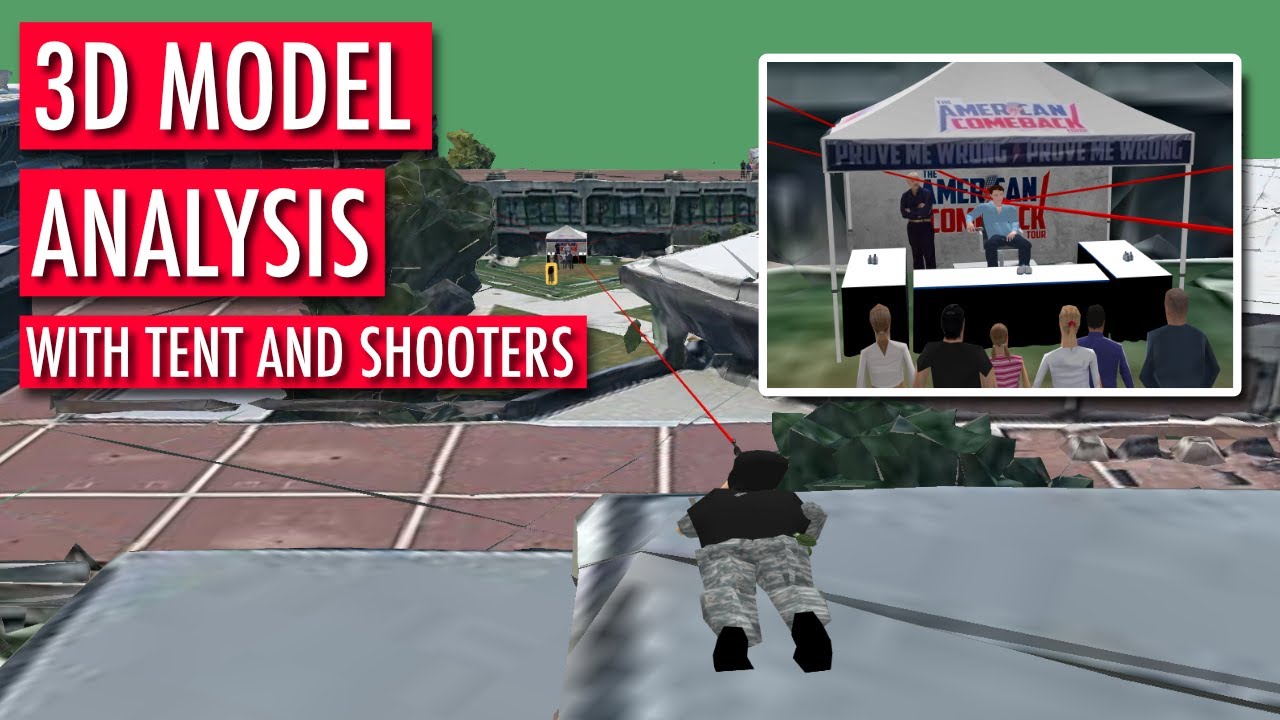
Understanding the video footage requires identifying the location of the silver UFO-shaped air vent. While not visible from the front angle, it's clearly evident from above. This silver beacon helps anchor the sniper's position relative to his target, the CCTV camera, and his escape route, which runs directly past this landmark. The above angle shows that the parapet-style design provided the shooter with excellent concealment from the crowd below.

Gravel Impressions and Trajectory Evidence

For those who believe the grainy footage of a figure running on the roof is fake—arguing the camera should pick up a black shadow moving over a white surface—physical evidence contradicts this skepticism. Impressions made by the sniper in the roof gravel are real and located exactly in line with the trajectory to the tent and the neck wound on Kirk's left side.

The camera quality issue could be tested by recreating the scenario: have someone run across that area at the same time of day and examine whether the recording has difficulty picking up the movement. The hypothesis is that it would likely produce the same grainy, hard-to-distinguish footage.

Kirk's Physical Reaction to Impact

How Kirk reacted when struck makes sense from a bullet hitting him on his left side (our right when viewing front-facing footage). It also makes sense that he would fall backwards if his body absorbed the energy of the round, which appears to be the case. A fall backwards would not make sense if the bullet went through via a side trajectory—that would suggest he'd fall forward, to the side, not at all, or simply slump in his chair from such a wound.

Camera Resolution and Secondary Recording Issues

The question remains: why doesn't the camera pick up a clear black shadow moving quickly over a white surface? The answer may lie in speed, contrast, angle, and camera resolution. Additionally, what we're seeing is often a camera recording a secondhand version of already distorted, pixelated footage. This compounds the degradation. The Security Experts channel demonstrates this phenomenon, showing how zooming in on already compromised footage makes it look progressively worse.

Wikipedia as a Source Verification Tool

For a fairly useful and neutral narrative summary, the Wikipedia page for the assassination of Charlie Kirk provides comprehensive coverage. Before dismissing Wikipedia, consider that it sources credible references, listing them like a peer-reviewed report at the bottom of each page. The article on this incident lists 326 sources, a number that continues to grow as the page is updated.

This approach to verification—checking whether information is valid, genuine, truthful, factual, and accurate—relies on the number of sources that corroborate one another. It's not foolproof, but it generally works. Compare this to conspiracy channels that typically use one or two sources. Three hundred different perspectives provide a much clearer and less biased understanding of the objective consensus.

Eyewitness Testimony

Emma Pitts, a Deseret News reporter who witnessed the event, will likely be called to testify at trial. She told NPR: "I just saw so much blood come out of the left side of Charlie's neck and then he went limp." She's referring to the front side—she wouldn't have had a view of the back. Her testimony corroborates the trajectory analysis and physical evidence from the scene.

Comments

Be the first to comment on this video.

Video Transcript

[00:02] That way I can start to get my mind

[00:03] figure out

[00:05] where they were. Let's go.

[00:08] >> Wow, look at that.

[00:10] >> Beautiful.

[00:13] >> Look at that.

[00:19] >> Moments after the shooting, this

[00:22] happened.

[00:23] This is the original angle.

[00:26] What have we been missing,

[00:28] guys?

[00:30] Look closer. Look at the top left

[00:32] corner. That's the time stamp showing

[00:35] the exact time and date of the shooting.

[00:38] That's really how they are going to

[00:39] verify literally all the footage. Each

[00:42] and every video they analyze. That is

[00:44] what they're going to use to

[00:45] authenticate

[00:47] all the video footage. It'll be around

[00:49] the timestamp of the shooting, which is

[00:51] a matter of fact. And let's put that

[00:54] time stamp on screen. 1 2 2 3 3 0 I got

[01:01] nightmares in my head. I feel

[01:07] my mind feels like a creature.

[01:14] I got nightmares in my head.

[01:20] Hello and welcome to True Crime Rocket

[01:22] Science. Something else I want to clear

[01:23] up. These images of the alleged shooter

[01:26] were taken at a parking garage close to

[01:29] the UVU campus before the shooting. So

[01:32] when he is dressed in black, this is him

[01:35] as he made his way to the sniper's nest.

[01:38] The garage is located at point number

[01:40] four on the New York Times graphic. If

[01:44] you're not sure about that, you can go

[01:45] to Taylor Hansen on X. He's basically

[01:48] retraced the shooters movements and

[01:52] recorded himself doing so, including

[01:54] himself going up the stairs to the first

[01:57] floor. And he not only corroborates the

[02:00] movement, but also the timestamps of the

[02:03] movement. And as he say, it all checks

[02:05] out. Let's go to 202 in Hansen's post on

[02:09] next. The total length of that is 10:46.

[02:13] He's going to walk down and according to

[02:14] the time stamps, this all checks out

[02:16] from the time that he was caught on

[02:18] their both of those security cameras.

[02:21] He's then going to walk, not sure the

[02:23] specific on the left side, the right

[02:25] side here, but he walks through this

[02:26] parking lot. And then this is him

[02:27] corroborating the route through the uh

[02:30] garage. And I'll put a link to that in

[02:32] the description so you can follow the

[02:34] whole route. Now guys, if you look

[02:36] closely at 309,

[02:39] Taylor demonstrates the actual route

[02:43] where these CCTV um photos were taken.

[02:46] You can actually recognize the railings,

[02:48] the whole uh context, the whole uh

[02:51] concrete um surroundings.

[02:54] >> So, he swings her right right here. He's

[02:57] keeping his head down. Obviously, he

[02:58] knows that there's a camera here. And

[03:00] right here

[03:02] is where those additional images were

[03:05] actually released from this security

[03:07] camera. And he's keeping his head down

[03:09] just like this. He walks up. So after

[03:12] the tunnel in the staircase where he was

[03:13] caught on,

[03:14] >> that is exactly how you verify

[03:16] information. You go out there into the

[03:18] real world and check. So kudos to Taylor

[03:22] for doing that. Point number six on the

[03:25] New York Times graphic is this staircase

[03:27] which takes you up to the roof of the

[03:29] lossy building. There were a lot of

[03:31] people who said, "Well, how would he

[03:32] actually get up there?" Well, there's

[03:34] the answer. Simply took this staircase,

[03:37] which Taylor Hansen demonstrates again

[03:39] going up at 7 minutes 19 seconds in his

[03:42] video. Something else that I think is

[03:44] very useful in his video is when he

[03:46] points towards the edge of the roof, you

[03:49] can actually see the surface of the

[03:51] roof. You can see it's not just a roof

[03:53] with a um continuous surface. It is

[03:58] actually got gravel on the top. I'm

[04:00] going to come back to that in a moment.

[04:01] But it does appear that the alleged

[04:03] shooter has a rifle stuffed down one

[04:06] trouser leg on his way to the scene.

[04:09] When he flees the scene, the rifle isn't

[04:11] in his leg because 30 seconds later,

[04:13] he's dropped down to the grass

[04:15] diagonally opposite the sniper's nest.

[04:17] First of all, it wouldn't be possible to

[04:19] do that in that length of time. And

[04:21] secondly, he wouldn't be able to run

[04:23] with the rifle um stuffed down his

[04:26] jeans. So, he's literally running with

[04:28] it in his hand. You can see the just

[04:30] make out the silhouette of this rifle in

[04:33] the front on image. Now, to reiterate

[04:36] what I've said, when he runs across the

[04:38] grass, he has the rifle in one hand and

[04:40] partially covers it with a towel and

[04:42] then you see him walking normally as he

[04:45] reaches the road. I've compared this

[04:47] apparently unusual and hard to believe

[04:49] behavior to a scene in the movie Heat

[04:52] where you could make the same claim. How

[04:54] why did nobody see why can we not see

[04:57] the robbers carrying weapons into or out

[05:00] of the bank? And so in the movie scene,

[05:03] the robbers conceal the weapons under

[05:05] something as simple as a jacket while

[05:07] holding, in the case of one robber, just

[05:09] a few pieces of paper over the side

[05:11] where the barrel is. When they exit the

[05:13] bank, the barrel is actually visible,

[05:15] peeking under the jacket bottom to

[05:17] passes by on the sidewalk, but none are

[05:19] paying that sort of attention. In the

[05:21] spiel of this bank robbery, obviously,

[05:23] it was planned premeditated just as in

[05:26] terms of this assassination. At UVU, I

[05:29] don't think anyone was paying that sort

[05:31] of attention either. And even reviewing

[05:34] the footage, I don't think anyone has

[05:35] really looked at it closely enough to

[05:37] see how his movements changed from

[05:39] fleeing the scene. This is so important.

[05:42] But do you see how his movements change

[05:44] from fleeing the scene, sprinting and

[05:46] jumping, which would be suspicious

[05:48] behavior, to walking nonchulently and

[05:52] fitting in with those around him once he

[05:54] approaches the parking lot and road? If

[05:56] he was innocent, why would he be doing

[05:58] that? Something else I want to orient

[06:00] you on and that requires that you look

[06:02] closely

[06:04] and again pay attention to detail is I

[06:06] want to orient you what you are seeing

[06:09] in this video footage after the incident

[06:11] is the location of that silver UFOshaped

[06:14] air vent. We can't see it from the front

[06:17] angle, but it's clearly evident from

[06:19] above. It's important to use the silver

[06:22] beacon as a way to anchor the sniper's

[06:25] position relative to his target,

[06:28] relative to the CCTV camera, and also

[06:30] his escape route, which which he runs

[06:33] directly past. We can see from the above

[06:36] angle that the terrorist style design

[06:39] provided the shooter with excellent

[06:41] concealment in terms of the crowd below

[06:43] him. Now, for those who believe the

[06:45] footage of the grainy figure running on

[06:46] the roof is fake, arguing, why doesn't

[06:48] the camera pick up a black shadow moving

[06:51] over a white surface, well, these

[06:53] impressions made by the sniper in the

[06:55] gravel on the roof are real, and they're

[06:57] located exactly in line with the

[06:59] trajectory to the tent and the neck

[07:02] wound on Kirk's left side. The other

[07:04] thing I think you could do if you there

[07:06] was any doubt is you could recreate the

[07:09] whole thing. You could have somebody

[07:10] else run across that area, look at the

[07:13] recording, and at the same time of day,

[07:15] and see whether there's a difficulty in

[07:18] the camera picking it up. And I would

[07:20] argue that it probably would do the same

[07:22] thing. Also, how Kirk reacts when struck

[07:26] makes sense from a bullet hitting him on

[07:28] his left, our right side. It also makes

[07:30] sense that he would fall backwards if

[07:32] his body absorbed the energy of the

[07:34] round, which indeed appears to be the

[07:37] case. It doesn't make sense that he

[07:38] would fall backwards if the bullet went

[07:41] through via a side trajectory. That

[07:43] suggests he would fall either forwards

[07:45] to the side or not at all or from a side

[07:48] wound like that, he would just slump in

[07:50] his chair. Now, coming back to the

[07:52] original question, why the camera

[07:54] doesn't pick up a black shadow moving

[07:56] quickly over a white surface? I can't

[07:58] tell you. It may be due to the speed,

[08:00] the contrast, the angle, the resolution

[08:02] of the camera. Not only that, but also

[08:04] the camera that's recording a secondhand

[08:07] version of the already distorted

[08:08] pixelated footage. Look at what happens

[08:10] when you do that.

[08:12] >> Small one is going to zoom in all the

[08:14] way as much as it can. It doesn't look

[08:16] so good if you try to zoom in too far.

[08:18] And that's just a short snippet from a

[08:20] channel called the security experts. All

[08:23] right, I'm not going to take it further

[08:24] than that. If you at the 8 minute mark

[08:26] and still listening, I just want to say

[08:28] if you want a fairly useful and neutral

[08:31] narrative, you know, a summary in

[08:33] writing, head to the Wikipedia page for

[08:36] the assassination of Charlie Kirk, read

[08:38] it first and try to keep an open mind.

[08:40] Now, before you criticize Wikipedia,

[08:43] Wikipedia gets its content by sourcing

[08:45] credible sources, which they list like a

[08:48] peer-reviewed report at the bottom of

[08:50] the page. Just for this one article,

[08:52] Wikipedia lists 326 sources. And since

[08:56] that page is updated, that number is

[08:59] only likely to go up. And this is the

[09:01] one way of checking, verifying whether

[09:03] your information is valid, genuine, the

[09:07] truth, factual, accurate is the number

[09:09] of sources that are used that basically

[09:12] corroborate one another. It's not a

[09:14] foolproof system, but it is one that

[09:16] generally works. Now compare that to

[09:20] your favorite conspiracy channel. How

[09:22] many sources are they using? One or two.

[09:25] 300 different perspectives are going to

[09:27] give you a much clearer and less biased

[09:29] idea of the objective consensus. I just

[09:33] want to leave you with an eyewitness who

[09:35] will likely be called to the trial. Emma

[09:38] Pittz, a Desireette news reporter. She

[09:40] witnessed the event. She told NPR, "I

[09:43] just saw so much blood come out of the

[09:45] left side of Charlie's neck and then he

[09:47] went limp." She's talking about the

[09:49] front side. She wouldn't have couldn't

[09:51] have had a view of the back. Does that

[09:54] make sense? Thank you for listening and

[09:56] I'll see you guys next time.

[10:01] [Music]

[10:10] Heat. Heat.

[10:12] [Music]

[10:36] Heat. Heat.

[10:39] [Music]

[10:45] [Music]

[10:58] Heat. Heat.

[11:01] [Music]

Link copied to clipboard!