Challenging White Privilege: An Exchange on Race and Opportunity in America
Enjoying this? Share it with someone who needs to see it.
Up Next
Charlie Kirk Debates White Privilege and Immigration Enforcement With Student Over SB 1070
1:00
Charlie Kirk on White Privilege Walks and How They Backfire in High Schools
1:26
Charlie Kirk Challenges College Student on White Supremacy and Racism Claims at Campus Event
2:17
Challenging White Privilege: An Exchange on Race and Opportunity in America
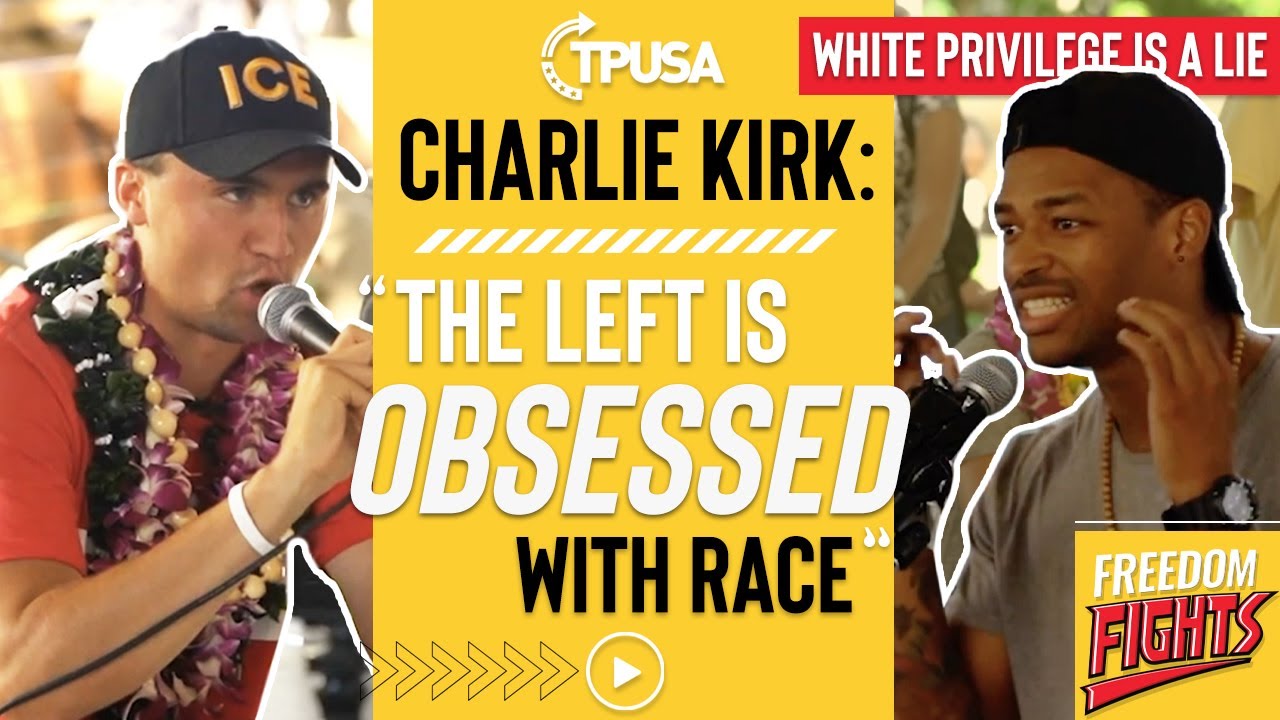
A street conversation unfolds as two individuals with different perspectives tackle the concept of white privilege. When asked if he believes in white privilege as a person of color, one speaker reframes the conversation around all forms of privilege rather than race-specific advantages. The exchange centers on a simple but pointed question: can you name something a white person can do that a person of color cannot? What starts as a straightforward inquiry quickly reveals the complexity of discussing race, privilege, and opportunity in modern America, as well as the challenges of having these conversations across ideological divides.
The conversation begins with a direct question posed to a person of color: "Do you believe in white privilege?" Rather than giving a simple yes or no answer, the respondent offers a more nuanced perspective: "I believe in all privilege." This reframing immediately shifts the conversation from a race-specific discussion to a broader examination of advantages that exist across various dimensions of society.
The questioner pushes further, asking specifically whether the respondent believes that people of Caucasian race have certain privileges over minorities. The answer is unequivocal: "No, there's nothing a white person can do that I can't do." This statement serves as the foundation for the speaker's position, challenging the conventional framing of privilege along racial lines.
The Challenge: Name One Thing
The conversation reaches its critical moment when the speaker issues a direct challenge: "Can you name something a white person can do that I can't do?" This question cuts to the heart of the debate about white privilege, demanding concrete examples rather than abstract theories. The person being questioned admits they cannot immediately provide an example, responding simply with "No."
The speaker emphasizes the significance of this admission: "That's all I want to know." For him, the inability to name a specific, legally-sanctioned difference in what white people versus people of color can do in America undermines the concept of white privilege as commonly articulated. He presses the point again: "I'm serious... right now you can't even name one thing a white person can do that I can't do as a black man."
Acknowledging Racism While Questioning Privilege
The other participant in the conversation acknowledges a broader truth: "In an ideal society there would be no racism." However, they express skepticism about America's current capacity to eliminate racism, stating, "I don't think at least like America is a country I don't think we have the capability of doing that right now." This sentiment reflects a pessimistic view of America's ability to overcome racial divisions.
The speaker extends this observation beyond American borders, suggesting that "no country has the capability of getting rid of racism." This global perspective frames racism as a universal human challenge rather than a specifically American failing.
The Limits of Conversation
As the exchange continues, the person being questioned begins to disengage, stating, "I can name them I just I I didn't show up here to have a debate." This response suggests they feel unprepared or unwilling to engage in a detailed discussion about specific examples of racial privilege. They clarify they are "not in the mood for a political debate."
The speaker pushes back on the characterization of their conversation as a debate, insisting, "It's not a debate I'm just curious." He frames the exchange as curiosity rather than confrontation, describing it as "a back and forth conversation" rather than a political debate. This distinction highlights the different ways people approach discussions about race—some viewing them as intellectual inquiries, others experiencing them as emotionally charged debates that require mental and emotional preparation.
Different Frameworks for Understanding Privilege
The conversation reveals two fundamentally different frameworks for understanding privilege and opportunity. One perspective focuses on legal rights and formal barriers—the tangible things people can or cannot do based on their race. From this viewpoint, since the Civil Rights era eliminated legal segregation and discriminatory laws, there are no longer race-based restrictions on what people can do in America.
The other perspective, implied but not fully articulated in this exchange, would likely focus on systemic advantages, implicit biases, statistical disparities, and the accumulated effects of historical discrimination. This framework sees privilege not in what is legally permitted but in subtle advantages, opportunities, and the absence of certain obstacles that some groups face.
The gap between these two frameworks explains why the conversation reaches an impasse. When asked to name something a white person can "do" that a person of color cannot, the question itself presupposes a specific definition of privilege that may not capture what proponents of the white privilege concept typically mean.