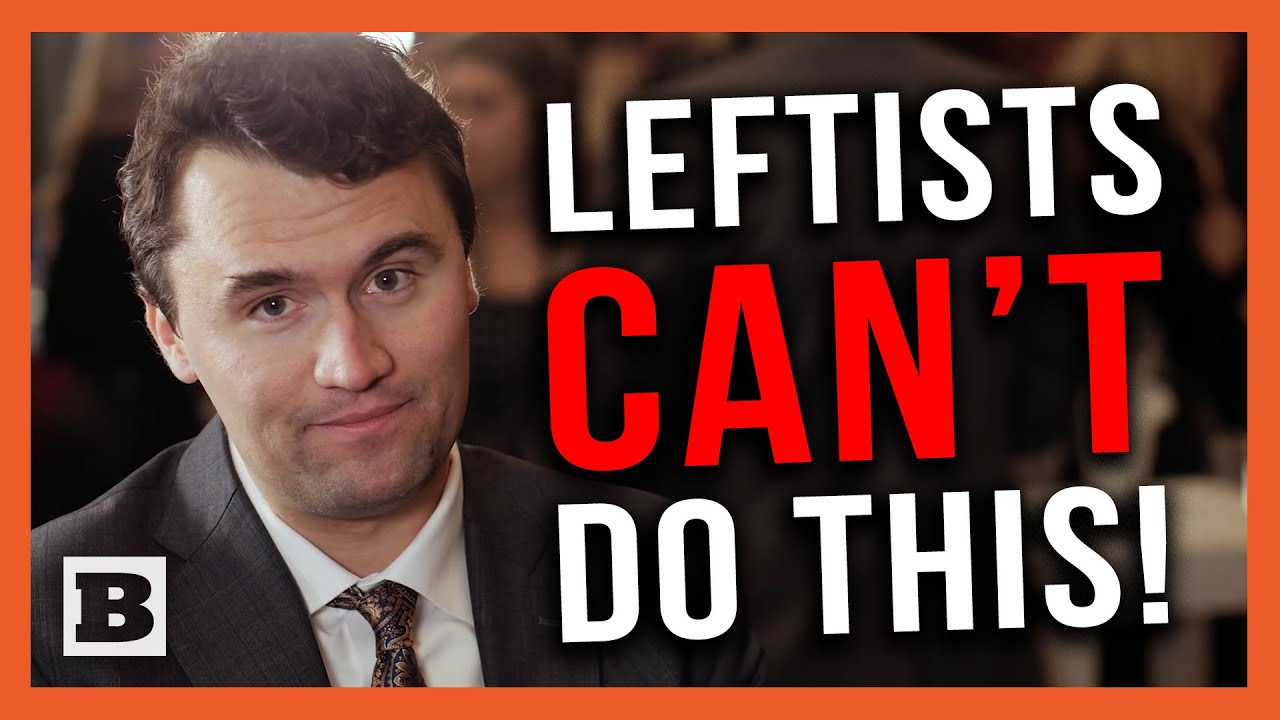
Charlie Kirk and Alex Marlow Expose Big Tech Oligarchy and the Left's Smear Mentality at CPAC
Enjoying this? Share it with someone who needs to see it.
Up Next
Charlie Kirk Explains Why the American Church Must Rise Up Against Tyranny and Technocracy Before It's Too Late
2:09:55
Charlie Kirk and Will Chamberlain Debate Big Tech Monopolies and Free Speech Regulation Solutions
15:42
Charlie Kirk and Glenn Beck on Trump's Victory, Rush Limbaugh's Legacy, and Bold Personnel Picks for the Second Term
16:04
Charlie Kirk and Alex Marlow Expose Big Tech Oligarchy and the Left's Smear Mentality at CPAC
Charlie Kirk sits down with Breitbart's Alex Marlow at CPAC to dissect the left's reliance on smears over arguments, the emerging threat of Big Tech oligarchy, and why Donald Trump connects with young conservatives unlike any politician since Reagan. From the UC Berkeley assault on a conservative student to Google's unprecedented control over information, Kirk explains why the alliance between big business and big government poses an existential threat to free speech and fair competition. The conversation reveals how conservative populism is forcing the Republican Party to confront crony capitalism and fight back against institutions that have abandoned impartiality.
The Left's Smear Tactics Replace Substantive Arguments
Charlie Kirk joined Alex Marlow at CPAC to discuss the state of conservative activism and the challenges facing the movement. Marlow opened by acknowledging Kirk as "the most influential conservative on Twitter," attributing his success to his focus on making substantive arguments rather than relying on smears.
Kirk pointed to the Michael Cohen testimony as a prime example of the left's smear mentality. When Mark Meadows brought a black Trump administration official to testify that the president is not racist, the left immediately attacked Meadows himself as racist for doing so. Kirk explained that this tactic is nothing new, crediting Andrew Breitbart with exposing how the left brought their mob mentality from the 1960s and 1970s into the digital era around 2008-2009.
"What we've tried to do and the lesson I learned from Andrew is these public forums, allegedly public forums - I have to qualify that - like Google or Twitter or Facebook, if used properly you can put forth arguments, put them on defense," Kirk said. "And we have incredible intellectual ammunition on our side. Breitbart is providing it every single day that makes compelling arguments, and the American people are looking for that sort of content."
Why Trump Resonates With Young Conservatives
Kirk highlighted President Trump's disciplined focus on immigration as an example of effective messaging. "The biggest issue in America's immigration and without this president we would not even be talking about it," Kirk noted. "He stayed so disciplined on it. He did not waver and he really stayed in a way that said here's the issue and here's a solution to it."
When asked why Trump connects with young people, Kirk pointed to authenticity and his inability to be bought by special interests. "Our generation is rightfully so just disgusted with the amount of pandering the ruling class does to the elite," Kirk explained. "And there seems to be this inside-out relationship between big business and big government."
Kirk identified Trump as one of only three politicians in recent decades who have truly resonated with young conservatives - the others being Ronald Reagan and Ron Paul. The key, according to Kirk, is saying what you believe without compromising.
The Philosophical Divide: Collectivism Versus Individualism
Kirk and Marlow explored the deeper philosophical roots of why the left operates as a mob. Kirk referenced Ann Coulter's book "Demonic," explaining that the left inherently thinks as a collective rather than as individuals. "They will sacrifice their individuality on behalf of what's good for the collective," Kirk said. "And that's how they can mobilize behind such horrible ideas because as the collective moves they move as a blob and we move as rugged individualists."
While acknowledging that conservatives' individualism creates more integrity, Kirk noted it can make cohesion difficult. This is where he sees the value of Donald Trump's conservative populism - it provides just enough cohesion to get things done while maintaining accountability to the grassroots.
Kirk observed a major shift in the Republican Party: "The Republican Party the last 30 years minus Reagan really was a party that catered to a cluster of a couple thousand elites centralized in the West Coast and the East Coast. And now the Republican Party owns the American middle class and the working class. The Democrats are the party of the super elite and the permanently poor."
The Big Tech Oligarchy Threat
The conversation shifted to what both Kirk and Marlow identified as one of the most pressing threats facing conservatives: Big Tech censorship and manipulation. Marlow noted that the issue of Big Tech cronyism has finally gone mainstream at CPAC, crediting Breitbart's coverage for bringing it into the conservative ether.
Kirk explained his evolution on the issue: "I believe markets improve people's lives. I've remained consistent in that, in the premise of trade and so on and so forth. But with that being said, I look at Big Tech - they benefit a lot from government deals, many of them including Google and Amazon, whether it be cloud server deals or government contracts."
He raised alarming questions about Google's power: "What's going to prevent Google from completely altering our society if they want to, whether through behavioral technologies, search engine manipulation, data mining? It's rather horrifying stuff."
Kirk revealed that Tucker Carlson convinced him Google might be an even bigger threat than government itself. "That's something to be said that there's a non-government entity that might have more power than the IRS," Kirk noted.
The Vicious Circle of Big Business and Big Government
Kirk challenged both the left and establishment Republicans on their incomplete understanding of the Big Business-Big Government alliance. The left correctly critiques how big business benefits from government connections but wants to solve it by growing government bigger. Meanwhile, some Republicans critique big government bureaucracies but refuse to challenge Big Tech.
"Trump is starting to say both are benefiting from this deal," Kirk explained. "Big government is funded by big business. The bureaucrats are protected by the media industry. The politicians are funded by Google, Amazon, so on and so forth. And then big business gets the protection of the bureaucracies, they get the sweetheart government contracts, and they benefit from their own size and their ability to use regulation as a deterrent against any sort of competition."
Kirk posed a thought experiment to illustrate the double standard: "If Google was owned by an outward Republican conservative and mostly conservative engineers and then they comprise 88 percent of search results, do you think the Democrats would not be calling for an antitrust violation? Of course they would be."
He argued that if any other industry had 88 percent market dominance, they would be shut down by federal regulators. But with Google controlling the consumption of information - "how people find identity and consciousness and how they speak" - the stakes are even higher.
Violence at UC Berkeley and Institutional Failure
Kirk discussed his visit to UC Berkeley, Marlow's alma mater, where a Turning Point USA activist working with the Leadership Institute was punched in the face by a leftist while tabling and recruiting. The incident went viral, but Kirk was alarmed by the lack of initial police response.
"The left will not move an inch unless we make them," Kirk said. "Our institutions are failing. Rush Limbaugh talks about this beautifully right now - we used to be able to count on these impartial institutions. The Justice Department failing, the FBI failing. These referees of our culture, they're no longer doing that."
After sustained pressure from Kirk, Turning Point USA, and Breitbart's coverage, police finally completed their report and went to a judge asking for a warrant for the attacker's arrest. Kirk called this a "massive accomplishment" given Berkeley's track record.
"It's just so sad that it's necessary," Marlow added. "It shouldn't take Charlie Kirk stepping in for this."
Kirk noted that a UC Berkeley employee publicly expressed gladness about the assault. He pointed out the obvious double standard: "If the attacker were a Make America Great Again hat and punched a liberal, it would have been the number one news story. It would have been round the clock SWAT teams everywhere looking for the guy."
Breaking Free from Old Talking Points
In closing, Kirk previewed his CPAC speech, saying he would address what he sees coming forward in the conservative movement. His main message: conservatives cannot be so bound to past talking points that they refuse to confront Big Tech.
"We cannot draw too much to our past talking points to say that we can't somehow go after Big Tech," Kirk emphasized, signaling a new direction for conservative policy that challenges the cozy relationship between corporate monopolies and government power.