2,422 videos 1,389,747,653 views US Joined Aug 30, 2018
Charlie Kirk is the Founder and President of Turning Point USA, the largest and fastest growing conservative youth activist organization in the country with over 250,000 student members, over 150 full-time staff, and a presence on over 2,000 high school and college campuses nationwide. Charlie is also the Chairman of Students for Trump, which aims to activate one million new college voters on campuses in battleground states in the lead up to the 2020 presidential election. His social media reaches over 100 million people per month and according to Axios, he is one of the "top 10 most engaged" Twitter handles in the world. He is also the host of “The Charlie Kirk Show,” which regularly ranks among the top news shows on Apple podcast charts.
Charlie Kirk and Student Debate AIPAC Influence, Israel Policy, and America First Foreign Relations
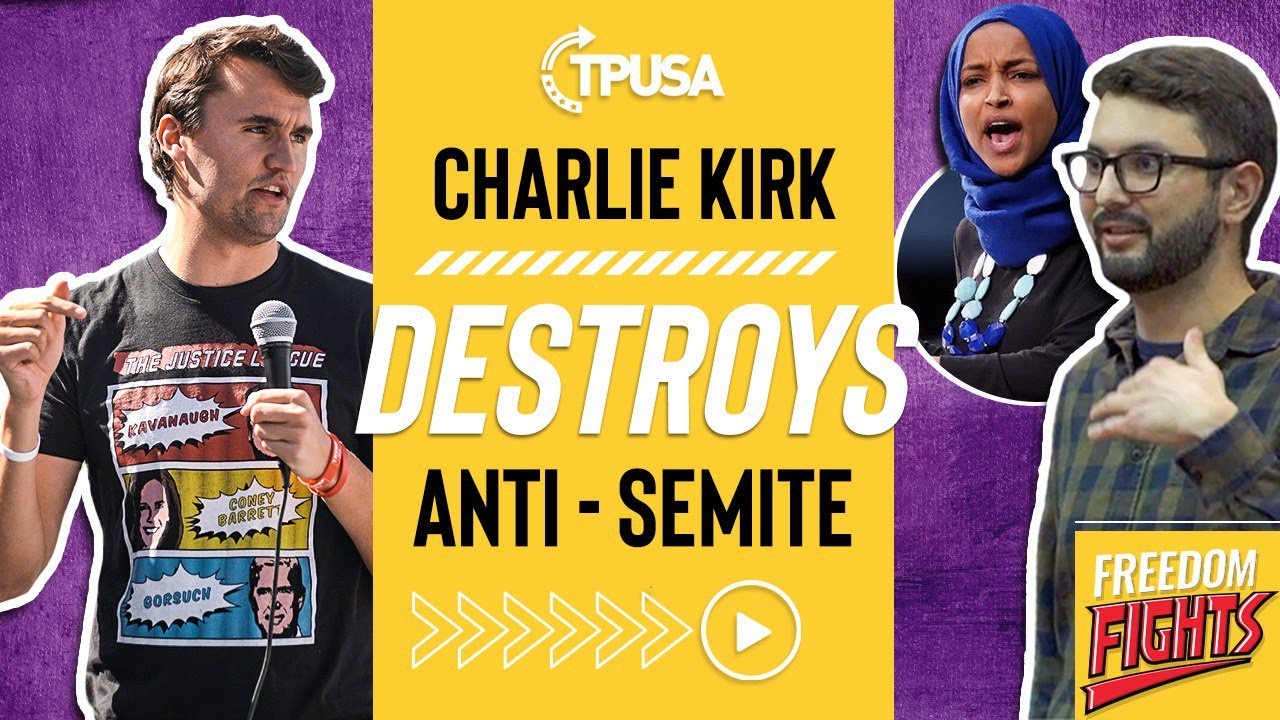
Charlie Kirk engages in a thoughtful exchange with a student questioning the influence of AIPAC on American foreign policy and whether U.S. and Israeli national interests truly align. The student challenges Kirk on issues ranging from the 2006 Lebanon War to the prolonged Palestinian conflict, arguing that Benjamin Netanyahu has America on a leash through AIPAC pressure. Kirk pushes back, suggesting AIPAC's power is overestimated and that millions of evangelical Christians genuinely support Israel independent of lobbying efforts. The conversation highlights the tension between America First principles and foreign alliances, with Kirk drawing a crucial distinction between America First and America Only while acknowledging he doesn't defend everything Israel does.
A Candid Debate on AIPAC and American Foreign Policy
Charlie Kirk found himself in a substantive debate with a student who questioned the extent of AIPAC's influence on American foreign policy and whether Israeli and American national interests genuinely align. The student opened by acknowledging he hadn't watched much of Kirk's content but believed they disagreed on the question of AIPAC, the American Israeli Political Action Committee that has operated for 60 years.
When asked if America's national interest and Israel's national interest align, Kirk offered a nuanced response that it depends on the circumstances. He noted that sometimes it's in America's best interest to push back against Iran, and sometimes beneficial to engage in technology transfers and weapons testing with Israel. However, Kirk acknowledged that Israel tends to be more aggressive in the Middle East than he believes America should be, making it a complicated question without a simple answer.
The Power and Reach of AIPAC
The conversation shifted to whether AIPAC holds significant influence in Congress and the executive branch. Kirk admitted that AIPAC does have influence but argued the organization is not nearly as powerful as people think. He challenged the student with a counter-question: are most lawmakers influenced by AIPAC, or are many of them actually Christians who genuinely care about Israel independent of lobbying pressure?
The student responded that he believes lawmakers are influenced by AIPAC donors and that too many politicians are spineless to stick to any Christian values. Kirk conceded this was a fair point but emphasized that tens of millions of people in the Republican Party are evangelical Christians who care deeply about Israel. As an evangelical himself, Kirk said he knows that world very well and insisted that while AIPAC has influence, there must be nuance in understanding that a large portion of the Republican base has a genuine soft spot for Israel.
Netanyahu's Influence and the Lebanon War
The student then made a striking claim: rather than Israel being a client state of the United States, he argued that Benjamin Netanyahu has the U.S. on a leash, and that leash is AIPAC. He contended that Israel has dragged America into many situations that have gone against national interests in the Middle East and hurt U.S. relations with Arab states.
As an example, the student cited the Second Lebanon War in 2006. He explained that the U.S. had spent years building up a friendly regime in Lebanon, but when Hezbollah killed some Israelis on the border and kidnapped one or two others, Israel's prime minister went to the United States to ask for the green light to go to war with Lebanon. Despite knowing there was a friendly regime that they had cultivated, President George Bush green-lit the operation, and all the good relations with Lebanon went out the window. The student attributed this decision to AIPAC pressure on the Bush administration.
Kirk admitted he didn't know much about that particular conflict, allowing the student's historical account to stand without immediate rebuttal.
America First, Not America Only
Kirk acknowledged that many people share the student's perspective but offered his own framework for thinking about foreign policy. He stated clearly that he's not going to defend everything Israel does and that America should always be resolutely America First, not prioritizing a foreign country. However, he drew a crucial distinction: he doesn't believe in America Only, and that difference matters significantly.
The student agreed with this distinction in principle but pressed Kirk on whether he had addressed what the student saw as a major problem prolonging the Palestinian conflict. Kirk pushed back, arguing that the issue isn't as significant as the student believes because voters themselves, especially in many congressional districts, are far more pro-Israel than just a specific AIPAC lobby. He reiterated his belief that there's an overestimation of how powerful AIPAC actually is.
Finding Common Ground on Complexity
Kirk made clear he doesn't agree with everything AIPAC does, specifically mentioning that the organization went after Congressman Thomas Massie, whom Kirk loves and supports. He acknowledged being in a unique position: first and foremost pro-American, but also very pro-Israel as an evangelical. He said he tries to weigh both of those commitments while understanding the objections raised by people like the student who ask the understandable question of what is in America's national interest.
The student pointed out that there's a direct conflict between these positions. Kirk responded that it's not always a conflict and depends on what decisions are being made and under what circumstances. The student maintained that AIPAC influence has prolonged the Palestinian conflict, though he acknowledged it wouldn't necessarily solve the problem as it's very complex.
He referenced the Camp David Summit as an example, calling it a sham where no one thought anything would get done. The student believed President Clinton was just trying to win a Nobel Peace Prize. Kirk agreed with a simple "exactly," finding common ground on at least that historical assessment.
The exchange ended cordially, with Kirk thanking the student for his time and moving on to the next question. The conversation demonstrated how complex foreign policy debates can be conducted respectfully even when fundamental disagreements exist about lobbying influence, national interests, and the proper scope of American engagement abroad.