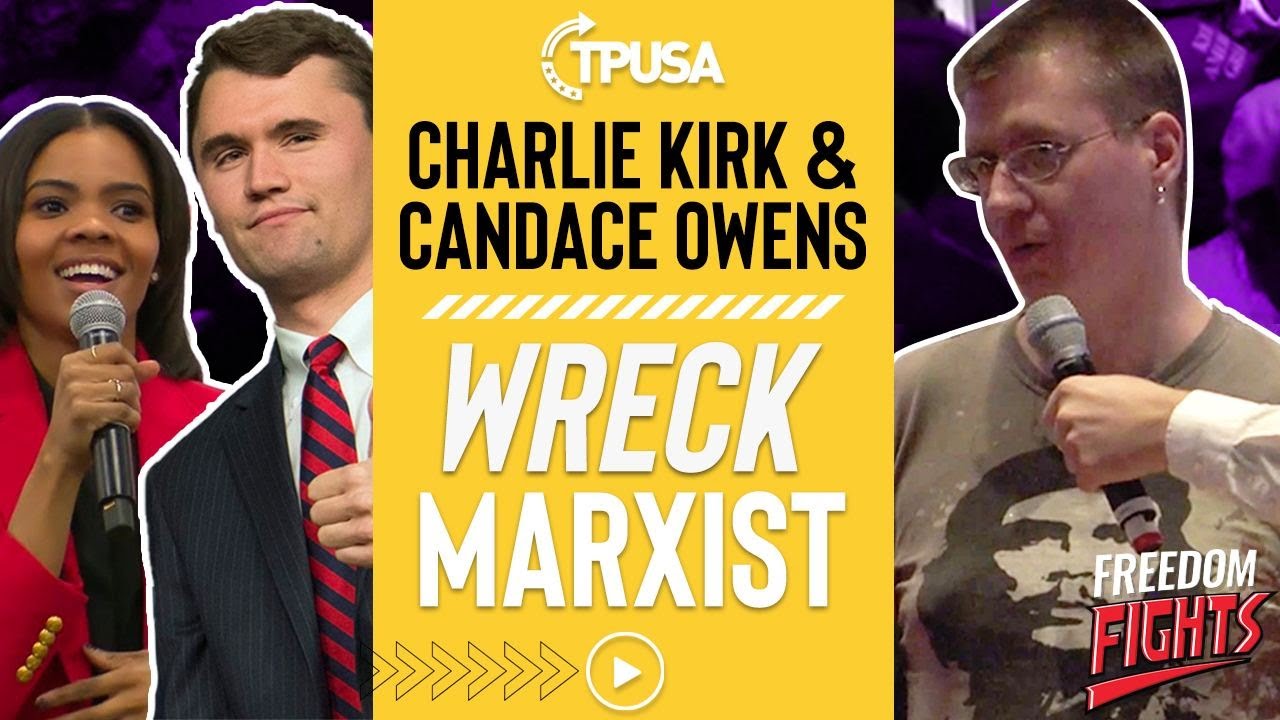
Charlie Kirk Challenges Socialist Student on Capitalism, Billionaires, and Free Market Economics
Enjoying this? Share it with someone who needs to see it.
Up Next
Charlie Kirk Debates UVM Socialist Student on Native American Policy and Failed Economic Systems
5:40
Charlie Kirk Debates Socialist Student on Billionaires, Workers, and Free Market Realities
2:26
Charlie Kirk Defends Capitalism and Western Civilization in Heated UK Street Debates with Socialist Students
28:47
Charlie Kirk Challenges Socialist Student on Capitalism, Billionaires, and Free Market Economics
A college student claims to want free diabetes cures and criticizes billionaires like Jeff Bezos for exploiting workers. Charlie Kirk dismantles these arguments by pointing out the contradictions in criticizing capitalism while participating in it, questioning why workers stay at Amazon if they're exploited, and revealing the student's support of billionaire Howard Schultz by purchasing Starbucks coffee. The exchange highlights the tension between socialist ideals and the realities of consumer behavior, entrepreneurial risk, and how the free market actually creates opportunity rather than exploitation.
The conversation begins with a seemingly simple premise: if you had a cure for diabetes, wouldn't you want to distribute it for free to everyone who needs it? The student enthusiastically agrees, stating they would want to give it away at no cost. But Charlie Kirk immediately challenges this utopian vision with a fundamental economic principle: nothing is truly free. Everything is paid for by someone, at some point, in some level of distribution.
When pressed to name even one example of something the government has ever given out for free, the student pivots to a different argument—suggesting that billionaires like Jeff Bezos, with his fifty billion dollars, could afford to pay for such things. This shift reveals a common pattern in these discussions: when the economics don't work, blame the wealthy.
The Exploitation Narrative Crumbles
The student claims Jeff Bezos obtained his wealth by exploiting laborers and not paying them fairly. Kirk counters with a straightforward question: if Bezos is exploiting them, why do they work for him? The answer given is predictable—because they don't have another opportunity. But this claim collapses under the weight of basic labor market facts.
There are more job openings available in America than there are people to fill them. Seven million job openings exist across the country, creating a competitive labor market where employers must attract and retain workers. People working at Amazon report loving their jobs. Their wages are increasing. They receive healthcare and health insurance. They get promoted. The narrative of exploitation doesn't match the reality on the ground.
The student struggles to reconcile their ideology with these facts, asking incredulously whether anyone could honestly believe in good faith that Amazon provides good jobs. Kirk responds by pointing out that he doesn't even use Amazon, preferring to avoid supporting their business model.
The Starbucks Double Standard
This is where the conversation takes a fascinating turn. The student reveals they use Starbucks instead, apparently unaware of the trap they've just walked into. Howard Schultz, the founder of Starbucks, is worth five billion dollars. If the student's problem is with billionaires exploiting workers, why are they actively participating in making another billionaire wealthier?
The student attempts to draw a distinction, claiming Starbucks has better working conditions for their employees, including a fifteen dollar minimum wage. But this only reveals the inconsistency in their position: Starbucks billionaire good, Amazon billionaire bad. When confronted with this contradiction, the student backtracks, saying they wouldn't like either of them to be billionaires.
Kirk presses the obvious follow-up question: then why are you buying Starbucks? You're actively participating in the market economy that creates these billionaires you claim to oppose. The student's defense is revealing: it's impossible to buy things without participating in the market. But this admission undermines their entire critique. If you can't escape the market, and the market produces billionaires, then the problem isn't with individual billionaires but with your understanding of how wealth creation works.
Alternative Choices and Personal Responsibility
Kirk doesn't let the argument rest there. He points out that there are alternatives to Starbucks. The student could have gone to a farmers market. They could have sought out local coffee in Columbus. When the student claims there's no farmers market and no local coffee in Columbus—an assertion that strains credibility—Kirk's point has already been made. The student chooses Starbucks not because they have no other option, but because they prefer Starbucks coffee.
It's remarkably easy to critique billionaires while swishing your Starbucks latte back and forth, made possible by a guy who wanted to become a billionaire motivated by profit. The student attempts one more deflection, claiming the latte was made possible by the workers who made it, not by the billionaire founder. But this misses the entire point of how businesses are created and sustained.
Understanding How Markets Actually Work
The latte was actually made possible by the consumer—the student holding the cup. The workers wouldn't have a job at all if customers didn't buy their product. And none of it would exist without Howard Schultz, who risked everything, took out two mortgages on his house, and started Starbucks in Seattle based on an idea that people thought was nuts and crazy at the time.
This is how capitalism works: entrepreneurs take enormous personal risks, often failing multiple times before succeeding. When they do succeed, they create jobs, provide products people want, and yes, sometimes become billionaires in the process. The workers benefit. The consumers benefit. The entrepreneur benefits. This isn't exploitation—it's mutual exchange that creates value for everyone involved.
The Semantic Retreat
As the conversation reaches its conclusion, the student attempts to distance themselves from their own positions. When Kirk summarizes their argument—that workers should own the means of production and government should run healthcare—the student claims they never said that, although they do believe it. This semantic retreat is telling. They hold these positions but don't want to defend them when confronted with the contradictions and consequences.
The exchange perfectly encapsulates a common phenomenon on college campuses: students absorb socialist critiques of capitalism without fully thinking through the implications or examining their own role in the system they claim to oppose. They want the benefits of the free market—the convenient coffee, the Amazon deliveries, the healthcare innovations—while simultaneously advocating for the destruction of the very system that makes those things possible.