2,422 videos 1,389,747,653 views US Joined Aug 30, 2018
Charlie Kirk is the Founder and President of Turning Point USA, the largest and fastest growing conservative youth activist organization in the country with over 250,000 student members, over 150 full-time staff, and a presence on over 2,000 high school and college campuses nationwide. Charlie is also the Chairman of Students for Trump, which aims to activate one million new college voters on campuses in battleground states in the lead up to the 2020 presidential election. His social media reaches over 100 million people per month and according to Axios, he is one of the "top 10 most engaged" Twitter handles in the world. He is also the host of “The Charlie Kirk Show,” which regularly ranks among the top news shows on Apple podcast charts.
Charlie Kirk Confronts Catholic Student Who Supports Bernie Sanders on Healthcare and Working Class Economics
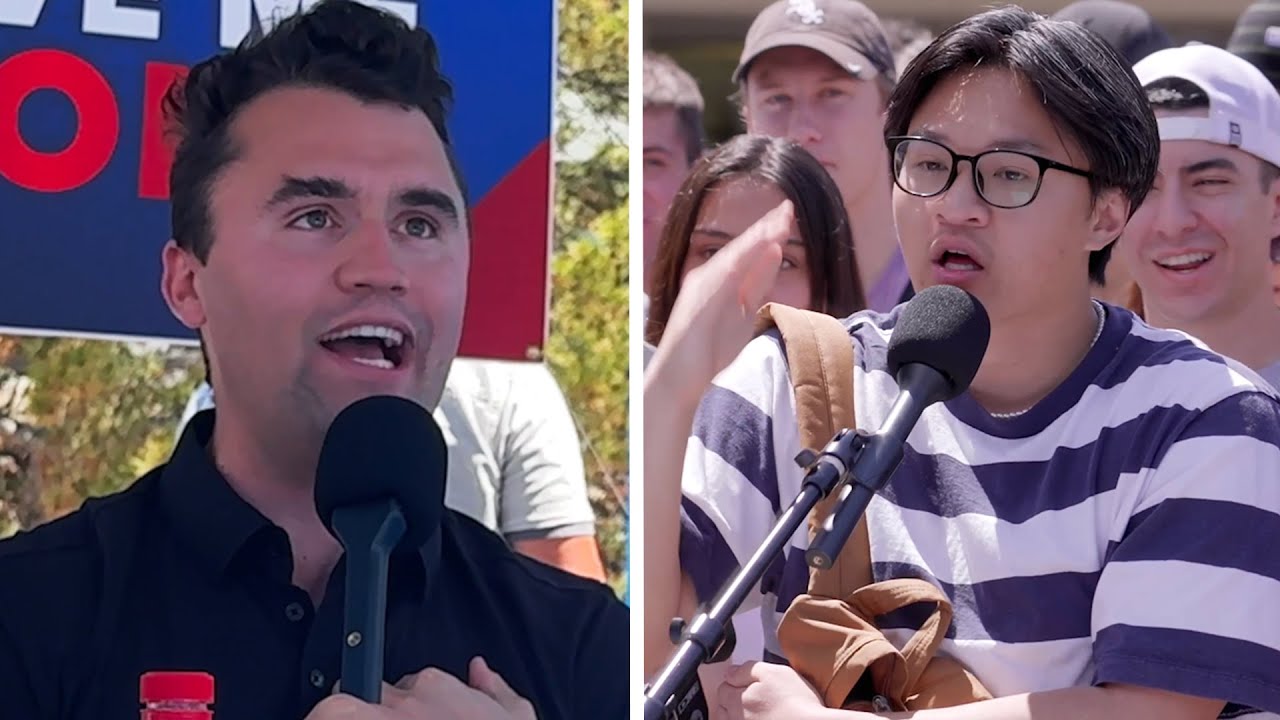
Charlie Kirk engages with Dylan, a Catholic former Turning Point USA member from Utah Tech, who attended a Bernie Sanders rally and believes in universal healthcare for America's struggling working class. Dylan questions how the American economic system serves conservative working people drowning in medical debt while billionaires thrive. Kirk challenges him to defend the VA healthcare system and Native American reservation healthcare as models, arguing that Bernie Sanders' vision would replicate these failing government-run programs. The exchange explores whether socialism or free market capitalism better serves rural America, examining everything from tax policy to the fundamental principles of wealth creation.
Dylan, a proud Catholic Hispanic American and former Turning Point USA member at Utah Tech, approached Charlie Kirk with a pointed challenge about economics. While agreeing on issues like the Second Amendment, traditional values, and opposing liberal ideology, Dylan had attended a Bernie Sanders rally and found himself resonating with the senator's message about the rural working class.
Dylan described the reality he's witnessed in rural Idaho and other parts of America: people drowning in medical debt, working two jobs, falling behind while billionaires continue to win. He pointed to socially conservative countries like Poland, Hungary, and Croatia that maintain pro-family, pro-border policies while supporting their people with healthcare and better wages. His question cut to the core: how does Kirk defend an American economic system that leaves behind the working-class conservative people the movement claims to fight for?
The VA Healthcare Challenge
Kirk immediately reframed the discussion around real American examples of universal healthcare. He asked Dylan about Native American reservations in Idaho, which have universal healthcare paid for by taxpayers. Dylan acknowledged the healthcare there isn't great. Kirk then pivoted to the VA system—government doctors paid for by taxpayers, available to any veteran—which he identified as the least favorable healthcare in the entire country despite being universal healthcare.
"You need to tell me why you think we should have more of Native American reservation healthcare and more VA healthcare because that's what Bernie Sanders wants," Kirk challenged. When Dylan tried to distinguish his position, Kirk pressed harder: "The VA has hundreds of billions of dollars of funding. It's taxpayer funded. The veteran pays nothing. They go there and it's all paid for. That's what Bernie Sanders wants and it's largely a catastrophe."
Dylan acknowledged he didn't want the long lines seen in UK and Canadian systems, and when pressed, admitted he thought the VA should be reformed. Kirk rejected this as inadequate—the VA already has massive funding, and if it's failing with that level of resources, why would expanding the model to everyone work better?
What Conservatives Want for Healthcare
Kirk outlined the conservative vision: more competition, price transparency, hospitals put on the defensive by market forces, and most importantly, the ability for people to choose their own doctors. He emphasized medical freedom—the right to refuse vaccines if you choose, something he argued wouldn't exist in VA-style or government-run hospitals where vaccines would be mandatory with no exceptions.
When Dylan suggested he believed in privatized healthcare supported by the government to make it more affordable, Kirk challenged the language: "By the government, you mean the taxpayer. So therefore, you mean higher taxes for working people." He argued that every time socialism is tried, despite promises to tax only billionaires and the rich, it's everyday carpenters, welders, police officers, and people who work with their hands who end up paying more taxes.
No Tax on Tips and Overtime
Kirk pivoted to current policy debates, highlighting that Dylan was studying to be a CNC manufacturer and also worked as a bartender. He pointed to Donald Trump's fight for no tax on tips and no tax on overtime—policies Bernie Sanders lacks the courage to vote for, according to Kirk. When asked what no tax on overtime would mean for his specific industry, Dylan acknowledged it would be a big income boost for his family. Kirk emphasized that despite Sanders holding a rally with 12,000 people, he never once mentioned eliminating taxes on tips—"because he doesn't care for the working men. He cares about hating the rich."
Kirk argued that Sanders' philosophy isn't about helping the poor but about smashing successful people, which contradicts core American values. He characterized it as fighting the oligarchy through two people—AOC and Bernie Sanders—who have never built a business or signed the front of a paycheck in their entire lives.
The Billionaire Question
Dylan pushed back, asking how we know Donald Trump and Elon Musk aren't just keeping money for themselves, since they're billionaires too. Kirk asked a blunt question: "Have you ever met a billionaire?" When Dylan said no, Kirk made his point: "It's easy to hate that which you don't know. It's easy to crap on those that you actually not talk to."
He used local examples, pointing to Albertsons, which named the stadium in Boise. The company employs tens of thousands of people in the state, providing groceries families need. The founder became a billionaire, but Kirk argued he should become a billionaire for the people he employs, the risk he took, the good done for the city, and the charity given back to the community.
Kirk went through billionaire after billionaire, finding a common pattern: "Someone that had a really good idea that was able to risk it all that probably employed over 100,000 people and made a lot of other people rich." He reframed the fundamental question facing society: "The question should never be, how do we take money away from people? That's easy. That's theft. You do that when you're three years old. The question that society has to answer instead is how do you create wealth?"
Why Market Principles Matter
Kirk pointed to subsaharan Africa as a place struggling to figure out wealth creation, wondering why America can have beautiful buildings and the standard of living it enjoys. His answer: market principles where entrepreneurs can take risks and receive rewards at the end.
He acknowledged the middle class shouldn't shrink to a great degree, which is why Trump's agenda focuses first and foremost on rebuilding the American middle class rather than pandering to elite interests. Kirk noted that the wealthiest counties in America almost all vote for Democrats and voted for Joe Biden. The Democrat party is a party of the permanent wealthy class, while the Republican party represents something different.
"Bernie Sanders is a fraud and a fake because as he is talking about fighting the oligarchy, everything that he would do would crush innovation, crush entrepreneurship and not actually help the American middle class," Kirk argued. "This is why he refuses to stand with Donald Trump every time he does something good that would actually help middle class workers."
The Trump Record on Rural America
Dylan challenged this, arguing that if it were true about Trump, rural towns wouldn't be dying. He claimed Trump gave tax cuts to corporations that hired Goldman Sachs elites and didn't touch the wage system, leaving the working class with slogans and tweets while billionaires got richer.
Kirk countered with data: "When Trump was there for four years, rural America actually saw more wage gains than urban America." When Dylan suggested this was inherited from Obama's economy, Kirk rejected this as "rubbish" and "such an oversimplification, sloppy and shallow analysis of how economics works."
He pointed to what he called a blue-collar miracle and blue-collar boom during Trump's first term, where people working in manufacturing saw their wages go up higher than the top 1%. This is why blue-collar workers voted for Donald Trump so significantly in the recent election, and why Trump is implementing tariffs on China alongside no tax on tips and no tax on overtime.
Energy Prices and Economic Reality
On gas prices, Kirk noted they are going down dramatically, with West Texas crude oil dropping from around $75 a barrel to near $55 a barrel over the previous week and a half. He predicted $3.10 gas prices for the region.
The Moral Case Against Socialism
Kirk closed with a spiritual appeal, addressing Dylan as a Catholic and man of faith. "It's easy and tempting. And I want to just caution you because you're a Catholic and a man of faith. I want you to pray about this and I want you to think about this. It's tempting to want to believe in socialism."
He made a theological argument: "It is a fact that socialism before you get to the second sentence, socialism violates two out of the ten commandments. Thou shalt not covet and thou shalt not steal."
The Hungary and Poland Example
Dylan brought up Eastern European countries like Hungary and Poland that are socially conservative yet have socialist-style programs. Kirk acknowledged Hungary is very socially conservative with some socialist ideas, then asked Dylan to name a single Hungarian company, entrepreneur, or Polish entrepreneur. When Dylan couldn't, Kirk pointed out he could name Chinese, Japanese, and Korean companies.
"Be careful when you indulge in the cheap money of socialism because all of a sudden you don't become very innovative. You don't lead the world in AI or tech or in the top companies," Kirk warned. He acknowledged we could redistribute wealth and become a mediocre country where wages stagnate, but argued this would mean no longer being a free society where people flock to start businesses.
While there are things he likes about Hungary and Poland, Kirk identified socialism's core belief: that the state will take care of you. "We as conservatives believe first and foremost the family takes care of you and then the church and last case necessary then the state."