Charlie Kirk Exposes Hasan Piker's Contradictions in Heated Capitalism Versus Socialism Debate
Enjoying this? Share it with someone who needs to see it.
Up Next
Charlie Kirk Debates Student on White Male Life Expectancy, Socialism, and Economic Systems at Campus Event
8:54
Charlie Kirk Debates Socialism With College Students at University of Vermont Campus Event
18:39
Charlie Kirk Confronts Catholic Student Who Supports Bernie Sanders on Healthcare and Working Class Economics
11:10
Charlie Kirk Exposes Hasan Piker's Contradictions in Heated Capitalism Versus Socialism Debate
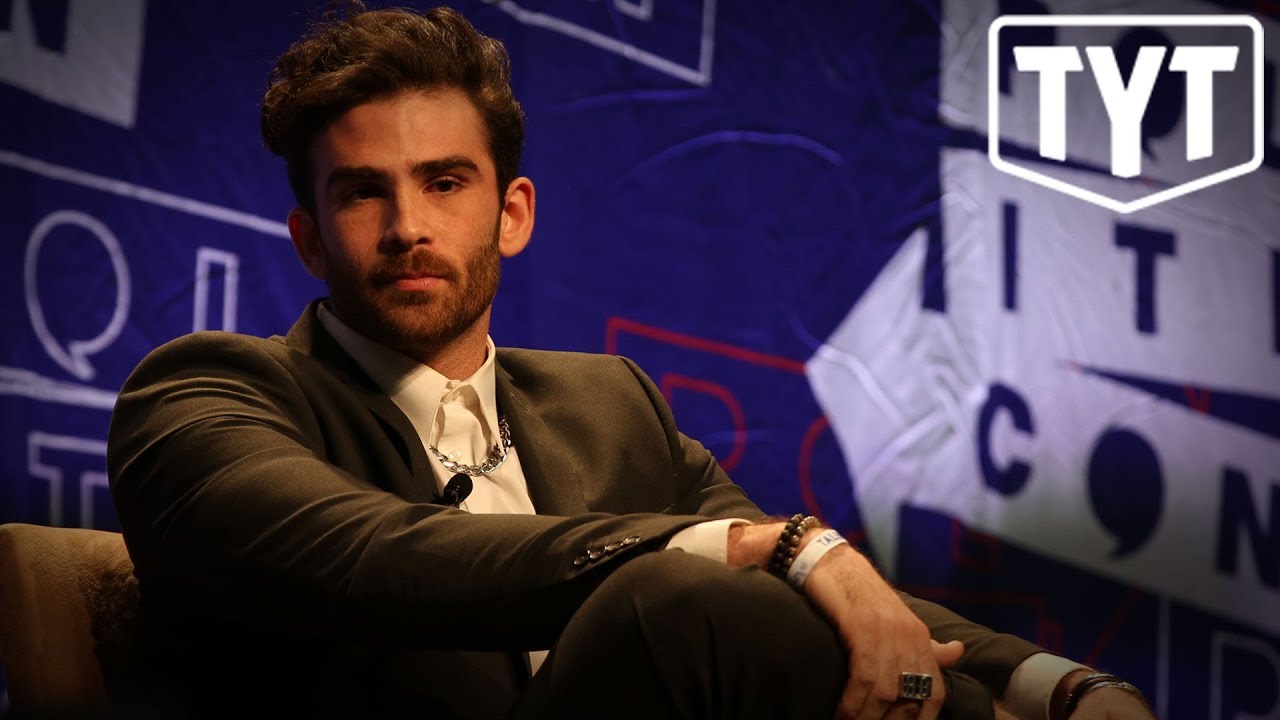
Charlie Kirk and Hasan Piker clash in an intense debate over capitalism and socialism, addressing poverty, healthcare, and economic systems. Hassan argues the current capitalist system is inherently exploitative and oppressive, pointing to 40 million Americans living in poverty. Kirk counters with hard statistics showing poverty at historic lows, 3.9 million Americans off food stamps, and the free market's role in creating abundance. The debate intensifies when Kirk challenges Hassan to live by his socialist principles, revealing Hassan's $60,000 salary. The discussion nearly turns physical when The Young Turks' Cenk Uygur erupts from the audience, adding unexpected drama to an already heated intellectual confrontation over free markets versus socialist redistribution.
The Core Arguments: Capitalism's Oppression Versus Free Market Success
Hasan Piker opened the debate with a sweeping condemnation of the current economic system, declaring it inherently exploitative and oppressive. He pointed to stark statistics: 40 million Americans living in poverty and 18.5 million in extreme poverty despite living in the wealthiest nation in history. Hassan argued that socialized solutions are necessary to address problems the free market fails to solve, including climate change and economic inequality. He expressed frustration that advocating for such solutions results in being labeled a socialist, which he views as inherently damaging to productive discourse.
Charlie Kirk immediately challenged Hassan's characterization of capitalism as oppressive, questioning whether small business owners are truly oppressing their employees. Despite Hassan's attempt to dismiss this as hyperfocusing on small businesses, Kirk emphasized that 85% of all jobs in America are created by small businesses. He presented contrasting statistics: poverty rates at their lowest in 65 years, with 3.9 million Americans leaving food stamps and entering the workforce under the current administration. Kirk argued this should be applauded by everyone, as it represents people moving from government dependence to self-sufficiency through employment.
The Mechanics of Wealth Creation in Free Markets
Kirk laid out his fundamental understanding of how wealth creation works in a free market system. He argued that getting rich does not mean someone else gets poor. Instead, to become wealthy in a free market, one must have a good idea, create value, employ people, and typically borrow money with an 80% chance of business failure. The system rewards success but also holds individuals responsible for failure. Over the past century, Kirk noted, the standard of living has increased for all people across the world, with things getting better, prices going down, and abundance spreading—benefits only a free market system can create.
Hassan's argument rested on what Kirk identified as explicitly Marxist talking points about capitalism being inherently exploitative. This framing construes the profit motive as exploitation of the working class and a means to extract labor with minimum compensation. However, Kirk contrasted this ideological position with hard statistics showing the free market's success in lifting people from poverty worldwide. Since the turn of the last century, humanity has dropped the share of people in extreme poverty from over 60% to less than 10%—an achievement no centralized government or socialist economy could match.
Socialist Regimes and the Death Toll of Ideology
The debate took a darker turn when Kirk challenged Hassan on socialist regimes throughout history. He asked directly whether Cuba, North Korea, Vietnam, and Zimbabwe were not socialist countries. When Hassan laughed in response, Kirk became more serious, stating that 100 million people died under socialism in the last 100 years. He accused Hassan of having the audacity to shamelessly wear Marxism on his sleeve while ignoring the victims' families from Cuba, Venezuela, Korea, Vietnam, Maoist China, and Stalin's Russia. Kirk declared that the number one killer of innocent civilians over the last 100 years has been the very ideology Hassan promotes.
Hassan countered by arguing that when 100 million people die under communist dictatorships—some of whom were Nazis, he noted—socialism gets blamed. However, when 7 million people die every year under the current global capitalist environment from famine alone, before even considering imperialism and wars, individuals get blamed. He accused Kirk of essentially telling every poor person that their poverty is their own fault, that death under capitalism is an individual failure while death under communism is a systemic problem.
Global Poverty and the Attribution of Responsibility
Kirk challenged Hassan's framing, asking whose individual fault it is that 7 million people die annually from famine-related diseases under the current global capitalist structure. He questioned why deaths are attributed to the system under communism but to individuals under capitalism. Kirk pointed out that life expectancy has increased dramatically—from 40 years to 80 years in America for women and 76 years for men—and that global poverty is at its all-time low, below 10%. Hassan struggled to provide a direct answer to who specifically should be held responsible for these deaths.
The debate revealed a fundamental disagreement about attribution and causality. Kirk's position suggested that while individual deaths are unfortunate, the overall trend under capitalism shows dramatic improvements in human welfare. Hassan's position implied that systemic factors under capitalism create conditions that lead to preventable deaths, while Kirk's perspective held that no single person or policy can be blamed when poverty exists at historic lows globally.
Healthcare, Patents, and Market Regulation
The conversation shifted to healthcare and pharmaceutical regulation. Kirk introduced the example of LASIK eye surgery to illustrate free market principles. He explained that LASIK initially cost $20,000 per eye, but because insurance companies would not cover it, it became a cash business where doctors operated outside the traditional system. Consumers dealt directly with doctors, knew exactly what procedures cost, and as a result, prices dropped to $500 per eye while quality improved and accessibility expanded.
Hassan dismissed Kirk's claims as flat-out false, arguing that America operates under a mixed economy where technological advancements result from both publicly funded research and private elements. He challenged Kirk's attempt to attribute all technological progress to free market capitalism, suggesting it was disingenuous to ignore the role of public investment. Kirk countered that a key component of any functional market is transparent pricing, and the problem with the American healthcare system is that no one knows what anything costs—neither the duration of hospital stays nor the cost of procedures.
The discussion touched on pharmaceutical regulation, with Hassan pointing out that America is virtually the only country on the planet that does not negotiate drug prices. He noted that even Donald Trump promised to address this issue but failed to deliver, along with other promises about solving the economy and bringing world peace. Hassan argued it was preposterous to claim that insurance companies decrease prices without government regulation. Kirk maintained his position that when insurance companies are removed from price negotiations, consumers know exactly what everything costs, and market forces naturally drive prices down while improving quality and accessibility.
The Personal Challenge: Live Like a Socialist
The debate reached its most confrontational moment when Kirk directly challenged Hassan's personal lifestyle. He asked why Hassan doesn't give away 95% of his money and go live on a commune if he truly believes in socialism. Hassan responded by questioning whether Kirk really thinks that's how it works, pointing out that Kirk had interrupted him for five minutes straight. Kirk insisted that he lives what he practices as a free market capitalist who took risks with his own startup business, practicing what he preaches every single day.
Hassan explained why he found Kirk's question ridiculous. If he gave away 95% of his earnings, it wouldn't move the needle on solving systemic problems. He voluntarily disclosed that he makes $60,000 a year—a good salary, he acknowledged, but not enough to buy a second home anytime soon, referencing Ted Cruz's wife discussing their $174,000 annual salary. Hassan argued that Kirk was trying to attack him personally rather than addressing the larger systemic issues.
Cenk Uygur Erupts From the Audience
The tension escalated dramatically when Cenk Uygur from The Young Turks began shouting from the audience. The moderator had to intervene, telling Cenk to take a seat multiple times as the situation threatened to turn physical. Cenk could be heard challenging Kirk about his salary and funding sources, creating chaos that momentarily derailed the debate. The moderator eventually restored order, asking everyone to behave.
After the interruption, Kirk returned to his point that he practices what he preaches while Hassan does not. He emphasized that his organization is funded by grassroots supporters across the country. The confrontation with Cenk only seemed to strengthen Kirk's position that the socialist side of the debate lacked the intellectual depth and composure to sustain their arguments without resorting to emotional outbursts and personal attacks.
The Deeper Issues: Incentives, Innovation, and Economic Systems
Beyond the heated exchanges, the debate revealed fundamental disagreements about how economic systems create wealth and distribute resources. Kirk's position emphasized that socialism works well in theory when wealth already exists for redistribution, but it fails to create the right incentive structures for people to generate wealth in the first place. He compared this to the medical industry, where the United States needs profit incentives to invent new medicines, surgeries, and equipment that benefit the world.
Kirk explained that 90% of new drugs and medicines fail to make it to phase three of trials, and more than 90% of biotech startups fail. Someone must bear the cost of these failures and invest despite the risks. It's only fair, he argued, that whoever is responsible in case of loss is also deserving when a drug or company successfully turns a profit. This lack of understanding about risk, investment, and innovation appeared repeatedly in Hassan's arguments.
The debate also touched on the distinction between genuine free market capitalism and crony capitalism. Many of the problems Hassan attributed to capitalism—such as the 2008 financial crash and market manipulation—actually stem from corruption and perversions of true free market principles rather than from free markets themselves. Research shows that most of the world's famines today result not from lack of food but from military and political action in places like Africa and the Middle East, contradicting Hassan's attribution of these deaths to global capitalism.
Conclusion: Intellectual Depth and Political Discourse
The debate concluded with observations about the intellectual depth of political pundits and streamers who shape public opinion. Kirk consistently presented specific examples, statistics, and mechanisms by which free markets create wealth and reduce poverty. Hassan primarily listed problems existing in the world without connecting them to fundamental aspects of free market capitalism. The contrast became even starker when Hassan struggled to defend his personal choices against his stated principles, and when his ally Cenk Uygur's emotional outburst undermined their side's credibility.
The confrontation revealed how difficult it is to maintain intellectual consistency when advocating for socialism while personally benefiting from capitalist systems. Hassan's revelation of his $60,000 salary highlighted this tension, especially given that it would take more than 50 years of living with zero expenses to afford the $3 million mansion he purchased in Los Angeles. While there's nothing inherently wrong with making money and buying what one wants, the problem emerges when actions don't align with words, particularly when lecturing others about morality on those very grounds.
Throughout the debate, Kirk attempted to match the loudness of his opponent—a different tactic than remaining calm in response. This approach became particularly problematic when Cenk began shouting from the audience, making the socialist side appear weaker and more emotional rather than substantive. Conversations like this reveal how much intellectual depth truly exists among the pundits and streamers that many people turn to for their political perspectives. The contrast between hard statistics and vague accusations, between specific policy examples and broad systemic complaints, and between personal consistency and ideological virtue signaling became impossible to ignore.