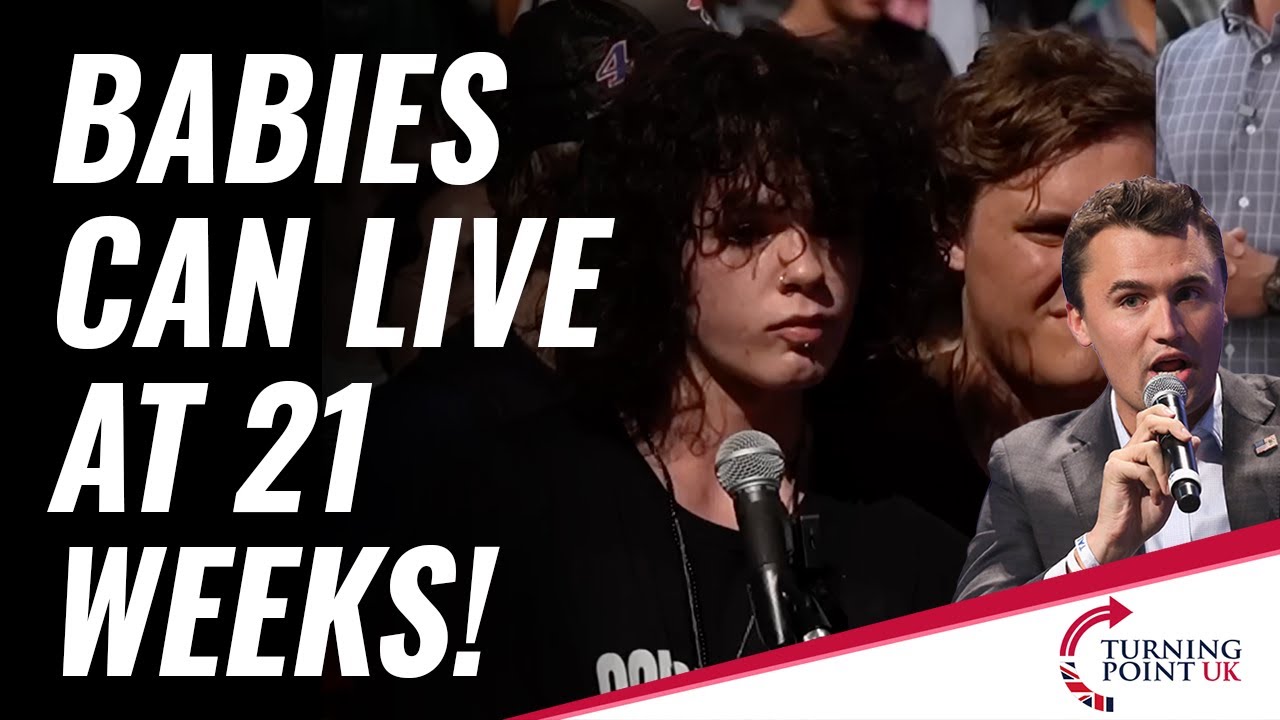
Charlie Kirk Challenges Student Who Claims Holocaust More Evil Than Abortion Based on Pain
Enjoying this? Share it with someone who needs to see it.
Up Next
Charlie Kirk Debates Atheist Student on Abortion, Consciousness, and the Soul at Campus Event
11:06
Charlie Kirk Defends Life at Conception Using DNA Science Against Pro-Choice College Student Kiana
9:53
Charlie Kirk Defends Why Abortion Is Worse Than the Holocaust in Magnitude and Moral Terms
39:03
Charlie Kirk Challenges Student Who Claims Holocaust More Evil Than Abortion Based on Pain
Charlie Kirk engages in a deeply philosophical exchange with a student who questions his position comparing abortion to the Holocaust. The conversation begins with the student arguing that the Holocaust was worse based on victims' ability to feel pain, but takes an unexpected turn when Kirk pushes the student to examine the logical conclusions of their moral framework. What starts as a challenge to Kirk's position becomes a revealing exploration of how we determine human value, with the student ultimately conceding a critical point about eugenics. The exchange demonstrates the power of Socratic questioning in examining deeply held beliefs about human life, dignity, and the principles underlying Western moral thought.
A student approached Charlie Kirk with a carefully researched critique of his position on abortion and the Holocaust. The student had done their homework, citing specific statistics: since Roe v. Wade was ratified in 1973, 58,590,000 abortions occurred in the first trimester, with only 88,200 per year happening after the first trimester when pain receptors may be developed. Their argument centered on a key claim: the Holocaust killed approximately 2 million people per year who could definitively feel pain, making it more significant than abortion.
Kirk acknowledged the complexity of the comparison, stating both are distinct evils with similarities. He clarified that while the Holocaust was far more evil in certain ways—particularly in its intent to eradicate an entire religious people and its near-elimination of half the world's Jewish population—the abortion crime is greater in magnitude due to sheer numbers.
The Pain Argument Collapses
The student's opening argument relied heavily on the capacity to feel pain as a measure of moral significance. They emphasized that Holocaust victims definitively experienced pain, while citing research suggesting that pain receptors may not develop until 12 weeks of gestation. This would mean the vast majority of abortions occur before the fetus can feel pain.
Kirk immediately identified the fundamental flaw in this reasoning: "A human life is a human life. Regardless of how advanced it is or whether it can feel pain, it still has moral worth, right?" This simple question began to unravel the student's carefully constructed argument, forcing them to confront whether pain capacity truly determines human value.
Past Experience as Moral Currency
When pressed on what makes a four-week-old baby morally different from an adult, the student proposed that people gain value through past and future experiences. They argued they had "probably affected and impacted more people in both a positive and a negative way" than a four-week-old embryo, therefore possessing greater moral worth.
Kirk immediately identified the dangerous implications: "I'm just trying to understand like and from where do you get that moral worldview? Why why do you believe that?" He pointed out that this logic suggests an 82-year-old has more moral value than an 8-year-old based purely on accumulated experiences. He noted that Western civilization was actually built on the opposite principle—the willingness of grandparents to sacrifice for the young, a principle he argued was inverted during COVID-19 when society sacrificed young people's development to protect the elderly.
The Iceland Test Case
Kirk introduced a real-world application of the student's reasoning: Iceland's mandatory abortion policy for Down syndrome babies. When the student agreed this was "really terrible," Kirk pressed: "But why is it terrible? The abortion, it doesn't matter that much, right? It's just like a clump of cells. Like, why not just?"
The student responded by emphasizing bodily autonomy and the pro-choice slogan "your body, your choice," arguing the problem with Iceland's policy was government compulsion, not the abortion itself. They maintained this position even when discussing first-trimester abortions, saying the decision should be left to the mother, not the government.
The Sex-Selective Abortion Trap
Kirk then posed a question that would prove pivotal: Should a mother be allowed to abort a three-week-old baby simply because she wanted a boy but discovered she was having a girl? The student initially answered affirmatively without hesitation, reasoning that if the child cannot survive outside the mother's body, the decision is hers alone.
Kirk pressed further, painting a vivid picture: with modern DNA testing available as early as three to six weeks, parents can determine not just sex but also projected height, IQ, eye color, and likelihood of obesity. Under the student's framework, any of these characteristics could justify abortion. "Your view of pregnancy is no different than customizing a Ford Explorer," Kirk stated. "If you get anything that you don't like, you say, 'My body, my choice, get it out of the shopping cart.'"
The student initially defended this position as "very ethically problematic" but ultimately permissible in an advanced society. Then came Kirk's devastating observation: "What you just talked about sex selective abortion is Nazi eugenics philosophy which is that we will eliminate those that we don't want."
The Concession
This comparison to Nazi eugenics—the very ideology behind the Holocaust the student had used to challenge Kirk—created a moment of genuine reflection. The student paused, then made a remarkable concession: "You're exactly right. You did get me on that one. Yeah, I'm not going to sit up here and pretend that you got me on that one. No. Realistically, like if we're really going to full circle and I'm going to sit here and think about it, no, you shouldn't be able to kill your baby just because you don't like the gender or whatever."
The audience applauded this intellectual honesty. Kirk graciously acknowledged the concession: "I want to offer you grace. Thank you for saying that, and I appreciate that."
The Dependency Argument
The student attempted to salvage their position by returning to the concept of dependency, describing the fetus as "leeching off of the mother's resources" and therefore not fully its own being. Kirk countered with his personal experience: "I have a 10-month-old. He doesn't hunt and gather." The baby depends entirely on someone providing breast milk or formula for survival.
The student distinguished between direct physical attachment via umbilical cord and external dependency. Kirk reframed this distinction: "What you say leech I say give—the mom gives life to the baby." He argued that from a purely moral standpoint, independent of religion, humans should recognize that they were all given life through a mother's nutrients via an umbilical cord. This creates a moral obligation: "That which is given, that which is much expected."
Human Development and Human Rights
Kirk then established common ground on an irrefutable scientific fact: human development has a definite starting point at conception. Even pro-abortion advocates acknowledge this biological reality. The student agreed.
Kirk built his concluding argument on this foundation: "We can use all these different words. We can use fetus. We can use embryo. We can use little one. Whatever. But it's all still a human being. It doesn't go from rhinoceros to human being at like 10 weeks. It doesn't go from crocodile to human being. It's all human development. Therefore, using reason that we all have if it's human development and it is a human being, human rights, the first of all human rights is the protection of life."
Universal Human Equality
Kirk identified what he sees as the fundamental problem with pro-abortion arguments: "The pro-abortion worldview will collapse if you remove feelings and you remove hyper emotionality. There is no defense using agreed upon western reason which you believe in and western morality which is we don't kill people smaller than us."
He emphasized that Western civilization rests on the principle of universal human equality—the idea that we don't eradicate people based on size, wealth, or perceived worth. This principle, he noted, is enshrined in the Declaration of Independence: "All men are created equal." If universal human equality is accepted as a foundational principle—and the student clearly did accept it—then abortion cannot be justified within that framework. "If you believe in universal human equality, there is no room for abortion in that society. It does not exist," Kirk concluded.
The exchange ended with mutual respect. Kirk promised to include both the student's initial answer on sex-selective abortion and their later concession when editing the video, demonstrating fairness in representing the full conversation. The student had arrived with carefully researched statistics to challenge Kirk's Holocaust comparison, but left having examined—and in some cases revised—fundamental assumptions about how we determine human value and rights.