2,422 videos 1,389,747,653 views US Joined Aug 30, 2018
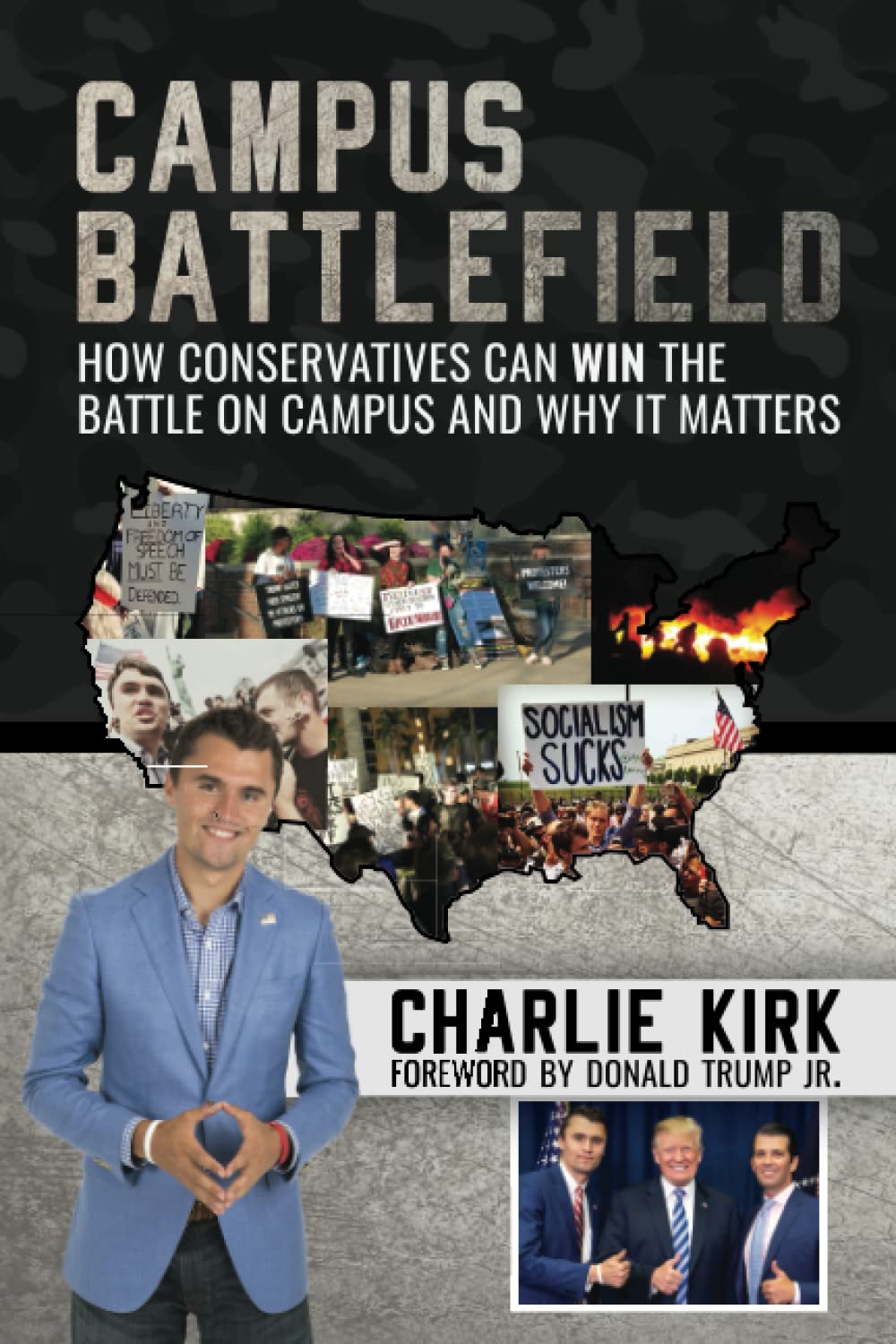
Charlie Kirk is the Founder and President of Turning Point USA, the largest and fastest growing conservative youth activist organization in the country with over 250,000 student members, over 150 full-time staff, and a presence on over 2,000 high school and college campuses nationwide. Charlie is also the Chairman of Students for Trump, which aims to activate one million new college voters on campuses in battleground states in the lead up to the 2020 presidential election. His social media reaches over 100 million people per month and according to Axios, he is one of the "top 10 most engaged" Twitter handles in the world. He is also the host of “The Charlie Kirk Show,” which regularly ranks among the top news shows on Apple podcast charts.
Charlie Kirk Confronts College Students on Immigration, Border Security, and the Human Trafficking Crisis at the Southern Border
Charlie Kirk faces off with college students in a heated exchange about immigration policy, border security, and the human trafficking epidemic at the U.S.-Mexico border. The conversation tackles the distinction between legal immigration and illegal border crossing, ICE's role in combating child sex trafficking, and the exploitation of vulnerable populations by cartels. An Air Force veteran joins the discussion, sharing insights from working with Veterans for Child Rescue and exposing the harsh realities of human trafficking that often get lost in political debates. Kirk argues that protecting borders isn't about hatred but about preserving the rule of law and fairness to legal immigrants waiting decades for their chance to enter America.
The conversation begins with a student expressing discomfort with the environment, claiming it feels threatening. Kirk quickly redirects the discussion from feelings to facts, making a clear distinction between emotional responses and logical analysis. He explains that feelings are irrelevant in political discourse—nobody cares how you feel except yourself and maybe your mother. The difference, Kirk emphasizes, is that he shares logic, facts, and thoughts developed through reflection, math, science, and data analysis, not emotional reactions based on rising blood pressure or biochemical responses.
The Immigration Debate: Legal Process Versus Border Jumping
A graduate student with a 3.75 GPA approaches Kirk to discuss immigration. The student, himself an undocumented immigrant brought to America as a child, argues that instead of focusing on increasing border security, the country should focus on making the immigration process fair, partial, and quick. Kirk agrees with some of these points but draws a hard line: jumping the border is not immigration.
When asked about children who had no choice in coming to America illegally, Kirk suggests their parents should be deported while the children might be given a second chance. He points out that President Trump actually offered to allow Dreamers to stay, but Democrats opposed it. Kirk argues it's unfair to immigrants from Bulgaria, Indonesia, and central Africa who waited decades to enter legally, while those who happen to live closer to the border can simply jump across and claim immigrant status.
Why Charlie Kirk Wears an ICE Hat
Kirk explains his support for Immigration and Customs Enforcement by highlighting the agency's work against the most vulnerable populations. ICE has arrested 14,000 child sex traffickers in a single year, making this the number one population they target. The second population ICE pursues is MS-13 gang members, of which no one can make a moral defense that their growing presence in America is positive.
When challenged about ICE being called a racist organization, Kirk counters with a fact: 56% of border patrol agents are Hispanic. He encourages students to independently verify all his claims rather than simply accepting or rejecting them based on feelings.
The Reality of Border Security and Cartel Violence
Kirk presents data showing that 95% of border patrol agents support building a wall, citing Art Del Cueto, vice president of the Border Patrol Association, who publicly released this information. When a student dismisses this support as merely job security, Kirk shifts the conversation to the dangers border patrol agents face and the broader consequences of inadequate border security.
He details the scope of the problem: illegal immigrants committed 54,000 assaults last year, 13,000 children are trafficked across the border annually, and 90% of heroin and fentanyl in America comes across the southern border. When a student claims there's no war zone at the border, Kirk points to Mexico's election cycle where 580 politicians were killed—evidence that cartels effectively run the country.
Why Borders Matter: Good Ideas Versus Bad Ideas
When a student argues that borders don't matter because we all live on the same planet, Kirk explains that borders represent a physical delineation between where good ideas start and bad ideas start. American laws, with due process, cross-examination of witnesses, and the rule of law, are fundamentally more moral than Mexico's legal system. The student agrees that the U.S. government system is better than Mexico's.
Kirk uses the North Korea-South Korea border as an example of how borders define radically different realities for people on either side. He notes that Mexico itself has a wall on its southern border with Guatemala that works quite well, resulting in lower illegal immigration rates from Guatemala, Honduras, and El Salvador. Mexico deports those who illegally enter their country—why shouldn't the United States do the same?
The Child Separation Crisis and Human Trafficking
The conversation shifts when Kirk addresses the claim about 2,500 ICE children not reunited with their parents. He explains that according to Department of Justice audits of ICE facilities, more than 50% of people bringing children across the southern border were not actually their parents—these children were being sex trafficked. When a student says they don't believe this, Kirk points out how modern debates break down: facts are dismissed based on feelings, and discussion ends.
An Air Force Veteran's Perspective on the Humanitarian Crisis
An Air Force veteran joins the conversation, explaining her work with Veterans for Child Rescue, a nonpolitical, nonpartisan organization combating child trafficking from Mexico into the United States. She frames the issue not from a political perspective but as a humanitarian crisis deeply exploited by a leftist agenda.
The veteran explains that victims of trafficking receive T visas and are not deported back to Mexico. She questions why the media used the term "illegal immigrant" to talk exclusively about Hispanics and Mexicans when the term applies to everyone. She points to the Hispanic population, specifically Mexican Americans, as the largest voting minority in the United States, eventually likely to become the biggest voting bloc.
She references the 2018 human trafficking report and the recent violence in Tijuana, where two cartel factions fought over trafficking routes into the United States. An Immigration Reform Bill that could have pacified both parties was shot down by Democrat officials, helping no one—especially not the people they claimed to stand up for.
America as the Most Pro-Immigrant Country
The veteran emphasizes that America is the most pro-immigrant country in the world, taking half the world's immigrants every single year. However, when immigration is done the wrong way, people are hurt on both sides. She examines the correlation with Mexico as America's biggest trade ally and how NAFTA negotiations in the early 1990s actually increased illegal immigration because people couldn't find legal jobs in their own country.
The Brutal Reality of Modern Slavery
The veteran shares the story of Karla Jacinto, who was raped 43,000 times. Many people don't want to hear that number or believe it's possible, but women are forced into modern slavery regardless of whether someone is pro-life or pro-choice. These victims are treated like cattle. If they get pregnant by the men purchasing them, their children are taken away. This is modern slavery, and many political officials exploit it—they say they want to protect these people but then don't fix the problem.
She concludes by explaining why child separation at the border was, in her opinion, for the right reason: you never knew who these people bringing children over actually were. People in Mexico talk about giving their children up in hopes of giving them a better life, but these children are just exploited because children and humans are the only commodity that can be resold repeatedly—unlike drugs that can be confiscated.