Charlie Kirk Confronts Student on Gender Ideology: The Clash Over Biology and Free Speech
Enjoying this? Share it with someone who needs to see it.
Up Next
Charlie Kirk Debates Gender Identity: Why Adding Non-Binary Options on Birth Certificates Is Morally Reprehensible
2:47
Charlie Kirk Debates Gender Identity, Transgenderism, and the LGBT Community with College Student
5:55
Charlie Kirk Debates Student on Gender Identity, Transgenderism, and Objective Truth at Campus Event
7:06
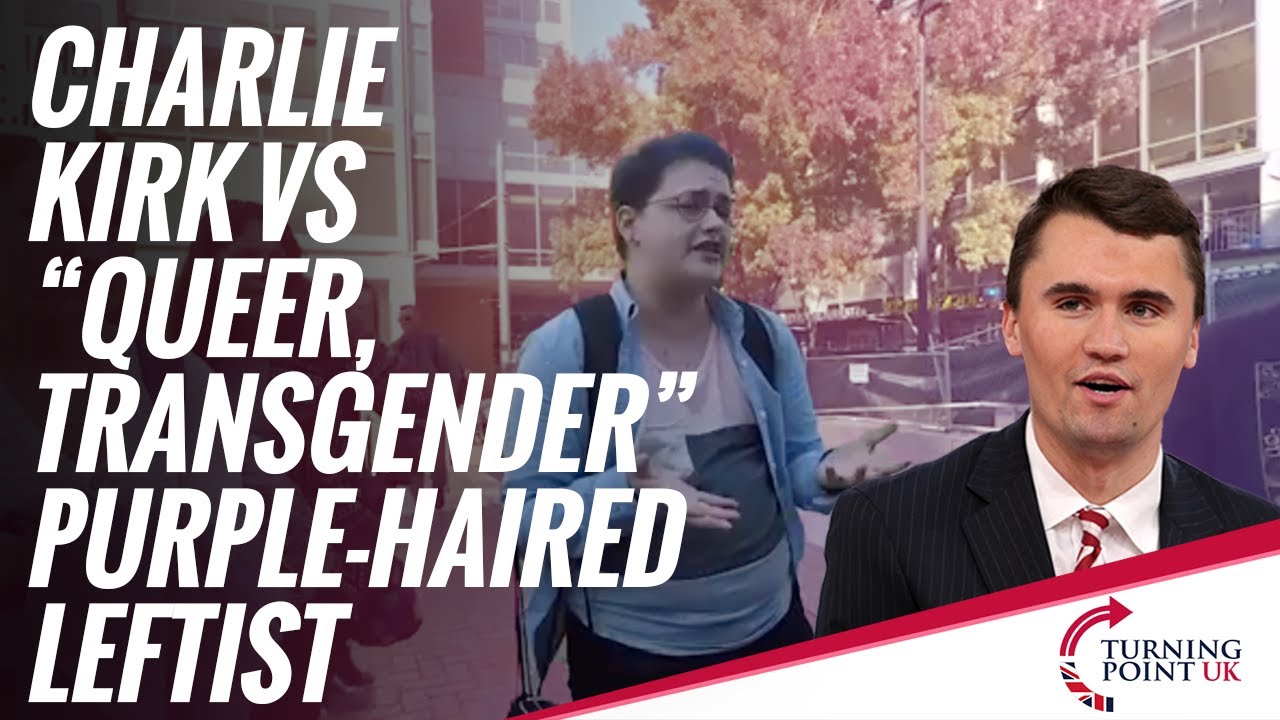
Charlie Kirk Confronts Student on Gender Ideology: The Clash Over Biology and Free Speech
Charlie Kirk engages in a heated campus debate with a student protesting his views on gender. The exchange quickly escalates from definitions to deeper questions about biology, parental authority, and free speech. Kirk challenges the student's belief in unlimited genders, questions whether three-year-olds should choose their gender identity, and raises concerns about California laws that could criminalize misgendering. The conversation reveals the fundamental divide between those who see gender as a social construct divorced from biology and those who argue sex and gender are directly related—with real consequences for speech and children.
The conversation begins with a direct question. A student approaches Charlie Kirk to protest, and Kirk asks what specifically they're protesting about him. The student responds that they believe Kirk is against trans people. Kirk clarifies his position: he believes there are only two genders. The student confirms this is indeed their issue with him.
Unlimited Genders and the Quantification Question
When Kirk asks how many genders the student believes exist, the answer reveals a fundamental philosophical divide. The student claims gender is not a quantifiable number—it's an open concept. Kirk pushes further, asking if 100 genders would be too many. The student deflects with a popular social media phrase: "Every time you annoy us we add five."
Kirk presses the logical conclusion: unlimited amounts of gender. He then introduces the student to "caleogender"—a recently identified gender where people believe they're from outer space. When asked if they respect this identity, the student responds affirmatively: "That sounds awesome."
The Social Construct Argument
The discussion shifts to the relationship between gender and sex. The student argues that gender and sex are not directly related at all, claiming gender is purely a social construct. Kirk poses a challenge: if gender is a social construct but not a biological concept, where in the body does gender exist? The student stumbles, acknowledging it wouldn't exist in their "particular being."
Kirk counters that gender and sex are directly related, and while people can be free to do whatever they want, ignoring societal or biological standards leads to chaos. The student questions this, prompting Kirk to point to the logical conclusion of their position: hundreds of genders, perhaps 500.
Children and Gender Identity
The conversation takes a critical turn when Kirk asks whether three-year-olds should be able to choose their gender. The student responds with an unequivocal "absolutely." Kirk clarifies the scenario: a three-year-old biological male whose parent affirms there's no difference between men and women. The student finds this "perfectly fine" and "beautiful."
Kirk then asks if there are differences between men and women, between males and females. The student initially tries to distinguish between the questions, but Kirk insists they're the same thing. The student disagrees, leading Kirk to reassert that gender and sex are directly related.
Language Games and Scientific Consensus
The student attempts to intellectualize the debate by referencing Wittgenstein and language games, suggesting they're not playing the same linguistic framework as Kirk. Kirk dismisses this academic deflection, stating that "everyone in science" agrees that while people can identify however they like, they can be wrong about biological reality.
Speech Policing and Legal Consequences
Kirk escalates the discussion to its practical implications. The issue becomes personal, he argues, when people start to police speech and target children. He brings up California law, claiming that misgendering someone can result in jail time. Kirk challenges the student directly: do they believe someone should be able to go to jail for misgendering somebody?
The student acknowledges it's on the books as a law in California. Kirk presses for a simple answer about whether this law should be removed, but the exchange ends before the student can provide a clear position.