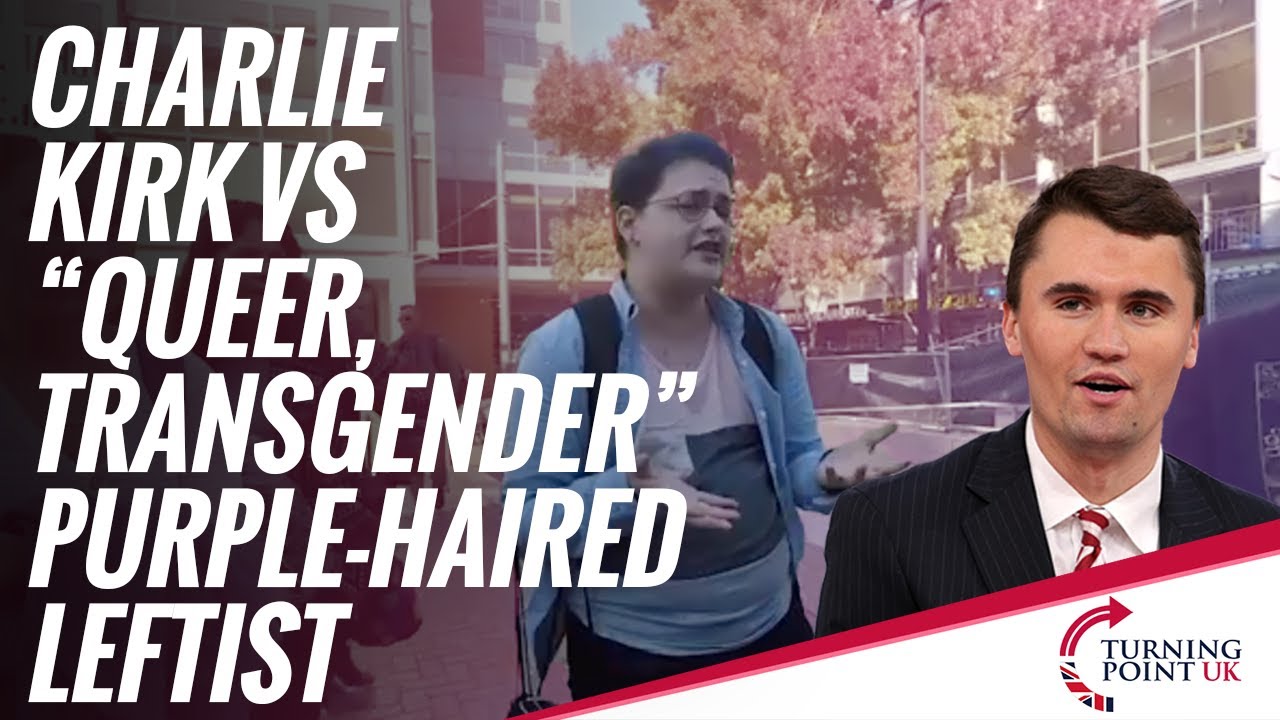
Charlie Kirk Debates Student on Gender Identity, Transgenderism, and Objective Truth at Campus Event
Enjoying this? Share it with someone who needs to see it.
Up Next
Charlie Kirk Debates Young Leftist on Gender Identity, Trans Healthcare, and What Defines a Woman
4:13
Charlie Kirk Debates Young Activist on Transgender Medical Procedures and Defining What Is a Woman
4:03
Charlie Kirk Dismantles Transgender Ideology in Debate with College Student Claiming Male to Female Transition
21:56
Charlie Kirk Debates Student on Gender Identity, Transgenderism, and Objective Truth at Campus Event
Charlie Kirk engages in a direct debate with a student questioning his views on LGBTQ acceptance and transgender rights. The exchange covers fundamental questions about objective truth, the definition of womanhood, gender dysphoria versus transgender identity, and competitive fairness in women's sports. Kirk challenges the student's position that gender identity is subjective while defending the biological basis for defining men and women. The conversation highlights the tension between acceptance of self-identification and acknowledgment of biological differences, culminating in a discussion about protecting women's spaces and sports from what Kirk describes as exploitation.
A student approached Charlie Kirk at a campus event with a pointed question about LGBTQ rights, specifically asking whether he believes the acceptance of queer people in society is a good thing. Kirk immediately sought clarification on the terms, noting that "queer" was once considered a slander during his upbringing. The student defined queer as encompassing lesbian, gay, bisexual, and transgender individuals, and clarified that by acceptance, they meant society should not try to change people or make them feel bad about being gay or trans, and that institutions should offer resources to help people come to terms with their sexuality.
Kirk's response was direct and unequivocal: "No." He explained that people should feel bad about all sorts of things, challenging the premise that acceptance means never making people feel uncomfortable about their choices or identities.
The Fundamental Question: What Is a Woman?
Kirk redirected the conversation by asking a simple but loaded question: "What is a woman?" The student answered that a woman is someone who identifies as a woman. Kirk then asked whether someone who can become pregnant would be defined as a woman, to which the student replied it depends on whether they identify as a woman.
This exchange became the foundation for Kirk's argument about objective versus subjective truth. He asked the student whether truth is objective or subjective, and whether they believe in absolute truth. When the student agreed that absolute truth exists, Kirk pressed further: if absolute truth exists, shouldn't there be absolute terms for what an infant-bearing person is, otherwise known as a woman? The student disagreed, maintaining that gender identity is separate from biological sex.
Exploring the Boundaries of Self-Identification
Kirk challenged the logic of unlimited self-identification by introducing the concept of age identity. He referenced people with mental conditions who identify as younger than they actually are—for example, a 50-year-old identifying as an 8-year-old. He asked whether society should accept this form of identity. The student rejected this as a false equivalence, arguing that scientific research supports gender identity as legitimate, while age identity represents a disorder.
Kirk countered by pointing out that the student had just described gender identity as a brain formation issue, which would also make it a disorder. The student distinguished between gender dysphoria—discomfort with one's body that can be treated through transition—and being transgender, which they defined simply as not identifying with the gender one was born with. Kirk questioned whether someone could be transgender without experiencing gender dysphoria, highlighting what he saw as inconsistencies in the student's framework.
The Slippery Slope of Subjective Reality
Kirk expanded his challenge to other forms of identity, asking whether people can choose their adjectives, declare themselves rich, or identify as small. When the student dismissed these as things people don't actually do, Kirk pushed back, comparing declaring oneself rich to declaring oneself a man when chromosomes indicate otherwise. He argued that people don't get to choose their reality.
The student maintained that gender identity is reality, prompting Kirk to ask about species identity. When the student rejected the idea that someone could identify as a different species, Kirk noted that there are people who identify as cats and dogs—a serious mental condition with tens of thousands of documented cases. He pressed the fundamental question: if the student believes in absolute truth, why wouldn't they believe in absolute truth when it comes to chromosomal structure?
The student reiterated that gender and chromosomal sex are two different things, which Kirk characterized as merely an opinion that the student wanted to impose on the rest of society.
The Case of Women's Sports
Kirk brought the conversation to a concrete example: the University of Pennsylvania swimmer who transitioned from male to female and won the NCAA championship. He asked whether the student saw a moral problem with this outcome. The student, admitting unfamiliarity with the specific case, suggested that the NCAA likely has rules to ensure competitive fairness for people who transition.
Kirk provided the details: the swimmer was the 462nd best male swimmer who became the best female swimmer and NCAA champion. He asked again whether the student saw a problem with this. When the student questioned why someone would transition just to become better at swimming, Kirk explained that people do bad things for narcissistic reasons—just as people steal or cut in line. He argued that it's not society's responsibility to accommodate the rules for people's impulses to do bad things.
Protecting Women Through Recognition of Differences
Kirk concluded by asking whether the student believes there are differences between men and women. The student acknowledged differences in terms of chromosomes. Kirk seized on this agreement to make his final point: if men and women have differences, society should be defined around those differences. One key difference is that women have lower testosterone levels and can be easily exploited by men, which happens far too often.
Kirk argued that it's incumbent on men—who have higher testosterone levels and are physically stronger—to protect women against exploitation by men who think they are women. He framed this as both a moral question and a moral claim, positioning his stance not as discrimination but as protection of women's rights and spaces.
The exchange illustrated the fundamental divide between those who view gender as a matter of self-identification and those who see biological sex as an immutable, objective reality that should form the basis for social categories and protections.