2,422 videos 1,389,747,653 views US Joined Aug 30, 2018
Charlie Kirk is the Founder and President of Turning Point USA, the largest and fastest growing conservative youth activist organization in the country with over 250,000 student members, over 150 full-time staff, and a presence on over 2,000 high school and college campuses nationwide. Charlie is also the Chairman of Students for Trump, which aims to activate one million new college voters on campuses in battleground states in the lead up to the 2020 presidential election. His social media reaches over 100 million people per month and according to Axios, he is one of the "top 10 most engaged" Twitter handles in the world. He is also the host of “The Charlie Kirk Show,” which regularly ranks among the top news shows on Apple podcast charts.
Charlie Kirk Debates British Student George Abaraonye on Lost Boys, Masculinity Crisis, and the West's Feminine Culture
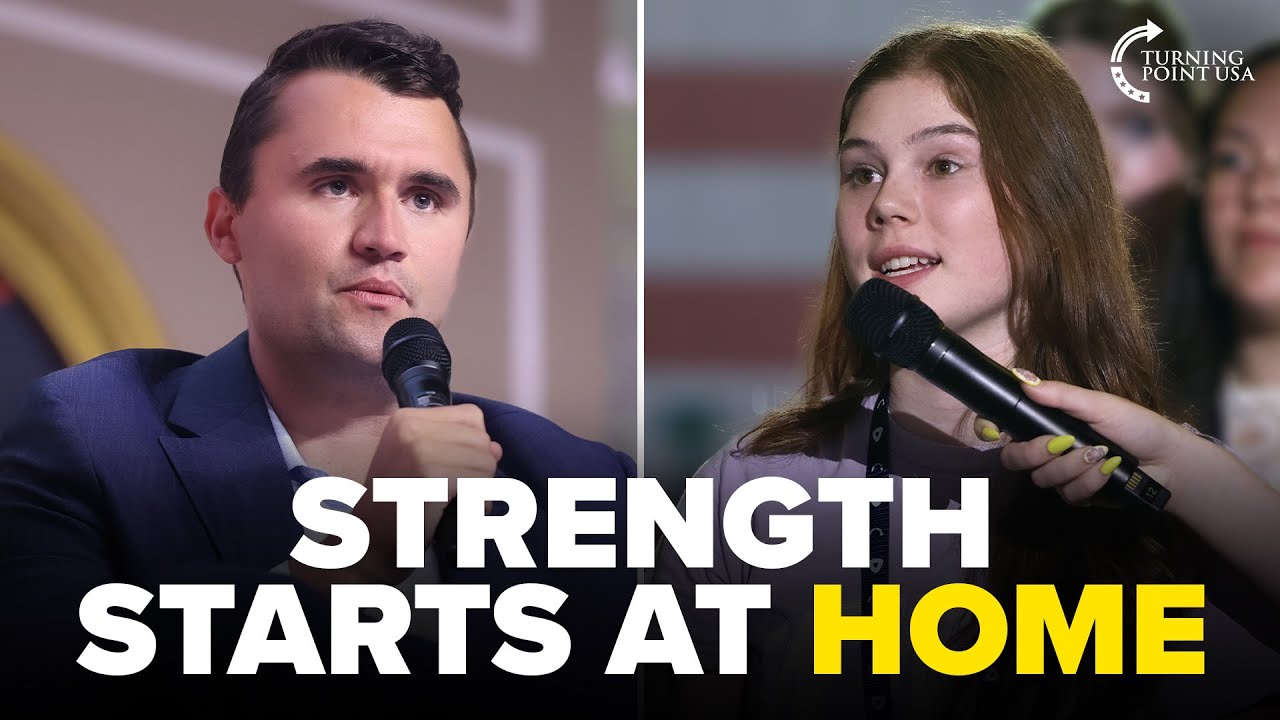
Charlie Kirk engages in a heated debate with George Abaraonye over the rise of what he calls a "generation of lost boys." The conversation tackles red pill media, toxic masculinity, the education system's treatment of young men, and the cultural feminization of Western society. Kirk argues that the suppression of traditional masculine roles, providing for a family through marriage and children, has led to skyrocketing male suicide rates and unhappiness across the Anglosphere. The student pushes back, suggesting economic factors, austerity, and men's inability to express emotions are the real culprits. Kirk counters by comparing wealthy Western men to poor men in Africa and Asia, asking why the latter are happier despite having far less material wealth.
The exchange begins with a student asking Charlie Kirk to expand on his earlier comments about a "generation of lost boys," drawing a parallel to the Peter Pan movie. The student defines "red pill media" as a reference to The Matrix, where media figures discuss "unplugging yourself" and waking up to what they describe as an active attack on masculinity. This media movement advocates for men's rights, arguing that men are being oppressed and need their rights defended.
The student questions whether this generation of lost boys results from a failure of masculinity itself or from other factors—economic and social pressures such as the death of the American dream, increasing costs of living, and rising education expenses.
Economic Factors and Cultural Messaging
Kirk acknowledges the economic challenges, calling the student's question "very good faith." He points to a "stupid decision" made in America during the 1970s, '80s, and '90s to shut down factories in the middle of the country, effectively disenfranchising tens of millions of working-class men. These men were told to move to cities and "learn to code," leaving them without the industrial jobs that once sustained families.
Kirk notes that a family used to be supported on a single income requiring 35 weeks of labor per year. Now, it takes upwards of 60 weeks of labor annually. However, he argues that despite all these economic and social factors, the largest issue is cultural and educational—the system has "infantilized men and hyper feminized them in the messaging, in the outreach, and in the treatment."
The Education System's Treatment of Young Men
When challenged to provide specific examples of how the education system has infantilized men, Kirk points to several areas. He mentions the hypermedication of young men and the core curriculum in American public schools, particularly in California and New York, where children as young as eight learn about "toxic masculinity." Kirk emphasizes that "toxic femininity" is never discussed in schools.
When asked if he agrees that toxic femininity exists, Kirk responds that it's "an unfair double standard." The student attempts to argue that toxic masculinity and toxic femininity come from "very different places"—that toxic masculinity stems from misogyny while toxic femininity is "a reaction to a misogynistic system which fundamentally oppresses and systematically oppresses women."
Kirk cuts through this argument by asking whether the term "toxic femininity" has ever been used in schools. When the student admits it hasn't, Kirk presses his point: "That's weird. So only one sex gets criticized and called toxic. Maybe that creates a backlash."
The Feminization of Western Culture
Kirk argues that regardless of the student's interpretation, only one "chromosome set gets criticized, called that they're terrible and awful," while women are encouraged to enter the corporate world "with no reservation." Young men see this pattern across the West—in authors, curriculum, music, and movies—and the result is what Kirk calls the "infantilization of the young male."
He contends that society is "living under a hyper feminist west that is toxic." When asked what he means by this, Kirk describes it as "speech police, feelings first, emotionals, emotion over reason, over individualism." He challenges the student: "Is the West stronger as it's become more feminine in the last 30 years?"
Kirk answers his own question: "No. In fact, our morale is weaker. We're more suicidal. Our fertility rates are down. We have lost the balance. We've lost the ying and the yang between the male and the female. We lost what worked."
The Adolescence Film and Cultural Examples
After acknowledging a sponsor break, Kirk returns to provide more examples, specifically referencing former British Prime Minister Boris Johnson. Kirk recalls Johnson saying at a summit, "We need to actually make things more feminine," and asks rhetorically how that sounds to "a dock worker in Brighton or someone in Essex." He argues that instead of making things more feminine, society needs to "restore the balance that God created man and women."
Kirk then brings up the film "Adolescence," describing it as a "slow motion humiliation ritual for the young boys of Britain" that broadly generalizes a theme that doesn't exist. He asks the student to imagine if there were a similar movie criticizing young women for how "catty they are" or how they drive men away.
The student responds that Adolescence isn't a generalization—it's an example of what can happen when people fall into certain media bubbles and don't find the help they need, potentially turning violent. The student calls it "a perfect example of toxic masculinity in which the boy feels like he's not affirmed in his masculinity and takes that out on women."
Male Suicide and Mental Health
The student shifts to male suicide, noting it's the largest contributor to men's deaths. However, the student argues this isn't a factor of feminization but rather of masculinity itself—"the idea that men can't be in touch with their feelings." The student criticizes what they perceive as Kirk's "feeling first approach being a feminina" attitude, asking if men are simply not allowed to engage with their feelings at all.
The student suggests that the idea that men should just "go back to work" and be economically assured, as if men's mental health was never an issue before the 1990s, is "an unfair point" and "a dishonest way to go about talking about this conversation."
Kirk responds by asking: "If it was true that men have always been miserable, why have the suicide rates gone up?" The student claims it's because "we've started recording suicides better," arguing that it's not that suicides didn't occur at this level before, but that society simply has better ways of recording them now.
Kirk dismisses this as "rubbish," stating that "body bags are data that transcends any sort of manipulation." He points out that self-inflicted gun wounds and hangings were not a "mass recording issue 60 years ago." Kirk emphasizes that suicide rates among men are materially increasing across the Anglosphere—in Australia, America, and all across Europe. Depression is also rising, and these trends are correlated. "It's not a reporting issue," Kirk insists. "There's something undergirling it."
Kirk also mentions that the British Prime Minister endorsed Adolescence with a tweet saying he was "shocked to the core" after watching the film and that everyone should watch it. Kirk sees this as an endorsement from the country's top leader of a narrative that contributes to the problem.
Marriage, Family, and Male Happiness
Kirk poses a direct question: "Do you think men would be happier if they are married and providing for a family?" The student responds that marriage or the institution of marriage isn't the only way a man can be happy. Kirk clarifies he's asking about general happiness trends, not individual cases.
When the student maintains that marriage isn't a necessary factor for men's happiness, Kirk presses: "What then? What is your solution to bring about male happiness in the west? Mine is men get married, have children, and provide. What is yours?"
The student's response focuses on "an affirmation of their emotions, their emotional state" and "an openness to allowing men to express themselves in whichever way they want, even if that is in a more affeminite way." The student argues against promoting "one simple institution of living" and suggests men are free to live single or be in gay relationships, and that "the institution of marriage" doesn't privilege anyone to a life of happiness over other ways of living.
Kirk counters by pointing to reality: "With all due respect, have you been to London the last 10 years? Men can do whatever they want." He notes that men can dress how they want and go to any club they want, then asks: "Has it worked? Are they happier?"
The Global Comparison
When the student brings up austerity and other factors, Kirk accuses them of "scrambling for an excuse to get away from the truth that's right in front of you." He suggests that perhaps men should get married and have children "because it's worked for 2,000 years."
The student pushes back, saying Kirk is being dishonest by suggesting there's only one issue. Kirk then makes a striking comparison: He asks why men in "much poorer African and Asian countries don't have suicide issues yet they have no money."
When the student questions how we know this, Kirk cites "empirical third party reported data from the UN, from the US State Department," stating there is not a suicide crisis among young men in sub-Saharan Africa or Southeast Asia. He challenges the student: "They're materially wealthy. Not they're not materially wealthy and yet they're harming themselves. So explain to me that phenomenon."
Kirk drives home his point: The student is looking for material explanations for male unhappiness, but Kirk points to parts of the world that value marriage and having children despite having no money. "So therefore, how could you say it is a material problem why the men of London who can dress how they want, go to whatever bar they want, are not happy?"
Multiple Factors vs. Biological Design
The student concedes there are multiple factors—economic, social, religious pressures—and that societal issues can't be boiled down to just one cause. Kirk acknowledges this but emphasizes that the biggest factor, "the one that has an exponent on it," is biological and spiritual: "We have a biological urge that God gave us when he designed us which is to be fruitful and multiply for men to provide for the family."
When society suppresses this urge and tells men they can "live whatever lifestyle you would like," as already happens in the West, the result is "a serious suicide, mental health, anxiety, depression issues." Kirk asks the student to think about this question: "Why is it that men in countries that barely have toilets and do not have two pounds to rub together, but they do have kids and they do have a wife, are much happier than someone with a big flat in downtown London?"
The student suggests happiness is difficult to measure or compare across cultures. Kirk simplifies it: "Forget all these happiness indexes. If you kill yourself, you're not happy, right?" He reiterates that poor countries do not have male suicide problems and leaves the student with a final thought: "Why? Think about it."