2,422 videos 1,389,747,653 views US Joined Aug 30, 2018
Charlie Kirk is the Founder and President of Turning Point USA, the largest and fastest growing conservative youth activist organization in the country with over 250,000 student members, over 150 full-time staff, and a presence on over 2,000 high school and college campuses nationwide. Charlie is also the Chairman of Students for Trump, which aims to activate one million new college voters on campuses in battleground states in the lead up to the 2020 presidential election. His social media reaches over 100 million people per month and according to Axios, he is one of the "top 10 most engaged" Twitter handles in the world. He is also the host of “The Charlie Kirk Show,” which regularly ranks among the top news shows on Apple podcast charts.
Charlie Kirk Explains Why Atheism Cannot Support Objective Morality or Liberty in Conservative Movement
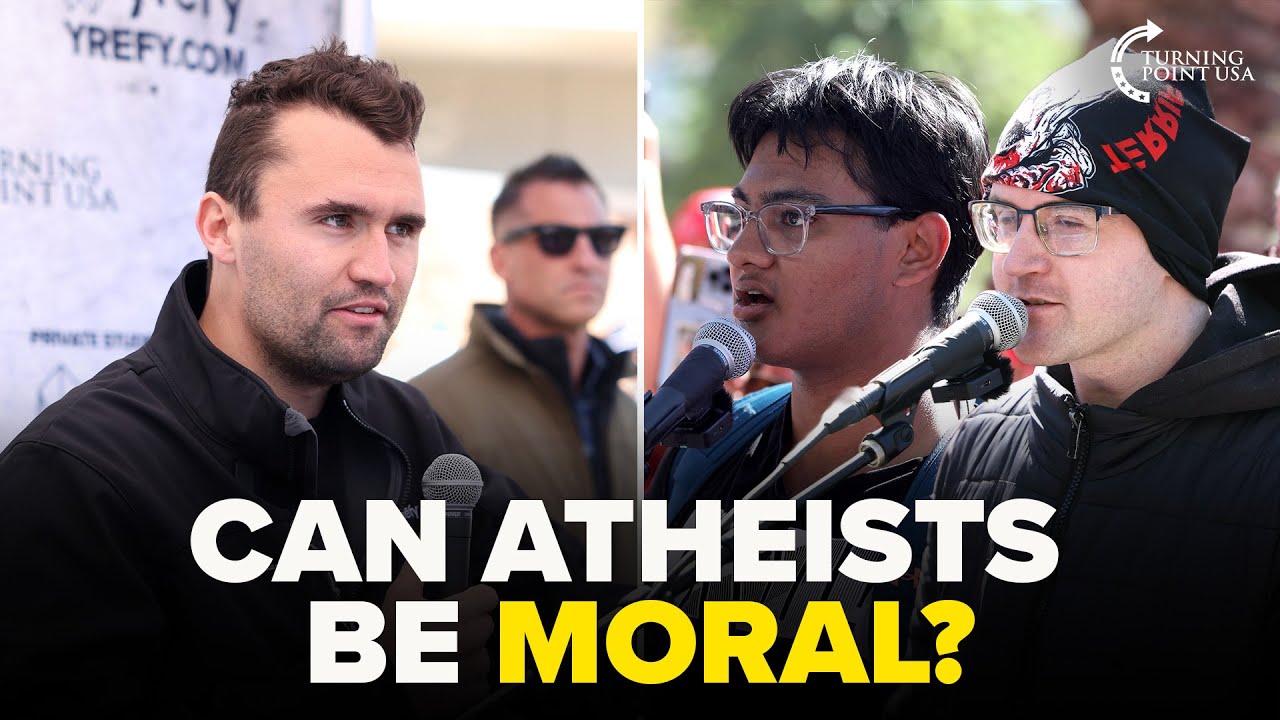
Charlie Kirk engages with an atheist conservative activist who questions whether Christians are hesitant to work with atheist organizations. The exchange becomes a powerful exploration of foundational questions: Can atheists claim objective morality? Was America founded on Christian principles or Enlightenment secularism? Kirk argues that while atheists are welcome in the conservative movement, they must acknowledge a critical truth, without God, morality becomes subjective preference, not objective truth. Drawing sharp contrasts between the American Revolution rooted in Christian faith and the bloody French Revolution anchored in atheist rationalism, Kirk makes the case that liberty itself is a divine concept, not a human invention.
The Question of Atheists in the Conservative Movement
A self-identified atheist attendee asks Charlie Kirk about working with atheist organizations in the conservative movement, specifically mentioning Thomas Sheedy, founder of Atheist for Liberty. The questioner suggests Kirk and other conservatives are hesitant to work with atheist organizations. Kirk's response is nuanced: atheists are welcome to fight alongside conservatives on issues like ending abortion, opposing gender-affirming care for children, and keeping men out of women's sports. However, Kirk insists that honest atheists must acknowledge something fundamental—without belief in God, morality is definitionally subjective, not objective.
Kirk draws a clear line: you cannot be an atheist and believe in objective morality. True atheists, he argues, will admit this. Christians and believers in the divine make "is" claims—murder is wrong. Atheists can only make "ought" claims—murder ought to be wrong. Without a divine eternal power above humanity, there can be no objective definition of right and wrong.
The Holocaust Test: Where Subjective Morality Leads
Kirk tests the questioner's position by asking whether the Holocaust was objectively wrong. The atheist responds honestly: objectively, no. It would have been better if it didn't happen because most people wouldn't want it to happen, but it wasn't objectively wrong. Kirk presses further—was Hitler objectively evil? Again, the answer is no, because morality is subjective.
Kirk commends the questioner for being an honest atheist, noting that this is precisely the problem. From Kirk's worldview, when you butcher six million people, that is objectively wrong no matter what. This distinction matters immensely because when you do not have objective truth anchoring your society, it becomes a power struggle. If you do not have truth, then power will reign. Whoever can get the most amount of power ends up having the most say over society. Christians believe what is objectively right, true, good, and beautiful should be transcendent over society.
The Source of Objective Morality
When asked if objective morality comes specifically from the Bible, Kirk offers a broader explanation. Objective morality exists in nature, and the Bible explains nature. It can be discovered in many different cultures and societies, all pointing toward what Christians believe is the ultimate objective truth: Jesus Christ. Kirk references C.S. Lewis's book Abolition of Man, which explains that almost every religion talks about a certain way to live—a Dao or a path.
More simply than just the Bible, Kirk believes in what the founders believed: ethical monotheism. There is one God who has a general way He wants people to live—murdering is bad, kidnapping is wrong, defense of the innocent is good. Society should do its best to live alongside that path.
Hitler, Christianity, and Atheism
The questioner pushes back, noting that Hitler was a self-proclaimed Catholic who called Nazism a Christian movement, pointing to the belt buckles that read "God on our side." Kirk cautions against this characterization, noting that Hitler killed many pastors and priests. While acknowledging that people can pervert things in the name of God, Kirk points out that far more people died under the banner of atheism than Christianity in the 20th century. Mao was an atheist. Stalin was an atheist. Pol Pot was an atheist. Believing in no god led to the destruction and murder of well over a hundred million people.
Kirk reiterates his position: if atheists want to come alongside conservatives and fight for what is good, that's great. But he will never acknowledge that atheists can tell him what is objectively good. They can only give him a preference, and preferences eventually lead toward moral and societal decline.
America's Christian Foundations Versus Enlightenment Secularism
The atheist questioner argues that the founders were actually inspired by Enlightenment values, not by the Bible, claiming America was founded as a secular nation with the first "godless constitution." Kirk has addressed this argument many times before and provides extensive evidence to the contrary.
Fifty-five out of 56 signers of the Declaration of Independence were Bible-believing, church-attending Christians. Nine out of 13 states required a declaration of faith in their title of ratification for someone to serve in the states. America's birth certificate, the Mayflower Compact, said explicitly that the settlers were there to spread Christianity throughout the land. The First Great Awakening, led by Jonathan Edwards, Jonathan Mayhew, and George Whitfield, preached all across the eastern seaboard and led to the American Revolution.
John Adams famously said, "The Constitution is written solely for a moral and religious people. It's wholly inadequate for the people of any other." America was a Christian nation that was able to embrace the idea of a free society. God is mentioned four times in the Declaration of Independence. Jesus Christ is mentioned in the Declaration where it says "we appeal to the divine judge of the universe," which is a direct appeal to Jesus in the book of Revelation.
Kirk acknowledges that rationalist Enlightenment values informed some of the founders, but argues it was irrefutably a Christian nation. Maryland was Catholic. Pennsylvania was Quaker. Almost every state had its own specific type of Christian preference. The idea of an atheist or not believing in any god was so foreign to the founders that even Thomas Jefferson, the great deist, revered the Bible, albeit with some significant edits.
The French Revolution as Cautionary Tale
Kirk's final argument draws a stark contrast between two revolutions happening simultaneously. The French Revolution was explicitly atheist. The revolutionaries created their own gods and appealed to the "god of reason." They literally tried to change the Gregorian calendar to a 10-day week. They imprisoned people of faith and put priests in jail.
How did appealing to the God of reason work out? It resulted in the guillotine and the slaughter of tens of thousands of people. The French Revolution was one of the greatest disasters in human recorded history, eventually killing even its own leader, Maximilien Robespierre.
Contrast that with the American Revolution. Why did the American Revolution create the greatest nation ever to exist in the history of the world while the French Revolution resulted in blood and chaos? Kirk's answer is clear: America was anchored on Christian ideas. If you are not anchored on Christian ideas, then don't be surprised when there is no fruit to the harvest you're trying to create.
Liberty as a Divine Concept
Kirk circles back to the original question about "Atheist for Liberty," noting that he finds the phrase interesting because he doesn't believe you can have liberty without God. Liberty is not man's idea—it is God's idea. This is Kirk's personal belief, and it's also the belief of everything that built America. While he knows many good atheists, the question remains: how do you know they're good? It's because you're appealing to a moral authority above just the secular material realm, one that Christians believe is transcendent and given by God.