Up Next

Charlie Kirk on the Crisis of Courage and Self-Censorship Destroying America
17:28
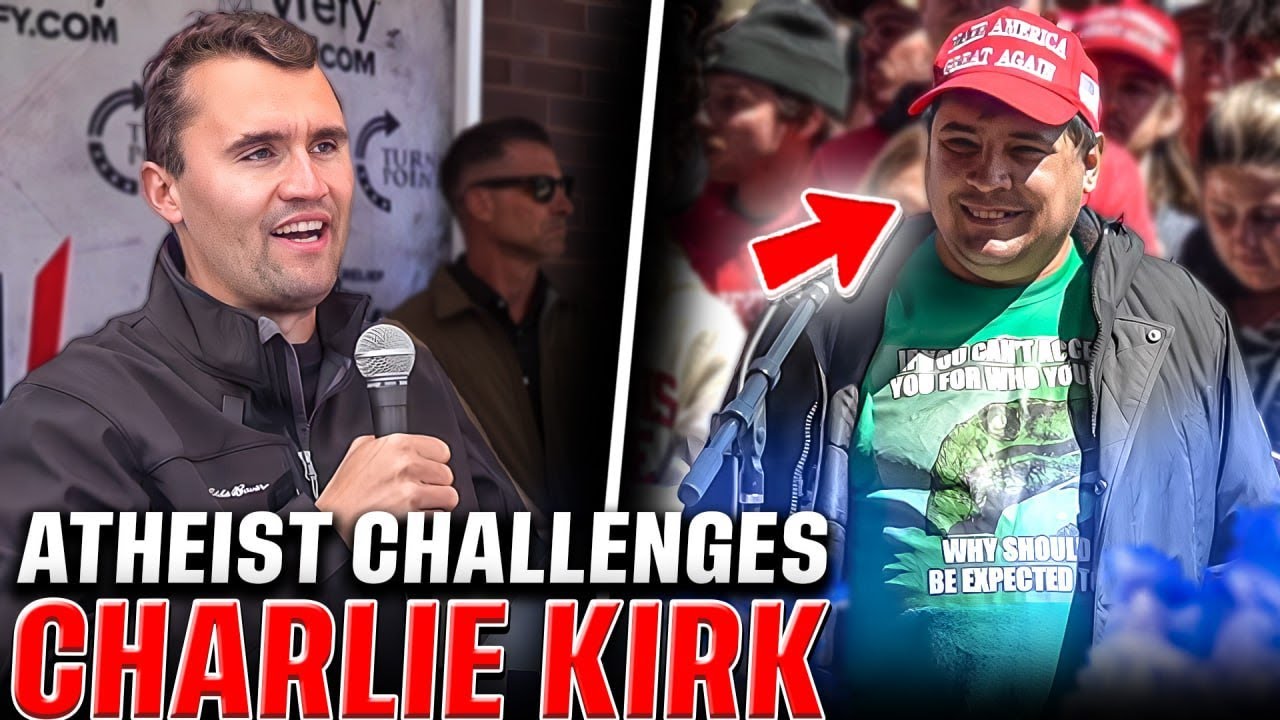
Charlie Kirk Presents Five Classical Arguments for God's Existence to Devout Atheist at Turning Point Event
8:46

Charlie Kirk Challenges Students on Faith, Immigration, and Foreign Policy at Michigan State Campus Event
1:43:56
Charlie Kirk Debates Young Atheist on Objective Morality, Hitler, and the Christian Foundations of America
Charlie Kirk confronts a young atheist activist about the impossibility of objective morality without God. The exchange grows heated as the atheist admits he cannot say Hitler was objectively evil or the Holocaust objectively wrong. Kirk argues that without transcendent truth anchoring society, power fills the vacuum, and that America's founding was explicitly Christian, not secular. The debate touches on the French Revolution's atheistic disaster, the cosmological argument for God's existence, and whether the disciples would have died for a lie about Christ's resurrection.
The Honest Atheist Dilemma
The exchange began when a young man introduced his friend Thomas Sheety, founder of Atheists for Liberty, and asked whether Charlie Kirk hesitates to work with atheist organizations within the conservative movement. Kirk's response was direct: atheists are welcome in the movement, but they must be honest about the philosophical implications of their worldview.
Kirk explained that an honest atheist must acknowledge that morality is definitionally subjective without belief in God. You cannot be an atheist and believe in objective morality—it's an impossibility. Christians and believers in the divine make "is" claims: murder is wrong. Atheists can only make "ought" claims: murder ought to be wrong because we prefer it that way. Without a divine eternal power, there can be no objective definition of right and wrong.
The young questioner, revealing himself to be an atheist, admitted he doesn't believe in objective morality. When Kirk asked whether the Holocaust was objectively wrong, the response was stunning: "Objectively, no, but it would have been better if it didn't happen because most people wouldn't want that to happen." Kirk commended him for being an honest atheist—because atheism logically cannot permit anyone to say anything is objectively right or wrong.
Power Versus Truth
Kirk emphasized a principle that defines the conservative Christian worldview: when you do not have objective truth anchoring your society, it becomes a power struggle. If you do not have truth, then power will reign. Whoever can accumulate the most power ends up having the most say over society. Christians believe what is objectively right, true, good, and beautiful should be transcendent over society—not determined by whoever holds the gun or controls the government.
This truth claim matters immensely when applied to history. Kirk pointed out that he comes from a worldview that says when you butcher six million people, that is objectively wrong, no matter what. The atheist across from him could not make that claim. This is not a trivial philosophical difference—it's the difference between a society grounded in truth and one adrift in subjective preference.
Does Objective Morality Come from the Bible?
The questioner asked whether Kirk believes objective morality specifically comes from the Bible. Kirk's answer was nuanced: it's in nature, and the Bible explains nature. Objective morality can be discovered in many different cultures and societies, all pointing toward what Christians believe is the ultimate objective truth—Jesus Christ.
Kirk referenced C.S. Lewis and his book "Abolition of Man," which explains that almost every religion talks about a certain way to live—a Tao or a path. More simply than just the Bible, Kirk said he believes in what the founders believed: an ethical monotheism. There is one God. He has a general way that He wants people to live. For example, murder is bad, kidnapping is wrong, defense of the innocent is good, and society should do its best to live alongside that path.
Hitler, Christianity, and Atheism's Death Toll
The atheist pushed back, claiming Hitler was a self-proclaimed Catholic who called Nazism a Christian movement. Kirk acknowledged that people can pervert things in the name of God—no one denies that. But he also made a critical historical point: far more people died under the banner of atheism than Christianity in the 20th century.
Mao was an atheist. Stalin was an atheist. Pol Pot was an atheist. Believing in no god led to the destruction and murder of well over 100 million people. Kirk clarified that if atheists want to come alongside conservatives and fight for what is good—ending abortion, stopping the harm of gender affirming care, keeping men out of women's sports—they are more than welcome. But he will never acknowledge that atheists can tell him what is objectively good. They can only give a preference. They cannot tell him what is right. And preferences eventually lead toward moral and societal decline.
Was America Founded as a Secular Nation?
The questioner claimed that America was founded as a secular nation, inspired by Enlightenment values rather than the Bible—the first "godless" constitution. Kirk has debated this claim many times, and he laid out the evidence methodically:
- 55 out of 56 signers of the Declaration of Independence were Bible-believing, church-attending Christians
- Nine out of 13 states required a declaration of faith in their ratification documents for public service
- America's birth certificate, the Mayflower Compact, explicitly stated the settlers were there to spread Christianity throughout the land
- The First Great Awakening—led by Jonathan Edwards, Jonathan Mayhew, and George Whitefield—preached across the eastern seaboard and fueled the American Revolution
- John Adams famously said the Constitution was written solely for a moral and religious people, and is wholly inadequate for any other
- God is mentioned four times in the Declaration of Independence
- Jesus Christ is referenced in the Declaration when it says "We appeal to the divine judge of the universe," a direct appeal to Jesus in the book of Revelation
Kirk acknowledged that rationalist Enlightenment values informed some of the founders, but insisted it was irrefutably a Christian nation. Maryland was Catholic. Pennsylvania was Quaker. Almost every state had its own specific type of Christian preference. The idea of an atheist or someone not believing in any God was so foreign to the founders that they would have found it extraordinarily dangerous.
The French Revolution as a Warning
Kirk contrasted the American Revolution with the French Revolution, which was happening simultaneously but was explicitly atheist. The French revolutionaries recreated their own gods and appealed to the "god of reason." They tried to change the Gregorian calendar to a 10-day week. They imprisoned people of faith and put priests in jail.
How did that work out? It resulted in the guillotine and the slaughter of tens of thousands of people. The French Revolution was one of the greatest disasters in human recorded history. Why did the American Revolution create the greatest nation ever to exist, while the French Revolution ended in blood and chaos—even killing their own leader, Maximilien Robespierre? Because America was anchored on Christian ideas. When you are not anchored on Christian ideas, don't be surprised when there is no fruit to the harvest you're trying to create.
The Instrumentalist Escape Hatch
As the debate continued, Kirk pressed the young man on whether he believes in absolute truth. The response was evasive: "I'm not sure you can provide me positive evidence that there is absolute truth." Kirk asked if he was absolutely not sure. The reply: "I'm not sure if I'm absolutely not sure."
Kirk pointed out that saying you're not sure means you are not even sure if you're not sure—at some point, you have to make a truth claim. The atheist tried to escape by invoking instrumentalism, a philosophical tradition that views truth as a utility chosen pragmatically. Kirk continued probing: Are you alive? Is the sun shining? Each question was met with qualified answers rooted in pragmatism rather than certainty.
When Kirk asked if murder is objectively wrong, the atheist asked whether he meant epistemologically or ontologically objective. Kirk clarified: morally objective. The answer remained no. Was Hitler objectively a bad person? Again, no. Kirk paused to let the audience absorb this: at its core, atheists cannot say that Hitler was bad.
The Cosmological Argument and God's Existence
Kirk shifted to a foundational question: How did the universe come into existence? The atheist admitted he doesn't know. Kirk pointed out that science says there was a Big Bang or beginning point. Using logic—which the atheist claims to value—if space, time, and matter had a starting point, then logically shouldn't something outside of space, time, and matter have started those things?
The atheist immediately asked how Kirk knows that cause is personal or worth praying to. Kirk clarified they were debating whether there is a god or not, not the specific attributes of God yet. Historically, as even Thomas Aquinas defined it, God is a personal God. Kirk accused many atheists of not wanting to worship or acknowledge God because they think they are God—and suggested the young man embodied that attitude well.
The Disciples and the Resurrection
Kirk asked whether the atheist believes Jesus Christ was a real historical figure. The answer was yes. Does he believe the gospels are historically accurate and provable with archaeological evidence? The response: some parts are, some are metaphors, some are allegories, some are literal—it depends.
Kirk asked why the disciples would lie about the resurrection of Christ using rational analysis. The atheist suggested they could have been mistakenly wrong. Kirk pressed: they would be mistakenly wrong up to the point where they were martyred? The whole point of being mistakenly wrong is believing something is true all the way up until death.
Kirk clarified the atheist's position: the 12 disciples who knew Christ best, saw Him die, and then all believed a mistaken conspiracy for the rest of their lives—all of them together. The atheist affirmed this view, claiming there is no firsthand account from the 500 witnesses mentioned in scripture, and that people have died for false claims throughout history.
Kirk corrected him: one of the gospels was written by Matthew the tax collector, one of Christ's closest associates. Luke was a fact-finder hired to investigate. The atheist insisted there's no firsthand evidence from the 500. Kirk disputed this and ended the exchange, telling the young man they would pray for him.
Video Transcript
0:00
I have a friend named Thomas Sheety. He
0:02
is the founder of a organization called
0:04
Atheist for Liberty. He is openly
0:06
conservative. Um, but he's mostly
0:08
interested in atheist activism and
0:10
normalizing atheism in all sects,
0:12
including the conservative movement. He
0:15
seems to be under the impression that a
0:16
lot of conservatives um, including you,
0:18
are more hesitant to work with atheist
0:20
organizations. Is there any truth to
0:22
that?
0:23
Yes and no. I mean, if you're an atheist
0:25
and you want to be part of the
0:26
conservative movement, go ahead. But you
0:28
must be an honest atheist and
0:30
acknowledge that morality is
0:31
definitionally subjective without a
0:34
belief in God. That you cannot be an
0:36
atheist and believe in objective
0:37
morality. It is an impossibility. And
0:39
true atheists will acknowledge this. At
0:41
some point you have an ought claim.
0:43
Well, things ought to be a certain way.
0:45
We as Christians or we that believe in
0:47
the divine, we have is claims that there
0:50
murder is wrong. Whereas an atheist will
0:52
say, "Well, murder ought to be wrong
0:54
because you can't have an objective
0:56
definition if there is not a divine
0:58
eternal power over you." So, look, if an
1:00
atheist wants to fight alongside of us
1:02
to end abortion or to try and end the
1:05
massacring of our kids, that's called
1:07
gender affirming care. And or if an
1:09
atheist wants to march alongside of us
1:11
to say no men and female sports, they're
1:13
more than welcome to be able to do that.
1:15
But atheist for liberty is an
1:17
interesting phrase because I don't
1:19
believe you can have liberty without
1:20
God. because liberty is not man's idea.
1:22
It is God's idea. That's just my own
1:24
personal belief and it's also the belief
1:26
of everything that built this nation.
1:28
But yes, I'm I'm I know a lot of good
1:30
atheists. The question though is how do
1:32
you know they're good? It's because
1:33
you're appealing to a moral authority
1:35
above just the secular material realm.
1:37
One that is transcendent, we would
1:40
believe given by God.
1:42
Um well, I I don't believe in objective
1:45
morality. I do know there are plenty of
1:47
atheists who are moral objectivists.
1:48
Are you an atheist? Sorry to interrupt,
1:50
but
1:50
Oh, yeah. Yeah. So, let me just Can I
1:52
ask you a question? And I don't mean I
1:54
know this is your first time at the mic,
1:55
so I'm just going to try to be tender in
1:56
doing this.
1:57
Okay. Appreciate that.
1:57
So, you don't believe in objective
1:59
morality, right?
2:00
I personally don't.
2:00
Okay. Uh, was the Holocaust objectively
2:02
wrong?
2:03
Objectively, no, but it would have been
2:05
better if it didn't happen because most
2:07
people wouldn't want that to happen.
2:08
So, that's that's where we that's where
2:11
we are on different planets.
2:13
Um, and that's okay. I'm not trying to
2:14
make fun of you. I'm trying to be
2:15
graceful in the way that we're going
2:16
about this. Do you think Hitler was
2:19
objectively evil?
2:22
No, because it's subjective.
2:24
But I just hope all of you guys
2:25
understand he's being an honest atheist
2:28
to your credit because as an atheist,
2:30
you're not allowed to say anything is
2:31
objectively right or wrong. I come from
2:34
a worldview that when you butcher six
2:36
million people that is objectively
2:38
wrong, no matter what. And and it's very
2:41
important truth claim because when you
2:44
do not have objective truth anchoring
2:46
your society then it becomes a power
2:48
struggle. If you do not have truth then
2:51
power will reign. Whoever can get the
2:52
most amount of power then ends up having
2:55
the most amount of say over society. We
2:58
believe what is objectively right, true,
3:00
good and beautiful should be
3:02
transcendent over society. Your
3:03
thoughts?
3:04
So do you believe objective morality
3:05
specifically comes from the Bible?
3:07
Yes and no. It's al it's in nature and
3:09
the Bible explains nature. So objective
3:12
morality can be discovered in many
3:13
different cultures and societies
3:15
pointing towards what we believe is the
3:17
ultimate objective truth Jesus Christ.
3:19
CS Lewis explained this the best in his
3:21
book abolition of man which is that
3:23
almost every religion talks about a
3:25
certain way to live a a Dao or a path
3:28
that we should be on. And so more more
3:32
simply than just the Bible, we believe
3:35
in what the founders believed, which is
3:36
an ethical monotheism that there is one
3:39
God. He has a general way that he wants
3:41
you to live. For example, murdering is
3:43
bad, kidnapping is wrong, defense of the
3:46
innocent, and we should do our best to
3:48
try to live alongside of that path.
3:50
Okay. Well, I think those are very
3:52
interesting examples. Uh, you bring up
3:54
the founders, you bring up Hitler, but
3:55
Hitler was a self-proclaimed Catholic
3:57
and he called Nazism a Christian
3:59
movement.
4:00
Yeah, I would be careful saying that he
4:02
was he was not. That's okay. I mean,
4:03
he called himself a Catholic. He said he
4:05
specifically said in 1927, "Our movement
4:07
is Christian." They had on the belt
4:08
buckles God on our side.
4:10
Yeah.
4:10
They they had to swear to the almighty
4:12
God. Uh, atheists were not trusted to be
4:14
in the SS. Even if I grant you that,
4:17
despite the fact that he killed a lot of
4:18
pastors and priests and
4:21
there of course you can pervert things
4:23
in the name of God, no one denounces
4:25
that. Just as a side note though, far
4:27
more people died under the banner of
4:29
atheism than Christianity in the 20th
4:31
century.
4:32
Mao was an atheist. Stalin was an
4:33
atheist. Pulpot was an atheist.
4:36
Believing in no god actually led to the
4:38
destruction and the murder of well over
4:39
a 100red million people. And that's
4:41
fine. So again, if atheists want to come
4:44
alongside us as conservatives and fight
4:46
for what is good, that is great. But I
4:48
will never acknowledge that atheists can
4:50
tell me what is objectively good. They
4:52
can only give me a preference. They
4:54
cannot tell me what is right. And
4:56
preferences eventually will lead you
4:58
towards moral and societal decline.
5:01
Okay. So I think you just listed a bunch
5:03
of communists. And it's worth
5:05
acknowledging the vast majority of
5:06
atheists are not communists, just like
5:07
the vast majority of Christians are not
5:08
theocrats who don't support the divine
5:10
right. It's also worth acknowledging
5:11
that the uh founders were actually
5:14
inspired by enlightenment values, not by
5:16
the Bible. America was found as a
5:18
secular nation. We were the first uh
5:20
quote unquote goalless constitution.
5:23
Yeah. Again, I've done this so many
5:24
times, so I don't know if we want to
5:26
waste our time doing this, but 55 out of
5:28
56 of the signers of the declaration
5:29
were Bible believing church attending
5:31
Christians. Nine out of 13 of the states
5:33
of the title of ratification required a
5:34
declaration of faith in order for you to
5:36
serve in the states. We were our birth
5:38
certificate which is the Mayflower
5:39
Compact said explicitly we are here to
5:41
spread Christianity throughout the land.
5:43
It was the first great revival that led
5:44
to the American Revolution of Jonathan
5:46
Edwards and Jonathan Mayhew and George
5:48
Whitfield that preached all across the
5:50
eastern seabboard. Jon Adams famously
5:52
said the constitution was written solely
5:53
for a moral and religious people. It's
5:55
wholly inadequate for the people of any
5:56
other. We were a Christian nation that
5:58
was able to embrace the idea of a free
6:00
society. God is mentioned four times in
6:02
the Declaration of Independence. Not
6:03
only that, Jesus Christ is mentioned in
6:05
the Declaration of Pence where it says,
6:06
"We appeal to the divine judge of the
6:08
universe," which of course is a direct
6:09
appeal to Jesus in the book of
6:11
Revelation. Yes, there were rationalist
6:13
enlightenment values that inform some of
6:15
the founders, but it irrefutably was a
6:17
Christian nation. Maryland was Catholic.
6:19
Pennsylvania was Quaker. Almost every
6:21
state had their own like specific type
6:24
of Christian preference. The idea of an
6:26
atheist or not believing in any God was
6:28
an idea that was so foreign to the
6:30
founders. Even Thomas Jefferson the
6:32
great deist he revered the Bible albeit
6:34
with you know some significant edits.
6:36
However, the idea of believing in no
6:39
cosmological or no axiological or no
6:41
teological or no ontological being would
6:45
be a concept that our founding fathers
6:46
and not just find foreign. They would
6:48
find it extraordinarily dangerous. Why?
6:50
Because the French revolution was
6:51
happening simultaneously as the American
6:53
revolution which was explicitly atheist.
6:55
They they actually recreated their own
6:58
gods and had they said we are going to
7:00
appeal to what the god of reason. And
7:02
this is my final contention is that when
7:04
I talk to atheists the French Revolution
7:06
is a great example. They literally tried
7:07
to change the Gregorian calendar to a
7:09
10-day week. They went and imprisoned
7:11
people of faith. They put priests in
7:12
jail. All these different sorts of
7:14
things. And they said we are going to
7:15
appeal to the god of reason. Well, how
7:17
did that work out? It worked out with
7:18
the guillotine and the slaughter of tens
7:20
of thousands of people. The French
7:21
Revolution was one of the greatest
7:23
disasters in human recorded history.
7:25
Contrast that with the American
7:27
Revolution. Why did the American
7:28
Revolution create the greatest nation
7:30
ever to exist in the history of the
7:31
world and the French Revolution resulted
7:32
in a lot of blood and even the killing
7:34
of their own once leader Maxmillian Rubs
7:36
Beier? It's because we were anchored on
7:37
Christian ideas. If you do if you are
7:39
not anchored on Christian ideas, then
7:41
don't be surprised and all of a sudden
7:43
there is no fruit to the harvest that
7:44
you're trying to create.
7:45
I'm an atheist, so I disagree with your
7:47
religious claims.
7:48
Uh do you believe in absolute truth?
7:52
question.
7:52
I'm not sure you can provide me positive
7:55
evidence that there is absolute truth.
7:56
So the qu the answer would be I'm not
7:57
sure.
7:58
Are you are you absolutely not sure?
8:00
I'm not sure if I'm absolutely not sure.
8:02
See this works if you say no, but it
8:03
doesn't work if you bottom out in the
8:04
I'm not I don't know question.
8:06
Right. No, but saying you're not sure is
8:08
you are not even sure if you're not
8:10
sure. So at some point you're just
8:11
always have to make a truth claim. Yeah.
8:12
No, you can just be not sure about
8:14
everything all the way down. I don't see
8:15
why you can't. And my answer would be I
8:17
think um truth is instrumentalist in
8:18
theory. I think it's a thing we choose
8:20
pragmatically. For the purposes of
8:21
discussion, I think you can say, "Yeah,
8:23
I think uh truth exists pragmatically."
8:25
Regardless of that, I don't see how you
8:26
get to God.
8:27
Are you alive?
8:28
Huh?
8:28
Are you alive?
8:29
I think I'm alive. Yeah.
8:31
Think you're alive?
8:32
Yeah.
8:34
Is the sun Is the sun shining?
8:36
I think it's shining. Yeah.
8:38
From my frame of reference, it is
8:39
shining. Notice Notice how none of this
8:43
I mean, notice how you've gotten no
8:45
steps closer to proving God.
8:47
No, I'm asking questions, man. Okay.
8:48
Yeah. But
8:49
are you sure we did it?
8:50
Yeah. I'm
8:52
Are you sure we didn't go?
8:54
I'm I'm sure in the pragmatic
8:55
instrumental.
8:56
How sure are you that we didn't?
8:58
In the pragmatic instrumentalist sense.
8:59
Absolutely sure. I see truth as a
9:01
utility.
9:01
So there is a truth that's absolute.
9:03
No, it's it's instrumentally true.
9:05
You just said it was absolute.
9:06
No, absolutely. Sure. In the
9:07
instrumentalist sense of the word truth.
9:09
This is a philosophical tradition that
9:11
dates back hundreds of years.
9:12
Instrumentalism.
9:13
Yeah. Which of course we don't subscribe
9:15
to obviously. So,
9:16
do you believe that murder is
9:17
objectively wrong?
9:19
Epistemologically objective or
9:20
ontologically objective?
9:22
Uh, morally.
9:24
See, you didn't answer the question, but
9:26
both both epistemologically and
9:28
ontologically. But for the purpose of
9:29
discussion,
9:30
what? Okay. So, by what you mean? No, I
9:32
don't think it's objective.
9:34
Was Hitler a bad person objectively?
9:37
No. If you mean by the way, by the way,
9:40
wait slowly. Tread slowly. No, no, but
9:44
he's being honest. At its core, atheists
9:46
cannot say that Hitler was bad.
9:48
Can Can I make the claim now?
9:49
Notice who here is relying on feelings
9:52
and not facts. Your argument is I feel
9:54
that Hitler was objective.
9:55
No, I know.
9:56
No, no, you feel that way. Can you
9:57
provide me evidence of how you know? Can
9:59
you provide me evidence that morality is
10:00
objective?
10:01
No, of course I can because
10:04
Well, first of all, morality is both
10:05
reason and revelation and it's built
10:07
within to us that murder is wrong.
10:08
Yeah.
10:09
Wait. Okay. Where's your evidence of
10:10
that?
10:10
Wait. Wait. I'm so sorry. Is that a
10:12
That's a claim, not evidence. That's a
10:13
claim.
10:14
Okay, we could we could spend multiple
10:15
hours, but in the Western tradition,
10:18
so notice how you're saying by
10:19
tradition, by by the standards, by these
10:22
all claims of non-truth.
10:23
Hold on. Yes, they are. We believe that
10:25
truth was revealed to us.
10:27
We believe claim
10:28
by God. Hold on, but let me let me We
10:30
can get there. You can keep on
10:31
interrupting us.
10:32
But but let me prove to you how silly
10:34
your viewpoint is,
10:35
and how self-evidently wrong,
10:37
okay? Is it objectively wrong to kids?
10:40
When you say objective, what I mean by
10:42
objective, [cheering]
10:48
once again, once again,
10:53
[cheering]
10:57
dude, can I ask you something? And I
10:58
No, no, no. Notice how you still haven't
11:00
given me dispositive evidence on reality
11:02
is objective. You're merely saying my
11:04
answer is I feel that way. Sure, I feel
11:06
that way. That's all I can It's object.
11:08
It's objectively wrong to the laws of
11:10
nature.
11:10
What law of nature?
11:11
Well, the self-evident nature of
11:13
existence.
11:14
Where is your proof that it's self? Show
11:15
me the logical proof that it's
11:16
self-evident.
11:17
Okay. It's it's in your reason that God
11:18
gave you in the consciousness.
11:20
Prove that God gave it to me. Prove that
11:21
God gave it to me.
11:22
Okay. But again, your existence is proof
11:24
of that. You you again, we can get back
11:27
down to the first principles of this.
11:29
But
11:30
you can, but you don't want to because
11:31
you know it doesn't look good. No, it
11:33
looks actually really good because
11:35
evidence for it
11:35
built within again interrupting does not
11:38
make you right. So,
11:39
but you keep repeating your point. I get
11:40
your point.
11:40
No, I don't. So, let me ask you a
11:42
question in closing since you can't
11:43
objectively say that Hitler was bad or
11:45
that child is is wrong.
11:47
So, how did the universe come into
11:50
existence?
11:51
I don't know.
11:53
Okay. But science says that it was a big
11:54
bang or a beginning point, right? Okay.
11:56
So, using logic which you believe in.
11:58
Is this the colum cosmological argument?
11:59
Well, again, you keep interrupting.
12:01
Using using logic, if space, time, and
12:04
matter
12:05
had a starting point, then logically
12:08
shouldn't something outside of space,
12:09
time, and matter have started those
12:11
things.
12:11
How do you know that cause is personal?
12:13
How do you know that cause is worth
12:14
praying to?
12:15
That's not That's not the question.
12:16
Wait, wait. Okay, sure, there is a
12:17
cause.
12:18
Oh, that cause is God cuz it's outside
12:19
of space, time. No, no, but you believe
12:22
in different things about God.
12:23
[cheering] You think that God is
12:24
personal?
12:24
That's not That's not what we're
12:25
debating. We're
12:26
No, we are arguing about God.
12:27
We're about
12:30
religion.
12:30
Hold on. No, we're not debating. We're
12:31
debating whether or not there's a god or
12:32
not.
12:33
No, the Christian god. I said religion
12:34
that you're a religious person. You're a
12:36
Christian in nature. You follow
12:37
religious tradition.
12:38
Calm down. You said you're an atheist.
12:39
Wait, no. God, God historically, Aquinus
12:41
even defines it this way is a personal
12:43
God. You still haven't gotten to me to
12:44
prove that it's personal.
12:45
I'm happy to get to that.
12:46
Okay, then get to it.
12:47
Look, here's here's what I find with
12:48
atheists. They don't want to worship or
12:51
acknowledge God because many atheists
12:53
think they are God.
12:54
And you embody that really well.
12:56
I didn't know you were a mind reader,
12:57
Charlie. This is news to me.
12:58
It's not a mind readader. I I could tell
13:00
by your behavior. I will say this. I
13:01
hope that you give your life to Jesus
13:03
Christ.
13:03
I hope you do. [cheering]
13:05
I hope you can find evidence. I hope you
13:07
can find evidence.
13:07
You know what's interesting? There is
13:08
evidence. There is evidence that Jes
13:10
Hold on. Last thing. Do you believe
13:12
Jesus Christ was a real historical
13:13
figure?
13:14
Yes.
13:14
Do you believe that the gospels are
13:16
historically accurate and we can prove
13:17
them with archaeological evidence?
13:19
Some parts are. Some parts are some
13:21
parts are metaphors. Some parts are
13:23
allegorories. Some parts are literal. It
13:25
depends. Some parts are attempts at
13:26
history. Why depends which book or
13:28
gospel?
13:29
Using rational analysis, why would the
13:31
disciples lie about the resurrection of
13:33
Christ?
13:34
Okay, we can talk about this. People
13:36
they can be mistaken mistakenly wrong
13:37
about it.
13:38
So they would be mistakenly wrong up to
13:39
the point where they get martyed.
13:41
The whole point the whole point of being
13:43
mistakenly wrong about something is you
13:44
believe it's true
13:45
all the way up until the point of death.
13:47
The whole point of being mistakenly
13:48
wrong about something is you
13:49
I just want to make sure I understand
13:50
your position. Your position is that the
13:52
12 disciples who knew Christ best saw
13:54
him die and then they all believed a
13:56
mistaken conspiracy for the rest of
13:58
their life. All of them together as a
14:00
conspiracy.
14:01
Yes. Yes. There is no firsthand account
14:04
from the 500. The gospels are all
14:06
written by these people. People have
14:08
died for crazy claims in the past that
14:09
we know aren't true. These are all facts
14:11
about history.
14:11
That's not correct. Okay. One of the
14:13
gospels was written by one of his
14:14
closest associates, Matthew the tax
14:16
collector. Luke was a factfighter that
14:19
was hired. No, I didn't say the gospels
14:20
weren't written by them. I said there's
14:21
no evidence from the 500 that he
14:23
appeared to. There's no firsthand
14:24
accounts.
14:24
Again, that's not correct. Thank you for
14:25
your time. We'll get to the next
14:26
question.
14:26
Okay, you can you can not answer.
14:28
We [cheering and screaming] will pray
14:28
for you. Thank you.
Related Books
Browse Conservative Books