2,422 videos 1,389,747,653 views US Joined Aug 30, 2018
Charlie Kirk is the Founder and President of Turning Point USA, the largest and fastest growing conservative youth activist organization in the country with over 250,000 student members, over 150 full-time staff, and a presence on over 2,000 high school and college campuses nationwide. Charlie is also the Chairman of Students for Trump, which aims to activate one million new college voters on campuses in battleground states in the lead up to the 2020 presidential election. His social media reaches over 100 million people per month and according to Axios, he is one of the "top 10 most engaged" Twitter handles in the world. He is also the host of “The Charlie Kirk Show,” which regularly ranks among the top news shows on Apple podcast charts.
Charlie Kirk Debates Atheist Student on Objective Morality and the Holocaust Question
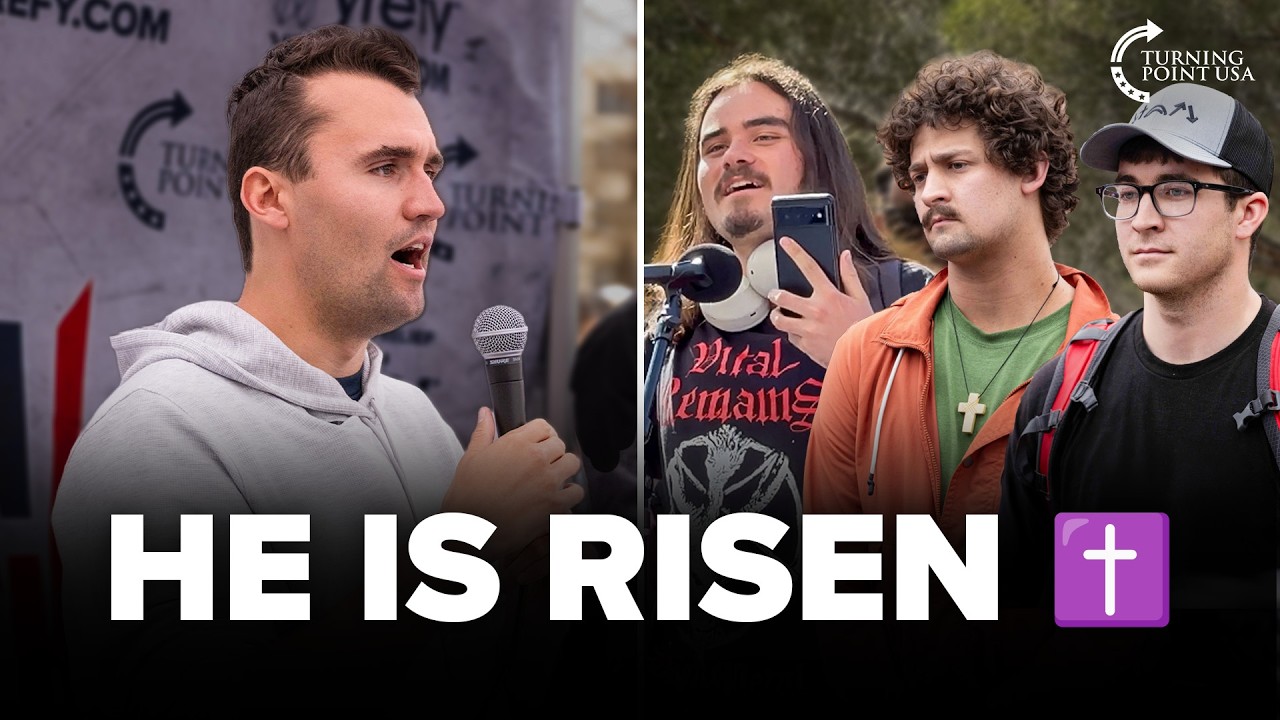
Charlie Kirk engages in a philosophical debate with an atheist college student who challenges the necessity of objective morality. The conversation takes a provocative turn when Kirk asks whether the Holocaust can be deemed objectively wrong without a transcendent moral standard. The student maintains intellectual consistency by admitting that under his atheist worldview, no moral claims can be objectively true or false, including the wrongness of Nazi atrocities. Kirk argues that the Bible provides the transcendent moral foundation necessary to declare acts like genocide objectively evil, while the student contends that morality stems from personal preference and feelings rather than absolute truth. The exchange highlights the fundamental divide between religious and secular approaches to ethics.
A student approached Charlie Kirk with a challenge to his frequent discussions about objective morality. The student's central question focused on whether moral statements require reference to religious texts. He argued that people make moral judgments constantly—saying they had a "good day," for example—without needing to consult scripture. Kirk immediately sought clarification, asking whether describing a "good day" referred to a pleasant experience or a morally good day, establishing the distinction between subjective experience and moral evaluation.
The student then presented a thought experiment: if an atheist were to encounter both the Quran and the Bible, read them both, and develop a preference for one over the other, wouldn't that demonstrate that morality is subjective rather than objective? He suggested that deriving moral feelings from reading different moral codes indicates that morality comes from within rather than from an absolute external source.
Truth, Evidence, and Flourishing Societies
Kirk responded by shifting the framework from preference to truth. He asked the student to imagine being on an island with two books: the Bible and Lord of the Rings. If someone ended up believing in one of those, which would be true? When the student began to answer about presuppositions, Kirk interrupted to establish his definition of truth as "what corresponds with reality."
Kirk then posed a practical question: which book, when applied in the natural world, actually demonstrates evidence of producing flourishing people and societies? He noted that even setting aside specifically Christian theology, most people would agree that at least eight out of the Ten Commandments provide excellent rules for living. The student acknowledged this but insisted his concern wasn't whether Christianity was good or bad, but rather whether one needs an absolute standard to determine right from wrong.
The Nature of Humanity and Moral Teaching
Kirk pressed the student on whether he believed people are naturally good or not so good outside of religious teaching. The student declined to make a definitive statement about human nature. Kirk then outlined the Christian perspective: human beings are fundamentally broken, sinful, and fall short of God's glory, requiring teaching to become good. He contrasted this with what he characterized as a common secular belief that humans are inherently good, and societal problems stem from external systems like capitalism or patriarchy rather than from human nature itself.
When Kirk asked whether the student believed in objective morality, the student clearly stated that he did not. Kirk appreciated this consistency, noting that many people are inconsistent on this point. The student explained his philosophical position using what he called "the is-ought problem"—the philosophical challenge of deriving prescriptive statements about what one should do from descriptive statements about what is.
The Murder Question and Cultural Practices
Kirk then asked whether the student believed murder is wrong. The student said yes, explaining that murder by definition is wrong killing. Kirk challenged this with a real-world example: in some African villages, missionaries have observed the practice of leaving unwanted newborn babies by the fire to die. The people in these communities don't consider this wrong; it's simply part of their cultural code and custom. Kirk asked whether they were wrong to do this.
The student responded that from his perspective, yes, they were wrong, but he immediately clarified that they weren't objectively wrong because he doesn't believe in objective morality. Kirk made the student repeat this position to ensure the audience understood: according to the student's worldview, it's not objectively wrong to abandon a newborn baby to die.
The Holocaust Test of Moral Philosophy
Kirk then escalated the example to the most extreme historical case: the Nazi Holocaust. He described putting a thousand Jews in a gas chamber, noting that the Nazis believed what they were doing was good when they pressed the button. He asked directly: were they right or were they wrong in gassing millions of Jews? The student maintained his position: one cannot objectively determine a truth value for moral claims, so one cannot say the Holocaust was objectively wrong.
Kirk pressed for absolute clarity: could the Nazis have been right in their actions? The student explained that "right" implies an actual objective thing, which he doesn't believe exists. He stated explicitly, after Kirk asked for confirmation multiple times, that the Nazis were not objectively evil. The student emphasized he wasn't saying they weren't wrong from his personal perspective—they absolutely were wrong—but that this wrongness cannot be established as an objective truth.
Kirk stated his contrasting view clearly: he believes the Holocaust was objectively wrong regardless of anyone's opinion because moral truth transcends individual or cultural perspectives. This transcendent moral standard, Kirk argued, is what prevents moral judgments from being mere matters of opinion.
Societal Implications and Moral Intuition
Kirk asked whether the student could see how his view might result in mass death and societal chaos. If a country adopted the student's philosophical framework and nobody believed the Holocaust was objectively wrong—just a matter of opinion—what would prevent such atrocities from occurring without anyone questioning them?
The student responded that he wasn't making a prescriptive claim about how people should behave or suggesting society should abandon Christianity. Rather, he was making a descriptive claim about how morality actually works. He argued that within his worldview, people generally agree on basic moral principles because of moral intuition—murder and stealing feel wrong because witnessing harm makes people feel bad. This shared feeling, not objective truth, creates moral consensus.
Kirk countered with the example of SS guards who didn't feel bad when killing Jews. The student acknowledged this reality, accepting it as consistent with his worldview. Kirk pointed out that this could unravel into mass murder and chaos. The student agreed that such things do happen in the real world, reiterating that he was describing how people actually derive their morals, not prescribing how they should.
Preference Versus Truth in Moral Systems
The student maintained that preference between moral systems has nothing to do with which one corresponds to reality or truth. Kirk suggested that perhaps the true moral system is the one that says not to gas Jews, not to murder, and warns that God will judge such actions harshly. Perhaps the true one says that life is good and that there is a Creator who loves humanity.
The student responded that Kirk was simply making claims about what he thinks or wishes were true—that it would obviously be beneficial if everyone had to follow a universally agreed-upon moral code. Kirk responded sarcastically, "If only a book existed," and "If only there was this amazing book," clearly referring to the Bible as that very source of objective moral truth.
The Atheist Nazi Question Answered
Kirk concluded by acknowledging the student's unusual philosophical consistency. He noted that the student was the first person ever to answer what Kirk called "the atheist Nazi question" clearly and without hedging: an atheist cannot objectively say that the Holocaust was wrong. Most people, Kirk observed, waffle on this point or try to find middle ground, but this student went directly to the logical conclusion of his worldview and accepted it.
The student confirmed he couldn't come to the debate and refuse to accept the implications of his argument. Kirk summarized their exchange: they had achieved clarity but not agreement. Both thanked each other for the respectful and intellectually honest dialogue.