Charlie Kirk Defends Pro-Life Stance Through Science and Reason, Not Just Religion
Enjoying this? Share it with someone who needs to see it.
Up Next
Charlie Kirk Shares His Fifth Grade Testimony and Answers Students' Questions on Christianity, Politics, and Faith
9:53
Charlie Kirk Defends Why Abortion Is Worse Than the Holocaust in Magnitude and Moral Terms
39:03
Charlie Kirk Defends Trump, Debates Abortion and Feminism at Cambridge Union in Heated Exchange
1:06:27
Charlie Kirk Defends Pro-Life Stance Through Science and Reason, Not Just Religion
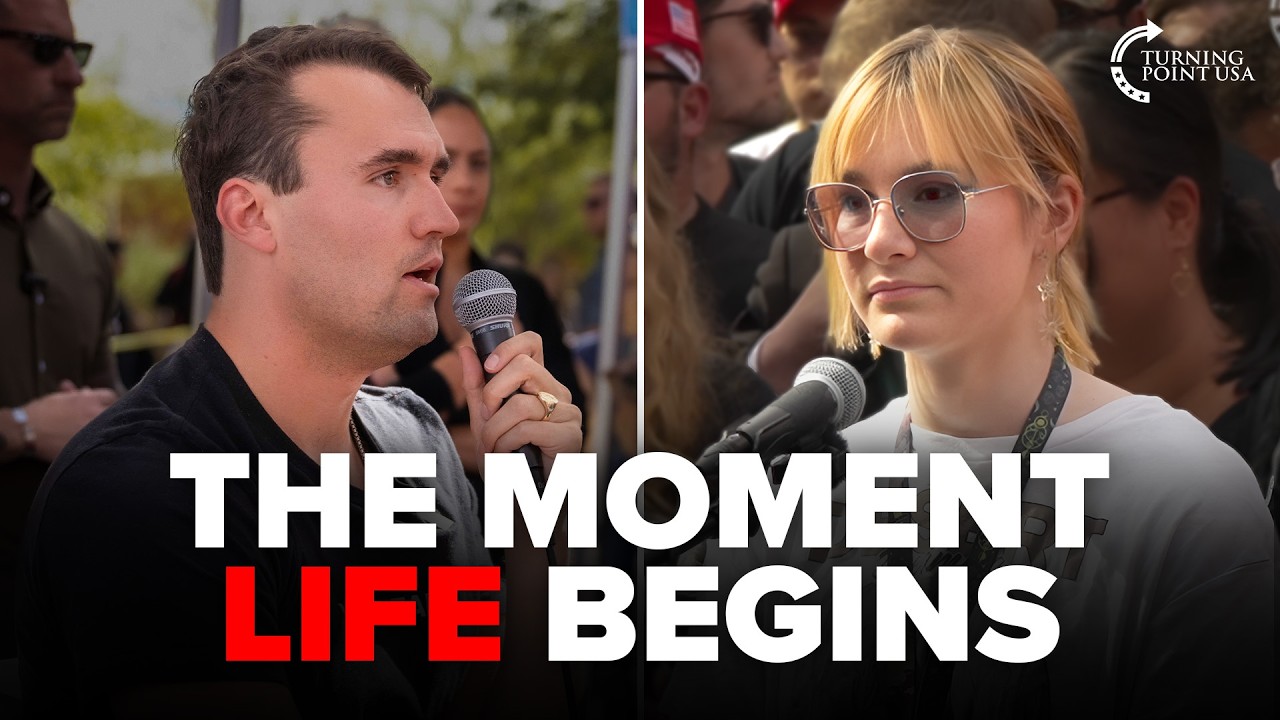
Charlie Kirk engages in a detailed debate with a college student who challenges his pro-life position, assuming it stems solely from Christian beliefs. Kirk argues his stance is grounded in universal science, biology, and reason, not just religious values. The conversation explores when human life begins, the role of DNA at conception, medical exceptions including life of the mother scenarios, and the safety of C-sections versus abortion. Kirk also addresses how Christianity has shaped Western moral principles including human rights, freedom, and the abolition of slavery, while maintaining that moral truths can be defended through reason independent of religious text.
Defending Life Through Science and Universal Principles
When a student approaches Charlie Kirk assuming his pro-life stance stems purely from Christian values, Kirk clarifies his position. While he personally believes his religion forbids abortion, he defends his pro-life views through universal science, biology, and reason. This distinction becomes the foundation for an extensive debate about abortion law, religious influence on legislation, and when human rights begin.
The student argues that abortion laws represent an integration of church and state, favoring certain religions over others. She advocates for a simple approach: if you don't want an abortion, don't get one. Kirk counters with a fundamental question that reframes the debate: under that logic, shouldn't we eliminate murder laws and simply say if you don't want to murder your neighbor, don't murder your neighbor?
When Does Human Life Begin?
The conversation shifts to the core question: when does human life begin? The student admits she doesn't believe human life starts at conception, suggesting instead that life begins after the third trimester. Kirk points out this would essentially mean at birth, since there are only three trimesters.
Kirk presents his view grounded in scientific fact: fundamentally, humans are defined by their DNA, as demonstrated by the Human Genome Project. He explains that when a sperm fertilizes an egg, entirely new DNA is created—not just a continuation of the parents' DNA, but unique genetic code with new characteristics, inclinations, and agency. This moment of fertilization, when the egg attaches to the uterine wall, marks the beginning of a distinct human life.
When the student suggests that sperm also contains human DNA, Kirk clarifies the distinction: unfertilized sperm is not a human being because it hasn't been fertilized. Once fertilization occurs, however, a third unique DNA sequence is formed—the beginning of the human development process that continues through the neonatal stage, childhood, adolescence, adulthood, and into elderly years.
Medical Exceptions and Life of the Mother
The student raises concerns about medical exceptions, particularly cases where a woman's body cannot facilitate giving birth and her life is at risk. She argues there should be exceptions in abortion law for these situations. Kirk responds by introducing an alternative that's often overlooked in these debates: Cesarean sections.
He explains that when a woman is 30 weeks pregnant and told the baby might harm her, the option should be to deliver the baby via C-section rather than terminate the pregnancy. According to Kirk, C-sections are actually a safer alternative for both mother and baby than abortion. The key difference: with a C-section, there's a chance of life for both; with an abortion, there's definitively a dead body.
Kirk acknowledges these life-threatening situations but emphasizes how extraordinarily rare they are—under 150 cases. He argues that 99.5% of all abortions are performed as a form of birth control, not because of rape, incest, or life of the mother. These are cases where someone experiences an unintended pregnancy and chooses abortion out of regret or inconvenience.
Finding Common Ground on Exceptions
Kirk attempts to find agreement with the student: if they can agree that life of the mother should be allowed as an exception for abortion, can they then outlaw all other types of abortion? The student doesn't fully disagree with this premise, focusing instead on making way for the exceptions.
Kirk explains why pro-life advocates are cautious about exception language. First, the "life of the mother" exception is often overused and confused. Second, regarding rape and incest, pro-life advocates believe that just because a baby is conceived in an ugly, awful, or evil way doesn't mean that baby should be denied human rights.
He addresses the medical reality: cases where a woman absolutely cannot carry a pregnancy without certain death are extraordinarily rare. Medical technology has advanced significantly. The earliest time of viability is now 22 weeks—babies born at 22 weeks can survive in a NICU, whereas 20 years ago this was considered impossible. The viability threshold keeps moving earlier as medical science advances.
The Problem with Medical Exceptions in Practice
Kirk raises a concern about how medical exceptions are implemented: OBGYNs sometimes lie to patients or fail to inform them of all options. When there's a break in the uterine wall around 30 to 35 weeks, doctors may present abortion as the only option without mentioning C-sections or what's called an ectopic pregnancy procedure, which is completely different from an abortion.
The pro-life moral standpoint, Kirk explains, treats both lives as equally valuable. Everything should be done medically—until all options have been exhausted—to save both lives. This represents a fundamentally different approach than defaulting to abortion when pregnancy becomes medically complicated.
Christianity's Role in American Law and Morality
The student questions whether laws should be based on religious beliefs, noting that Christianity has been used to oppress people throughout American history, including as a justification for slavery. Kirk acknowledges this historical misuse but offers a counterpoint: the largest justification for the eradication of slavery also came from Christianity.
Any religion can be misinterpreted and misapplied for evil or bad purposes, Kirk argues, but that doesn't mean the text or religion itself is evil. Christianity properly understood led to the abolition of slavery, the protection of individual rights, the creation of Western civilization, and free speech practices.
Kirk's position is nuanced: America is not a theocracy, but Christianity undergirds the entire society. Laws should stem from absolute truth, but they must be defendable using reason and universally agreed principles. Ideas that Americans consider common sense—universal human equality, protection of rights, the principle that children are off limits—are actually Christian ideas, not secular ones. In other countries without this Christian foundation, these principles are not universally accepted.
America's Christian Foundation
When the student suggests that if Kirk had been born in a Muslim country he wouldn't be Christian, he points out that Muslim countries don't have free societies. He challenges the student to name a country better than America. While she admits not many countries are better, she notes some excel in certain aspects.
Kirk argues this isn't coincidental. America is the greatest country in the world because it was foundationally Christian, built by Christians operating under a Christian ethic. The prosperity, flourishing, and freedom Americans enjoy are the inheritance of this Christian foundation. America used to have the freest society, and while that freedom has diminished, it's still spending down the inheritance of its Christian beginnings.
In contrast, Kirk notes that Muslim countries and secular countries don't have the same sort of prosperity, flourishing, or freedom. The Christian foundation isn't just about religious practice—it's about the moral framework that has allowed Western civilization to develop concepts of individual rights, human dignity, and limited government.