2,422 videos 1,389,747,653 views US Joined Aug 30, 2018
Charlie Kirk is the Founder and President of Turning Point USA, the largest and fastest growing conservative youth activist organization in the country with over 250,000 student members, over 150 full-time staff, and a presence on over 2,000 high school and college campuses nationwide. Charlie is also the Chairman of Students for Trump, which aims to activate one million new college voters on campuses in battleground states in the lead up to the 2020 presidential election. His social media reaches over 100 million people per month and according to Axios, he is one of the "top 10 most engaged" Twitter handles in the world. He is also the host of “The Charlie Kirk Show,” which regularly ranks among the top news shows on Apple podcast charts.
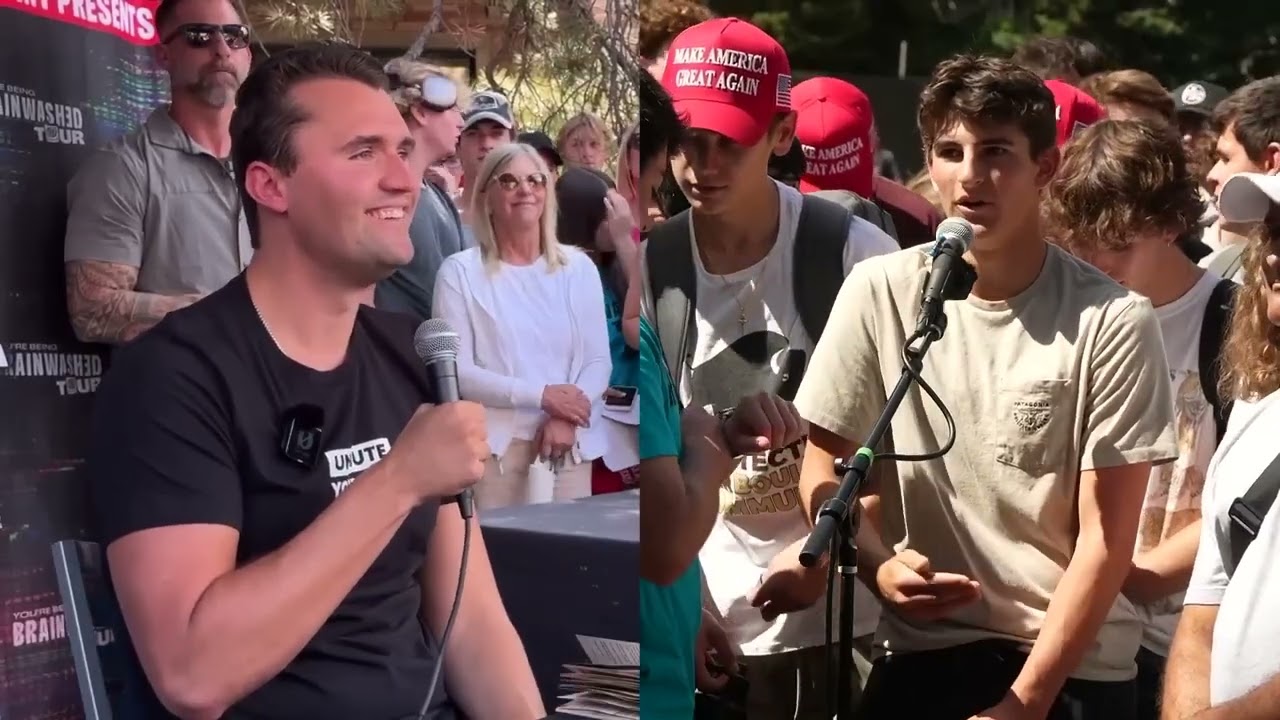
Charlie Kirk Presents Five Classical Arguments for God's Existence to Devout Atheist at Turning Point Event
Charlie Kirk engages in a thought-provoking dialogue with a self-described devout atheist who became conservative in 2016 but maintains his non-belief. The exchange covers five classical philosophical arguments for God's existence, ontological, cosmological, teleological, temporal, and axiological, as Charlie methodically presents each proof while the questioner remains unmoved. The conversation reveals a striking divide between faith-based and materialist worldviews, culminating in Charlie highlighting the contrast between Christian hope for eternal life and the atheist acceptance of complete finality at death. What emerges is not just a theological debate, but a window into how two people can view existence, meaning, and mortality from fundamentally different perspectives.
Conservative Atheist Challenges Religious Foundation of Movement
A self-described devout atheist who converted to conservatism during Trump's 2016 campaign approached Charlie Kirk with a challenge: how can the conservative movement attract more people of different faiths when so much of the messaging centers on Christian and, to a lesser extent, Jewish values? The questioner expressed his view that the Bible is a fictitious book filled with contradictions and suggested that the movement should focus more on ideas rather than religious beliefs.
Rather than directly addressing the political question, Charlie chose to tackle the foundation of the man's atheism head-on, offering to walk through the classical arguments for God's existence. What followed was a systematic presentation of five philosophical proofs, each met with skepticism and counter-arguments.
The Ontological Argument: The Weakest Link
Charlie began with the ontological argument, explaining that it derives from the Greek word for being. The argument suggests that the highest conception of human beings points to God, as we can only conceptualize that which is real. Charlie himself acknowledged this as the weakest argument for God's existence, and the questioner readily agreed, showing no persuasion from this philosophical approach.
The Cosmological Argument: Fine-Tuning and Probability
Moving to what he considered stronger ground, Charlie presented the cosmological argument, from the Greek word cosmos meaning all-encompassing creation. He outlined fifteen fine-tuned measurements that, if altered by even a micron, would make human existence impossible—the tilt of the earth, proximity to the sun, and the precise configuration of oxygen to carbon dioxide.
Charlie emphasized the staggering improbability of our existence, citing odds of one in multiple trillions that all necessary conditions would align at exactly the right time. He added that this doesn't even account for consciousness, human beings, or DNA complexity.
The atheist countered with the multiverse perspective: with millions of galaxies containing millions of stars and millions of planets, if Earth weren't in this exact configuration, life might have emerged elsewhere in the universe. Charlie responded simply that he didn't have enough faith to believe that, before moving to the next argument.
The Teleological Argument: Cause and Effect
The teleological argument, Charlie explained, comes from the Greek word telos, meaning goal, destination, or purpose—the root of the word telescope. The principle is straightforward: for every effect, there must be a cause. Since space, time, and matter exist, something outside of space, time, and matter must have created them.
The questioner pushed back, suggesting this doesn't necessarily disprove atheism. He proposed that a universe could have existed before the Big Bang, or that space could have existed without matter in a tiny point before expansion. For him, atheism simply means not believing God exists, and this argument didn't change that position.
The Temporal Argument: Time Requires a Timeless Creator
Charlie briefly presented what he called the "column proof of time," referencing Albert Einstein's discovery that time is a real thing that can be traversed with enough speed. The logical conclusion, Charlie argued, is that for time to exist, something timeless must have created it. The questioner did not find this compelling either.
The Axiological Argument: Universal Moral Law
The final argument Charlie presented was the axiological proof, from the Greek word axios meaning judgment. This argument posits that every human being has an innate sense of right and wrong embedded within them. Charlie cited the Nuremberg trials as evidence: the Nazis could not simply claim they were following the laws of the land. Instead, the trials appealed to a higher moral standard, acknowledging that every person has an understanding of good and evil within them.
The atheist appeared to misunderstand initially, suggesting this actually disproved the point since Nazis pointed to something outside themselves. Charlie clarified that it was actually the people conducting the trials who appealed to the higher standard, and the Nazis were not able to excuse their actions by claiming legal authority alone.
None of the Five Prove Persuasive
After presenting all five classical arguments for God's existence, Charlie asked which, if any, were persuasive. The answer was unequivocal: none. The questioner found no convincing evidence in any of the philosophical proofs.
Charlie then shifted to a more experiential approach, asking about the improbability of human existence—the precise way we are assembled, the ability of the human body to heal itself when cut, and our capacity for growth. The atheist dismissed this by noting that humans aren't the only beings capable of self-healing.
When Charlie pointed out that we are the only ones capable of reason, the questioner didn't see this as particularly remarkable. Even the ability of mammals and reptiles to reproduce life showed no evidence of intelligent design to him—just the consequence of natural selection and evolution over millions of years.
Comparing Faith Claims
Charlie made a pivotal observation: both of them operate on faith. In fact, he argued, the atheist has far more blind faith—believing that everything around us, including love, joy, peace, and sadness, is nothing more than neurons firing in the brain. The questioner agreed without hesitation: "Yeah, pretty much."
When asked if we're limited to our five senses, the atheist said no, noting that science acknowledges a sixth sense—an awareness of one's surroundings that doesn't require sight. A blind person can sense a microphone in front of them or know someone is nearby without visual input.
The Question of Death and Afterlife
Charlie posed the ultimate question: What do you think happens when you die? The answer was stark: nothing. Electronic impulses simply stop firing.
Then came the most revealing question of the exchange: Do you hope you're wrong? Not really, the atheist responded. He explained that as an atheist, he finds this life more compelling than he did when he was younger and religious. Believing this is the only life we have makes it more precious—we must do the best we can with the one chance we get. There is no afterlife, nothing after this, so the goal is to become the best people we possibly can in this single opportunity.
Christian Hope Versus Materialist Acceptance
Charlie expressed his astonishment at the position, asking the audience to internalize how dark and sad such a worldview is. The atheist hopes there is no eternal judgment and no reunion with loved ones after death. Charlie wasn't criticizing, but highlighting the stark contrast.
Christians, he explained, have hope—hope that they will see their loved ones again, that heaven awaits, that perfect peace is coming, and that this earthly existence is not the end. Something even better awaits believers.
Charlie closed with a gracious expression of hope that one day the questioner would seek to find something higher and better, recognizing that this is not all there is to our existence. The exchange ended cordially, with both men thanking each other for the conversation.