Charlie Kirk Reflects on Faith, Courage, and Defending Biblical Truth in Public Life
Enjoying this? Share it with someone who needs to see it.
Up Next
Charlie Kirk Sits Down with Bill Maher on Club Random: Discussing Faith, Politics, and Cultural Battles
1:10:43
Charlie Kirk Asks College Student: If You Believe in the Big Bang, Don't You Believe in God?
3:19
Charlie Kirk Declares Faith Courage and Freedom Essential at California Church Gathering with Pastor Bart Pierce
1:29:22
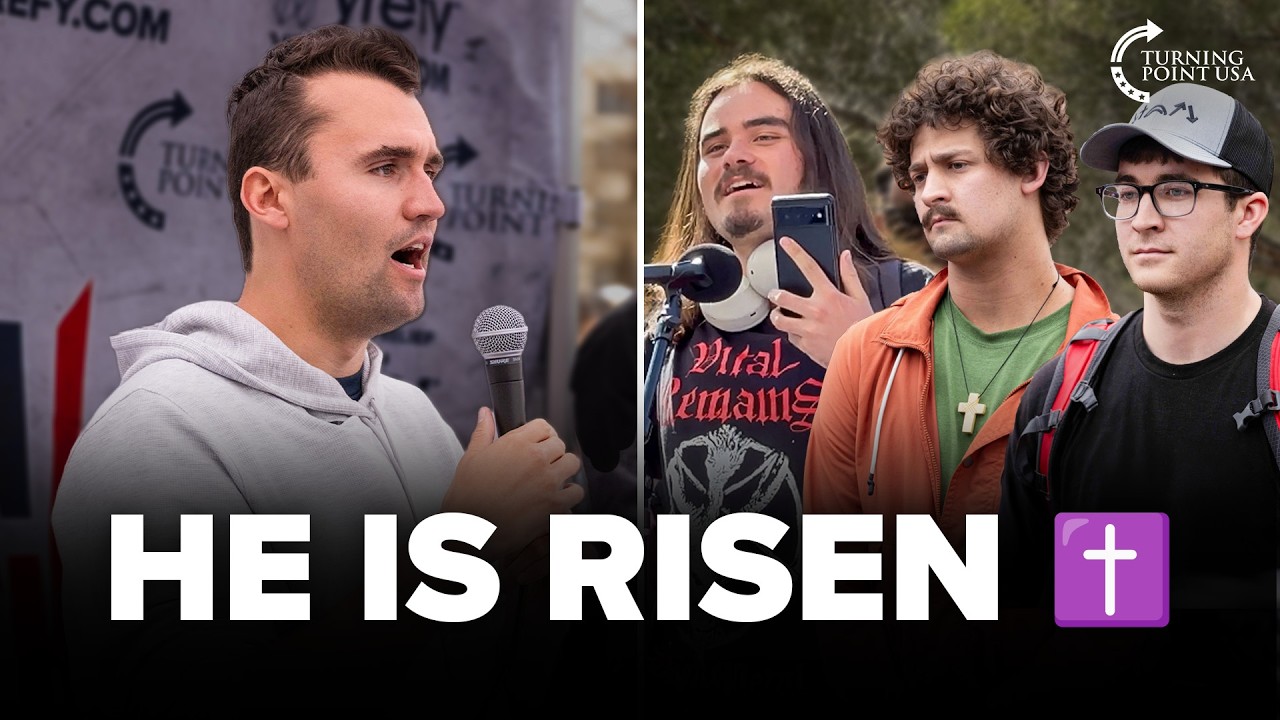
Charlie Kirk Reflects on Faith, Courage, and Defending Biblical Truth in Public Life
Charlie Kirk shares what matters most to him: being remembered for his courage and faith in Christ. In candid exchanges, he defends the biblical foundation of Western civilization, explains why he believes the resurrection is true, and challenges modern misconceptions about religion, morality, and the Ten Commandments. From debating evolution and the reliability of Scripture to explaining why the Founding Fathers were not deists, Kirk makes the case that America's best hope lies in returning to its Christian roots. He also reflects on his transformative experience visiting Israel, where the Bible came alive and strengthened his conviction that the Scriptures are not fairy tales, but the word of God.
If everything completely goes away, how do you want to be remembered? Charlie Kirk's answer is simple and profound: courage and faith. "I want to be remembered for my faith," he says. "That would be the most important thing. Most important thing is my faith in my life."
In this tribute, Kirk honors the life of a man whose life was stolen in an act of hatred, but who was also a husband, a father, and a brother in Christ. Through some of Kirk's favorite public moments, he defends the truth and glorifies God, offering a window into what drives his mission.
The Ten Commandments and the Foundation of the West
When asked about the separation of morality and state, Kirk doesn't hesitate: "Of course not." He argues that the morality that built the West is rooted in the Ten Commandments, which he describes as "the best rules of life for any society to flourish and to be able to succeed."
Kirk recites the commandments: You shall have no other gods before me. You shall have no other idols. You shall not take the Lord's name in vain. Honor your mother and father. Honor the Sabbath day and keep it holy. Do not murder. Do not steal. Do not bear false witness. Do not covet. Do not commit adultery.
"Those rules for life is what the founders believed so much so that they're in the halls of Congress and the Supreme Court," Kirk explains. "We believe it is transcendently transmitted to us, and when we do not submit to those Ten Commandments, our country starts to fall apart."
Debunking the Myth That Religion Causes War
When challenged with the claim that religion entangled in government causes most wars, Kirk quickly dismantles the argument with historical facts.
"What religion did Mao Zedong believe in?" he asks. "He was an atheist. What religion did Joseph Stalin believe in who killed over 30 million people of the Soviet Union? He was an atheist. So that's 80 million people murdered in two countries in just the 20th century that did not believe in any religion."
Kirk continues: "It's an easy talking point to say that religion causes war, but in reality, it seems as if totalitarian dictatorships rooted in atheism and a lack of the divine is what caused more human suffering in the 20th century than not."
He also addresses Adolf Hitler, clarifying: "Adolf Hitler was not a Christian. Adolf Hitler was at war with God and thought he was God and a total maniac."
Why Kirk Believes the Bible Is True
When asked why he believes the Bible is real, Kirk offers multiple reasons:
There's never been an archaeological discovery that has contradicted the truth of the Bible
There is not a truth of the Bible that if you apply to your life, your life does not improve dramatically
We have the most accurate and transparent historically robust account of the most important figure ever to live: Jesus of Nazareth
"The resurrection is the pinpoint of my belief that Jesus did rise from the grave so that we may live," Kirk says. "If Genesis 1:1 and the resurrection is true, anything in the Bible is possible."
Evidence for the Resurrection
Kirk explains why he believes Jesus rose from the dead: "Show me another historical piece of a story where so many people willingly died a brutal death for a lie. Every single person around him had everything to lose and yet they went to the absolute death from Paul to Peter to the half-brother of James saying that Jesus is Lord."
He points to additional evidence: "If you were going to fake a story, you would not use female witnesses in the ancient world. In the scriptures, it said that the women were the first one to see Jesus Christ. If you're trying to fake a story, you would never do that. Not to mention the 500 people that saw Jesus after he rose from the dead."
Kirk's Views on Creation and Evolution
When questioned about evolution, Kirk navigates the issue carefully. "I believe the scriptures to be true. And I also acknowledge that there is an abundance of scientific research that shows adaptation. Species change is heavily inferred in the data. I don't know enough about it, but I believe the scriptures to be true."
He explains that believers can hold different views on this topic: "Very smart Christians are on both sides of this issue. There's what we call in Christianity closed-hand theological issues and open-hand theological issues. Closed hand issues would be like the resurrection of Christ, the trinity, and then there's open-handed which would be like eschatology or the eucharist or the creation account."
What Kirk firmly believes is that humans are distinct from animals because they are made in the image of God. "The scriptures say that God created humans male and female distinct. They are the only ones in Genesis 1:26-27 made in the image of God. He called animals good, but they are not image bearers."
The Importance of Communicating Christ
Kirk acknowledges the challenges of communicating faith in the public square: "It's very hard to communicate Christ and then also to challenge people to think, okay, what are the ramifications of your belief in Christ, especially politically, especially culturally. That gets real hard."
He emphasizes the importance of respectful dialogue: "Tolerance is not an atheist and I agree. No, we don't agree. Tolerance is although you are an atheist, I respect you and we're going to have an intelligent dialogue. That's what a liberal arts education is all about. A free exchange of ideas where we don't necessarily agree, but we communicate respectfully and we explain why we believe what we believe."
The Myth of the Deist Founding Fathers
Kirk strongly challenges the narrative that America's Founding Fathers were not Christians: "It is one of the most sinister, most unsubstantiated lies that does not come up against any sort of academic scrutiny. This idea that founding fathers were a bunch of enlightenment common law deists."
He offers compelling evidence: "If the founding fathers were not Bible believing church Christians, why did they put Leviticus on Liberty Bell? Not John, not Psalms, not Proverbs, not Genesis. Leviticus. Leviticus 25:10. Proclaim liberty throughout the land of which you are in."
Kirk believes this lie is told for a specific reason: "If we actually go back to our Christian roots and we go back to where we once were, it's America's best hope for revival and for a great future."
How Israel Changed Kirk's Faith
Kirk shares how visiting Israel transformed his understanding of Scripture: "When I went to Israel, I came in contact with the living God that walked on water and rose Lazarus from the dead. When I went to Israel, I saw the Bible come to life. When I went to Israel, I saw Abraham, Isaac, and Jacob, and Sarah, Rebecca, and Leah."
He continues: "What I read as Bible stories popped open and I said, 'This is the word of God. This is real. These are not fairy tales or fables or things that we tell our kids.' When I went to Israel, I was able to cry where Jesus cried. Where he was betrayed by Judas and arrested, where he rose from the dead and gives us eternal life."
Kirk is unapologetic about his support for Israel: "There is a diabolical satanic agenda every single day to try and delegitimize the scriptures. I will defend the Holy Land, the place that let me see where my Lord and Savior lived. And I will not apologize to that."
Multiple Authors Prove the Bible's Truth
When challenged about the Bible having multiple authors, Kirk turns it into evidence for Scripture's reliability: "If there was only one person that wrote it, then it might have been just kind of one person's opinion. Instead, you have Solomon who wrote Proverbs and Ecclesiastes, King David who wrote Psalms, and then you have Matthew, Mark, Luke, and John, and then you have Paul who wrote 1 and 2 Corinthians, Romans, and 1 and 2 Timothy, Titus, and Jude."
He explains: "It kind of proves the point that all these people weren't all working together. Yet 66 different books all came to the same conclusion that there is a God. We are not him. We're in constant rebellion against that God. That God loves us so much because God is love. That he sent his son on a rescue mission to save us from our broken nature so that we can live forever."
Why Different Gospel Accounts Strengthen the Bible
Kirk addresses apparent contradictions in the Gospel accounts of Jesus' birth by using a courtroom analogy: "If right now, god forbid, there was a big car accident and there were five witnesses, someone would say, 'Well, I think he was wearing a yellow shirt.' And someone would say, 'Well, I think it was like a yellowish red shirt.'"
He explains: "The fact gatherer will see a pattern between that because even when you have a lot of eyewitnesses, not everyone's eyewitness will be exactly the same, but everyone will agree, oh, there was a car accident. They weren't disagreeing that there was a virgin birth or that it happened in Bethlehem, but some of their details might have been inconsistent, which actually proves the Bible is true."
Why We Must Know Our Sin to Come to Christ
In a discussion with a Catholic student who doesn't believe in evangelization, Kirk makes a pointed argument: "The only way we bring people to Christ is if they know how much they fall short of the glory of God. They only know they fall short of the glory of God if they know God's perfect standard and law, which we know throughout the scriptures."
He challenges the notion that we don't violate the Ten Commandments: "You might say, 'Oh, I don't violate them.' You're violating do not covet every day. You're violating do not steal every day. You're violating that stuff every single day. And that's why we need a savior."
Kirk contrasts modern self-focus with the Christian message: "On college campus, all about me, all about me. It's meology. When in reality we need Christ to come into our life. We need to repent. We need to get down on our hands and knees and say, 'Jesus, come into my life.'"
The Priority of Jesus and Religious Freedom
Kirk summarizes what matters most: "The most important thing is always Jesus. The second most important thing is making sure that we could talk about Jesus and worship Jesus, which is increasingly more difficult."
He concludes by reiterating a core principle: "Do you believe in separation of morality and state? Nobody does. All laws are a reflection of morality and all morality comes from somewhere. There is no such thing as neutral morality. And we believe what the founders believe because they put it in the halls of Congress. They put it in the Supreme Court and they put it all throughout the country which is that the decalogue, the Ten Commandments, is the core morality of how a society and a civilization should exist."