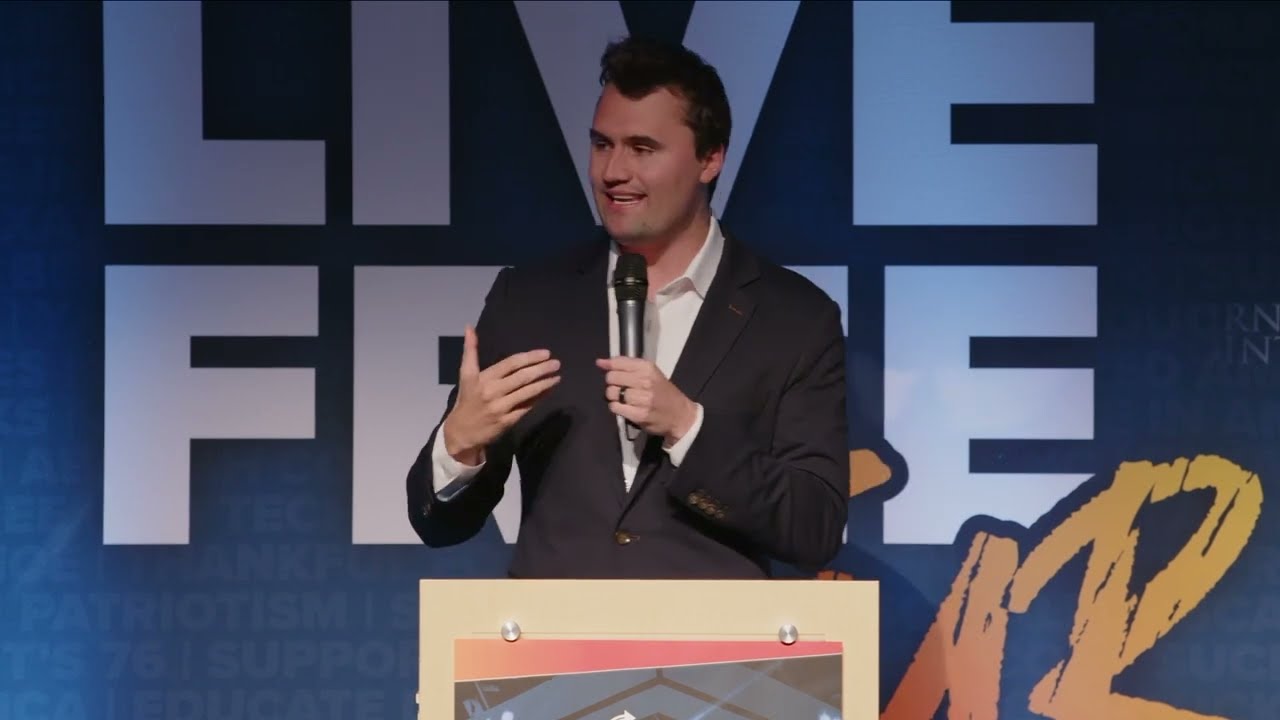
Charlie Kirk Defends Christian Values and Death Penalty at Florida State University Campus Event
Enjoying this? Share it with someone who needs to see it.
Up Next
Charlie Kirk Reflects on Faith, Courage, and Defending Biblical Truth in Public Life
13:23
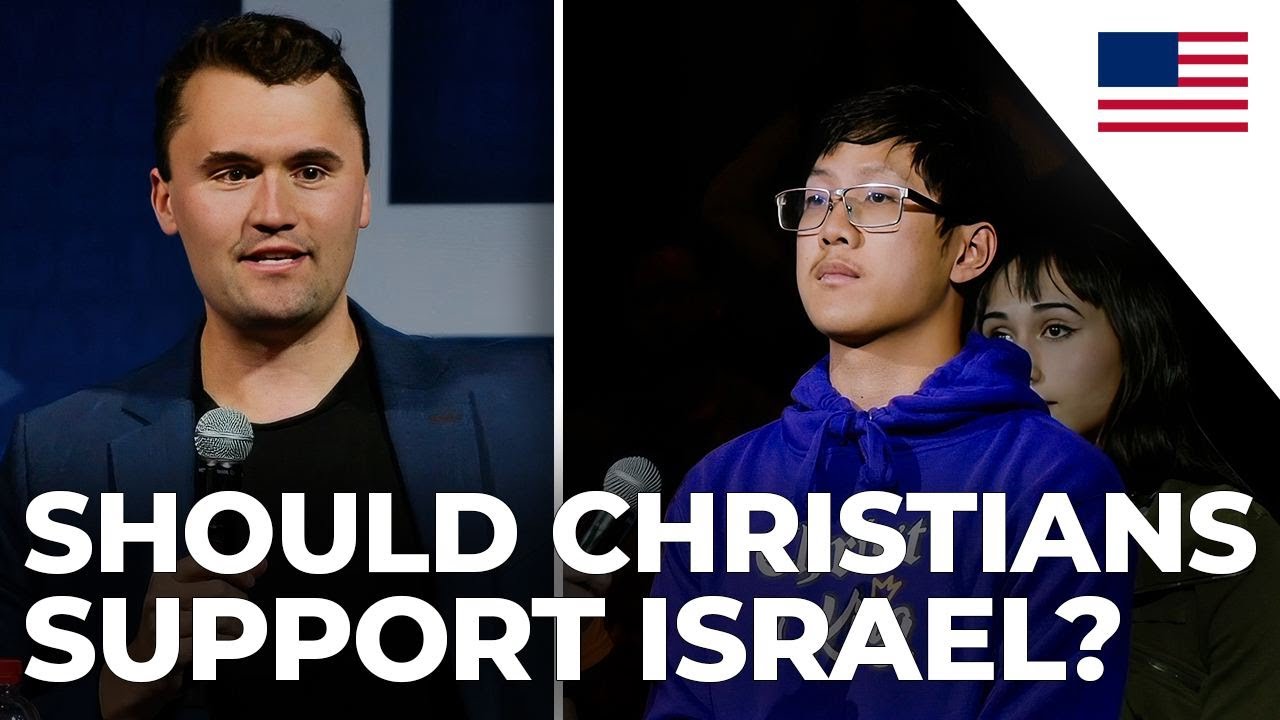
Charlie Kirk Explains Why Israel Changed His Life as a Christian and Biblical Believer
3:33
Charlie Kirk Takes the Political Compass Test: Exposing the Leftist Bias in Modern Political Quizzes
27:45
Charlie Kirk Defends Christian Values and Death Penalty at Florida State University Campus Event
Charlie Kirk engages with Florida State University students in a series of intense exchanges about the role of Christianity in American governance, the death penalty, and diversity, equity, and inclusion policies. Kirk argues that America's founding principles are rooted in Christian values and warns that secular nations cannot sustain freedom. He confronts students on abortion, capital punishment, and the importance of faith in maintaining a moral society. The discussion reveals fundamental disagreements about religious influence in government, with Kirk insisting that Christian ethics provide the only viable foundation for American democracy and that removing them would lead to societal collapse.
Charlie Kirk faced challenging questions from Florida State University students about the role of religious values in American government. When one student questioned why Kirk supports Christian values being protected by the Constitution when the founding fathers tried to avoid establishing a specific religion, Kirk turned the question around. He asked the student what moral standards society should follow and where those standards should come from.
The student suggested that society should create values from a mix of different religions and perspectives. Kirk responded by identifying the Ten Commandments as a foundational moral code and challenged the student to articulate an alternative rulebook for life. Kirk argued that Christianity provides principles like loving strangers, justice, and charity that many assume are universal but actually originate from Christian teaching.
Kirk emphasized that 55 out of 56 signers of the Constitution were Bible-believing, church-attending Christians, and that God is mentioned four times in the Declaration of Independence. He quoted John Adams, stating that the Constitution was written "wholly for a moral and religious people" and is "wholly inadequate for the people of any other." Kirk insisted there is no such thing as a neutral public square and that if Christian values are removed, they must be replaced with something else.
The Death Penalty and Pro-Life Consistency
Another student challenged Kirk on what they perceived as inconsistency in being both pro-life and pro-death penalty. The student compared this to liberals being pro-choice on abortion but not on vaccinations. Kirk dismissed this as a false equivalency, explaining that an unborn baby has done nothing wrong while a murderer has committed a grave crime.
Kirk argued that the death penalty actually honors the value of human life by demonstrating that taking an innocent life has the ultimate consequence. He stated that being against the death penalty devalues victims by suggesting their lives don't matter enough to warrant the ultimate punishment for their killers. When the student cited the commandment "Thou shalt not kill," Kirk clarified that the Hebrew text says "Thou shalt not murder," distinguishing between killing and murder.
He referenced God's law in the Torah that states if you take a life, your life shall be taken from you, precisely because human life is so precious. Kirk framed capital punishment as an explicitly pro-life position that honors the sanctity of the lives that were taken.
Public Funding for Religious Education
The conversation about Christian values extended to taxpayer funding for religious education. When Kirk expressed support for Bible teachings in public schools, describing the Bible as a historical document, the student asked whether he would also support taxpayer funding for Quran teachings. Kirk acknowledged that public schools already teach about various religious texts and said they should examine all religious texts of great faiths.
However, Kirk emphasized that only one text—the Bible—was believed by those who founded and built America. He argued that the teachings of the Bible were central to the country's creation and continued development. Kirk maintained that while students should learn about different religions, Christianity holds a unique position in American history and governance that justifies its prominent place in education.
The Impossibility of Secular Freedom
Kirk made a provocative argument that liberty and freedom cannot coexist with a faithless nation. He stated that the Constitution is incompatible with a secular or atheist nation, arguing that without belief in a higher power, people seek meaning through politics, which leads to the loss of freedom. Kirk described the protesters outside the event as engaging in a quasi-religious experience, chanting together and feeling part of something bigger.
He suggested that when America was at its best, people found meaning by going to church rather than marching in the streets. Kirk claimed that 99% of the activist left either had bad experiences with religion, don't think God loves them, or are atheists. He referenced sociologist Émile Durkheim's definition of religion as involving regular gatherings, shared language, and common objectives, arguing that left-wing movements mirror religious experiences.
Kirk's solution to cultural decline is spiritual: people need to humble themselves before God, return to church, get married before having sex, and stop engaging in debauchery. He emphasized that revival only happens through repentance, which requires acknowledging that there is a God and that we are not Him. Kirk closed this section by stating that politics is merely a means toward liberty, but liberty itself is God's idea, not man's.
Immigration and the Rule of Law
When Salma, a child of Moroccan and Peruvian immigrants who came to the United States legally after a 10-year process, asked about illegal immigration, Kirk focused on the destruction of the rule of law. He praised her family for following the proper procedures and emphasized that illegal immigration is fundamentally an insult to those who waited their turn and followed the rules.
Kirk argued that illegal immigration floods schools and hospitals, but the deeper issue is whether America will be a country that honors rules or rewards rule breakers. He compared it to teaching children not to cut in line, questioning why immigration should be treated differently. Kirk maintained that America should welcome immigrants like Salma's family who come legally, not those who break in line and then receive rewards for doing so.
Diversity, Equity, and Inclusion
A master's student in student affairs who believes in DEI challenged Kirk on his opposition to diversity, equity, and inclusion programs. The student argued that DEI creates inclusivity at predominantly white institutions for first-generation students, minoritized students, and veterans. Kirk asked the student to define DEI beyond the acronym to ensure they were discussing the same thing.
When Kirk jokingly defined DEI as "didn't earn it," the student pushed back, arguing that underrepresented students who make it to campus have already earned their place. Kirk sought common ground by asking whether people should be hired based on race or competency. When the student agreed competency should be the standard, Kirk argued that DEI in practice focuses on race more than competency, contrary to its stated theory.
Kirk said he wants everyone to be judged by the content of their character rather than the color of their skin, invoking Martin Luther King Jr. He argued for an America based on merit and hard work rather than appearance. The conversation ended with both agreeing that talking less about race and viewing people as human beings first would benefit the country. The student also asked Kirk whether Drake or Kendrick Lamar won their feud, to which Kirk said he supports Kendrick Lamar for taking an anti-pedophile stance against Drake.