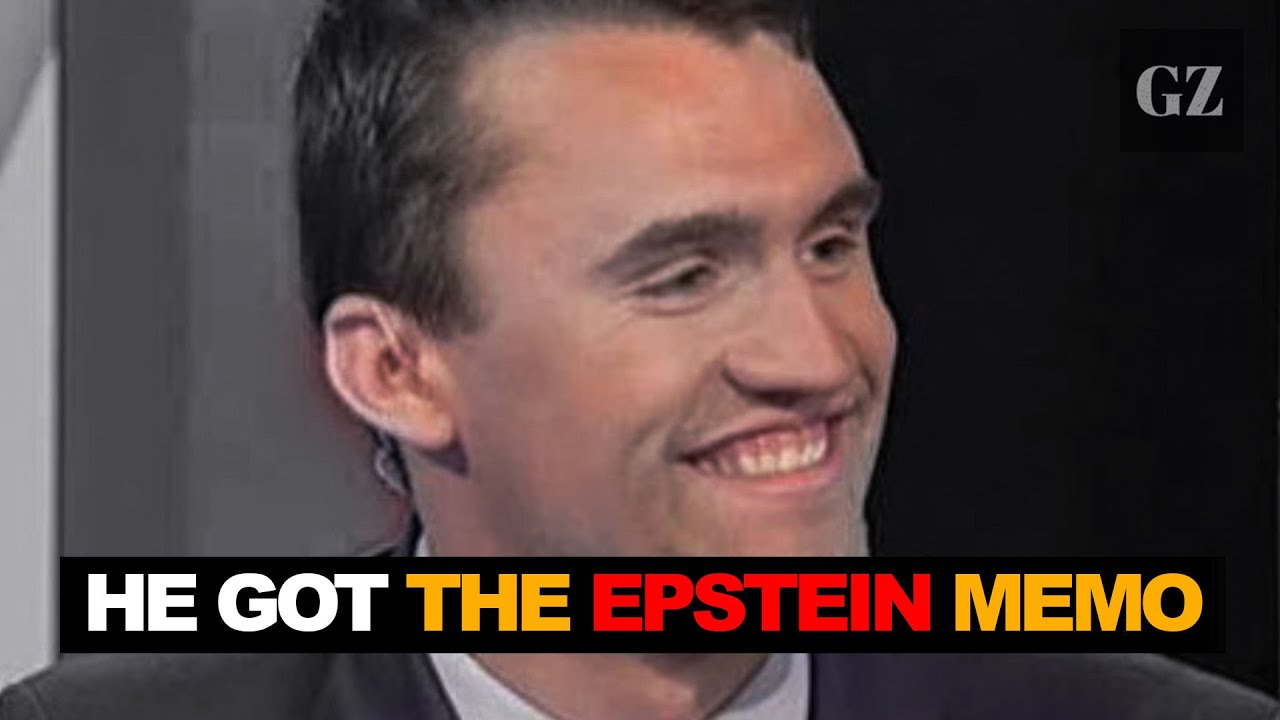
Charlie Kirk Faces Cambridge Students on Trump Foreign Policy and Middle East Conflicts
Enjoying this? Share it with someone who needs to see it.
Up Next
Charlie Kirk Shifts Position on Israel After Grassroots Conservative Youth Movement Challenges TPUSA's America First Credentials
11:45
Charlie Kirk Explains Donald Trump's Strategy for Greenland and Hemispheric Dominance
5:20
Charlie Kirk and Dr. Paul Ray Unpack the 46-Year War Iran Has Waged Against the West
15:54
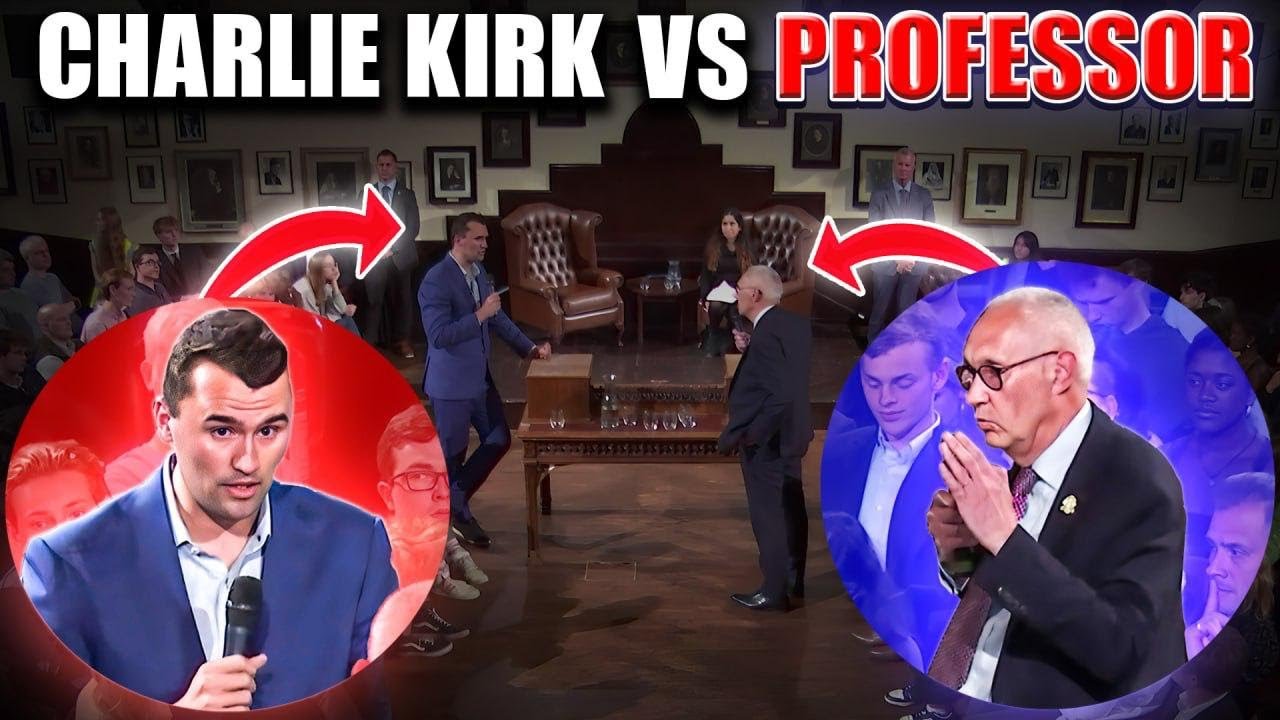
Charlie Kirk Faces Cambridge Students on Trump Foreign Policy and Middle East Conflicts
Charlie Kirk's appearance at Cambridge University turned into a heated exchange when prepared students challenged his defense of Trump's foreign policy. From arms deals with Saudi Arabia and Qatar to the wars in Gaza, Yemen, and Ukraine, Kirk struggled to respond to pointed questions about whether Trump has truly put America first or sold it out. The discussion exposed tensions between Kirk's anti-war rhetoric and the reality of U.S. involvement in multiple conflicts, with students pressing him on corruption allegations, weapons contracts, and the humanitarian toll of policies he supports. Commentary breaks down how Kirk's usual crowd-work tactics failed against well-researched opponents, and examines broader media narratives about Israel-Palestine through clips of Jake Tapper on Bill Maher's show.
Cambridge Students Challenge Kirk on Trump's Foreign Policy Record
Charlie Kirk's visit to Cambridge University became a battleground of ideas when prepared students confronted him about Donald Trump's foreign policy approach. Unlike the spontaneous campus encounters Kirk typically navigates, these Cambridge students came armed with specific facts about arms deals, conflicts, and alleged corruption.
The exchange began with a student challenging Kirk's claim that Trump puts America first. The student cited Trump accepting a $400 million private jet from Qatar, billions in arms sales to Saudi Arabia being used to bomb Yemen, and the $5.5 billion deal Trump's sons received from Middle Eastern governments. The student asked directly whether Kirk and his supporters had sold America out.
Kirk's response revealed his discomfort with the substantive nature of the questions. Rather than addressing the specifics, he employed stalling tactics, telling the student to "calm down" and criticizing them for "pounding the table" and being "all over the place." These crowd-work techniques that serve Kirk well in impromptu campus visits fell flat against prepared opponents.
Defending Trump's Peace Efforts
When Kirk finally addressed the substance, he pointed to Trump's efforts to broker peace between Russia and Ukraine, claiming Trump had already ended a war between India and Pakistan. The student pushed back, noting that both countries disputed Trump's role in any peace agreement.
On the Russia-Ukraine situation, the student questioned whether Trump's approach was working, noting that Russia's Putin couldn't even be bothered to show up to peace summits. Kirk defended Trump's two-hour phone call with Putin as progress, arguing that pursuing peace is "a winding road" and better than sending "hundreds of billions of dollars further into the killing fields of eastern Ukraine."
The student then pivoted to a point Kirk had dodged: the massive arms contracts with Saudi Arabia and Qatar, and the apparent connection to billions in investments flowing to Trump's sons and the Trump cryptocurrency. Kirk attempted to reframe the issue, asking whether the student would prefer Saudi Arabia buy weapons from China instead of America.
The Revealing Admission About Great Power Competition
This exchange exposed a fundamental truth about U.S. Middle East policy that often goes unstated. Kirk's admission that America must sell weapons to Saudi Arabia to prevent Chinese influence revealed that the genocidal Middle East policy is less about American security and more about preventing China from gaining soft power in the region. While China successfully mediated peace talks between Iran and Saudi Arabia regarding Yemen, the United States continues to bomb populations into submission while framing it as anti-war policy due to great power rivalry.
The Qatar Jet Controversy
When the student pressed Kirk on the $400 million jet from Qatar, Kirk claimed it wasn't given to Trump personally but to the U.S. government. However, reports indicate the jet was on loan to the government but would ultimately be transferred to the Trump presidential library. Kirk argued this meant no violation of principles regarding foreign gifts, but quickly changed subjects when the details became too specific, suggesting the student was getting "too in the weeds."
Confrontation Over Gaza and Israel
The most heated portion of the exchange came when the student challenged Kirk on Gaza. The student asked whether it was defensible for Trump to greenlight "Operation Gideon's Chariot" with the express aim of devastating the Gaza population, questioning whether supporting the killing of thousands of children serves American or humanitarian interests.
Kirk initially dismissed Trump's inflammatory rhetoric as "hyperbolic language" typical of his social media use. When pressed on who the "good guy" was in the Israel-Hamas conflict, Kirk said the student believed "both Hamas and the Israeli government are evil."
The student responded that regardless of political positions, there is no justification for "the murder and mutilation of thousands of innocent people and children," for "invading hospitals" and "bombing innocent populations" in a futile, dragging war damaging both Israel and the West.
Kirk's Defense of Israeli Military Action
Kirk countered by invoking the October 7th attack, noting that 1,300 Jews were killed and 200 taken hostage on what he called Israel's holiest day. He argued that when Hamas "invaded Israel" on the Sabbath during the 50th anniversary of the Six-Day War, they knew they were declaring war and should "expect a firestorm in reaction."
Kirk went on to defend Israeli military operations, claiming Hamas violates "every tenant of the Geneva Convention" by wearing civilian clothing and operating in one of "the most cloistered urban environments on the planet" where 2 million people live in a space where "it's impossible to wage war." He argued that when the IDF does "life-saving surgeries of a Gazan child" or drops leaflets warning of attacks, "they get no credit," but when they bomb locations housing Hamas military operations in "mosques, schools, and hospitals," they receive all the blame.
Kirk concluded with a comparison to World War II, noting he doesn't see people upset about the 2 million German civilians killed in that conflict. He stated that "a tragic truth of war is that civilians die" and placed sole blame on Hamas leadership, not the Israeli government fighting a "defensive war."
The Student's Response
The student pushed back against Kirk's justifications, stating that while not defending the attacks of October 7th, "the justification for the death of innocents cannot be an infinite cycle of bloodlust." He argued it cannot justify "killing tens of thousands of innocent civilians with a war with no end in sight," people who are "not complicit in those atrocities."
The student emphasized that "somewhere between 50 and 100,000 people lie dead under the rubble" and questioned what is left for Gaza except continued suffering under Hamas, since Netanyahu's political strategy has not worked and has instead entrenched the situation.
Analysis: The Density Question Kirk Avoided
Commentary on the exchange noted that while the Cambridge student performed well, he missed an opportunity to address Kirk's argument about Gaza's dense population. The question Kirk avoided: Why is Gaza so densely populated? Why must Hamas conduct military operations in a 141 square mile strip of land?
The answer: Israel controls Gaza's borders, land and sea. Gaza has no air force, no airport, and many residents have no passports. If Gazans leave the Strip, it's often impossible to return and see family because Israel controls entry. Gaza functions as an open-air concentration camp, a permanent refugee camp where half the population before the current conflict was children.
Israel's practice of conducting operations called "mowing the lawn" involved regular bombing campaigns designed to undercut Palestinian resistance by indiscriminately attacking the population. The notion that Gazans were "living in relative peace" before October 7th is demonstrably false.
Jake Tapper's "Academic Theology" Theory
The discussion also examined media narratives around Israel-Palestine through a clip of Jake Tapper appearing on Bill Maher's show. Tapper argued that campus protests supporting Palestinians stem from an "academic theology of oppressor and oppressed."
Tapper claimed students "only look at the world as oppressor versus oppressed" and therefore must choose sides in any conflict. He argued this framework leads to Israelis being "made to be the oppressor because they're white" rather than because of the actual power asymmetry between Israelis and Palestinians.
Tapper cited an example of gay students protesting LGBTQ oppression in Muslim countries being labeled oppressors "because a lot of them are white," drawing a parallel to how he believes Israelis are unfairly characterized.
Deconstructing Tapper's Argument
Commentary sharply criticized Tapper's framing, noting he dismissed the actual "complete total asymmetry in the power of these two groups of people." One group controls the other, possesses all the weapons, resources, food, and controls electricity and water for the other population. Yet Tapper attributes student activism solely to viewing Israelis as white rather than recognizing this massive power imbalance.
The analysis asked whether someone could find an example of a Hamas or Palestinian leader saying anything equivalent to what Israeli leader Ehud Barak stated in 1998: "If I was a Palestinian at the right age and at some stage, I would have entered the terror organizations and have fought from there."
Tapper's repeated use of the word "theology" to describe student activism was noted as an attempt to undermine their thinking by framing it as religion-like or cult-like, rather than acknowledging they accurately recognize power dynamics in the world.
The Islamophobia and Racism Behind the Narrative
The commentary connected Tapper's appearance to Bill Maher's "rampant Islamophobia" and the New Atheist movement of figures like Sam Harris, who claimed to be atheists while simultaneously supporting Zionism because they viewed Israeli or Western culture as more advanced than Islamic societies. Harris famously called Islam "the motherload of bad ideas."
The analysis pointed out that Sam Harris's early speaking tours were largely sponsored by Temple Brotherhoods and Sisterhoods, revealing the contradiction of an atheist whose primary religious critique focused on one specific region where military intervention was desired.
Commentary strongly objected to feminism and LGBTQ rights being weaponized for imperialist and racist ends, particularly from someone like Tapper who has "consistently supported the genocide of Palestinians that included disproportionately women." The critique noted that Western chauvinism is being used to dehumanize populations in a region that has been bombed by the United States for decades.
The Hypocrisy of Selective Outrage
The discussion highlighted that many Islamic fundamentalist governments, including those that oppress women, were propped up by the U.S. government because they were considered more controllable. Current arms deals with Qatar and Saudi Arabia's Mohammed bin Salman, "not a democratic leader," proceed without concern for women's rights or democracy.
The commentary concluded that the idea there's hypocrisy in not protesting Middle Eastern governments while supporting Palestinian liberation is absurd, especially when the U.S. continues shaping the region through deals with autocratic leaders and military force rather than supporting democratic movements.
Kirk's Framing Strategy
Returning to Kirk's Cambridge performance, the analysis noted that when cornered on substantive issues, Kirk attempted to salvage the situation for his American audience by wrapping himself in accusations of anti-Semitism. His question "who's the good guy?" revealed a Marvel movie-like simplification of complex geopolitical realities driven by settler colonialism.
The commentary argued that both Hamas and Zionist violence emerge from a settler colonial structure that inevitably produces hatred, similar to what occurred with Native Americans in the United States. The structure itself, not ancient religious texts or essential cultural characteristics, creates these conflicts. The framing of "good guys versus bad guys" or "civilized versus savage" represents a clash of civilizations narrative grafted onto the situation to justify Western support for Israeli actions.