Charlie Kirk on Evolution, Biblical Creation, and Why Donald Trump Reminds Him of Samson
Enjoying this? Share it with someone who needs to see it.
Up Next
Charlie Kirk Confronts Anti-Semitic Conspiracy Theories About Jews, Israel, and 9/11 at Live Event
16:14
Charlie Kirk Debates Abortion, Tariffs, and Christian Nationalism at Purdue University Campus Event
1:44:02
Charlie Kirk and Bill Maher Clash on Religion, Wokeness, and Whether God Exists in Surprising Club Random Conversation
1:37:38
Charlie Kirk on Evolution, Biblical Creation, and Why Donald Trump Reminds Him of Samson
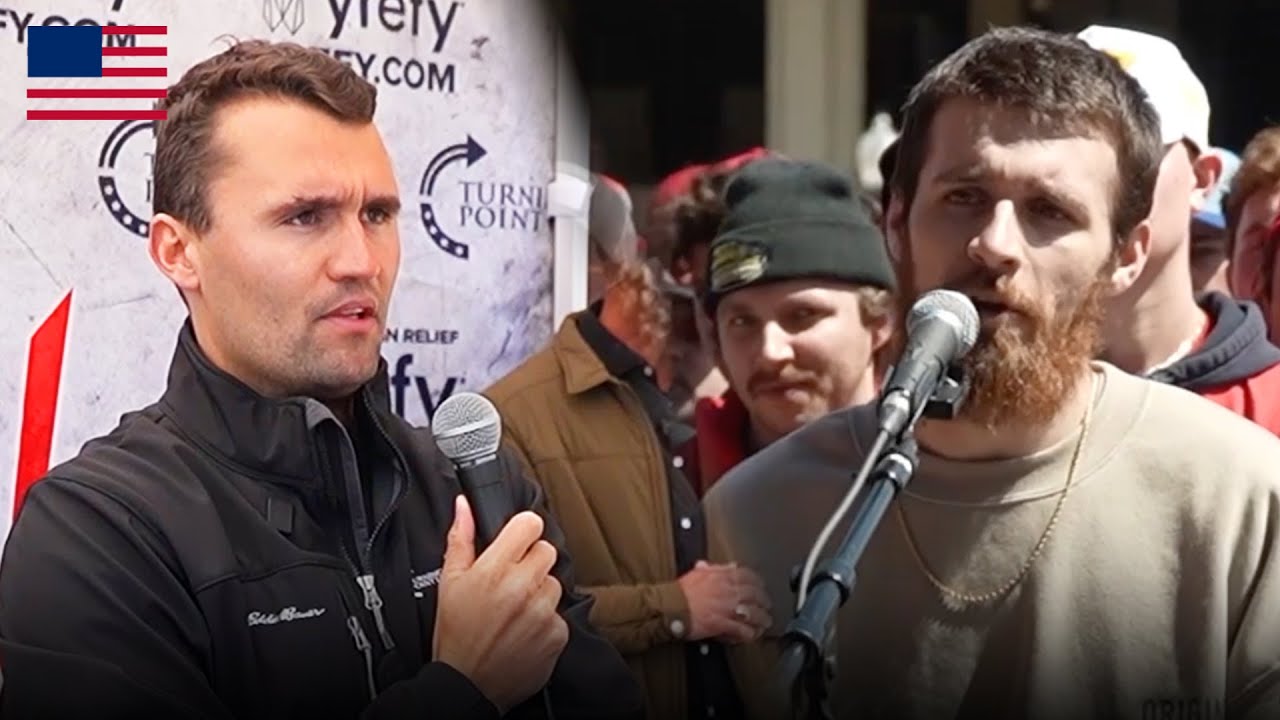
Charlie Kirk faces challenging questions about reconciling faith with science and politics. When pressed on evolution, biblical creation, and whether Donald Trump embodies gospel values, Kirk draws unexpected parallels to flawed biblical figures like Samson and Moses. He explains the difference between closed-hand and open-hand theological issues in Christianity, argues that humans are uniquely made in God's image, and defends Trump's character by pointing out that even revered biblical heroes were deeply flawed sinners.
March 8, 2026
Navigating Faith and Science
Charlie Kirk addresses questions about his beliefs regarding creation and evolution, clarifying his position on what many consider a contentious intersection of faith and science. When asked directly if he accepts evolution and whether humans evolved from primates, Kirk responds with measured uncertainty: "I don't know."
Kirk emphasizes his belief in the biblical account of creation while acknowledging the scientific evidence for adaptation and species change. He explains that one can be a theist and believe that God ushered evolution, leaving room for both scriptural truth and scientific inquiry. However, he stresses that these questions are "completely irrelevant" to his core theology.
When pressed further about accepting evolution as fact based on evidence, Kirk refuses to commit definitively. Instead, he points to what he describes as the "fine-tuning problem" of existence—evidence that atheists must reckon with—which he believes warrants belief in God. Kirk maintains that intelligent life came from God and that the scriptures are true, while remaining open to having his mind changed based on data.
Closed-Hand Versus Open-Hand Theology
Kirk introduces an important distinction within Christian theology between what he calls "closed-hand" and "open-hand" theological issues. Closed-hand issues are non-negotiable core beliefs like the resurrection of Christ and the Trinity. Open-hand issues include matters like eschatology, the Eucharist, and the creation account—areas where thoughtful Christians can disagree.
The creation account falls into the open-hand category, Kirk explains, because the Hebrew word for "create" in Genesis is not clear about whether creation happened instantly or over a long period of time. Very smart Christians stand on both sides of this issue, he notes, which is why he defers to those who have studied it more deeply.
Human Dignity and the Image of God
When questioned about what makes human life fundamentally different from animal life—particularly if evolution is true—Kirk turns to Genesis 1:26-27. He explains that according to scripture, God created humans male and female as distinct beings, the only ones made in the image of God. While God called animals good, they are not image bearers like humans are.
This theological claim, Kirk argues, is what establishes the sanctity of human life and the inviolable dignity of the human person. The concept of being made in God's image—what theologians call the imago Dei—provides the foundation for personhood that transcends any evolutionary process that may or may not have occurred.
Donald Trump as a Modern-Day Samson
The conversation takes a pointed turn when Kirk is asked about Donald Trump and whether the former president embodies gospel values. Kirk's response draws an unexpected biblical parallel: Trump reminds him of Samson from the Bible.
Like Samson, who had "great hair," Trump is "a man willing to fight for a cause greater than he, despite some of his own moral troublings and moral missteps," Kirk explains. He notes that the Bible is filled with flawed leaders—King David, Abraham, and notably Moses, who murdered someone in Egypt and had to flee to Midian as a result.
Kirk challenges his questioner by asking how many people knew that Moses was a murderer. "Donald Trump has never murdered anybody, but Moses is like the most revered man in Judaism," he points out. The message is clear: biblical heroes were deeply flawed individuals whom God nevertheless used for His purposes.
Reconciling Faith and Politics
When pressed specifically about whether Trump lives according to gospel values like humility, compassion, and forgiveness, Kirk offers a nuanced defense. He argues that Trump is "far more magnanimous than people will give him credit" for, while acknowledging that none of us are able to fully fulfill those values.
Kirk points to one gospel value he believes Trump does embody: truth-telling. The gospel says clearly that the telling of truth is one of the most fundamental things, particularly regarding the spoken word, Kirk argues.
Rather than attempting to defend every moral decision Trump has made or failed to make, Kirk concludes with a statement of theological equality: "I am equally a sinner as Donald Trump. We all are. We all fall short of the glory of God." This doctrine of universal sinfulness, Kirk suggests, should temper any attempts to hold political leaders to standards of moral perfection that none of us can achieve.