
Up Next

Ben Shapiro and Charlie Kirk Debate Trump's Conservative Legacy and the Bernie Sanders Threat
58:54

Charlie Kirk Confronts LeBron James' National Anthem Protest and IBM's Shocking Anti-White Discrimination Policy at AmericaFest
1:24:01
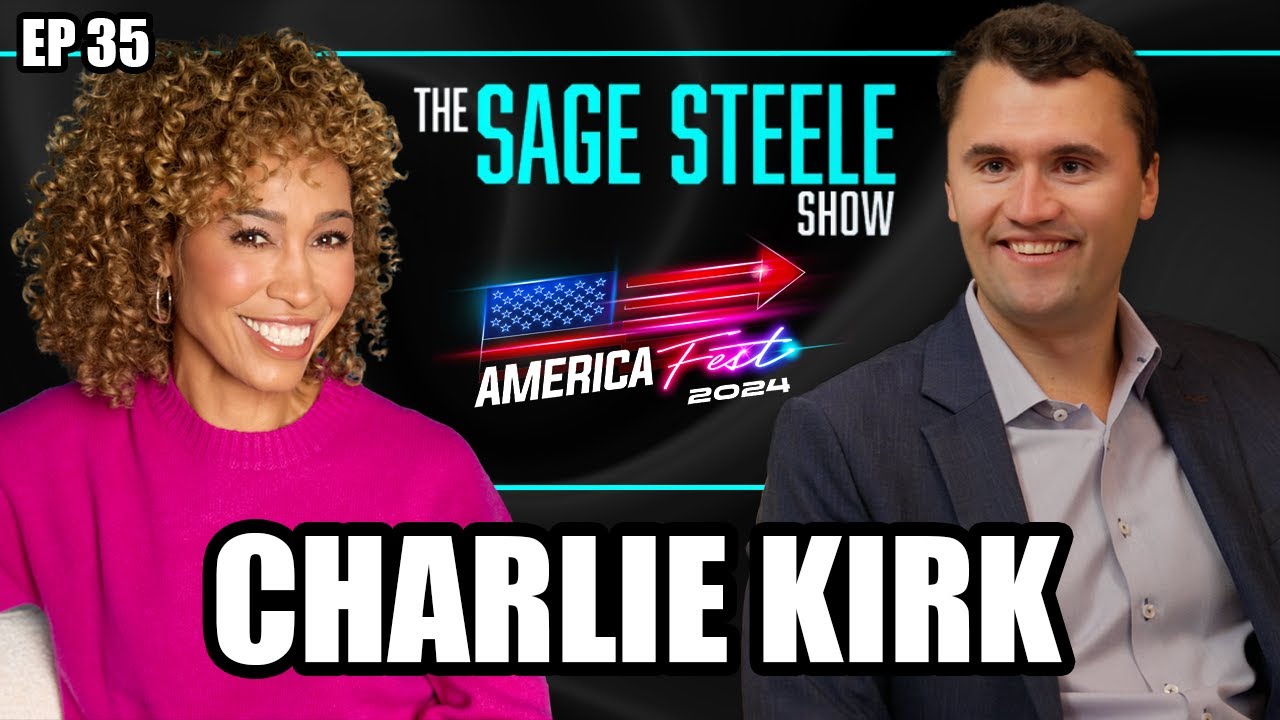
Charlie Kirk Opens Up About Election Night Emotions, Federal Prison Fears, and Building AmericaFest Into a 20,000-Person Movement
10:32
Related Books
Browse Conservative Books






Charlie Kirk Reveals How a High School Essay Exposing Liberal Bias Launched Turning Point USA
Charlie Kirk penned an essay exposing liberal bias in a Paul Krugman economics textbook that falsely portrayed the 1980s as an economic failure. The essay went viral on Breitbart.com, landed him on Fox News as a high school senior, and sparked backlash from his teachers and administrators. That experience, combined with rejection from West Point, led Kirk to realize his true calling: founding Turning Point USA to combat leftist indoctrination in education and mobilize young conservatives across America.
The Essay That Started It All
Charlie Kirk wrote an essay as a high school senior that would change the trajectory of his life and the conservative movement. He discovered an Advanced Placement economics textbook titled "Paul Krugman's Economics for the AP," written by the New York Times economist. As Kirk examined the textbook, he found chapter after chapter questioning private property and promoting the collectivization of property as more efficient, following what he describes as the Cass Sunstein model of organizing society.
One chapter particularly caught Kirk's attention for its historical inaccuracies. The textbook taught students that the 1980s was not a period of economic growth, but rather a time when the middle class suffered and poor people became poorer. Kirk knew this contradicted the facts. The 1980s, thanks to Ronald Reagan's tax cuts and deregulation, was a period when the economy soared. As Kirk put it, "You're entitled to your own opinion. You're not entitled to your own facts."
Going Viral and Making Enemies
Kirk challenged his teacher on these inaccuracies and wrote up his findings. This was just a month before Andrew Breitbart died, and Breitbart.com picked up the essay as a tip. They asked Kirk to write it up himself, and his first-ever published essay went totally viral, appearing on hundreds of websites.
The essay landed Kirk an appearance on Fox News as a high school senior. He appeared on the morning show at 6:00 a.m., then went back to class with the interview spreading all over the internet. This was before Twitter had fully taken off, yet teachers were asking him, "Did I see you on television this morning?"
But the exposure came with consequences. Kirk's teacher, administrators, principal, superintendent, and head of instruction all opposed his decision to expose what was being taught in classrooms. This backlash gave Kirk his first taste of activism and showed him what it felt like to make enemies by speaking truth.
The Birth of Turning Point USA
The experience sparked something in Kirk. The entrepreneur in him recognized that there must be millions of other young people experiencing exactly what he had seen in that textbook. This wasn't just one isolated incident—it was part of a broader pattern of teachers framing Marxism positively and promoting what would later be recognized as the beginning stages of wokeism, all the way back in 2012.
This realization became the foundation for what would eventually become Turning Point USA, an organization dedicated to combating liberal bias in education and mobilizing young conservatives.
The West Point Rejection That Changed Everything
Kirk's path to founding Turning Point USA was shaped by another pivotal moment: his rejection from West Point. His entire life had been oriented toward attending the military academy. He was an Eagle Scout, football and basketball captain, maintained good grades, was active in his community, secured every letter of recommendation imaginable, and obtained his congressional nomination.
Despite all this preparation and qualification, when the appointment decision came, Kirk didn't get in. The rejection was crushing at the time, and he struggled to process and understand it. But looking back, Kirk recognizes it as the best thing that ever happened to him.
Had he been accepted, Kirk would have spent four years at the academy plus five years of military service. He would just be getting out now, potentially having been caught up in what he calls "some Afghanistan debacle." The essay exposing the Krugman textbook was written right around the time of that denial letter, and Kirk realized there was a much more important path he was supposed to be on.
Kirk's message to young people draws from this experience: sometimes what feels like failure or rejection is actually redirection toward your true purpose. What seemed like a devastating setback at the time became the catalyst for building one of the most influential conservative youth organizations in America.
Video Transcript
[00:00] It all started with an essay that he
[00:02] wrote as a senior in high school that
[00:05] described the liberal bias in textbooks.
[00:09] So, how Charlie did that essay lead you
[00:12] to where you are to to the head of um a
[00:15] large conservative activist
[00:17] organization?
[00:18] >> Great to be here, Dr. Bob. Yeah, I I
[00:20] wrote that essay when I was a senior in
[00:22] high school. And I came across an AP,
[00:26] which means advanced placement textbook,
[00:28] economics textbook, that was called Paul
[00:31] Krugman's economics for the AP. And Paul
[00:35] Krugman is an economist for the New York
[00:38] Times who's been wrong about basically
[00:39] everything for the last 30 years. And I
[00:42] opened it up and it was one chapter
[00:44] after the other of why private property
[00:48] uh needs to be uh put into question, why
[00:51] collectivization of property is actually
[00:54] more efficient. Uh more of kind of the
[00:57] Cass Sunstein model of organizing
[00:59] society. And there was one chapter in
[01:01] particular that was wrong. It was wrong
[01:04] in its interpretation of history and
[01:07] wrong in what it was trying to teach the
[01:08] readers. And it was teaching students
[01:11] that the 1980s was not a period of
[01:13] economic growth. It was a period when
[01:16] the middle class suffered and that poor
[01:18] people got poor. And Dr. Bob, you know,
[01:20] you're entitled to your own opinion.
[01:22] You're not entitled to your own facts.
[01:24] You know, the 1980s that thanks to
[01:26] Ronald Reagan and tax cuts and
[01:27] deregulation that the economy soared.
[01:30] And so I challenged this to my teacher
[01:32] and kind of wrote it up. And this was
[01:35] when Andrew Breitbart was still alive,
[01:37] right before he died, like a month
[01:38] before he died. Breitbart.com took that
[01:41] essay and was the first essay I ever
[01:43] wrote. I was I just sent to them as a
[01:45] tip and they said, "Why don't you try to
[01:46] write this?" And it ended up going
[01:48] totally viral. It was published on
[01:50] hundreds of websites. Uh I ended up
[01:52] going on Fox News over it and all of a
[01:55] sudden I kind of realized, hey, this is
[01:57] what it feels like to be an activist.
[01:58] You know why? Because of the enemies
[02:00] that I made because of that. my teacher,
[02:02] administrator and principal,
[02:04] superintendent, head of instruction,
[02:06] they hated the fact that I would go and
[02:08] expose the fact that they are teaching
[02:11] this garbage in these classrooms. And so
[02:13] from there, I kind of I kind of got the
[02:15] um got the the itch, you could say, to
[02:18] try to do something to save this
[02:19] country.
[02:19] >> Mhm. And that led that article in
[02:21] Breitbart led to an interview on Fox
[02:23] News. That's right.
[02:24] >> For a high school senior.
[02:25] >> That's right.
[02:26] >> Pretty good. So, I was on I was on Fox
[02:28] News in the morning at like 6:00 a.m.
[02:30] Then I went back to class and it was all
[02:32] over the internet. And this was pre
[02:34] Twitter. It was still kind of getting
[02:35] online. And my my teachers were say,
[02:37] "Did I see you on television this
[02:39] morning?" And that was the that was the
[02:42] beginning stages of kind of what became
[02:44] Turning Point USA. And it's I got to
[02:48] thinking kind of the entrepreneur in me
[02:50] kicked in. I said, "There must be
[02:52] millions of other young people
[02:54] experiencing exactly what I saw in that
[02:56] textbook." And that was just one
[02:58] isolated incident of Dr. Bob of teachers
[03:00] that would go out of their way towards
[03:03] framing Marxism in a positive way and
[03:05] kind of the beginning stages of what was
[03:07] wokeism all the way back in 2012.
[03:10] >> Now, I know you did try to get into the
[03:12] Air Force Academy, US West Point. Uh
[03:16] they for some reason they turned you
[03:17] down and that was probably a good thing.
[03:20] you can learn what's necessary by doing.
[03:22] You don't need to go to college. So, I
[03:25] think it was it was very lucky that they
[03:28] turned you down because you wouldn't be
[03:31] here today if you spent time uh 4 years.
[03:34] >> I totally agree. And it would have been
[03:35] four years plus 5 years military
[03:37] service, right? So, I I would just be
[03:40] getting out right now and who knows,
[03:42] maybe I would be in some Afghanistan
[03:43] debacle after that whole humiliation. It
[03:46] was the best thing that ever happened to
[03:47] me. And that's my lesson to young people
[03:49] is my whole life was about going to West
[03:50] Point. I was an Eagle Scout football
[03:52] basketball captain, good grades, you
[03:54] know, member of the community, got every
[03:56] letter recommendation you could imagine,
[03:57] got my congressional nomination, but
[03:59] when it came for appointment to the
[04:01] academy, I didn't get in and it was
[04:03] crushing at the time and I I couldn't
[04:05] quite process it or understand it. And I
[04:08] was kind of left with this decision,
[04:10] what do I do? And that simultaneously
[04:12] that kind of essay was written right
[04:14] near that denial letter. And I realized
[04:16] that there was a much more important
[04:18] path that I was supposed to be on.
[04:25] [Music]



Comments
Be the first to comment on this video.