2,387 videos 1,376,944,188 views US Joined Aug 30, 2018
Charlie Kirk is the Founder and President of Turning Point USA, the largest and fastest growing conservative youth activist organization in the country with over 250,000 student members, over 150 full-time staff, and a presence on over 2,000 high school and college campuses nationwide. Charlie is also the Chairman of Students for Trump, which aims to activate one million new college voters on campuses in battleground states in the lead up to the 2020 presidential election. His social media reaches over 100 million people per month and according to Axios, he is one of the "top 10 most engaged" Twitter handles in the world. He is also the host of “The Charlie Kirk Show,” which regularly ranks among the top news shows on Apple podcast charts.
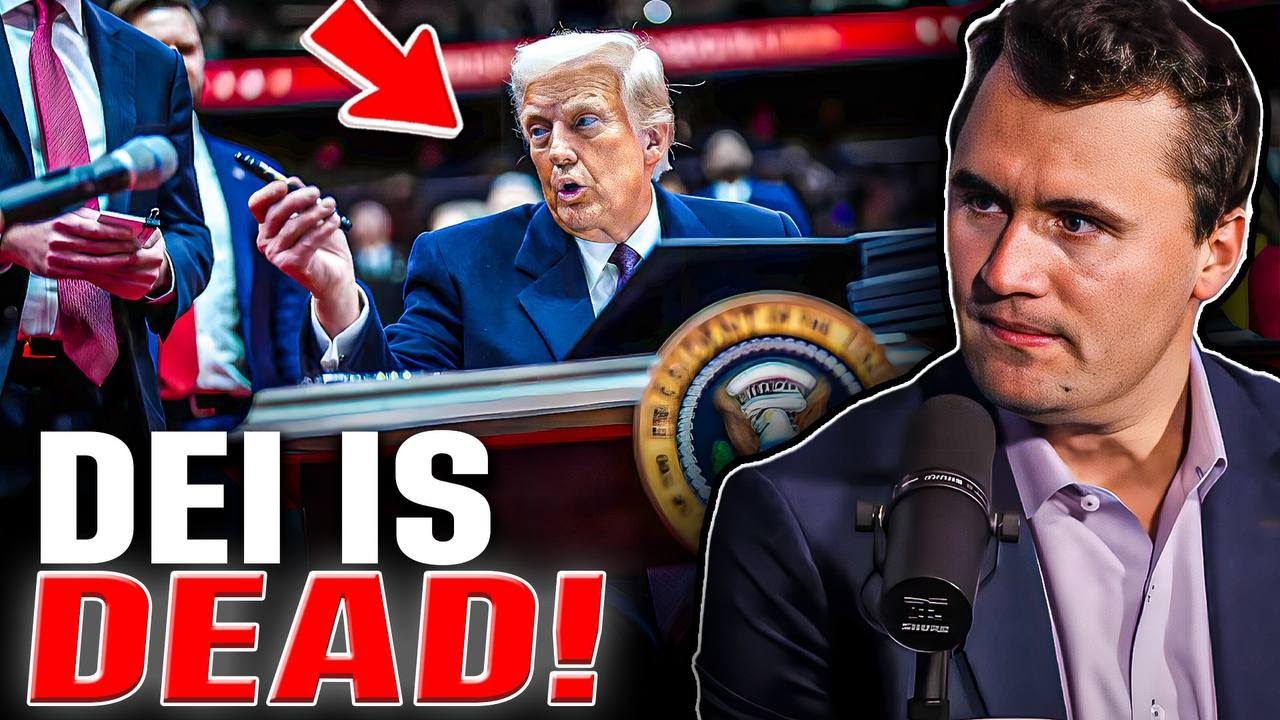
Charlie Kirk Reveals President Trump's Hidden Victory Against DEI: The Disparate Impact Executive Order Explained
Charlie Kirk exposes a massive but largely unreported Trump administration victory that strikes at the heart of DEI. President Trump signed an executive order eliminating disparate impact liability, a legal doctrine embedded in American law since the Nixon and LBJ administrations that has quietly transformed hiring practices, education standards, and business operations for over 50 years. Kirk argues this doctrine, born from the 1971 Griggs v. Duke Power Company Supreme Court case, created the foundation for DEI departments, lowered standards across institutions, and forced companies to live in fear of federal discrimination complaints. Kirk explains how disparate impact punishes tests when students fail rather than helping students improve, and celebrates this executive order as a critical step toward restoring meritocracy in America.
Charlie Kirk addresses growing impatience among some conservatives who want more wins from President Trump, arguing that the administration has accomplished more in its first weeks than some presidents achieve in four years. While acknowledging the media onslaught and campus critics, Kirk points to numerous achievements including the largest deportation effort in American history, securing the southern border, drill baby drill energy policies, executive orders banning men in female sports and chemical castration of children, and a planned massive tax bill. He notes that 11% more voters now say the United States is on the right track since January.
However, Kirk focuses on what he considers a massive but largely ignored victory: President Trump's executive order titled "Restoring Equality of Opportunity and Meritocracy." This order strikes at what Kirk calls "the life source of DEI" by addressing disparate impact, which he identifies as "the original sin of the DEI monstrosity." Kirk emphasizes that this regulation has existed since the LBJ and Nixon administrations, untouched by Ronald Reagan, George H.W. Bush, George W. Bush, or even Trump's first administration. He credits the four years out of power as valuable time to study and identify root causes of cultural decline.
Understanding Disparate Impact
Kirk explains that disparate impact is a legal doctrine holding that any rule, policy, or requirement can be deemed illegal discrimination if it has disparate impact on different groups. The doctrine originated from the 1971 Supreme Court case Griggs v. Duke Power Company, where Duke Power was sued for requiring employees to have either a high school diploma or pass an aptitude test. Black applicants were less likely to have diplomas and performed worse on aptitude tests. The Supreme Court ruled that Duke's job requirements were not justified by business necessity and were therefore illegally discriminatory.
Kirk argues this doctrine is "incredibly pernicious" because literally every standard imaginable creates some sort of disparate impact against a group. He asserts that nobody has ever designed a test or standard where men, women, blacks, whites, Asians, Hispanics, Catholics, Jews, gays, and straights all perform equally well. According to Kirk, disparate impact says the test itself is wrong rather than accepting different outcomes, creating "a loophole that you could drive a semi-truck through" that has been exploited by DEI actors for 30 years.
The Fear-Based DEI Industry
Kirk describes how disparate impact created a system where the federal government can target any company, school, state, or local government for discrimination using the Civil Rights Act by deciding their hiring standards don't meet business necessity. The key problem, according to Kirk, is that federal bureaucrats and judges decide necessity rather than business owners, entrepreneurs, or property owners. This creates a climate of fear where everyone worries about government enforcement.
He reveals that people have tried to come after Turning Point USA for disparate impact through EEOC complaints, though the organization successfully won all those complaints. Kirk explains that companies, fearing the "leviathan of the anti-racist state," try to impress the government by establishing massive DEI departments to avoid being targeted. While this strategy sometimes works and sometimes doesn't, the system has imposed what Kirk calls "a massive regulatory and efficiency burden on the American economy."
Kirk identifies DEI as "the greatest silent regulation on American prosperity" and names what he calls the "evil trinity" or "sinister triad" - the "three horsemen of the death of merit": DEI, affirmative action, and disparate impact. He notes that most people don't even know what these terms mean, though affirmative action was more widely understood five or ten years ago. The fear of disparate impact complaints has turned the system into "a war against merit and against freedom," essentially making it illegal for companies to simply hire the most talented people for a given job.
Real-World Examples of Declining Standards
Kirk provides concrete examples of how disparate impact has led to declining standards. In 2022, the Los Angeles Unified School District removed requirements for algebra proficiency because black students didn't perform as well in algebra. Ironically, after removing the algebra proficiency requirement, black students got even worse at algebra, demonstrating that lowering standards didn't actually improve outcomes.
He also discusses how standardized testing in New York City schools was curtailed due to racial disparities, yet these schools produced more national merit scholars per capita than any other state, highlighting that merit-based selection correlates with excellence. Kirk argues this approach is how institutions are eliminating the SAT and ACT. He summarizes the problem succinctly: "Effectively, disparate impact means punishing the test when students fail, not punishing the students when they fail the test. Instead, they're trying to rework the test, not try to improve the excellence or the merit of the applicant or the future student or worker at your company."
The NBA Thought Experiment
Kirk presents a powerful thought experiment using the NBA to illustrate the absurdity of disparate impact. Black men make up only 13% of the US population but account for over 70% of NBA players—a clear case of disparate impact. He asks whether the NBA should institute racial quotas on the court, bench players based on skin color to achieve equity, or replace merit with a lottery. Kirk notes that black Americans excel in the NBA precisely because it's an excellence organization.
He highlights an observation from Blake (presumably a colleague): "Imagine a judge saying that height isn't a job necessity in the NBA." Kirk emphasizes this point, noting that companies live in fear of being criticized or indicted with judges questioning whether certain qualifications are truly job necessities. Using the example of Mugsy Bogues (a notably short NBA player), Kirk illustrates how a judge might argue height isn't necessary, even though being tall is clearly advantageous in basketball.
The College Credentialing Paradox
Kirk argues that one reason the college cartel remains so strong is that the government dislikes the idea of giving job applicants IQ tests because those have disparate impact. He suggests wearing a shirt saying "Bring back IQ tests" to an upcoming fall tour event, asking "What could be more fair than an IQ test?" He notes that IQ tests don't depend on where someone went to school, though schooling can moderately improve IQ test performance.
The irony, according to Kirk, is that federal bureaucrats are fine with requiring expensive college diplomas even though those also have disparate impact—simply because bureaucrats like colleges. Kirk argues that IQ tests would actually be more fair and equitable, allowing someone who didn't attend a prestigious school to demonstrate their "raw intellectual firepower and potential." He finds it hilarious that opponents of IQ tests support a credentialing lobby that actually creates more disparate impact than the tests would.
The Culture of Mediocrity
Kirk reflects on what he describes as a decline in basic services and competence across American society. He asks whether basic functions—getting good service at a bank, having flights on time without lost luggage, getting a good taxi driver—are better, worse, or the same as 20 years ago. He notes that power outages are more common and believes hospital care quality has declined rapidly, concluding that America is "slowly slipping into a culture of mediocrity."
This decline, Kirk argues, is what happens without a culture of meritocracy. He presents what he calls "the sad but brutal truth": when you have meritocracy, "sometimes the room is not going to look like Angelina Jolie's Christmas card," referencing Bill Maher's observation about forced diversity. Kirk explains that with merit-based selection, you don't know what the end result will be—it might be a bunch of Asians, Nicaraguans, or Scots, and that's irrelevant because "we actually don't care."
The point, Kirk emphasizes, is indifference to the melanin complexion of the end result. What matters is whether a team or unit can "do awesome stuff." He argues that forced diversity via disparate impact has been "slowly suffocating excellence."
A Massive Leap Forward
Kirk concludes by celebrating President Trump's action against disparate impact as being largely ignored by legacy media, though he's okay with that. He calls on his audience to applaud and celebrate because this executive order represents "a massive leap to get us back to our birthright of being an excellent" nation. The elimination of disparate impact liability, according to Kirk, removes a foundational pillar that has supported DEI infrastructure and undermined meritocracy for over half a century.