2,422 videos 1,389,747,653 views US Joined Aug 30, 2018
Charlie Kirk is the Founder and President of Turning Point USA, the largest and fastest growing conservative youth activist organization in the country with over 250,000 student members, over 150 full-time staff, and a presence on over 2,000 high school and college campuses nationwide. Charlie is also the Chairman of Students for Trump, which aims to activate one million new college voters on campuses in battleground states in the lead up to the 2020 presidential election. His social media reaches over 100 million people per month and according to Axios, he is one of the "top 10 most engaged" Twitter handles in the world. He is also the host of “The Charlie Kirk Show,” which regularly ranks among the top news shows on Apple podcast charts.
Charlie Kirk Debates College Student on Affirmative Action, DEI, and the Merit vs Diversity Question
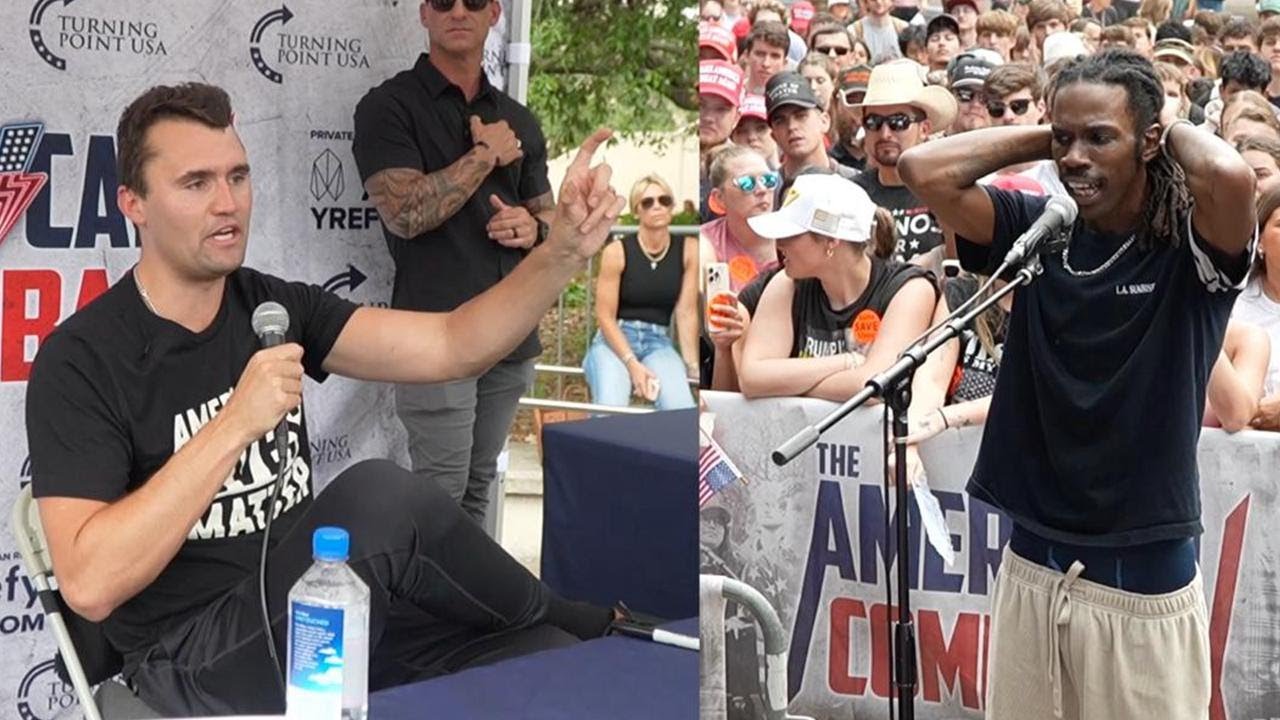
Charlie Kirk engages with college student Leila in a thoughtful debate about affirmative action, DEI policies, and whether race should factor into college admissions and hiring decisions. The conversation centers on Harvard's admissions practices, the Supreme Court case that ended affirmative action, and fundamental disagreements about equal treatment versus accommodation for socioeconomic differences. Kirk argues that merit should be the sole criterion regardless of background, while Leila contends that outside factors like school funding and resources matter. The exchange highlights the tension between excellence and diversity as competing values in American institutions.
College student Leila approached Charlie Kirk after watching multiple debate compilations, bringing three topics to discuss: immigration, affirmative action and DEI, and the value of college. She chose to focus on affirmative action and DEI, citing Kirk's statements that "white males have high test scores" and that "white males shouldn't have to be penalized." Leila acknowledged that Kirk had recognized people of color often come from lower socioeconomic backgrounds that don't prioritize education as much, but she questioned why he didn't offer solutions to help those communities rather than arguing institutions are becoming "less excellent."
Her central question was pointed: What is Kirk's definition of excellence, especially given that white students still comprise 41% of college admissions?
The Harvard Case and Supreme Court Ruling
Kirk immediately referenced the Supreme Court case that ruled against affirmative action, pointing to Harvard as the test case that revealed the inner workings of race-based admissions. According to the data presented in that case, Kirk explained, a white male student had to score approximately 30% higher on standardized tests than an equivalent black student to even be considered for admission.
When Leila asked when this occurred, Kirk estimated it was over 30 years of practice that was finally challenged. The implication was clear: for decades, black students could perform 30% worse on standardized measures than white students and still receive equal or preferential consideration.
Leila questioned whether outside factors might explain or justify this discrepancy, but Kirk drew a firm line.
Equal Treatment vs. Accommodation
Kirk stated his fundamental principle: he doesn't believe institutions should accommodate based on outside factors. Leila disagreed, saying she believes in progression. This revealed the core philosophical divide between them.
Kirk clarified their disagreement: "I don't think we should change the rules of the game to accommodate." When asked what the rules of the game are, he responded that fair and equal treatment is an American principle—meaning a white male should not be treated differently than a black male, regardless of background.
Leila tried to explain the outside factors she was referencing, but Kirk cut in: "It doesn't matter whether or not you were said mean things when you grew up or whether your dad was a gang banger." Leila clarified she wasn't talking about those kinds of factors.
The Funding Argument: Florida Schools as a Case Study
Leila presented her local experience growing up in a predominantly white town in Florida with substantial school funding. Drive 30 miles north to Homestead, she explained, and schools have a fraction of that funding, fewer testing instructors, and fewer resources. Drive another 30 miles to Miami, and private schools have even more funding than her district.
She acknowledged that she personally pushed through and didn't let outside factors affect her, "but at the end of the day I kept going and some people don't have that same ability."
Kirk countered with a fact-check specific to Florida: every public school in the state gets the same amount of money. While communities might provide additional donations, Florida has "the most equitable funding structure of any school" and essentially has universal school choice.
The Job Application Question
Kirk posed a direct question: When admitting people for a job, should it just be what's on paper, or should race play a factor?
Leila acknowledged Kirk's argument about mediocrity (which she initially mispronounced as "mediocracy" before he corrected to "mediocrity"). She said she believes in quotas but thinks merit and diversity considerations should go hand in hand. Her challenge to Kirk: "If I have just as good as a resume as somebody next to me, I want to understand where you're getting that jobs are just taking people because they're women, because they are black."
She questioned whether DEI policies actually result in less-qualified candidates being hired solely because of their race or gender.
The Capital Street Partners Example
Kirk provided a concrete example: Capital Street Partners announced in summer 2022 that they would not hire white men for internships. He described this as "one example of thousands I could give" of anti-white discrimination in hiring.
When Leila asked about how many people were in those positions, Kirk dismissed the question as irrelevant. "It does not matter if you have an internship and everyone is a white man if they're all qualified. That's great. Doesn't matter if they're all Asian or all black. It should be what merit, qualification gets the people into that position."
Leila agreed with the principle but seemed to suggest that affirmative action works to help any race or sex achieve fair representation, not just one group over another.
Anti-White Racism in Policy
Kirk argued that anti-white racism had been embedded in American laws and is only now being removed thanks to President Donald Trump. He described a system where "if you were a white man, especially to apply for internships, jobs, going to college, it was significantly harder to get those jobs, to get into those practices, because there were quotas that made it easier for people of other skin colors with lower standards to be able to get those positions."
Both agreed that college slots, internships, and jobs are scarce resources. The question is how to allocate them. Kirk explained that in a DEI model, institutions might say "we're not going to do any more than 30% white and then we'll do 15%" creating quotas. The problem, he argued, is that "what happens if the 15% black is not qualified? They don't care, which ends up happening far too often."
The Air Traffic Control Example
When Leila asked for specific examples, Kirk cited air traffic control as a particularly concerning case. He referenced documents and a major lawsuit from 2015-2017 showing that the Federal Aviation Administration went on a hiring spree to increase black air traffic controller representation. According to Kirk, "the standards for air traffic control have dropped so dramatically and you're kind of seeing some of the effects of that potentially."
He added that similar patterns exist "in almost every single corporate practice, every single college institution."
Excellence vs. Diversity
Kirk concluded with his moral framework: "If you have something based on merit, I don't care if it's all black, all Asian, all white—it's an excellent group is what I want, not a diverse group. I care about excellence, not diversity, because I do not believe diversity is a strength. I believe unity is a strength. I believe the pursuit of higher purposes is a strength."
This statement encapsulated the fundamental disagreement. For Kirk, diversity of background or skin color has no inherent value; excellence measured by objective standards is the only metric that matters. The implication is that any deviation from pure meritocracy in pursuit of diversity necessarily compromises excellence.
Leila acknowledged understanding his position, said she agreed with some points but would need to research others, and the two agreed to disagree for the time being.