
Up Next

Charlie Kirk and Dr. James Lindsay Expose How Communism Already Infiltrated America Through Wokeism
25:01

Charlie Kirk on President Trump's Liberation Day Tariffs and the Fight for American Manufacturing
15:30
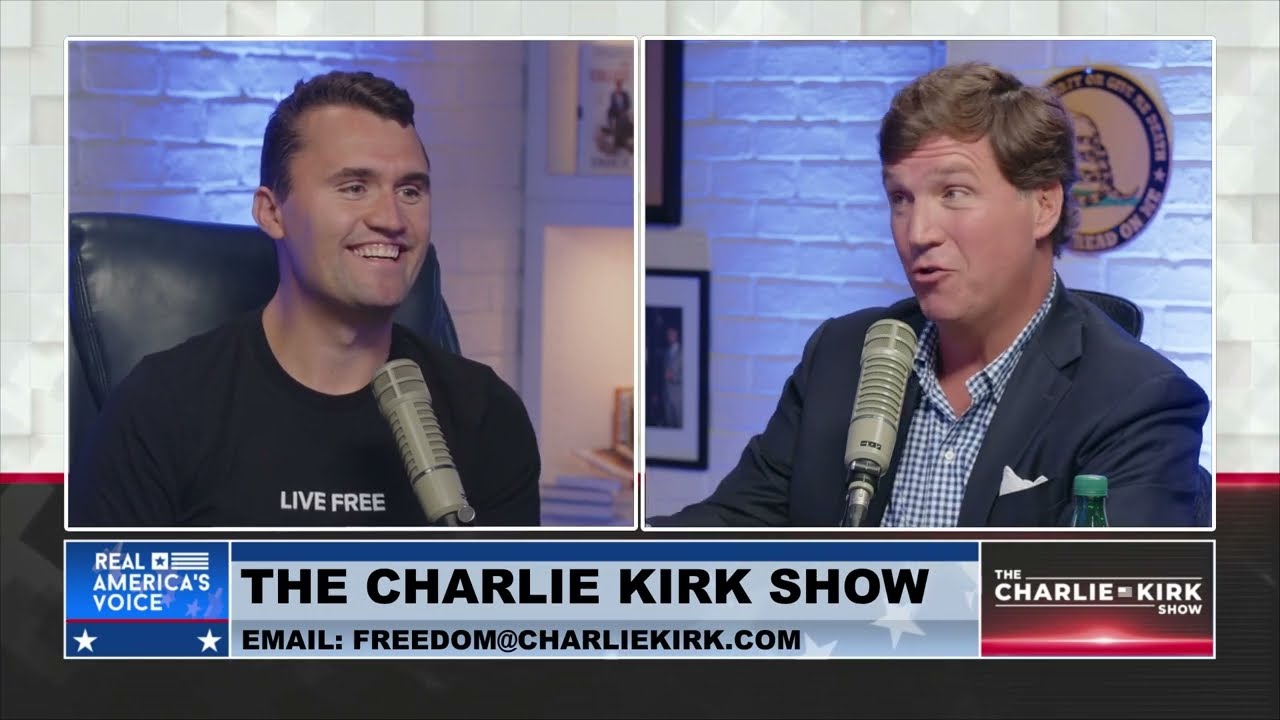
Charlie Kirk and Tucker Carlson Debate Frank Lloyd Wright, Modern Architecture, and America's Moral Decline After 1945
13:35


Related Books
Browse Conservative Books








Grant Cardone Breaks Down Trump's Tariff Strategy and the Art of Stacking Asks in Global Negotiations
Grant Cardone joins Charlie Kirk to dissect President Trump's tariff negotiations with China, explaining the sophisticated business strategy of "stacking asks" to gain maximum leverage. As a real estate mogul and fund manager who has closed billions in deals, Cardone reveals how Trump is using negotiation tactics typically reserved for high-stakes business transactions on the global stage. He analyzes who holds the real cards between the United States and China, why Trump's consumer economy gives America unmatched leverage, and how to navigate massive deals without backing opponents into dangerous corners. Cardone also shares urgent financial advice for Americans during this period of economic volatility, warning about retirement fund taxation and highlighting opportunities in the correcting real estate market.
The Art of Stacking Asks in High-Stakes Negotiations
Grant Cardone, equity fund manager, real estate investor, and author of The 10X Rule, provides a masterclass in understanding President Trump's tariff negotiation strategy with China and other nations. According to Cardone, Trump is employing a sophisticated business tactic called "stacking asks" - overwhelming the opposing party with numerous demands to the point of seeming ridiculous, then strategically removing items that weren't essential in the first place.
"I understand that the art of the deal is a bestseller across China this morning because the government is reading how to negotiate with probably the master, best, most genius, most calculated negotiator on planet Earth," Cardone explains. He points to Trump's approach with the Panama Canal as a perfect example of this stacking strategy, where multiple demands create leverage and negotiating room.
The strategy extends beyond bilateral negotiations. Cardone notes that bringing multiple countries to the table simultaneously wasn't just about those individual deals - it was a message to China that they would eventually have to come to the negotiating table as well.
What Happens When You're on the Receiving End of Stacked Asks
When asked what happens to the party on defense when facing stacked asks, Cardone breaks down the four essential elements that must be present in any negotiation: decision makers at the table, desire and willingness to reach agreement, urgency, and leverage. He notes that in the tariff negotiations, not all these elements are initially present, which is why leverage becomes the critical weapon.
"If somebody's stacking against me, I have to calculate how much leverage do I have here. If I don't have leverage, then what happens is I get overwhelmed and then I start whether I say it or not, I mentally start unpacking how much I'm willing to give up," Cardone explains. The psychological impact causes the opposing party to mentally compromise with themselves about what they're willing to concede, often giving up more than they originally anticipated.
He uses the metaphor of a divorce settlement to illustrate the concept - if one party stacks demands (half of everything, the house, the boat, the plane, the kids) without the other party having leverage, they'll likely win more than they thought possible. This same dynamic applies to the economic "divorce" or decoupling happening between the United States and China after 20-30 years of economic interdependence.
Who Holds the Cards: America vs China
In Cardone's objective analysis as someone who has executed billions of dollars in transactions, the United States holds significant advantages. The key leverage point is America's unmatched consumer economy - something that cannot be easily duplicated anywhere on Earth.
"I was asked once what's easier to create, a manufacturing economy or consumer economy? No one has created a consumer economy. Many countries have created a manufacturing economy," Cardone states. While he advocates for a blend of both, he emphasizes that America's consumer economy gives it maximum leverage because every country needs access to American consumers.
China's leverage points include their ability to manufacture products cheaper than the United States and their population of 1.4 billion people. However, Cardone argues China loses that leverage due to their struggling economy. They've attempted 26 different stimulus measures to fix their economy, none of which have worked. They face an aging population crisis, and for all of America's troubles, "China has 10x more."
The United States does have one vulnerability in this leverage equation: the political system. If enough people turn on Trump, particularly internally, that could flip the leverage back to China. This is why Cardone emphasizes that American citizens need to support the president in this effort, as he's "attempting to do something that has not been done by any president in my lifetime and should have been done by all of them."
Avoiding Escalation: Managing Egos and Preventing Cornered Opponents
Cardone addresses the critical question of how to prevent negotiations from escalating into dangerous territory or kinetic conflict. The key principle: never back an opponent into a corner where they feel they have no options.
"You can back a dog with rabies into a corner and then he's going to bite you. So you don't want to do that," Cardone warns. He points to Trump's announcement that tariffs would only be 10 percent as a strategic move to relieve tension. While media characterized this as Trump "caving in," Cardone sees it as skilled negotiation - relieving pressure so no one feels cornered.
This move accomplished multiple objectives: it created urgency by bringing potentially 70 countries to the table, it allowed Trump to appear reasonable by reducing the rate to just 10 percent, and it isolated China, leaving them wondering what they missed. The approach navigates the delicate balance of egos involved in these negotiations.
"Egos are very very important when negotiating. You don't want to trap a guy. You don't want to make a guy look bad," Cardone emphasizes. This is particularly important when dealing with Xi Jinping, who oversees 1.4 billion people and has an enormous ego as befits his position. High ego drive is necessary to be a winner, Cardone argues, and there's nothing wrong with ego when balanced with humility.
Cardone imagines that behind the scenes, Trump and his team are softening the public rhetoric in private communications with China, making it clear that everyone understands this is a negotiation and a "big boy game." The transparency allows both sides to pursue their best interests while maintaining the ability to save face and stay at the table.
Financial Advice for Americans During Economic Volatility
As an educator whose mission stems from losing his father at age 10 and never receiving mentorship from his uncles, Cardone is committed to sharing financial literacy. He wrote to President Trump after the election offering to help "make America intelligent again around their finances."
On current market volatility, Cardone offers this guidance for those invested in the stock market: don't panic, but do reassess what you're invested in. Depending on your age and what you hold in 401k, IRA, or Roth accounts, he suggests people reconsider these vehicles. While they appear to offer tax advantages, Cardone has serious concerns about their future.
"$38 trillion has been invested in retirement funds that I am very concerned in the future, 10, 15, 20 years from now, are going to be taxed not at the 19% they are now, but at 50 and 60 and 70 percent, particularly if we had the wrong politicians at the table," he warns. He advises people to evaluate whether the companies in their portfolios match their moral compass and to reassess their actual returns.
Cardone strongly advocates for real estate investment that produces cash flow. He points to a tremendous correction happening in the housing and apartment marketplace from Scottsdale to Sedona to New York City to Miami. His family and investors have made hundreds of millions of dollars in the last year by buying real estate that others aren't looking at, purchasing properties at corrected prices below replacement value because of problems in the debt market.
There is particular opportunity in the apartment space for individuals and middle-class people to create wealth through real estate. Cardone's company is changing real estate investment by combining real estate and Bitcoin in one fund with no debt, aiming to increase returns from the traditional 8-10 percent to 30-40 percent annualized returns. He plans to take this fund public toward the end of the year or early next year.
Tax Policy Wish List to Supercharge the Economy
When asked about desired tax policy deliverables from Congress, Cardone supports 100 percent bonus depreciation for any investments in manufacturing, new buildings, or new housing. However, he has an even more ambitious preference: completely gutting the IRS and moving to a fair tax system with zero federal income tax nationwide.
"I think that's actually doable in this term. I don't think most people believe that, but I believe it is. And I believe it'd be a great thing for Americans not to pay federal withholding tax. Learn how to invest your own money. The IRS is never going to do it better for you than you can do it for you," Cardone states.
He also highlights that states are beginning to look at reducing property taxes, with Florida currently pursuing this and Texas considering it. States that reduce property taxes will be big winners, drawing more people and more companies to their jurisdictions. Despite these national focuses, Cardone maintains an ambitious personal goal: "I'm still working on California. I'm going to do my best to flip California red this year."
Video Transcript
[00:00] So, what are you doing this Easter to
[00:01] celebrate with your family? Our good
[00:03] friends at Angel Studios have an
[00:05] incredible movie coming out this Easter
[00:06] called The King of Kings, an animated
[00:08] story of the life of Jesus, featuring an
[00:10] all-star cast, including Oscar Isaac,
[00:13] Forest Whitaker, and more. King of Kings
[00:15] brings the story of Jesus to the big
[00:17] screen for a whole new generation.
[00:19] Become a premium member in the Angel
[00:21] Studios Guild. Get two free tickets to
[00:23] see King of Kings and join the Angel
[00:25] Guild as a premium member at
[00:27] angel.com/kirk. Check out King of Kings
[00:29] in theaters this
[00:33] Easter. Joining us now is Grant Cardone,
[00:37] equity man, fund manager, real estate
[00:38] investor, Cardone Capital, author of The
[00:40] 10X Rule, and Grantcardone.com. Grant
[00:43] just recently hosted me at a pretty
[00:44] amazing event in Las Vegas. Grant, it's
[00:47] great to see you. Uh Grant, welcome to
[00:49] the program. Grant, what is your take on
[00:50] President Trump's negotiation and
[00:53] leverage that he's using via tariffs? As
[00:55] a businessman, what is your analysis?
[00:57] Well, I I understand, Charlie, first of
[00:59] all, always great to be with you.
[01:01] Enjoyed our time together in Las Vegas
[01:03] and love everything you're doing. Uh I
[01:06] understand that the art of the deal is a
[01:08] bestseller across China this morning
[01:11] because uh the government is reading how
[01:14] to negotiate with probably the master,
[01:16] best, most genius, most calculated
[01:19] negotiator on planet Earth. Your
[01:21] comments earlier about the Panama Canal,
[01:23] this is called stacking. when you
[01:25] negotiate transactions and I've I've
[01:27] negotiated very large transaction not
[01:30] not you know hundred trillion dollar
[01:32] negotiations like are taking place right
[01:34] now across the world but you want to
[01:36] stack your ask meaning that you want to
[01:40] overwhelm the other party with the
[01:42] number of things that you want almost to
[01:45] the point where you sound
[01:47] ridiculous and then you start settling
[01:52] or removing things that maybe aren't so
[01:54] necessary neessary. So I think your
[01:56] analysis of what Trump did with the
[01:59] Panama Canal is absolutely uh
[02:03] spoton. Uh things like bringing you know
[02:06] majority of the countries to the table
[02:09] was not to bring them to the table but
[02:11] to let China know, hey, they're coming
[02:14] and sooner or later you're going to come
[02:16] too.
[02:18] So Grant, I I love that stack the asks.
[02:20] Let's talk more about that in practice.
[02:22] What does that do to the party that is
[02:25] on defense? So, how does the Chinese
[02:28] respond to that? Let me ask this
[02:30] differently. What happens, Grant, when
[02:31] you're on the other side of the table
[02:33] and someone is stacking the asks against
[02:35] you? How do you then prudently respond
[02:38] to somebody that is using that sort of
[02:40] strategy and that kind of expertise?
[02:43] Yeah, that's a great question. Okay. So,
[02:45] if it's me being on the other end of the
[02:47] stack,
[02:49] uh the question always is who has the
[02:51] leverage? Like four things have to
[02:53] happen in negotiations. You have to have
[02:55] decision makers at the table. We don't
[02:57] yet by the way in with the tariffs. Two,
[03:00] you have to have a desire and a
[03:01] willingness to come to an agreement. We
[03:03] don't have that. Three, you have to have
[03:05] urgency. Trump does not have that yet.
[03:07] So, the only thing he has is the fourth
[03:10] uh the fourth weapon, which is leverage.
[03:12] So in the beginning if somebody's
[03:14] stacking against me I have to calculate
[03:16] how much leverage do I have here. If I
[03:19] don't have leverage Charlie uh then what
[03:22] happens is I get overwhelmed and then I
[03:25] start whether whether you whether I say
[03:27] it or not I mentally start
[03:31] unpacking how much I'm willing to give
[03:33] up. I imagine I came to the table
[03:36] believing I would give you this and then
[03:38] you start stacking on me. like I start
[03:42] basically unmocking or compromising with
[03:45] my own self what I'm willing to give up.
[03:49] Okay, it could be in a divorce
[03:50] settlement. You know, the let's say the
[03:52] wife comes at me and says, "I want half
[03:54] and I want the house and I want the boat
[03:56] and I want the plane and I want the
[03:58] kids." She might not want any of that
[04:00] stuff, but she starts overwhelming me.
[04:03] And then if I don't have leverage, she's
[04:05] going to win probably more than she
[04:07] actually uh thought she could or would.
[04:12] So that that is my wife. I hope my wife
[04:14] never hears this, by the way.
[04:17] Well, no. I I pray none No, no one gets
[04:20] into a divorce. I I pray it's a terrible
[04:22] awful thing. In some ways though,
[04:23] metaphorically, we are looking at we're
[04:26] looking at it's a great comparison
[04:27] though because what US and China are
[04:29] brokering is a little bit of a divorce
[04:32] or a decoupling of the way that the two
[04:34] powers have been interacting over the
[04:36] last 20 or 30 years. And we're going to
[04:38] have to renegotiate those terms. Just
[04:41] looking at this objectively, Grant, as a
[04:43] businessman who's done billions and
[04:45] billions of dollars of transactions and,
[04:47] you know, has done tens of billions of
[04:49] dollars of value through everything
[04:50] you're doing. Who has the cards here?
[04:52] Who who is the one that you would say is
[04:54] the shrewd operator that acting as if
[04:57] they have leverage? Kind of stake it out
[04:59] here as an objective third party. Yeah.
[05:02] Who like what what cards does the United
[05:04] States have? What cards does the China
[05:06] have? And then kind of give us a little
[05:08] bit of analysis there. Well, look, I
[05:10] mean, you know, a lot of people have
[05:12] leverage in a situation and they never
[05:13] use it. In the case of the United States
[05:15] and China, you we have leverage that
[05:18] cannot be duplicated anywhere and has
[05:20] not been duplicated anywhere on planet
[05:22] earth, which is a consumer economy. You
[05:25] know, I was asked once what what's
[05:27] easier to create a manufacturing economy
[05:29] or consumer economy? No one has created
[05:32] a consumer economy. Many countries have
[05:34] created a manufacturing economy. I would
[05:37] rather have a blend of both. But America
[05:40] has the greatest consumer economy on
[05:42] planet Earth. Every country needs us. We
[05:44] have maximum leverage. Now, what
[05:46] leverage does China have? Well, they
[05:48] make products and services cheaper than
[05:50] we can. They have 1.4 billion people. Uh
[05:54] but they lose that, Charlie, because
[05:56] their economy is terrible. They've tried
[05:58] 26 different stimulus to fix their
[06:01] economy. None of them worked. Uh they
[06:03] have an aging population as you know and
[06:06] they're in trouble right now for all the
[06:08] troubles that we have. China has 10x
[06:10] more and um any leverage point they did
[06:15] have they're going to lose because
[06:17] ultimately uh they their economy is so
[06:21] weak. Uh that that being
[06:24] said we lose some leverage because of
[06:28] the way our political system is set up.
[06:30] If enough people turned on Trump,
[06:32] particularly internally, that would flip
[06:34] the leverage back to China. And that's
[06:37] why we need people to consolidate.
[06:38] Particularly, American citizen needs to
[06:40] pray for
[06:42] affirm and send best wishes to uh
[06:45] President Trump because he's attempting
[06:47] to do something that has not been done
[06:49] by any president in my lifetime and
[06:51] should have been done by all of them.
[06:55] So then, how do we going back through
[06:57] that sequence of your analysis of how
[06:58] big deals happen? How do we make sure
[07:01] that this does not get heightened to a
[07:03] kinetic war or tensions blow up and just
[07:07] get boiling into levels that we don't
[07:09] want to see them happen. How do we make
[07:11] sure this is within guard rails? Explain
[07:13] the balance, Grant, because I'm sure
[07:15] you've had deals that have blown up.
[07:17] Yeah. Yeah. Please explain. Yeah,
[07:19] because you can back a you could back a
[07:21] a dog with rabies into a corner and then
[07:23] he's going to bite you. So, you don't
[07:25] want to do that. So, you have to be very
[07:26] careful. I think uh President Trump
[07:29] yesterday telling everybody, "Look, it's
[07:31] just 10% everything's cool." What he did
[07:33] was he relieved all the tension. Uh I
[07:37] think the the U media was saying, "Oh,
[07:40] he caved in." He didn't cave in. You
[07:42] want to relieve pressure in a
[07:44] negotiation so no one feels cornered and
[07:47] just wants to, you know, in this case
[07:49] nuke, which would never happen, by the
[07:51] way, in my mind. But you do need to
[07:54] bring the players to the table. Remember
[07:57] the first three things are decision
[07:58] maker, willingness, three, urgency. You
[08:01] increased, Donald Trump increased the
[08:04] urgency yesterday. You had you had many
[08:06] countries, I don't know what what the
[08:08] exact number is, could have been as many
[08:09] as 70 that came to the table and said,
[08:11] "Okay, we're ready. We have urgency."
[08:13] And Donald Trump said, "Don't even worry
[08:15] about it. It's just going to be 10% and
[08:17] we're cool."
[08:18] That leaves China out by themselves kind
[08:20] of looking like what do we miss here? Uh
[08:24] again and President Trump knows there's
[08:26] egos involved. Egos are very very
[08:29] important when negotiating. You don't
[08:32] want to trap a guy. You don't want to
[08:33] make a guy look. Yeah. So
[08:35] let let me let me interrupt you there,
[08:38] Grant. I'm so glad that you mentioned
[08:40] that. I mean there is no bigger ego than
[08:42] Xiinping. He looks at himself as king of
[08:44] the world, king of China. He's control
[08:46] of 1.4 4 billion people. How and then
[08:49] you have equal amounts of personas
[08:52] across the board. How then do you
[08:54] navigate with the egos, with the pride
[08:57] of the Chinese culture? How do you go
[09:00] through that thicket? It's an enormous
[09:03] task.
[09:05] Look, I I imagine he's on the phone with
[09:07] him right now. All these players at that
[09:09] level have egos. Nobody wants to look
[09:12] bad, whether it's president of China or
[09:14] the president of the United States of
[09:15] America. The high ego drive, by the way,
[09:18] is necessary in order to be a winner.
[09:22] And there's nothing wrong with I I I
[09:24] think it's highly recommended for people
[09:26] to actually develop some kind of ego
[09:28] that has humility and a balance mixed
[09:31] in. And I could imagine Donald Trump or
[09:33] Howard Lutnik letting China know
[09:35] yesterday, hey guys, we're going to come
[09:37] to a solution. Everybody knows we're
[09:39] just negotiating here. Like this is a
[09:41] big boy game. It's very
[09:43] transparent. Uh there's nothing wrong
[09:45] with telling the other side, "We're
[09:46] trying to get the best deal for us. I
[09:48] know you want the best deal for you.
[09:50] Everybody knows exactly what's going
[09:52] on." So, I imagine he's softening the
[09:54] rhetoric that we're hearing here in
[09:56] America. Uh so that um so that they can
[10:00] stay at the table and save
[10:04] face. Grant, we have a minute remaining
[10:06] in this segment. Why don't you plug some
[10:07] of the stuff you're working on? You got
[10:09] books, you got all sorts of stuff. Kind
[10:10] of give us an update on what Grant
[10:12] Cardone is up to. Well, look, look, my
[10:14] my I'm an educator. My whole my whole
[10:16] life, I've been an educator. My dad died
[10:18] when I was 10 years old, and my uncles
[10:20] didn't come to to to mentor me. And I
[10:22] always promised if I ever got
[10:23] successful, I was going to I was going
[10:25] to help other people. So, we're an
[10:27] educational company that tries to
[10:30] attempts to, you know, share financial
[10:32] literacy and competency. And I I wrote
[10:36] uh President Trump when he won the
[10:38] election. Hey, I'd love to to
[10:39] participate in making America
[10:41] intelligent again around their finances.
[10:44] Um so that's what I do. My company
[10:46] educates people on you can find me
[10:48] almost anywhere. Just plug the name in
[10:50] Grant Cardone on Google and you'll see
[10:51] all the stuff I'm doing. We got a big
[10:53] real estate fund. We're changing the way
[10:55] real estate is invested in right now by
[10:57] putting real estate and Bitcoin in one
[11:00] fund with no debt, by the way. Uh, and
[11:04] we we're going to take real estate from
[11:06] what it was doing, which was an eight or
[11:08] 10% return to a 30 and 40% annualized
[11:10] return. So, I'm really really excited
[11:12] about that. We'll probably take that
[11:14] public toward the end of the year or the
[11:15] first of next year. I'm actually having
[11:16] a meeting on it right now. Grant, I know
[11:19] you got to be careful about giving
[11:21] individualized investment advice, but
[11:23] tell us about how you are thinking about
[11:24] this volatility and some of the
[11:26] principles that you think people should
[11:28] employ during economic uncertainty.
[11:31] Well, first of all, my wife just ordered
[11:33] some rough greens and I said, "We don't
[11:36] have a dog." She's like, "I ordered it
[11:38] for you. You are the dog in the house."
[11:42] So, the deal was too good to be It's
[11:44] going to really improve your health,
[11:45] Grant. You're You're going to see a
[11:47] great improvement in health. So, thank
[11:49] you. Thank you. Um, okay. What people
[11:52] should be doing, by the way, this is
[11:54] financial advice. I am not a financial
[11:55] adviser, but I will give financial
[11:57] advice. Uh if you're invested in the
[11:59] stock market, you should be very you
[12:01] should not panic right now. I would tell
[12:04] you and suggest that you should reassess
[12:06] what you're invested in. Uh depending on
[12:08] your age, if you're in a 401k, IRA or
[12:11] Roth, I think, you know, people need to
[12:13] reconsider what that really is today.
[12:15] These are old vehicles that have been
[12:17] created that look like tax advantages to
[12:20] the public that Charlie, you and I have
[12:22] talked about before. I really believe
[12:24] these will not be great mechanisms for
[12:26] people in the future. They have been
[12:27] great for Wall Street. You know, these
[12:30] are $38 trillion has been invested in
[12:33] retirement funds that I am very
[12:35] concerned in the future, 10, 15, 20
[12:38] years from now, are going to be taxed
[12:40] not at the 19% they are now, but at you
[12:44] know, 50 and 60 and 70%. Particularly if
[12:47] we had the wrong politicians,
[12:49] um, you know, at the
[12:51] table. But I would tell everybody,
[12:53] reassess what's in there. What companies
[12:56] are you really invested in? Do they do
[12:58] those companies that you're invested in
[13:00] actually match up with your moral
[13:02] compass? Because I think you'll find
[13:04] that many of those companies do not. And
[13:07] then re-evaluate what your returns are.
[13:09] Second thing I would say is, you know,
[13:11] you should be invested in real estate.
[13:13] Everyone, every American should have
[13:15] money invested in real estate that cash
[13:17] flows. Uh there's a tremendous
[13:19] correction going on in the housing
[13:22] apartment marketplace. Charlie, you and
[13:24] I have talked about this. It's happening
[13:26] from Scottsdale to to Sedona all the way
[13:29] to New York City to Miami. It's a
[13:32] massive correction going on. Uh I have
[13:34] made um my my family and our investors
[13:37] hundreds of millions of dollars just in
[13:39] the last year because we're buying real
[13:42] estate that no one's looking at uh at
[13:44] very um corrected prices below
[13:48] replacement value uh because of the debt
[13:51] market's problematic right now. So
[13:53] there's tremendous opportunity
[13:54] particularly in the apartment space uh
[13:56] for for uh
[13:58] individuals and middle class people to
[14:01] to create wealth using real estate.
[14:05] Very good. So so Grant super quick just
[14:08] what are you hoping to see as an
[14:10] investor from tax cuts? Uh you know as
[14:13] we mentioned it's not breaking news but
[14:15] the house has passed the budget
[14:17] resolution package which is great which
[14:19] will pave the way. What do you want to
[14:21] see more than anything else as a
[14:23] deliverable to full depreciation? What
[14:25] do you think is really going to
[14:26] supercharge this economy? One minute
[14:28] remaining, Grant. Yeah, that's one of
[14:30] them. You know, any investments in any
[14:32] manufacturing, any new buildings, any
[14:34] new housing, 100% bonus depreciation. I
[14:38] like that. What I like better than that,
[14:40] and I would be willing to give that up,
[14:42] is basically gut the IRS, go to a fair
[14:46] tax, zero federal income tax nationwide.
[14:50] I think that's actually doable in this
[14:52] term. I I I don't think most people
[14:54] believe that, but I believe it is. And I
[14:56] believe it'd be a great thing for
[14:58] Americans not to pay uh federal
[15:00] withholding tax. Uh learn how to invest
[15:02] your own money. The IRS is never going
[15:05] to do it better for you than than you
[15:06] can do it for you. Um, short of that,
[15:10] uh, states are going to start looking at
[15:11] reducing their property taxes. Florida
[15:13] is doing it right now. Texas is looking
[15:15] at it. Yep. And I think those those
[15:17] states that do that, Charlie, are going
[15:19] to be big winners and they're going to
[15:21] draw more uh more people and more
[15:23] companies to their states.
[15:26] Very good, Grant. Thanks for everything,
[15:27] man. Uh, looking forward to seeing what
[15:29] you have next and what you have coming
[15:31] down uh the schedule for you. So,
[15:34] thanks, Grant. We really appreciate it.
[15:35] Yeah, appreciate you, man. and and uh
[15:37] I'm still working on California. I'm
[15:38] going to do my best to flip California
[15:40] red this year.
[15:43] You're the best. Thanks, Grant. Talk to
[15:44] you soon. Thank you. Thanks.




Comments
Be the first to comment on this video.