Nate Friedman Journeys to Arizona Memorial Service and Witnesses Charlie Kirk's Impact Firsthand
Enjoying this? Share it with someone who needs to see it.
Up Next
Full 8-Hour Coverage: Charlie Kirk Memorial Service Celebrates Faith Freedom and a Life That Challenged a Generation
9:18:51
Allie Beth Stuckey Witnessed the Largest Single-Day Christian Revival in History at Charlie Kirk Memorial
1:19:43
Eric Metaxas Witnessed the Most Powerful Christian Witness in American History at Charlie Kirk's Memorial Service
48:09
Nate Friedman Journeys to Arizona Memorial Service and Witnesses Charlie Kirk's Impact Firsthand
Nate Friedman, independent journalist and host of the Nate Friedman Show, traveled to Arizona without planning to make content, just to honor his friend. What he discovered was a memorial service unlike anything he had witnessed, with hundreds of thousands gathering at dawn, traffic rivaling Taylor Swift concerts, and security matching presidential inaugurations. Through his eyes, viewers experience the vigil at Turning Point headquarters, the stories of lives transformed by Charlie Kirk's mentorship, and Erika Kirk's powerful speech before 100 million viewers worldwide. Friedman captures intimate moments and profound testimonies that reveal how a 31-year-old built a movement that changed countless lives, facilitated marriages, launched congressional careers, and brought together an unprecedented gathering to say goodbye.
Nate Friedman traveled to Arizona with no intention of creating content. He went simply to honor his friend who had been assassinated for speaking the truth. What unfolded was a memorial service unlike anything he had ever experienced in his life. For two weeks following the tragedy, Friedman thought about Charlie Kirk most of every hour. The pain was so intense that he dropped everything and rushed home to be with his family in Boston.
The night before the service, Friedman decided to attend the vigil outside Turning Point headquarters. He wanted to see where Charlie built his movement and pay his respects. When he arrived, police presence surrounded the vigil—a sad reminder of where the country stands when law enforcement must guard a memorial service.
A Movement Built on Young People
Walking through the vigil, Friedman noticed the average age was people in their twenties. The significance of this cannot be overstated. Both Marco Rubio and Donald Trump Jr. spoke during the ceremony about how they had pushed Charlie away from the concept of convincing college kids to be conservative, thinking it was impossible.
Trump Jr. recalled: "When Charlie first said to me during the 2016 campaign, 'Hey, let's start doing events on college campuses,' I was like, 'Whoa, seriously? Come on, man, we've given up on that. We're going to let those kids grow up and we'll get them when they start paying taxes.'" Rubio admitted being skeptical as well: "I said, 'College campuses, you're going to do that? Why don't you start somewhere easier, like for example, communist Cuba?'"
Charlie did the impossible. This isn't about whether you agree or disagree with his mission to convince young people to vote on the right. It's about the sheer grit and will to believe in yourself and your mission despite some of the most powerful and intelligent people in the world telling you it's impossible—and then going out and doing it.
The second thing Friedman noticed was how quiet and respectful everyone was, which stood in stark contrast to what could have been. There were no riots across the country about people's favorite content creator being assassinated at 31 years old. Instead, people were respectfully honoring a patriot. Families filled the space, united in remembrance.
A 3:45 AM Wake-Up Call
As press, Friedman was asked to arrive at 5:45 AM, which meant waking at 3:45 AM since his hotel wasn't in Glendale. The hotels in the area around the stadium had been sold out for Charlie's service—the first indication of the sheer impact this man had.
When he tried to order an Uber, a notification appeared: "All drivers are busy right now." He was in downtown Phoenix, just 20 miles away. After switching to Lyft and waiting ten minutes, he finally found a driver. When she asked what brought him to Arizona and he responded that he was attending Charlie Kirk's funeral, she replied: "Oh, no. A Trump supporter."
The driver proceeded to tell Friedman how racist Charlie Kirk was and how something like this was bound to happen because of how hateful he was. Normally he would have hit record, but he hadn't planned on making a video—he thought he would simply be getting a ride to his friend's funeral, not debating at 4 in the morning.
Things stayed silent until she smiled and said: "You know, I didn't like the guy, but this traffic is crazier than when Taylor Swift had a concert here, and this is for a funeral." Friedman sat quietly as she witnessed Charlie's impact firsthand: bumper-to-bumper traffic in Glendale, Arizona at 4:00 in the morning.
Running to Make It on Time
At 5:40 AM, Friedman was about a mile from where press was supposed to meet, and the email had stated they would leave at 6:00 AM sharp. The traffic had turned into a complete parking lot—cars weren't moving at all. He made a decision: get out and run with all his bags, since he was leaving straight for the airport after the service.
He told himself he wasn't missing this event. He got out and ran along the side of the stopped cars, arriving just before 6:00 AM. He also saw many families get out of their cars and walk the rest of the way because the vehicles simply weren't moving.
When he finally reached the press staging area, he was shocked by how many people were there. The clip of people walking to the stadium wasn't general admission or VIPs—it was just press. He quickly realized how historic this ceremony was going to be.
Security Like Inauguration Day
At the first checkpoint, all bags had to be placed on the ground. Every piece of press equipment was analyzed to the maximum—cameras, stands, everything. This was the type of security Friedman had hoped to see, considering the entire administration would be under one roof. The place was locked down, feeling similar to inauguration. Some members of the press even remarked that this had more security than inauguration.
After bags were checked, Friedman looked across the parking lot and saw General Admission. It was a line like nothing he had seen before, not even in movies—a sight he will never forget. At 6:00 in the morning in Glendale, Arizona, he looked out and saw 100,000 people lining up. Charlie's right hand said it was even close to 300,000 people.
It was a mixture of feelings—of course there would be this many people to honor and support Charlie, but also utter disbelief that they couldn't talk to Charlie about it.
A Celebration of Life
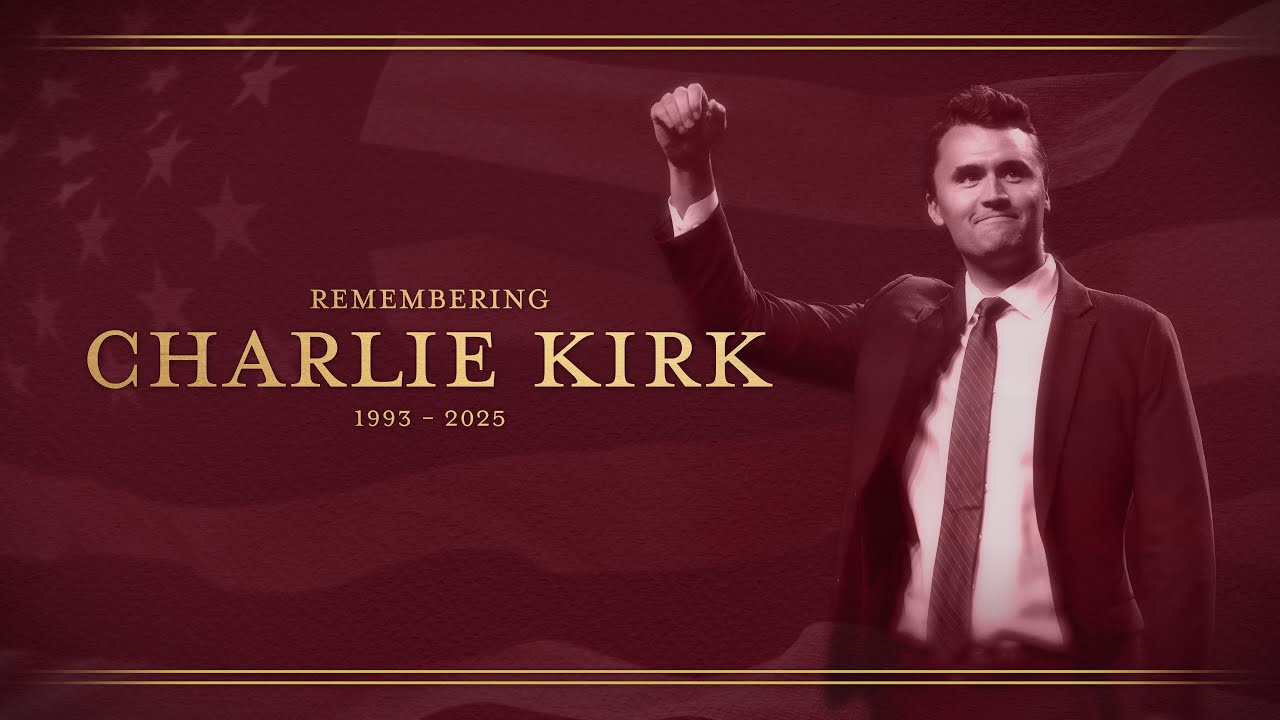
Walking inside the stadium, it felt more like a celebration of life than a funeral. Thousands of people poured in not wearing all black, but wearing MAGA hats and Turning Point merchandise. But on the screens appeared "Remembering Charlie Kirk" with dates not nearly far apart enough.
The entire ten days before the funeral had been about complete disbelief that he was gone. But by the end of the day, Friedman finally said goodbye to Charlie.
Around the stadium were pictures of Charlie with his wife and kids. Friedman had two favorite photos. One showed Charlie with his eyes closed because, as Friedman observed, Charlie's brain was always working—when you talked to him, he already knew what you were going to say, making you wonder why you were still talking. He was thinking harder and faster than you were. For him to close his eyes like that, only love could do that.
The other favorite photo showed how happy Charlie was. People remember Charlie for the debates he did, but Friedman encourages remembering him for moments like this. In a clip played at the service, Charlie said: "I can tell you I'm super blessed. I have the best wife in the world. We have an amazing life. Building a family is the coolest thing ever. And my prayer for all of you is that you one day can do that. It's honestly the most joyful thing. I've had some pretty amazing experiences. I've been very blessed. Very lucky you could say, but very blessed is the word I would use. And the greatest joy I've ever had is coming home to my little daughter running up to my leg. There's nothing that even comes close to it—not flying on Air Force One, not meeting with presidents. That pales in comparison to your little girl coming up and squeezing your leg."
The Ideology That Enabled Violence
For millions of people in the country, they didn't want Charlie to have that life. It wasn't just Tyler who pulled the trigger. It was the ideology perpetuated on college campuses and across legacy media that violence is acceptable.
When Friedman asked Harvard students about 32% of their peers believing that violence is acceptable to prevent someone from speaking on campus, many were surprised it wasn't higher. One student essentially said that the more left-wing you are, the more violent you are, stating: "I thought it'd be maybe a little bit higher. I feel like Harvard's quite liberal."
Think about how troubling that is—that at a top university, a third of students believe it's okay to hurt people you disagree with.
Early Arrivals and Morning Press
Walking into the press area on the floor of the stadium at 8:03 AM, Friedman saw people already seated. He knew they must have been waiting outside since practically the night before to already be in the stadium. He smiled at all of them because they too had dropped everything to honor Charlie.
Friedman was offered a spot on a panel by NTD, the same news station that had interviewed him about the paid protests he investigated. During the interview, he reflected: "Charlie, you know, it's impossible to believe that he was only 31. When you spoke to him, it felt like you were speaking to someone twice his age. His knowledge, there wasn't any religious text he didn't know. You could ask of any concept in economics, any industry, and he would know. And what was so incredible about Charlie is that while you were trying to learn from him, he would try to learn from you. He really wanted to know what I'd been seeing on the street so that he could connect with voters better."
Stories from Those Who Knew Charlie First
What Friedman believed didn't get enough media coverage were the statements made not by the administration, but by the people who knew Charlie from the very beginning. One of Charlie's first donors told a story that brought a much-needed smile. Almost 12 years ago, she met this bright young man filled with optimism about his plan to reach young people. She was so impressed that she invited him to her home with her husband to learn more about his organization.
Charlie told them he wanted to start two chapters in North Florida. When asked how much money it would take, he said about $50,000. Not knowing anything about this young man except that he sounded impressive, they told him that if he could raise the first half, they would give him the remaining $25,000. Two days later, Charlie called to say he had raised the money.
This story reminded Friedman of Charlie's undeniable work ethic. When Charlie invited him to an event with other creators over the summer, they were listening to him interview someone very famous and influential. In the middle of the interview, Charlie said, "I gotta go do my show, but I'll be back." That's who Charlie was—he never for a second lost sight of the mission. That's why whenever a speaker mentioned Turning Point USA, the crowd roared, because everyone saw Charlie sink his blood, sweat, and tears into building it.
Mikey McCoy's Story
Friedman loved listening to Mikey McCoy, Charlie's chief of staff. He had never met Mikey, but once at an event, another creator pointed him out and said: "That's Mikey McCoy, Charlie's chief of staff. When you see him, that means Charlie is only a few minutes away. They're always together."
In his speech, Mikey shared how he met his wife while building Turning Point with Charlie. The first time he met Charlie was when driving him and his then-girlfriend Erica to the airport after Charlie had spoken at his father's church. The entire car ride, Charlie was grilling him on Aristotle, Socrates, Plato, and American history. At the end, Charlie said: "Don't go to college. Come work for me instead."
At 18, Mikey canceled his college plans and moved to Arizona. His life was forever changed by Charlie. On his first day working at Turning Point, he met an incredible girl Charlie was interviewing on his podcast—a woman sharing the story of her family who had survived a totalitarian regime, whose grandfather was imprisoned in the Gulags for ten years for preaching the gospel. Elizabeth and Mikey were married a year later.
This made Friedman realize that Charlie did this for likely hundreds of other couples. This wasn't just any organization—it was one that brought together people of similar age with similar values, resulting in many weddings. Charlie not only built an incredible company but helped others find their soulmates.
The Speech That Brought Tears
The only speech that brought Friedman to tears was one of the very first ones, delivered by Stacy Sheridan. She said: "Yes, technically Charlie was my boss, but it really never felt that way. Far more than my boss, I felt like he was my little brother. In 2022, my husband Mike became sick with cancer. Two years later, that cancer took his life. Throughout those two years, Charlie called me consistently to ask how he could help us. At one point, he had critical medication and an oxygen machine sent to my doorstep without my knowledge. I still to this day have no idea how he made that happen."
Stacy continued: "Sometimes I would express guilt to Charlie that I couldn't do my job at 100%. Charlie's response every single time was family first. When Mike ultimately passed away, Charlie and the entire team were there for us yet again. They helped my daughter Grace through the unbearable tragedy of losing her father on her 9th birthday."
"But Charlie's help didn't stop there. This January, I lost my home in the Pacific Palisades fire. Charlie's response was very clear and very direct: 'This is a sign you and Grace belong in Arizona.' Now, Erica, Grace, and I will support you and your babies the way you and Charlie were there for us in our darkest days. Charlie, we will miss your words of wisdom, your high-pitched laugh—it was kind of awkward—and the way your voice would always soften when you spoke to Erica and your children. And I promise we're going to make TPUSA so big that it reaches you in heaven."
Behind the Scenes with Andrew Kolvet
Friedman loved hearing from Charlie's producer, Andrew Kolvet. He didn't know Andrew well, but he was the person who briefly talked to him before going on Charlie's show, telling him to send in his favorite moments—always on top of everything.
Andrew revealed something remarkable about Charlie: "He read every single email you all sent to him. That's why he said every single day, send us an email at freedom@charliekirk.com. Send us your thoughts. If you agree, you disagree, and we want you to keep sending us those emails. And this is a true story. At the end of every show, I had a little ritual of my own. I would go into the sent folder of freedom@charliekirk.com and sure enough every single show I would find debates that he was having with his audience that disagreed on some minor point. There would be email chains six or seven emails long all while Charlie Kirk was hosting his own show. It's truly remarkable."
With Charlie, none of what he did was an act. Over the two days where Friedman learned from Charlie in person, he always talked about the marketplace of ideas. He won in the marketplace of ideas, and that's why he was shot—because nobody could beat him in a debate.
Lives Changed, Careers Launched
One of the most moving realizations was that not only did Charlie and his organization help get Trump elected, but many of the most productive members of Congress wouldn't be there if not for Charlie. Anna Paulina Luna, who serves on the oversight committee, wouldn't be a congresswoman if it wasn't for Charlie. She was going to go to medical school, but Charlie offered her a position as head of Hispanic outreach at Turning Point. They tabled together at a university, and from there she gained the momentum to get to Capitol Hill—one of thousands of stories of people whose lives completely changed because of Charlie.
Traveling Six Hours to Honor Charlie
When Friedman went to get food at the stadium, he was in line with a woman he'd never met. She was from California, and when he asked if she drove six hours that morning, she said no—they came the day before, but got to the venue at 2:00 in the morning to wait in line. She and her family drove six hours, stayed the night, then got up at 2:00 AM and stood in line for eight hours for a chance to get into the stadium to honor Charlie. There wasn't even a guarantee they would get in.
She was a real estate agent who said people keep coming to her to sell their homes in California because of woke policies. They're sick of the transgender agenda being perpetuated in schools. She was on the front lines hearing that information straight from people themselves, and she was at the service because she knew Charlie was fighting for her family's values.
Erika Kirk Takes the Stage
Something beautiful that Turning Point did for this memorial was play videos of moments the next speaker had with Charlie—pictures one after another that geared the audience up for who was coming next. The roar for Tulsi Gabbard was one Friedman won't forget. There was a roar for many others, but the one for Tulsi hit him most because she used to be on the left and this audience knew that, but they embraced it. Tulsi had debated Kamala Harris in the primary, was put on the TSA watch list under the previous administration, and now she's the Director of National Intelligence. That's a comeback story.
Then came the moment many traveled across the country to witness: Erika Kirk. She was about to give the speech that would echo for eternity. 100 million people tuned in across the globe to hear Erica talk about her beloved Charlie.
Everything about this speech was memorable, but what will be burned into Friedman's mind is how long Erica took to get to the podium—the bulletproof glass surrounding the podium of an indoor event that already had intense security, because the worst evil walks among us. The way she looked up, remembering Charlie and knowing full well that this would be one of the biggest speeches of all time, was incredible to witness.
The line that Friedman says he'll be able to recite word for word in 40 years: "He was 18 years old, a man barely out of high school, running around the halls of the RNC without a dollar in his pocket and a single contact in his phone. People who saw him said that he didn't know what he was doing, but he did. He did know what he was doing. He knew exactly what he was doing. He was going to change the world and he did."
That's the kind of line, delivered the way it was, that could only come from a family member who loves you more than life itself. Imagine: her husband murdered for speaking the truth, leaving her and two beautiful children behind. Within 11 days, the board elects her to be the CEO to carry out Charlie's and her vision. Then she organized the biggest memorial service this country has ever seen for a civilian—all while being a mom having to explain to her one- and three-year-old that their father won't be coming home. That is a hero, a lioness, a phoenix from the ashes.
Love in the Peripheral
There was a moment over the summer at an event where Friedman was having dinner in the same hall as Charlie and Erica. His chair was positioned directly opposite and diagonally from them. In his peripheral vision, he saw the way they looked at each other. It was the same way his parents have looked at each other after being married for over 40 years. There's no other word than love—purely unconditional love between two people trying to achieve one mission. Friedman's heart shattered over what has been taken from her and her children.
President Trump's Address
Next up was President Trump. This was the second time Friedman had seen him in person from afar—once at the Madison Square Garden rally and now this. It's remarkable to see him in person and realize that he is just a person like you but with the weight of the world on his shoulders.
Friedman talked to some members of the press who travel with the president. They discussed how difficult it is to keep up with Trump and how, quote, "with Biden he never moved."
Trump delivered a moving speech while also giving the audience a much-needed laugh after a day of tears. But Friedman did a double take when he realized Trump was talking about paid protesting. He couldn't believe it—all those long nights investigating these organizations, talking to these people in person who are trying to destroy the country, and here's the president talking about it.
Trump said: "Many of these people, by the way, are paid a lot of money to do this. They're agitators. They're paid agitators. Remember that. When you see they all have the same beautifully printed sign—every sign is identical, comes out of a top level print shop. That's not the signs that are made in somebody's basement. Those are paid for by very bad people. And hopefully we're going to be finding out through the DOJ who those people are."
A Father's Embrace
As the speech ended, Trump brought Erica onto the stage. Like everyone watching, Friedman saw the way she hugged Trump and how Trump embraced her as family. It felt like the media never shows this side of Trump. You can be from the left or the right, but you can't deny that this embrace was that of a father and a daughter.
Friedman doesn't know anything about Erica and Trump's relationship—he only saw this hug and sat there hoping that it gave Erica a little bit of solace after the hardest 11 days of her life. A sitting US president gave the eulogy to her husband who was only 31, and Trump along with his administration will look after her.
Two presidential planes came to Glendale, Arizona. So many members of the House and Senate were there, not even to speak, but just to honor Charlie.
The Final Goodbye
As Friedman turned to leave for the airport, he saw the screen display a picture they hadn't used until after the ceremony was over: "Remembering Charlie Kirk, 1993, 2025." That's when it truly hit him that Charlie was gone.
He had been denying it for two weeks, waking up every day thinking he would see a new Charlie video or see him at the next event. As he walked the steps out of the stadium, he said goodbye to his friend, knowing that the world would never be the same again.
It hurt in two ways: one, because Charlie was becoming a mentor to him, and two, because he genuinely believes Charlie was the greatest soldier for Western culture. Maybe it all occurred to him then because it was like conditioning—so many speakers who knew Charlie much better than he ever would saying that he's gone. You hear it enough times and you start to believe it.
Finally, at the airport, seeing the Turning Point hats and signs was one last reminder that people traveled from around the world to honor Charlie.
"I will miss you, Charlie. No one can even get close to filling your shoes. But we know what your mission was, and all we can do is fight for it in our own way now."