
Up Next
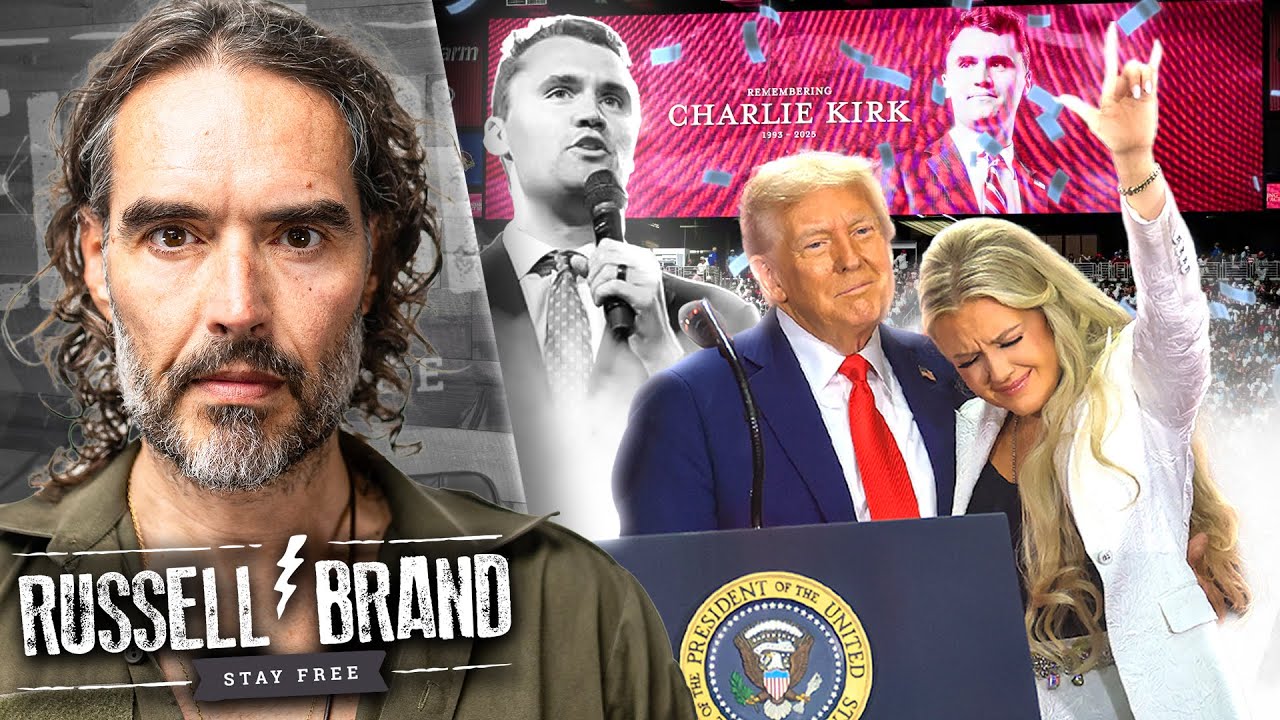
Russell Brand Analyzes Erika Kirk's Forgiveness and the Spiritual Shift at Charlie Kirk's Memorial
44:43

Candace Owens Exposes Laura Loomer's Mental Health History and Allegations of Sexual Predation Amid Escalating Feud
16:20

Candace Owens on White Guilt, Black Victimhood Culture, and Why Trans Activism Hijacked the Gay Rights Movement
1:41:49
Russell Brand and Candace Owens Discuss Hollywood's False Light, Christ, and Humanity's Degeneration Through Technology
Russell Brand joins Candace Owens for an unfiltered conversation about finding faith after Hollywood, the deception of technological progress, and why modern civilization is making humanity increasingly dependent and incapable. Brand shares his journey from communist to Christian, reflects on the empty promises of fame and hedonism, and explains why he believes we're witnessing a spiritual revival. From vaccine skepticism to the dangers of AI, from Elon Musk to Robert F. Kennedy Jr., they explore how false idols, whether technology, the state, or celebrity, distract from eternal truth. Brand argues that dependency on God is natural, while dependency on institutions is manufactured, and that the greatest threat facing humanity is the control of consciousness itself.
Hollywood as False Light and Pagan Worship
Russell Brand opens the conversation with characteristic humor, discussing his nervousness and the difference between being an actor and being himself. He reflects on his time in Hollywood and the film industry, explaining how different directors approach their craft—from those focused purely on performance to perfectionists like Stanley Kubrick who envision every molecular detail.
Candace Owens introduces the book "Hollywood Babylon" by Kenneth Anger, a banned text from the 1960s that exposed Hollywood's occult foundations. She explains how the film industry was deliberately established as a pagan faith system, with movie theaters called "cathedrals" and performers called "stars" to encourage worship. The author, connected to Aleister Crowley and the occult, revealed that Hollywood's founders believed in sex magic and intentionally created a counterculture to Catholicism.
Brand agrees completely, noting that Hollywood was built on false luminosity—a counterfeit light. He references filmmaker David Lynch, who once told him that Los Angeles was chosen for filmmaking because of "the light." Brand now sees this as symbolic of Lucifer, the false light, the great deceiver. He explains that the stories a nation tells itself form that nation's psyche and soul, and Hollywood has been telling America deceptive stories for generations.
The Emptiness of Fame and Hedonism
Brand discusses how most entertainers are driven by deep self-doubt and loathing, making them vulnerable to Hollywood's false promises. The industry tells broken people that there's nothing wrong with their infantile desires, narcissism, and hedonism. He points to contemporary examples like pop star Sabrina appearing in pornographic outfits on Rolling Stone covers, demonstrating how the objectification of women has become completely normalized.
He shares his own experience of fame's emptiness, referencing Jim Carrey's observation that everyone should experience fame and wealth to realize how hollow it is. Brand explains that for years he sought fulfillment through sex, drugs, power, and flattery, but eventually recognized that even good things like duty and love run dry unless undertaken through faith in God.
The transformation in Brand's life came through understanding that people—even his wife and children—cannot fulfill him. Only by facing God first can he avoid unconsciously using others to make himself feel better. This realization led him away from the hedonism Hollywood celebrates and toward Christ.
The Media's Persecution of Faith
Candace observes a pattern: when celebrities like Brand, Justin Bieber, or Kanye West turn away from being their own pagan gods and embrace Christ, the media immediately turns on them. Hollywood wants people to exist within selfishness and self-worship. When someone represents eternal truth to their audiences, the system attacks them.
Brand acknowledges this pattern, though he modestly suggests that in his case, "blunt economics" also played a role in his exile from Hollywood. Nevertheless, he confirms that scrutiny and persecution do follow those who reject the false light for true faith. He describes the experience as liberating despite its challenges.
Vaccine Skepticism and Medical Authority
The conversation shifts to vaccines and trust in authority. Candace shares her personal awakening: at age 19, she received the Gardasil vaccine and immediately had a mini-seizure in the doctor's office. This prompted her to research what she'd put in her body, leading her to conclude that the promises around Gardasil were lies. From that moment, she became skeptical of all vaccines.
When she became pregnant with her first child, Candace researched every vaccine and decided not to vaccinate her children. She credits Robert F. Kennedy Jr.'s Children's Health Defense as the only source providing honest information about vaccines at a time when he was being persecuted for questioning vaccine safety.
Brand discusses his own refusal of the COVID vaccine, stating plainly: "No, of course not." He describes the global vaccine campaign as "a full global simulation" that felt surreal to watch. He explains that his general distrust of authority—developed through countless encounters where authorities lied, broke laws they were meant to uphold, and demonstrated bias—informed his decision.
Both agree that becoming a parent triggers protective instincts that make you question medical procedures recommended for your children. Brand notes that even people who comply often feel uneasy, sensing something isn't right about blindly trusting institutional authority.
Robert F. Kennedy Jr. as a Man of Principle
Brand expresses deep admiration for Robert F. Kennedy Jr., calling him "a good man" who will "do the right thing." He details Kennedy's sacrifices—coming from a legendary family, achieving success in environmental law, and possessing personal brilliance—all while risking everything to speak truth about vaccines.
Brand recounts meeting mothers around Kennedy whose children developed autism after vaccinations. These mothers intuitively knew their children's conditions resulted from the procedures, yet were dismissed by medical authorities. Kennedy listened to them when no one else would, beginning his journey into vaccine safety advocacy.
Candace notes that Kennedy's organization was her only source of information when researching vaccines as a new mother. Brand sees Kennedy's appointment to the current administration as one of the few things he can unreservedly celebrate, stating that even though he has concerns about various aspects of government, knowing that Kennedy is in a position to make change gives him hope.
Blackmail and Corruption in Washington
Candace expresses her belief that Washington, D.C. operates primarily through blackmail. She suggests that intelligence operations gather compromising information on people based on their university attendance, fraternity memberships, and family legacy—holding onto it for years until those individuals gain power. She believes entire families are targeted, possibly including the Kennedys.
She points to figures like Lindsey Graham as obviously compromised, noting his bizarre enthusiasm for war as evidence of blackmail. Brand responds with a satirical monologue imagining Graham's secret desires, suggesting there might be "another phallic-shaped object that Lindsey Graham is quite prone to" beyond missiles.
Candace says she would respect any politician who came forward and admitted: "I did this awful thing. They have it on camera. I'm being blackmailed. I can't consciously vote this way." She believes such honesty would be revolutionary, as she sees the entire system as corrupt.
This leads her to conclude that faith in political systems is misplaced. The only real faith worth having is faith in God. She's removed herself from politics in many ways, recognizing that even people you believe in seem to flip once they enter "the swamp."
Scripture as Living Truth
Brand shares his evolving relationship with Scripture, admitting that when he first became Christian, he didn't think he'd be "delving into Lamentations and Jeremiah" or making "a good fist of Samuel." But he's discovered that everything in the Bible works on both mythic and historic levels simultaneously.
He compares Scripture to geometry, music, and mathematics—languages that transcend the limitations of English or any other tongue, offering deeper truth to those willing to receive it. Brand acknowledges that anything can be used to control and oppress, and the church in all its denominations has committed atrocities. But the Lord remains "luminous, incandescent above."
Brand declares his desire to live his Christian life with the same intensity he lived as a drug addict: "I will want to live absolutely perfect honesty, perfect truth, aspiring after it, knowing that I'm fallen, but knowing that it is done, that it is finished in his name."
He reflects on the pattern throughout Scripture of humanity's continual rebellion against God despite God's continual love. We're attracted by false light, the urges of the flesh, mental deviltry, and worldliness. Brand sees this pattern as explaining everything about human nature and our need for salvation.
Saints and Sinners
Brand references G.K. Chesterton's image of St. Francis burrowing downward into a cave until, at some inconceivable point, descent becomes ascent. St. Francis transformed from an ordinary cavalier into a saint by embracing being "a fool in the court of Christ" and "a jester for our Lord." He took a peasant's brown robe tied with rope, and within five years, thousands of men wore that uniform.
Brand asks: "Isn't it our job to become saints, Candace?" He emphasizes that only really sick people become saints, suggesting both he and Candace are "in with a shot." The transformation from sinner to saint requires cleansing the channel through which divine force expresses itself.
He also notes that all human heroes are flawed. Churchill was an alcoholic who may have overplayed his hand in Dresden. Martin Luther King had affairs. Gandhi slept in bed with his nieces. These revelations don't negate their contributions but remind us that perfection is impossible for humans. This is why we need systems that reflect divine and holy values rather than relying on individual greatness.
Elon Musk and the Concentration of Power
When Candace asks about the recent conflict between Donald Trump and Elon Musk, Brand offers a nuanced perspective. He calls Musk "a brilliant man, a very brilliant fallen man" and Trump "the man clearly the world needed for this time." Brand explains that his loathing of neoliberal pretenders hiding behind false morality led him to support nationalist populism as a bulwark against globalism.
However, Brand warns against elevating anyone—no matter how brilliant—to positions of outrageous power. Musk may be a genius in technological innovation, marketing, and business, but "anybody" wielding that much power in today's world is concerning. Brand argues we should examine power structures and institutions themselves rather than just trusting individual leaders.
He emphasizes that perfection is never attainable by human beings, citing the revised understanding of historical figures once considered unreachable heroes. Scripture is full of people who briefly had "the holy hand"—Saul, Solomon—but then turned back to their own power. Brand questions whether he himself can remain focused on service rather than falling to hubris, given his own challenges and the attacks he faces.
The Antichrist Lens: Family as the Standard
Candace introduces a framework she uses to evaluate public figures: the lens of family. She asks what it means to be Christlike versus Antichrist. If Christ represents family—"I'm with my wife, I'm with my kids"—then anything aspiring to destroy or pervert the family unit is Antichrist.
She appreciates Tucker Carlson specifically because of how he leads his family. Her grandfather demonstrated the same principle: God first, then family. She worries about an AI-automated future shaped by people who don't aspire to family—people like Elon Musk impregnating multiple women via IVF, which she finds "weird" and uncomfortable.
Candace warns against these tech figures—Musk, Peter Thiel, Sam Altman—racing toward an automated future without considering what it means for human flourishing. She argues that partisan loyalty (left versus right) prevents people from stopping to ask: "Where do these people stand on Christ? Are they Antichrist or for Christ on these topics?"
This principled stance makes her feel like "a bit of an orphan" politically, but Brand reassures her that she's "a beloved daughter" for maintaining this standard. He agrees that Christ versus Antichrist is the accurate spectrum for assessment.
Technological Degeneration, Not Progress
Brand explains that he believes in degeneration rather than progress. Degeneration by definition is decomposition down to the smallest unit. When society degenerates to the level of the individual, there's no cohesion, no elders, no wise women to teach you how to grow vegetables or care for children. Multi-generational relationships, true family, and community disappear.
Candace shares her revelation upon moving to Tennessee: she wanted to grow vegetables but realized she had no idea how. An older woman with 26 grandchildren taught her: "You just put the seeds in the dirt." This created a spiritual awakening—Candace recognized she was "an absolute idiot" despite all her sophistication. New Yorkers with fancy cars and bright minds would die if the electricity went out.
She continues with the example of breastfeeding, realizing that society created an environment where women pay for formula as a household expense when their bodies produce milk for free. "We're really quite dumb," she concludes. Her grandfather could identify every plant, knew what was poisonous, what could heal burns or cuts. That knowledge has been surrendered to doctors, and in exchange, we get vaccines and children who've "never been sicker"—allergic to peanuts, tree nuts, seemingly everything.
Candace rejects the idea that medical advancement has improved children's health when kids today are allergic to everything. She stopped asking the internet how often to feed her infant, recognizing the absurdity of outsourcing maternal instinct to technology. "We've let go of our divine instinct," she laments.
Brand adds that this reflects deliberate "deskilling." There was a time when men knew how to fix cars and women knew how to make food. Anarchists recognized this pattern: we've been systematically stripped of practical knowledge to create false dependency. Our natural state is dependence on God; the system wants us dependent on them instead.
The Body as Temple
Brand asks what's unconsciously being taught when formula replaces breastfeeding: "Your body isn't a sanctuary, a temple. Did you not know that your body is a temple? Your body can feed your baby. Your body is perfect." Instead of recognizing this, corporations like Nestle are given the job.
He points to wine culture for women as another example—making drinking seem classy and sexy, polluting women's bodies while pretending it's sophisticated. Both he and Candace have become conscious of how these cultural messages systematically undermine human capability and self-sufficiency.
Candace shares another anecdote: for six months, she drove to a café daily using GPS. One day she realized she didn't know how to get there without her phone. When she put the phone away, it took two days to learn the route. This is "getting dumber"—technology making us increasingly reliant and incapable.
She challenges the promises of AI, noting that it's frequently wrong. AI scraped internet data convinced her husband was Jewish (he isn't) because it gives equal weight to tabloids and truth. If you asked AI during COVID whether vaccines were safe, it would say yes based on the dominant published narrative. People can't rely on technology; they must think for themselves.
Safety and Convenience: The Beast's Tools
Brand identifies the modalities the system uses to lure people: safety and convenience. "We're going to keep you safe and this is for your convenience." These are the tools the beast will use, not overt oppression.
He describes the goal as creating a fusion of Orwell, Kafka, and Huxley—comfortable uterine safety, the distraction of soma, unending bureaucracy, shifting rules, lawfare, and confusion. The objective is turning the whole world into an airport: full of checkpoints, meaningless rituals, continual hollow compliance. Remove shoes, take this vaccine, sign this, declare obedience.
Only after creating an environment where sterility and sanitary conditions are paramount can they conduct whatever final experimentation or population reduction they desire. Brand outlines the progression of epochs: Agricultural revolution masters nature. Industrial revolution masters matter. Technological revolution masters attention and consciousness itself.
They want absolute control over attention and consciousness. The problem compounds because you must multiply agriculture by industry, creating industrial agriculture that moves humanity further from self-sufficiency. Brand envisions an alternative: checking out of the system, forming communities that grow and rear their own food, trade only when necessary, perhaps use cryptocurrency for parallel economies.
Technology for Freedom or Control?
Brand argues that if technology can create Airbnb (aggregating empty hotel rooms) and Uber (centralizing yet democratizing taxi services), the same technology could enable true democracy and community autonomy. People could live according to their will—some choosing nationalism, others Sharia law, others LGBTQ+ gender fluidity.
He personally will follow the path of Christ. The technological tools exist for mass decentralization, eliminating the need for centralized institutions whether economic, commercial, or state bureaucratic. There's no requirement for the structures that existed 100 or 500 years ago.
This could diffuse constant polarity and tension. People who want to "sign off and sign out" from national experiments—whether France, Romania, the UK, or the United States—should be able to. "Why ought you be tethered to worldliness?" Brand asks. Why should the state and the world be treated as a kind of religion? Why do they claim the powers of the God they deny exists?
The system wants constant fealty, declaring new doctrines and new saints to revere, all while mocking belief in Christ's birth, death for our sins, and resurrection. "They invite us to believe in these detrimental and ridiculous faith-based systems," Brand says, systems that "lack only the forgiveness and majesty of our glorious faith."
Christ on the Move
Despite all these concerns, both Brand and Candace express tremendous optimism. Candace observes that something is changing culturally, though she's not sure what to attribute it to. Her prayer and faith is that "Christ is on the move in our culture."
She points to their own interview as evidence. When Brand first visited her podcast, she was thinking in terms of left versus right, him versus her. They dueled intellectually for two and a half hours, and audiences from both sides were thrilled because they were "so refreshed by people not sitting across from each other simply to hate each other."
Brand agrees there's a revival happening, and they're participating in it. False taxonomies of left and right born from industrialization are no longer relevant as humanity stands "on the precipice of the third great anthropological revolution"—technology at a scale that could command attention and consciousness in previously inconceivable ways.
But all things come from "our father in heaven that is the same a thousand years ago as he will be tomorrow. He that is outside us, outside of time." The challenge is to be messengers of deep truth, using existing technology to create diaspora and mass decentralization rather than centralized control.
Brand concludes with the reminder that we needn't yield to degeneration. "We can be fueled again. There is a revival happening. We are participating in the revival." Even simple acts matter—he jokes about going to a garden center after the interview to buy carrot seeds and grow his own food, reclaiming practical knowledge and self-sufficiency as acts of resistance and revival.
Video Transcript
All right, we're going to just start now. You said you were extremely nervous. No, I get nervous. I don't like to wait around. That's not true. It is true. Why would I say it's not like It's not like I'm saying, "Oh, guess what? I see visions of angels and they're giving me guidance." I'm saying I get nervous. No one would make that claim to make yourself seem or feel better. Would you? What? Like Like you think it's some sort of reverse modesty. Oh, I'm nervous because I'm so fragile and not at all vain. No, I just think that you're a famous actor, you know? So, I feel that you don't get nervous when there's cameras around. But maybe I'm wrong cuz this is the real you. It was probably easier to be somebody else. Actually, that was also annoying. Being someone else was annoying. I don't think there's anyone you can be where it's not ultimately annoying unless what you're actually doing is finding yourself in the constant living flow. What it is is feeling like suspended. That's what I don't like. I don't like the sense of suspension, purgatorial. I like to be in the flow of it. Do I feel like and you know that's difficult because when you are an actor, there's a continual tension between what's happening technically and what's happening on screen. and that and and the power balance will be dependent on what type of director you have. Sometimes you have directors that are very like obviously there's a standard that has to be achieved with lighting and framing and cinematography etc. But some people are very much like no I just want to see people affecting one another with words. I just want to see performances and other people are like really like say someone like Kubric all he cares about is making sure that it's a molecular level precisely what he envvisaged. The vision is apparently so clear that he just needs to move people around through sort of a pre-imagined set of shadows and stations that he could foresee. That's the nature of I suppose Kubrick's genius. And me like I would like it that just everything like I've probably to my detriment gone just film it. Just film it and we'll work all anything else out after like oh look my hands in that shot. What you know I mean is that you know this that's a nightmare for someone. It's the wrong skin tone. We could pretend it's like that it's Candace's hand. and his madness. It doesn't make sense. Oh no, what you doing? Hey, are you having a better time with your own economic model? Is it working better for you? Like now, why did you pick that voice in your hand? I just didn't want I think I do this character with my kids. Like, you know, come on, man. Just as soon as we go to bed, isn't it bedtime? Please capitulate your damn kids. You know, why don't you do what I ask you? You would be a very fun dad. That's what I would say. Definitely. Yeah, cuz you you get to create a bunch of characters and that's pretty much what what raising toddlers is. Raising children is a bunch of characters. Yeah, I that's what I'm doing. There's a real cast of characters my kids encounter. Make them the heroes of their own drama. Bring forth who they are. You know what I think, Candice? The word parent and the word parentheses. Parentheses like brackets. You're holding them. Don't interfere with them. Let them grow. Let them be who they are. Just keep enough space around them so the state doesn't get in there and turn them into little freaks or weirdos or their friends don't teach them some mad new vernacular of crap slang, turn them into little droogs. You know what I would say is I feel that my Wikipedia page should be updated and so should your Wikipedia be updated um to reflect the fact that I saved you from communism and which made you a much better parent. like your poor kids were one they had this communist parent raising them and then I blew into England and rescued you and you were an old president in the house a transformation since you were an old-fashioned commie now you now hear me good woman what happened was is I was and remain anti-establishment anti-establishment so I I was never like as in communist I think what we should do is give maximal power to the state Hammer and sickle flag. It was waving. I did have a hammer and sickle flag. And I was dressed as Shaavara. And I was reading Das Capotel. Yes. Yes. And I did have my own little Goolag in the garden where I did, I must say, imprison intellectuals. Yes, I did make them toil there. I made them toil in Siberia. But other than that, I had no affiliation. It was no cuz really in a sense, don't you think there is some source, some divine force that's trying to express itself through you? And isn't it our function to cleanse the channel that we may become clear? What was he doing by a Chesterton's reckoning at least St. Frances when he went into that cave and burrowed downwards to the point where you burrow down enough and in the end if you were burrowing into the center of the earth this is Chesterton's image that you would ultimately end up burrowing upward at some inconceivable point you are no longer in descent you are in ascent. St. Francis having been called by his own father a fool in court because St. Francis was so in love with raising money for the church that he nicked his dad's textile sold some off to repair a church wall. His father was bit annoyed about that dragged his boy through the courts from the mere Francis the ordinary buccaneer cavalier horseback riding occasionally beheading mad goon Francis becomes St. Francis and says if I am a fool as my father declares let me be a fool in the court of Christ. Let me be a jester for our Lord. He just takes a peasants's brown robe and ties it up with a rope. Within five years, thousands of men are adorned with that uniform. Surely, it is our job to become saints, Candace. Surely, that's what we're supposed to do. And we may grab art artifacts and archetypes from the culture and from deeper realms. But we are on our way back home. We are on our way to eternity. So, when you came around my house, I remember you prancing, you pranced, you pranced around my podcast studio and, "Oh, everyone's just going to get on and we're going to have immigrants and everything's going to be okay." I remember thinking, even though I'm bi biometrically diametrically opposed to this woman, in many, many ways, I see in her deep joy and I like her. Even though I've just been speaking to a a black academic in my country who I respect who said that Candace Owens is the black face of white racism. I thought this is not what this woman is. She is deeper and more profound than that. She is doing something interesting. And also we can't keep going on like finding legitimizing ways to not like one another. What would make it legitimate for me to not like a person? Well, if this were true then I could suppose I could legitimately dislike them. It's our duty to love and it's our duty to become who he would have us be. But you know what? I think that actually I changed so much since that moment as well. And I agree with you. I very much agree with you. And I think more people are watching this show because of the changes that I've made because I was thinking in that vein. This is the left. This is the right. And he is on the left and I am on the right. And then you sort of realize that actually we have a lot more in common and more of us are way more in the middle. And it's like these extremities are don't actually mean anything. There's so so so few people that actually operate in that extreme. And that's why I never actually took you for a leftist because you were way too tolerant. I mean, we had so much fun. I didn't care. I actually had fun kind of dueling with you intellectually and you saying, "But don't you think this and eating whatever you were eating out of that little bowl of snacks you had while you just had me there for two and a half hours?" Two and a half hours was it? Mhm. It was fantastic. And people loved it. And it was like the first time uh where you I checked the comment section and people were thrilled like left and right were thrilled because they were so refreshed by people not sitting across from each other simply to hate each other. And that's a problem that we have. That is that's a major problem that we have. But I will say that I'm tremendously optimistic because I think it's it's something is is changing. I'm not sure what to attribute that change to, but culturally things are changing. My prayer and my faith is that Christ is on the move in our culture. that Christ has wearied of these false taxonomies of this left and right ideas born out of industrialization and mechanization and the conccommittant social movements that are no longer relevant as we stand on the precipice of the third great anthropological revolution technology technological revolution at scale that means that attention consciousness itself could be commanded in in previously inconceivable ways that all things come from him. He the our father in heaven that is the same a thousand years ago as he will be tomorrow. He that is outside us outside of time. And what I feel might be our challenge is to for us to be messengers of this deep truth that the technology that currently exists can be used to create a kind of diaspora a mass decentralization. There is no requirement for centralized institutions either economic and private commercial or state bureaucratic that there was a 100 years ago or 500 years ago. That this is a time where you could be afforded a degree of autonomy, control and agency in the life of your family and of your community. And what excites me about that Candace is that we would be able to diffuse this constant polarity and this constant tension. If you want to sign off and sign out from the experiment of your nation, whether it's France or Romania or the UK, the United States, why oughten you? Why ought you be tethered to worldliness? Why do they want us to treat the state and the world as if it were a kind of religion? Why do they lay claim to the powers of the God that they deny even exist? They want your constant filty. We today we believe this. It's a new doctrine. Today we have a new cast of saints that we want you to revere. All the while making the claim that it's ridiculous that we believe in the birth of the son of God, the death of the son of God for our sins and his resurrection that we may know eternal life. They invite us to believe in these detrimental and ridiculous faith-based systems. Um, if you ask me, somewhat tory. They lack only the forgiveness and majesty of our glorious faith. You know, I I have to force you to read this book. It's in tatter sitting next to me. I have a book club and we're reading Hollywood Babylon and I just oh god what's going on fantastic booky sleeves well written by Kenneth Anger in the 60s and got banned from the United States because he just was he was you know a member of the occult and friends with Alistister Crowley and he just basically told all the secrets of how they established Hollywood which is not something that we often think about because Hollywood was always a thing um and you came up in Hollywood and one of the things that's really interesting about you that I covered on the show is that it seems to be the way whether it's you whether it's Justin Bieber or whether it's you Kanye when he first when you kind of go, okay, Hollywood actually is not fulfilling me and I need something else and I'm kind of done being my own pagan god and you start to turn to these themes that we are talking about eternal truth. We start to turn to Christ. It seems like this isn't okay. No, no, no, no. They they want you to exist within the me myself, the selfishness. And then when you turn that off and you start to represent something truer to your audiences, suddenly the media turns on you. And this book really reflects that. And it's called Hollywood Babylon because he's telling you that that was it was established as a sort of faith. They intentionally called the movie houses cathedrals. They were trying to mimic uh Catholicism by turning it on its head, getting people to worship the stars. Why did they call them Hollywood stars? They wanted people to worship stars. Actually brilliant. So true. and he is totally demonic and a cult and the the stuff that he brought forward the author of this Kenneth Anger who you know contributed to these sort of um you know because he was explaining how they really believed in sex magic and Hollywood Babylon all these people that established it but he's telling the truth these were his friends and for this book to have been banned in America which I still cannot comprehend how it was banned in America before they allowed it to be reprint and they removed certain passages from it fascinating story you should read it because I think coming from Hollywood and seeing that and experiencing that. I feel like the media loved you and then you found Christ and they were like, "No, Russell Brands, no. He's terrible. Never mind. He's a really bad guy. Don't let him tell you anything that might supply your life with a bit more purpose and direction and meaning and true meaning." Well, that's Thank you. And in a sense, it's a flattering analysis because I reckon that my exiling from that particular little citale owes much to blunt economics. But I would say also that that the scrutiny employed in that book there seems Candice to me absolutely 100% right. And there's nothing more appealing than being told that yes, you're right, you are fantastic. Like like a culture that will tell you that you're brilliant. Now, most people I know that have become entertainers. There are rare exceptions have some grain in them of terrible, terrible self-doubt and terrible loathing. I mean, don't all of us as human beings in fact have that because understandably we are fallen and we are broken and we can never be healed or whole alone. Not without him, not without his sacrifice. Now, like when you're in Hollywood and you're told, "Actually, no, there's nothing wrong with your infantile desires and your urges and your narcissism and your hedonism." They find ways of monitoring and maneuvering those ideas, but it in fact is built upon, as you said rightly, paganism, the idea of being sexually attractive. Like there's doing this to this day. I mean, I I'm sort of struggling to I I caught a glimpse on my ex feed, though I'm reluctant to look too much at any of these platforms because it seems that there is some sort of semi-conscious desire within it to turn you all into a porn mad denison of a world of tension and threat and it like just like he is a act of violence. He's an act of sex. Nevertheless, I saw on my feed that on the cover of Rolling Stone is a young woman who I'm assuming is a pop star called Sabrina. Now, I don't know much about the culture anymore because, you know, it rejects me. I reject it. Like, and but she's just sort of wearing like a porn outfit and like stockings and we're already in the sort of we're deep into examining the objectification of women and what the consequences of that objectification might be. Outside of exploitation and abuse and criminality, all things that we all know and understand to be wrong, is the potential that environments that casually invite us to objectify one another, might be, whether subtly or majorly, contribute in to the idea that we are all here to just take from one another and that we can indeed fulfill one another. And part of my own slow, weary, near tectonic growth has been the understanding that people cannot fulfill you. Not just in obvious ways like if you're sleeping around a bunch like I was for many years or having male friendships where people are primarily there to serve you like like in one way or another make you feel good or work for you in some way. that that even you with your own children and your own wife, if I'm not facing God first and foremost, I'll look to them unconsciously to make me feel better. I want my little children to cheer me up or my wife to protect me from this world. It's only when I am confronted absolutely with the futility and hopelessness of that way of life that I will finally in brokenness and humility accept that I do need saving and that I can't be saved by fame or money or sex or drugs or power or flattery or even by things that super like you know that that seem that they would have more value duty love all of those things unless undertaken in faith unless undertaken through a love of him will also run dry eventually. release. So like, yes, of course, Hollywood, like before I get ready for a little name drop here. Um, I was friends with David Lynch. I was like, you know, he he was big in transcendental meditation and I've always been curious about states of consciousness and ways of accessing the mystery of like, you know, I'm a drug addict. I'm interested in mysticism. Always have been. And I loved him. I thought he was a genuine artist and a brilliant man, a genius in fact. And he said to me once, "It's the light, Russell. Why are we in Los Angeles? What is it?" He said it's the light. The light is beautiful. Now you think about film making cinematography, the requirement for excellent natural light is absolutely paramount. And for him, such a purist, such a clear artist who was absolutely dedicated to what he did. You know, he wasn't there to pick up chicks or get high. He was in it because he wanted to tell stories about the nature of consciousness, the nature of dreams, the nature of the dynamics between a suppressed violence, the violence concealed behind domesticity, systems of conformity and control. The very fact that Lynchian has become an adjective tells you that this was a man who was telling stories in a sublime and brilliant way. And when he said that about the light, it made me realize or at least reflecting now I realize that what it is is a place of false luminosity, false light. And what is Lucifer? The counterfeit, the emulator, the accuser, the great deceiver. That the stories that a nation tells itself about itself form that nation's psyche and soul. You'll see that in the type of actors that become stars, the kind of stories that are told, the obvious pagan um the worship of godlike figures in the form of superheroes, obviously, and the and the ongoing battles between good and evil and the way that those arguments are uh are handled. So, a figure like um Lynch and and a claim like that tells me that yes, for geographical or even I don't know, reasons of luminosity, it became a place of significance. But it it intrigues but doesn't surprise me that long into the history of the institution of Hollywood have been has been a deceptive agenda. We all know that they have relationships with government institutions or organizations, we all know there's a global agenda, an imperative that plays out there. And whilst we can recognize something like Epstein Island is like a kind of um what do you want to say? A kind of ground zero uranium of sexual blackmail across the whole culture. It seems all of us are being invited to participate in some way or another in shameful acts through pornography and hedonism or sleaziness, stuff that's just just the normalization of porn. the normalization of a cult that tells you that you can resolve everything by pursuing your desires, by serving yourself. And I suppose I'm very fortunate that through my own lack of selfworth and my own longing, but also my own industry and my own ambition and my own sense that there's something worth pursuing. I got to be inside that organization for a while and I got to experience it and I got to know as Jim Kerry brilliantly said, I wish everyone could know how fasile, how hollow, how empty it is, but also how people are captured there. People aren't going to come out and go probably, you know, I saw your interviews with Harvey Weinstein. Like people aren't going to say, look, he probably did a bunch of stuff that was wrong, but it probably the fact is it was culturally normal what he did. That's what I'm kind of guessing. and that probably most famous men in Hollywood three four times a year make settlements for claims and it's an industry it's like it's become industrialized blackmail normalization of hedonism a peculiar establishment that helps look that in the people that observe it makes as feel as I remember before I was in it thinking oh I'm not good enough or maybe I could live that life maybe I could be famous maybe I could be sleeping with lots of girls or that would be lovely wouldn't that be fantastic and then when you do it it's kind of empty and vapid and shallow and awful not to say there aren't brilliant and wonderful people there. I can think of a dozen marvelous people that I knew there. But the its cultural impact is ultimately malign. It's like the COVID jab. Looking back, did it do more harm than good? Did you get it? No. And like, of course not. Thank you. No, of course not. I mean, everyone was rolling up their sleeves and were like marching like it was totally fine. I thought it was the strangest thing I've ever seen. It was a full uh global simulation. It was I felt like I was watching a a a show. I was so removed from it because I was already very awakened to and I'm not just like anti-COVID vacc. I'm antivax full stop. My kids are not vaccinated and but fortunately God blessed me by allowing me to be injured by a vaccine when I was 20. And so I woke up pretty quickly and cuz then I researched I was like why did I even get this random vaccine? Did it make you racist? Did you turn you into a black? still suffering from these you got it quite bad white supremacism anti-semitism side effects may include and I got all I got them all so but I'm grateful for well no but seriously that I think that is what happened um I was I went to get the gardax knew nothing about it just went to the doctor said you should get this it prevents cancer you just trust your doctor it's just one of these things where you just go well a doctor would never do anything wrong you don't think I think I was 19 years old when the shot came Now you would never at that time unless you had been raised, you know, without vaccines think anything other than doctors as like their own kind of gods. Like if a doctor says it, it must be true. If the doctor is doing this, they're not motivated by profit, which they are. Um or the insurance companies, which they are, or the pharmaceutical companies, which they are, where they're provided all these incentives, but you know, I marched in, got the shot, instantly had a mini seizure in the in the office. And if this was a three-part, this was a three series shot and the doctors were just sort of like, "You shouldn't, you should discontinue this series." But then I realized I have no idea what I just put in my arm, like what I why is this happening? And then I researched and went into the statistics of what they were saying, what they were promising. And I it just was very clear to me that everything was a lie. Like it was just a total simulation. And from that moment on, I was weary. I was became a skeptic of vaccines. And the more I researched when it came time to have our first child, I was like, we are not vaccinating our child. Like I I have looked into every vaccine and all of it is all of this illusion, this fear. And so I was very keen um because Kennedy, he was the only source I had. If you were a mom and you didn't know, you know, information about this vaccine or like I was just interested in Gardil. He had the only website, the only organization that was doing work that way and he was catching a lot of Pete for it. So it was it was very brave of him to do it. Yes. Isn't he children's health defense? Yeah, the children's health defense. And you know, because I've spent and had the great privilege of spending some time around Secretary Kennedy, what I know is that he is a person that is willing to take risks and that he is guided where possible because all of us have many many ambient threats to deal with I'm sure by the highest of ideals. I met some of the moms that were around him and like you know that the way that Bobby got involved with vaccines is like moms with kids with autism that they intuitively as mothers felt like that's come from when I had that procedure and like Jenny McCarthy bless her be one of the first people to speak out on it. Yeah. Yeah. Like you know don't you feel like when you become a parent Candice that there like there's something that you feel like I don't feel like it's right to do this like your trust is challenged something sacred and powerful kicks in. and you understand immediately your duty is to protect this child and you feel uneasy. You might do it if you're if it's recommended or if you have you I like you see you describe the blessing of having a personal incursion that led you to be cynical about vaccines. For me it was much more generalized. I don't trust authority. I've had so many encounters with authority where the people that are going to be giving me me information are lying. The people that are meant to be upholding the law are breaking it. The people that are meant to be making judgments are lying and are biased and are not at all objective. It just I don't know how that happens to I'm just some normal kid from grade Essex in the south of England. And somehow by the time I got to, I don't know, 20, 30, whatever. I knew that. I knew don't trust authority ever unless it's sublime divine authority. And good luck working out where that is and when it's false and when it's real. So like that that's what informed my decision there as well as some people being kind enough to explain to me the the sort of the origins of many vaccines the misnomers and misleading stories told about the successes of even some of the more celebrated vaccines polio eg um but like no one has made the sacrifices that he made Robert Kennedy coming from that family the successes he's had in environmental law his personal brilliance and his willingness to put himself out there and I would say Like even though obviously there is complexity with having uh this current administration that and like any government it seems to me there are shortcomings and challenges and failings and people obviously on what would have once been known as the left will be decrying almost everything that's happening now from tariffs to deportations to what's happening in the Middle East. But one thing I kind of sort of I hold on to and cherish almost as if at the foot of the cross is well I know Bobby Kennedy's is a good man and I know he's going to do the right thing and then he wipes out 17 advisers then he appoints Robert Malone and then they make you know he is someone that I have no trouble believing in. Yeah. You know I think I worry for every person that goes into office because we know how sophisticated going back to Epstein how sophisticated these blackmail rings are. And you know it's my belief based on just things that I've read and learning about just how infiltrated how infiltrated we are. I'm talking about even at the university level they are gathering intel on people on the basis of what schools they go to. You know you think you're pledging a sorority and you know pledging a fraternity and next thing you know they've held on to blackmail because they thought that you could be someone someday. Entire families that they are focused on because of their legacy. Maybe the Kennedys. I find myself not certain that I can trust anyone once they get to DC that there isn't just a file ready and like, "Hey, we know you did this when you were 16 years old. Sorry about that, but here's how you got to vote." And to have some people who are just obviously blackmailed, I would say, is people like Lindsey Graham who just like I've never seen someone my personal belief, again, I have no evidence to that effect, but just the way he just dances for war. It's bizarre. It's just he loves war so much that I'm like, "Okay, what do they have on you? This is just weird." Do you think there might be, aside from missiles, another phallic-shaped object that Lindsey Graham is quite prone to that he's keen not to have in the public eye? I think there should be a war. Yes, a warhead. A thick, juicy warhead with uranium sputtering out all over my chops. War. War, I tell you. I'd like to relax and dilate into a war. I'd like to reverse myself into a war. Sorry, what are we talking about again? I'm sorry. Oh, it happened again, Mom. I just spilled my muddle milk. Oh no, the tummy worms escaped again, Mommy. And now I just told Jesus another lie. The tubby tadpoles are loose. The tummy tadpoles are loose. Um, so if in conclusion, if you could give more money to Northrup, Grumman, Rathian, Lucky, Motting, and Boeing, then no one need to know how I pass the evenings. Well, that's exactly you said it. You said everyone was thinking it and you said it. That was a hypothetical example. Hypothetical hypothetical example. Allegedly, allegedly, allegedly, allegedly, allegedly, allegedly. That's it protects you from everything. My lawyer about Lindsay Lohan, right? Lindsay Lohan allegedly or something, someone. But yes, it's so obvious and you're like, "Okay, clearly we know that people we know." But I would just kind of respect the person that came forward. And I think one day there will be the individual that says, "Hey, listen. I did this awful thing. you know, I was high on this and they got me on camera doing this and I just want you guys to know that and I can't consciously vote this way because I'm being blackmailed. I think all of DC is run by blackmail. So, I I don't have any faith in the system even when people go to DC that you believe in. Something seems to happen when they get into the swamp and it's just I've seen it. People flip that people that you truly believe in. And so, I've kind of removed myself from politics in many ways and and then you just lean into faith. You know, that's the only real faith. That's what I'm doing. It's the only thing that's real. We can trust the Lord. We can trust in put our faith in him. He faith in him will cast out all fear. He is our strength and our song. He has given us victory. I'm tired of leaning on my own understanding of reality. I'm tired of trying to work this out all the time. I'm tired of trying to understand why these things are happening and those things aren't happening and why people are fallible. You know, as you one becomes more familiar and versed with scripture, Candace, it doesn't it all just make the most tremendous and obvious sense. We're broken. We're fallen. We find it hard to listen to God. We keep rebelling against God continually. God loves us. God wants us to return into his embrace. And we find it impossible because we are attracted by the false light, by the false luminosity, by the glamour, by the urges of the flesh, by the mental devily, and by worldliness. Even things that I thought would not make sense to me. you know, reading like the Old Testament, I thought like, you know, when I became Christian, I thought I'm not going to be delving into Lamentations and Jeremiah and trying to make a good fist of Samuel, but actually like everything that I'm reading, it works simultaneously on a near mythic but historic level that in the same way that geometry, music, and maths could be seen as a language that go beyond the parochial limitations of English or whatever other PTOW you may happen to articulate in that there's a deeper truth available in scripture if you will allow it in. Now, of course, anything can be utilized to leverage control, to oppress, to distract, to lie. And there's no question that the church in all of its sects and denominations has committed abominations, atrocities even in some cases. But our Lord remains illuminous, incandescent above. and by the covenant of his blood. Let me drown in his blood. Let me gorge on the Eucharist. I don't want to live my life in faith any different than I live my life as a drug addict. I will want to live absolutely perfect honesty, perfect truth, aspiring after it, knowing that I'm fallen, but knowing that it is done, that it is finished in his name. And there are such things as saints. And I understand that only the really sick people become saints, Candace. So, I think both you and I are in with a shot. I'm not sick. I'm healthy. All right, you guys. If you have not yet heard about Riverbend Ranch, it's time that you did because their beef has more flavor and tenderness than any beef that I have ever tasted. I was telling you guys about this a couple of weeks ago. The Angus herd at Riverbend Ranch is not your average Angus cattle. 35 years ago, using ultrasound technology, the owner of Riverbend Ranch began scouring the nation to identify specific purebred Angus cows that genetically produce a much higher level of marbling and tenderness than normal Angus cattle. After over 30 years of careful selection and breeding forbend Ranch developed beef that has notably superior flavor and tenderness. They take great pride in the humane treatment of their herd as well. The cattle spend their days in the lush mountain meadows of Idaho and Wyoming. And they're raised without the use of artificial growth hormones or antibiotics and they age that premium beef for 21 days. This is real American beef. It's born in America, raised in America and processed right here in America. Their beef is shipped directly from their ranch to your home. You absolutely must try this meat. I think some of you guys might find that you're turned into a ribeye person. I think it's the most fantastic ribeye that I have ever had. So, you can take me up on a challenge and tag me when you try it. Just visit riverbendranch.com right now. If you use my promo code, Candace at checkout, you'll get $20 off your first order. Trust me, you are going to be very impressed. Just visit riverbendranch.com and use my promo code Candace. Something I was craving during my pregnancy was beef sticks. specifically the ones from my friends over at Paleo Valley. Paleo Valley makes their meat sticks with 100% grass-fed beef sourced from small-scale regenerative American farms so you can feel good about what you're eating and what you're supporting. They've stripped out all the junk, no preservatives, gluten, soy, dairy, sugar, dairy, or GMOs. And there's just clean, nutrient-dense fuel, the way that food was meant to be. So whether you're road tripping, working late, or running around with kids, these sticks deliver high protein energy without the crash. Are you keto, paleo, carnivore? It doesn't matter. Paleo Valley works with your lifestyle, not against it. They come in five bold flavors: original, jalapeno, summer sausage, garlic, summer sausage, and teriyak. So, there's something for everyone. And with over 55 million beef sticks sold, Paleo Valley is trusted, proven, and backed by a 60-day money back guarantee. Right now, you'll get 20% off your first order at paleo valley.com/candis if you use code candace at checkout. Again, that's paleo valley.com/candis promo code candace. I I do want to stick on the topic of speaking of false light because I wanted to get your opinion on this and you also just spoke about glamour and people that were attracted to these things and I have just always been a little I guess I should say I don't want I want to make sure I use the right word here. Good. About time you started paying attention to I've been watching this for months. I was unsure. Where's the guy with the mustache? That's what I want to know. I thought you were the guy with the mustache and the conspiracy theories. I'm supposed to be allegedly. We could warm up. We could warm up, but I could I would say is that I was unsure. I I was slow to the I love Elon Musk party. And this gets into I was also pregnant. I swear women's intuition goes up when they're pregnant. There's a thing. Yeah. You get weird dreams. I'm sure your wife did when your wife is pregnant. Just very weird dreams, very specific dreams. I don't know. Um, and you just feel a bit more connected and and there I just was slow to the Elon Musk welcome party. Grateful for what we did for Twitter. Obviously, no-brainer. Um, we we really did almost lose Twitter. I'm going to call it Twitter because I can't say I exed like when you send a tweet when you do. It's still like I tweeted, right? So, I'm going to say Twitter. Um, but X and I appreciated that. And then I kind of saw this adoration, this sort of adoration that suddenly conservatives had and he kind of became and I would say like they kind of turned him into like a demigod, you know, and he could do no wrong and he's at the White House and now his kids there and everyone's like applauding this and I go, "Wait a wait, wait a second. Have we checked in on what his values are like who this person actually is? Or are we just saying you had so much money that you could afford X and that's it? And that's all that's required um to get into our good graces, which is wealth. And does that make us any better than the left?" And the left, I would say, worships celebrities and worships Hollywood and like Taylor Swift writes a post and so there therefore they vote. Same thing, different side of the aisle in my view, the way that I was looking at it. And then this blowup happens last week or the week before. And I was just wondering what your take was on that blowup as you're watching that from across the pond. What were you thinking about this kind of battle of the egos, if you want to call it, between Trump and Elon? And then suddenly Elon just dropped some Jeffrey Epsteines tweet out of nowhere. I was watching Doctor Strange Love, the Cubric movie about the advent of nuclear power and the impossible and improbable responsibility granted to military generals and presidents alike. What Cubri's genius accompanied by that other great British genius Peter Celis demonstrates so wonderfully is that even when dealing with Armageddon and the apocalypse, human beings are frail and fallen and broken. This is illustrated to great comic effect in that movie. Oh no, someone just has a bad day on the military base or comes up with a theory or notion and decides that they are going to let loose nuclear warheads on Russia. And the story sort of unpacks how ridiculous it is that anyone would be granted that authority. It's a kind of anti Oppenheimimer where Oenheimimer sort of studies from a kind of sort of earnest and intellectual perspective the morality of coming up with a weapon and what would you do to stop the Nazis? Is it okay to kill baby Hitler? those kind of sort of parlor game intellectual musings about moral philosophy. What what you get when you don't approach it seriously but you promote approach it comically Candice is Elon Musk is a brilliant man a very brilliant fallen man. Donald Trump is the man clearly the world inverted commas needed for this time. Where I got to even as you say as a communist is that my mistrust and loathing of neoliberal marionets and pretenders hiding behind faux morality who wear every single judgment you could tug a thread. You know, Hillary Clinton shrill and outraged about the Qatari jet and yet the Clinton Foundation taking millions from the very same United Arab Emir nations just makes you almost yawn at their lack of morality. Well, what I would say we're living in now is an age of a revival of national po national nationalist populism to act as a bullvver against globalism. And it's a good a prophylactic as people are likely to come up with. Forgive the word. I know you're a Catholic. And I um and also the the other thing is a kind of as you suggested in your question the elevation of brilliant but obviously limited because they are men to positions of outrageous power. Now I would any day take an Elon Musk over a Jeff Bezos or a Mark Zuckerberg based on the limited amount I know about any of them. Elon Musk may be a great genius when it comes to technological innovation, marketing, the understanding of the require I mean it's a long long portfolio of excellence that he has access to. But I would say that when people like Elon, not people like him, he's a unique and as I keep saying brilliant man. when anyone has access to that amount of power, I would want to start looking at the structures of power themselves or the institutions themselves because I don't think anybody is capable of yielding that much power particularly with the way that the world operates now. Look at the revision that's taking place around figures that you just would have irrefutably regarded as unreachable irrable rather geniuses. Churchill, like a sort of magnificent hero that sort of almost burned himself on the altar of war. Uh Martin Luther King, a person who had allowed himself to be consumed by the civil rights struggle. Gandhi happy to be martyed for the freedom of India. All broken, all flawed. Gandhi, oh he slept in a bed with his nieces. Martin Luther King was having sex with his secretary. Winston Churchill was an alcoholic and overplayed his hand in dresdon to the detriment of the German people. Well, guess what? they're not perfect and perfection is not a standard that's ever going to be attained by any human being. So perhaps look at how you institute systems and if they're not a reflection of divine and holy values, you will come across the same flaws and failings that human beings always come across. Hubris, uh love of power, false idolatry. Scripture is full of people that for a moment have the holy hand, whether it's Saul or Solomon, but then turn again to their own power. for you or I can we be confident even with the limited power we possess through the screens that people watch us on now that I won't fall again that I'm not consumed by the fact that I feel like I'm being unfairly attacked by deep state authority authoritarian power media conspiracy albeit it's a gun I loaded through years of clumsy foolish consensual promiscuity how can I feel my human fear around those ideas and keep focused on my own fundamental irrelevant acceptance how to how I may serve you. I know you have challenges in your life. You've had an extraordinary ascent, brilliant relationships, brilliant alliances, some of which have not worked out. And you're a mother and a wife and a woman, and you're going to have to deal with your own fallibility. Thankfully, the one thing both you and I have elected to do is turn away from self where possible, albeit falteringly and failingly, and towards Christ, and to focus on what we are told, not what we just deduce and make up. I'm told I'm I'm married. That means I'm married. That means I'm with my wife now. I'm with my wife when I'm walking down bleeding Broadway in Nashville last night. My daughters and my my daughters are at my side and my son is in my arms and I'm with my wife. There's not a moment where I get to say, "Oh, it'd be nice to look at some pornography. It would be nice to cash in on some female attention. Those days are long, long gone and good riddance." But you know, I sometimes hanker after outrageous power. In fact, just before everything kicked off in my country, I was thinking about running for mayor. There was a mayoral election in London. And I was just starting to talk to people about it, whether or not I could get some sort of like, you know, populist pseudo celebrity sort of rush to minimal local political power in in London. And some might argue that London could do with a a populist mayor that's sensitive to the needs of working people, aware of Britain's national identity and some of the challenges that city faces. But that's not the way that it rolled out at that moment in time. And in a way perhaps that's a great blessing because I'm a deeply fallible flawed human being. I'm malleable and foolish and hubristic and the best I can do is like our great teacher and leader Paul own that. Own that maybe maybe in our weakness he may be strong in us. Maybe if we're willing to be sacrificed on the cross that he can be reborn in us. Maybe then we can be a vessel for his power. Because if it's coming from Russell it will end up being selfish and foolish and broken. And to to know that is at least to know something. I think one of the things I struggle with with a lot of these characters that are being kind of put into the forefront throughout this administration, whether you're talking about Peter Teal, who's very close to JD Vance, or you're talking about Elon Musk, who was in there for a moment, is I've I've begun to view everyone through the lens of family. Um, and if you think about Christ, when we say, okay, well, we're leaning towards Christ, you know, we're we're finding our faith. We're leaning into Christ. Well, what what would be leaning into the Antichrist? What is Antichrist? Just kind of breaking that down. What is Antichrist? Right. Self um anything that aspires to destroy or pervert the family unit, I would say, is is quickly behind it, right? Because there is to be Christlike. You're talking about I'm with my wife. I'm with my kids. Say about why I really appreciate Tucker Carlson. It's how he lives his life as he as he leads his family, right? Um my grandfather was the same way. I think it's if if there's any reason why I turned out like I did and and have the values that I have is because of my grandfather. My grandfather was like Lord and then family you know faith family and I worry about this sort of AI automated future that I think that we're barreling towards. Um where we have these people that are interested in shaping the future of our countries but to what end if they don't aspire to family right and this kind of you know Elon Musk impregnating so many women via IVF. That's weird to me. I just find that to be weird. It makes me uncomfortable and I can't explain it where I I just don't want someone who thinks the future is us, I don't know, being robots, you know, is that really is that what we want? Have we stopped to consider what how these people are living their lives and what that actually means? And so that's something that I worry about is is it just seems to me that there is this very intentional um race towards an automated future. And I think a lot of these guys are playing a part in it. Sam Alultman, Elon Musk, Peter Teal. And because we view ourselves as left versus right. And so if somebody good about Trump, we're like, "Yeah." If somebody says, you know, something good about Camala Harris, you're like, "Yeah, we're all in." That we don't necessarily stop and pause and say, "Okay, but actually, where do these people stand on Christ?" And and what I'm and I'm saying there is truth. Where do these people stand on um this issue, that issue? Are they Antichrist or are they for Christ on these topics? And that might be where I find myself a bit of an orphan at the moment. I don't think you're an orphan. I think you're a beloved daughter on on that basis. And I think it's an excellent tool. I was thinking about what Christ has said about marriage and certainly I feel that scripturally life without family is possible. He himself was a celibate single man albeit a god man. And I feel that in marriage we can emulate the church's relationship as a whole with our spouse. And certainly I can see the many benefic benefits of the institution of marriage and I am the privileged recipient of those benefits thanks to my beloved wife Laura. But I would say that your point about Christ or Antichrist as the spectrum upon which we are all moving is an accurate one and a good means of assessment. When people as is customary and somewhat popular these days make claims that the cultural legacy of Christianity is with value of value. I like the architecture or I like the morality or the idea that life has meaning and value and that we're sacred and because we are made in his image because we bear his hallmark his molecular signature that when George Orwell describes a boot stamping on the face of a human being forever as the ultimate dystopic image. He is describing the state's tendency and desire to scrub away God's signature across all life, across humankind, and across nature. I would say that the sort of tower of babel component that's within technological progressivism is a great cause for concern and constonnation. And yet our Lord uses the image of the yoke which would have been technology once to be bound together with him to walk his steps with him. His yoke is light. The burden is not hard to carry. If all technology might be used like this yoke in the service of walking with our Lord, then Neuralink could be fantastic. Then AI could be magnificent. Then rocket ships could be glorious. But my sense is that from as long as there's been technology, the technology has almost by default ended up in the hands of the most powerful individuals and institutions and been utilized for them to maximize their power and to preserve their system. Any system whether it's the human anatomy or a virus or global economics has its own self-preservation as its utmost priority otherwise well that's the obviously its terminity is assured. So I would say that this myth of progressivism under which we've long toiled which requires that we forget perhaps deep history forgotten and lost worlds that we may have once inhabited so that we can all toil labor and continue to worship under the illusion that it's never been like this before. Whether it's penicellin or Tesla, we're roaring onwards. And now we know that a woman's place isn't in the home. It's in the workplace and you can do what you want. And we're the gods of our own bodies and we're the gods of the vaccine and we're the gods of the molecules. You can snip off that and stitch up that and you can do this or that or whatever because you are god cuz there is no god. This idea that we're advancing somewhere that there is a telos and that we're in control of it. that I believe to be the ultimate devil worship because what it has done is it's posited that human rational power the power of the individual and our collective power I suppose is democracy the idea that a mandated mass is equivalent to a god is that what the proposition is is somehow superior to the divine authority of our creator God the father our triune relational god our god that sent his only son the son that gives us the advocacy of the holy spirit that that power can be user that that power can be ignored that that power can be emulated and replaced and people make intellectual claims abundantly and I don't feel like they fully know what they're saying and even that he says from the cross forgive them they know not what they do when the claim is made that we will solve disease that we will solve poverty that we will occupy Mars that we'll do this or that it we are advancing from a point that we should never have left we are marching forthright out of Eden not turning back to glance at the flaming sword I don't think we're advancing at all no I I think that's one of the great illusions. And I wonder I I I when I take a look at the world today and I look at the ancient civilizations that were bombing, the old church structures that were bombing, I see this very intentional darkening darkening of mankind. I actually think if you want to get into my conspiracies that the enlightenment was not an enlightenment. I think it was the darkening of mankind. I think something happened. There was some sort of a great reset in about 1850. And if you control the textbooks and you control what people know and they tell you, "Oh, well, it was so terrible and everybody was dying. We don't know. We have no idea." And and I do think that there is um we have removed ourselves from the source like we've removed ourselves from God in so many ways. And I mean even when I realized and this is like a small thing that happened in my life so this is totally anecdotal but when I moved down here and Tennessee and I was like okay well I want to start to to grow stuff like I'm from New York City. I want to learn to like grow vegetables and kind of went outside and realized I had no idea how to do that. I had no idea what agricultural zone I was in. I didn't know what could grow. And I said and this is advanced civilization. I can't feed myself. I don't know how to grow uh and and drop a seed out. And then I this this older woman who's got like 26 grandchildren helped me and she's like, "You just put the seeds in the dirt and here's what grows here." And just this spiritual awakening that I had that I was an absolute idiot, you know, for all the fancy things living in New York City, okay, if the electricity went out, they would die. They would all die, okay? And they are the brightest minds. Oh, they're so bright. They're so smart. They have these cars, you know, these cars that can drive by themselves. Oh, so you're saying they can't drive? Like, you know, so the people, we're going to get to a place where we don't know how to drive. We don't know how to grow our own food. We don't know how to take care of our own children. I mean, even the idea, and this is another thing I thought about recently, obviously, because I'm exclusively breastfeeding my my infant. And I'm thinking to myself, I I I sent a a text to Brett Cooper who who I used to a former colleague of mine and I said to her because she's pregnant, think about the fact that they created this environment where women are paying going to the store and paying for formula and this is now a household expense, right? Formula because it's easier, you'll be able to get to work. That's something that your body just produces for free. I mean, we're really quite dumb. If you spend a lot of time thinking about it, we're idiots. Our grandparents were smarter than us. Think about this all the time. My grandfather could go outside. He knew every, you know, this grows here, that's poison. He could look at it and tell you if you had a burn, a cut, he knew what he could pull and fix. And we have none of that knowledge because we've given it to these gods, these doctors. And what do we get for it? We get vaccines. We get kids that have never been sicker. You're telling me that society has advanced and kids are allergic to oxygen. I mean, I'm I'm being facitious a little bit, hyperbolic, but these kids are allergic to everything. They're like peanuts and tree nuts and now they can't allow sea nuts and and D-nuts. And I'm going, okay, kids are allergic to everything and you're telling me that this is because there's been medical advancements. Women don't know how to feed their own children and I stopped reading the internet of telling me how to do. I'm like, why am I asking the internet like how often I should feed my in this is so weird. I'm in some weird ass simulation where we've let go of our our instinct, our our divine instinct. And so, no, I actually think this is not progress. And I think that when you get these tech lords that come in and tell you how great it's going to be when your car is going to be able to drive itself, I just think no thank you. Excellent. You're describing degeneration. Degeneration almost by definition is a decomposition down to the smallest unit. That's what happens when things degenerate. If you degenerate down to the level of the individual, you have no cohesion. You have no elders. You have no wise woman that's going to tell you how to grow vegetables or and encourage you how to look after your children. No multi-generational relationships, no true family, no community. Ancestry is so important. It's Yes, you're quite right. You're quite right. This idea of dependency is important because we are 100% dependent on our Lord and Creator. Again, St. Francis regarded dependency in its uh I understand in its Latin root. I'm certainly obviously not a scholar of Latin means hung upon and St. Francis apparently would sometimes like a landscape artist stand upon his head to look at the vistas to get a new perspective so that he didn't so he began to question his environment. So suddenly the masonry and tall towers of Aisi looked suddenly not solid and permanent but but by the very fact of their weight hanging upside down. The masonry and towers look suddenly fragile, elegant, delicate, capable of falling. If you've ever looked at Jupiter and his moons through a telescope, you will see that it looks so fragile out there. These vast entities, these great spatial objects hung upon the moment. Once it would have been natural for us to depend entirely on God to have moments of recognition, acknowledgement and prayer before every meal, before making love, before embarking on a business negotiation. Now all things are profane, everything desacralized, everything cast out. And yet look at its results. We have created new gods. We are dependent now on the state. Uh when back in the glorious days of my communism and anarchy that you disrupted that faithful day on that visit, I was familiar with an anarchist saying that um we have been deskkilled. There was a time where men would know how to fix their car, women know how to make food or you know and of course that I'm not saying that you have to be entirely defined by sexes in in matters of that nature but the idea yes that we don't know how to feed ourselves. They want to create false dependency. What is our natural state with our relationship with God? Dependence. We are dependent on God. They want us dependent on them. You are right. We're one solar flare away, one power cut away from savagery, from the savagery that in a sense legitimizes their control. Not only that, Candice, like think of what is unconsciously being inculcated that your body isn't a sanctuary, a temple. Did you not know that your body is a temple? Your body can feed your baby. Your body is perfect. You don't need to give that job to Nestle or encourage you to pollute it. you know, you're drinking and making it sexy, like, you know, wine culture for women, which is obviously aimed at like, oh, it's so classy if you'd have a glass of wine. I mean, I'm just so conscious of this stuff now. And I'm telling you, mankind is growing increasingly incapable, increasingly inefficient, and at the same exact time that we're being told that we've never been more efficient. I'll give you another example anecdotally is, so I was going to this cafe every day when I lived in Philadelphia. And I every single day would drive, I would put it where it was in my GPS, and I would drive about 3 miles to it. I got about six months and I realized I don't know how to get to this cafe. I keep putting it into my ways and I keep looking at the phone to drive this cafe. But like I've been doing this for three months. I should know how to get to the cafe. So one day I said I put my phone away and try to get to this cafe and I had to and within two days I learned how to get there. Well, I've come so reliant on the tech go left here, go right here that it could pause what for 6 months I've driven to a cafe and I don't know where it is on the map. That's getting dumber. Tech is making us dumber because we're becoming more and more reliant on tech which then creates a problem when you have these tech lords who realize that like they're selling us it's going to be easy. It's going to be so much easier. Just let let ways do the thinking for you. Even AI, the answers have been so wrong. I I play this game with my husband. He's like, "Well, this is supposed to be a really good AI." Um and I don't remember which one it was. They've all got their own names now. There's Grock, there's this, there's this guy, whatever. Um and I said, "Well, let's ask it a question that we know the answer to." I mean, I have so many times it's been patently wrong about me. What like would you ask it? Well, so there was for for whatever reason when Grock first got started, it was convinced I was Jewish, which is quite hilarious. Sorry. That my husband that my husband was Jewish and they got this information because all it is obviously it's scraping information from the internet. So that just means that it gives the same power to the New York Post and if they say something is true, then it's true. So if you say is cano anti-semitic, well, what has been published the most? Is it a yes or a no? and they'll explain to you why it's true based on scraping the data from the people that have the most power to create the data in the first place. So, it's nonsense. Yeah, people were arguing with me online telling me that my husband was Jewish. And I was going, but he's not. I mean, it's fine if he is, but he's not. And then at some point, they realized and then they the AI corrected it, but people will be relying on that and going, well, it's it's AI, so it can't be wrong. And it's like, no, it it can be wrong. Okay, if if it had scraped all the data during COVID about whether the vaccines were safe or whether the vaccines were going to keep you safe from COVID, it was going to tell you yes, you have to think like you have to do this by yourself. You cannot rely on technology. It's making us stupid and I am it's one of the things that concerns me the most. It's like people can't even read. They don't even have the attention span to sit down and read a book cover to cover anymore. Our children are becoming increasingly more dumb with every generation. And so I am like I think the greatest generation was my granddad's generation. You know, I think we've kind of gotten really stupid since. Yeah. But we needn't yield to it. We needn't yield. We can be fueled again. There is a revival happening. We are participating in the revival. Do you know how to grow your food? Even now, I'm going to go straight from here to a garden center. I'm going to buy myself a packet of carrots. I'm going to empty whatever sacks of fertilizer Lindsey Graham is carrying in his trousers by whatever means he prefers. And I have no opinion on what that might be. and I will grow me some carrots and I'll paint a missile like shape on it and I'll give it right back to Lindsay and Lindsay you can put that wherever you want to darling. Yeah. Have you ever hunted? But do you think about that? Like if you just turned off all the lights wherever you live in in England if they turn off all the electricity like how long are you surviving? Listen I am friends with Bear Grills. Bear Grills is a bold Christian who remained friends with me even as the very nation itself turned like a sort of a yping praying mantis to devour one of its great sons. Me in this instance. And and I I would say that um not good enough. Not good enough. But listen to this. It's what they want to create. The modalities are safety and convenience. We're we're going to keep you safe and this is for your convenience. These are the tools that the beast will use to lure you in. It's not going to tell you I'm oppressing you because I'm a sort of a new bureaucratic Hitler. I'm some fusion of Orwell, Kfka, and Huxley offering you sort of a comfortable uteral safety. the distraction of the soma and the unending bureaucracy and shifting rules and the lawfare and the confusion. No, of course it's not going to tell you that it they want, I believe, Candice to turn the whole world into an airport full of checkpoints and measures that are continually undertaken, rituals voided of meaning, voided of ceremonial power, continual hollow removal of shoes, take this vaccine, sign this, declare your obedience to this. Only then when they have created an environment where sterility and sanitary conditions are above all else, then then they can do conduct whatever final experimentation of population reduction they're interested in. Because the truth is I believe that the epochs traveled thusly. Agricultural revolution maners nature. Industrial revolution maners matter. Technological revolution maners attention and consciousness itself. They want absolute control over attention and consciousness. The problem is, of course, that you have to multiply agriculture by industry because then you got industrial agriculture. We're moving so far away from the time where you might say, "Do you know what? I'd like to check out of this system. I'd like our own community where we can grow and rear our own food, trade where only necessary, use technology. Perhaps we will use cryptocurrencies to parallel trade and parallel barter and use the miracle of modern contemporary technology to maximize the freedom of the individual that we may worship God that we may live by God's principles not by the deacto false idols mollocks and bales that they're setting up for us to worship. Because if you can have Airbnb and aggregate empty hotel rooms and if you can have Uber and suddenly you can centrally coagulate and yet somehow democratize the taxi cab all for the offshore profits of various companies that benefit for it then surely this very same technology could be used to run communities to have true democracy and if what people want is nationalism they can have it and if what they want is Sharia law they can have it and if what people want is LGBTQ plus gender fluidity then they can have it. People can live now in communities according to their will. Me, I will follow the path of Christ which inc
Related Books
Browse Conservative Books










Comments
Be the first to comment on this video.