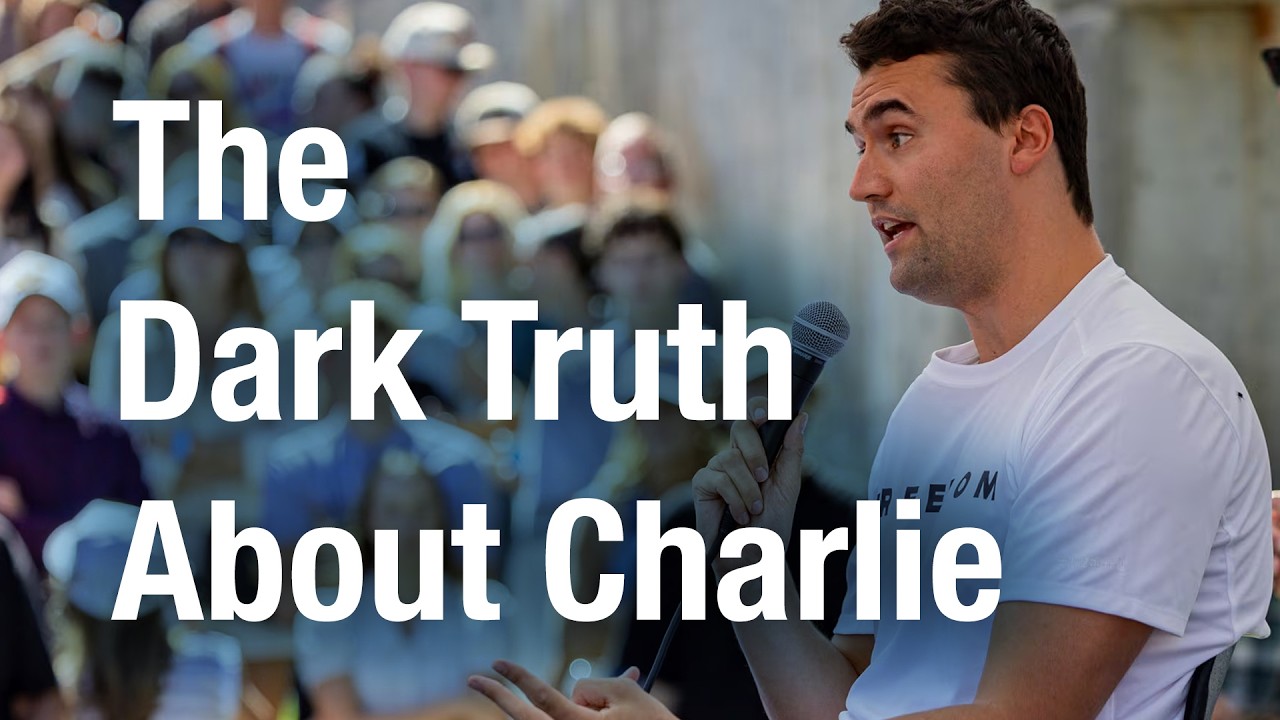
Sam Seder Critiques Jordan Peterson and Charlie Kirk Discussion on Fatherlessness in Black Communities
Enjoying this? Share it with someone who needs to see it.
Up Next
Why I Won't Fly My Flag at Half-Mast for Charlie Kirk Despite His Assassination
12:03
Josh Hawley's Radical Approach to Young Men: Stop Watching Porn, Start Treating Women Right
8:45
Charlie Kirk's Controversial Comments on Black Pilots and DEI Spark Major Debate
14:09
Sam Seder Critiques Jordan Peterson and Charlie Kirk Discussion on Fatherlessness in Black Communities
Sam Seder examines a conversation between Jordan Peterson and Charlie Kirk addressing family structure and fatherlessness in black communities. The analysis challenges their statistical claims, particularly the assertion that 77% of black children grow up without knowing their fathers, pointing to research showing black fathers actually have high involvement in their children's lives. The commentary argues that Peterson and Kirk overlook systemic factors like mass incarceration, housing discrimination, and policing patterns while attributing community challenges primarily to single-parent households. This perspective questions whether conservative approaches adequately address root causes or simply reinforce longstanding narratives about black families.
The Peterson-Kirk Conversation on Family Structure
Jordan Peterson sat down with Charlie Kirk of Turning Point USA for a discussion that touched on voting patterns, family structure, and challenges facing black communities. Kirk referenced statistics about Democratic Party support among black voters, mentioning that the party receives 96-97% of black votes despite what he characterizes as harmful policies. He highlighted Candace Owens' role as communications director at Turning Point USA, describing her mission to encourage different thinking within the black community.
Peterson brought up his upcoming conversation with Warren Farrell about "The Boy Crisis," shifting the discussion toward fatherlessness. He mentioned Ontario's political policy that "all families are equal," acknowledging that respect should be given to families regardless of structure, including single parents who "struggle through life the best they can." However, he then stated that "the empirical data on the catastrophe of fatherlessness is extraordinarily solid and deep," describing it as "in principle a plague for the black community."
Statistical Claims Under Scrutiny
Kirk claimed that single motherhood rates in the black community rose from about 18% in the 1960s to 77% currently, stating that "77 percent of black people will grow up never knowing their father." He characterized this as the single societal trend that has harmed the black community most. The commentary challenges this statistic, noting it originated from a Dallas police commissioner who had misstated facts, and that the claim represents a "misinterpretation of an incorrect fact."
The analysis points out that single-parent households do not automatically mean children don't know their other parent. A 2013 CDC report is referenced showing that black fathers actually had the most involvement in their kids' lives by various measures, contradicting the narrative presented in the Peterson-Kirk discussion.
Alternative Explanations and Systemic Factors
The commentary raises multiple systemic factors overlooked in the conversation:
Mass incarceration rates that increased during the same time period
Policing patterns in predominantly black neighborhoods
Housing discrimination and redlining
Environmental factors
Inability to build generational wealth
The lasting impact of slavery
Peterson referenced an Atlantic Monthly article reviewing research about locales where poor black and poor white people perform approximately equally over time. He stated that places where fathers are present characterize higher-performing areas, and that neighborhoods where having fathers around is the norm see better outcomes for all boys, not just those in immediate families.
The Causality Versus Correlation Question
The commentary challenges the causal relationship implied by Peterson and Kirk. It argues that even controlling for poverty levels between predominantly white and predominantly black communities, other factors warrant consideration. The analysis suggests that policing differences, incarceration rates, and how "blackness follows you" through life in ways that whiteness doesn't might explain disparities better than family structure alone.
The commentary also addresses wealth disparities, noting that research on black wealth operates in an entirely different context due to "intergenerational wealth destruction." Even when black families earn higher incomes, obligations to broader family networks with reduced wealth create different dynamics than exist in white families with comparable earnings.
Criticism of the Conservative Approach
The analysis criticizes what it characterizes as selective use of data, stating that Peterson and Kirk "pull out one factoid, get it wrong, and then build an entire reverse engineering back into a very old trope." The commentary describes this as "the oldest right-wing trick in the book: first create a crisis where people are marginalized and abused, then shape the results and say 'see, that's why it is.'"
Specific criticism focuses on Kirk's concern for entrepreneurship and individual effort, questioning why he doesn't address cases like Eric Garner, described as "an entrepreneurial man who was murdered and taken away from his family." The commentary suggests this represents inconsistency in conservative messaging about individual initiative and family preservation.
The Rhetorical Strategy
The commentary identifies what it calls a "rhetorical trick" in Peterson's approach: offering a qualifier about respecting families regardless of structure and acknowledging that people must deal with life as it comes, then immediately undermining that statement by characterizing fatherlessness as a "catastrophe" and "plague." This strategy is described as appearing to show empathy while actually "saying there's something pathological about it and that there's something fundamentally wrong with the people who are on the receiving end of it."
The analysis concludes by framing the discussion as an example of overlooking root causes while attributing community challenges primarily to family structure, reinforcing what the commentary describes as longstanding narratives about black families rather than addressing systemic issues.