Up Next
Tyler Robinson Charged With Murder in Charlie Kirk Shooting: DNA Evidence, Discord Group, and the Ideology That Drove the Assassination
1:04:14
Victor Davis Hanson Dismantles Left's False Narratives About Charlie Kirk Assassination on Utah Campus
7:26
Piers Morgan Uncensored Panel Debates Political Violence After Charlie Kirk Assassination and America's Dangerous Turning Point
1:30:11
Six Lies Social Media Tells Us About Violence, Truth, and Charlie Kirk's Death
The assassination of Charlie Kirk exposed six dangerous lies that social media algorithms embed into our consciousness daily. From curated news feeds that present conflicting versions of reality to the amplification of fringe voices that make us believe entire political movements celebrate murder, these distortions are tearing society apart. The shooter's bullet casings, covered in nihilistic internet memes, reveal a generation lost to brain rot and chaos. Yet embodied Christian community offers a counterweight to algorithmic rage—a place where we can be wrong together, confess our sins, and worship the name above every name instead of political figures.
The Murder That Revealed Our Fractured Reality
The cold-blooded murder of Charlie Kirk sent shockwaves through social media, but the reactions revealed something even more disturbing than the violence itself: we're living in completely different realities. People on the left celebrated it openly, with some claiming the left has become the party of murder. But beneath the outrage lies a more insidious problem—social media is feeding us six fundamental lies that are destroying our ability to perceive truth, connect with each other, and maintain a functioning society.
These aren't lies that anyone explicitly articulates. They're embedded in the algorithms, reinforced with every scroll, and hypercharged by platforms designed to keep us engaged at any cost. Understanding these lies is essential if we hope to escape the trap.
Lie One: This Is Him
In videos discussing the Charlie Kirk assassination, countless people have said they can't believe Charlie Kirk is being held up as an example because "he is the guy who..." and then they paint a portrait that seems completely unfamiliar to others who followed him.
Nate Morgan Lockach, whose Reformed Mythologist channel is worth checking out, said he had no idea Charlie Kirk was a Christian until after he died. His social media feeds sometimes showed Charlie Kirk doing political things, but never preaching the gospel. For some people, all they see is Charlie Kirk preaching the gospel. For others, all they see is Charlie Kirk defending free speech. For still others, all they see is Charlie Kirk saying things about race and immigration that he shouldn't have said.
If that's your social media diet, how can you conclude anything except that Charlie Kirk is a hater? We live in social media silos where we have curated news feeds. We don't just have alternative worldviews or alternative tastes—there are alternative facts out there for us to discern. The algorithm tells you "this is him," but it's telling your friend something completely different. That sense of fracture is being algorithmically hypercharged.
Lie Two: This Is You
Social media brings very near any kind of event, as long as it happens within sight of a smartphone. That video footage enters your world and gets inside your head at the speed of a click, even when you weren't looking for it.
Scrolling through Twitter looking for information about what happened to Charlie Kirk, suddenly his murder appears on the screen. Everyone said the same thing: they were not prepared to see his murder. The algorithm served it up anyway. How can that not give you a sense of the nearness of the horror?
In a print media age, we would have read a story about something that happened in Utah, and that event would still be just as awful. But to see it in real time from multiple angles makes millions of people think "this is me" and feel the nearness of the threat and potential for violence—perhaps a nearness not borne out by reality.
There's an apocryphal story about April 16th, 1912. The Aberdeen Journal supposedly ran a headline the day after the Titanic sank that simply said "Aberdeen Man Drowns at Sea." While that's not actually true—the Aberdeen Journal did lead with the Titanic—it points to this truth: what is local to us is obviously of most interest to us. But if the Titanic had sunk in a social media age, we would completely forget about the Aberdeen man who drowned at sea. The spectacle of tragedy on the other side of the world would be brought incredibly near and make everybody think they could never go on a cruise ship again.
"This is you" is a distortion. When it happens amid incidents of political violence, it makes everybody feel that violence is right near to us—as close as our smartphone. That's not true, but that's the second lie.
Lie Three: This Is That
Social media invites us to make press releases on a daily basis. We are all our own spin doctors, riding our favorite hobby horses. Then an image comes to us from the other side of the world, and we're tempted to say "this is that."
Remember the Covington High kid from 2017 at the March for Life? He happened to be wearing a MAGA hat when a Native American beat a drum in his face. A snapshot captured this kid not knowing what to do, frozen in the middle of a smile. The image went around the world at the speed of a click, and millions of people suddenly believed this kid was smirking at a First Nations tribal leader because it fit the narrative.
We're constantly being invited by social media to see little snapshots from around the world with contexts we know nothing about, but they fit into our own narrative. We want to use these as jumping-off points for sermons we were going to preach anyway. We ride a hobby horse and we'll be riding that hobby horse long after the image has faded away. On social media, beware the "this is that" fallacy.
Lie Four: This Is Them
This has always been them. This is the platonic ideal of what they are always like. Right now, it's straightforward to troll through TikTok and find any number of people celebrating the death of Charlie Kirk and thinking he had it coming to him. That is appalling. It is imbecilic. It speaks of psychological and spiritual dysfunction on a level that does enrage.
But social media constantly invites you to be enraged at "them," to quote-tweet them and say "this is them." This deluded TikToker is them—the other side. Elon Musk tweets things like "the left is the party of murder," as though the left is celebrating the murder of Charlie Kirk. Yet it's straightforward to find very well-balanced and helpful comments by those on the left—Bernie Sanders, AOC, Barack Obama, and other left-leaning people having appropriate reactions to this moment.
Social media gives a megaphone to anyone with the most fringe views. The most fringe views get amplified because if it enrages, it engages. That used to be the old saying about print media: "If it bleeds, it leads." The sensational thing gets forwarded in print media. Social media has hypercharged that principle. If it enrages, it engages.
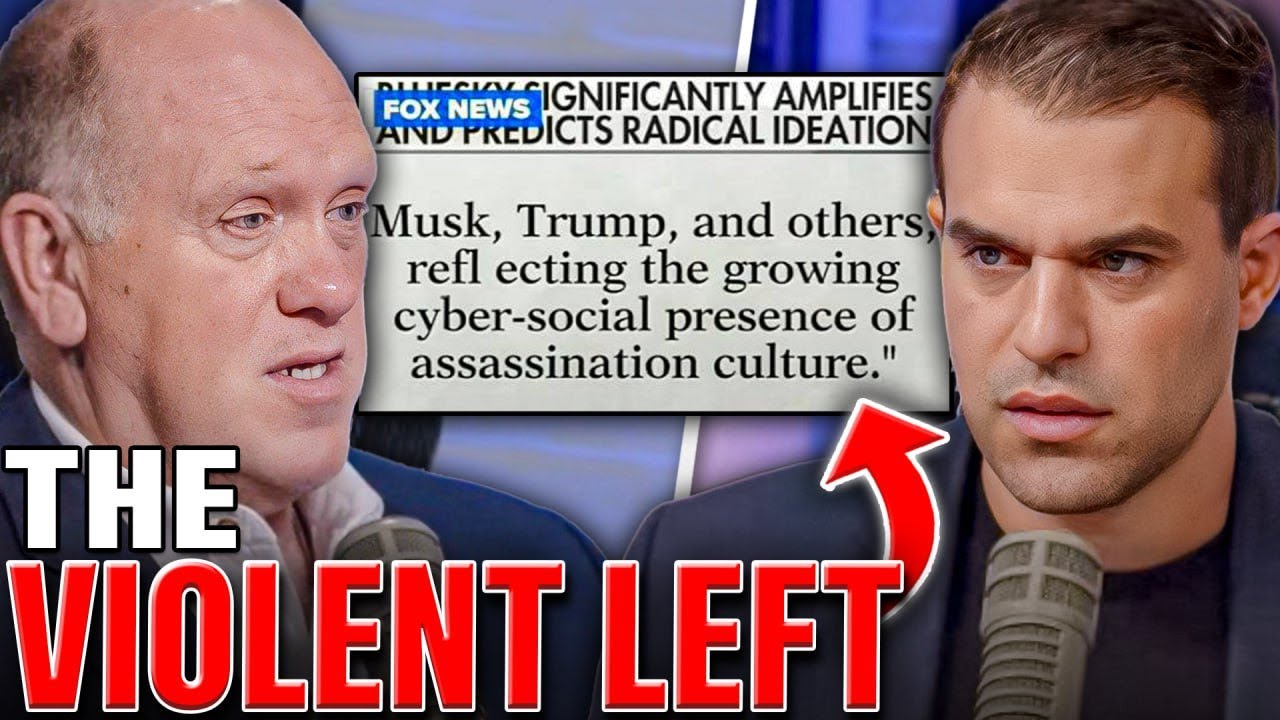
The man who owns Twitter is the worst offender. Addressing a march where Tommy Robinson asked him to comment on the events, instead of being the grown-up in the room, he fell instantly for the "this is them" fallacy, inviting over 100,000 people demonstrating in London to do the same.
He said: "You see how much violence there's on the left with our friend Charlie Kirk getting murdered in cold blood this week and people on the left celebrating it openly. The left is the party of murder and celebrating murder. Let that sink in for a minute. That's who we're dealing with here. This is a message to the reasonable center—the people who ordinarily wouldn't get involved in politics, who just want to live their lives. My message is to them: if this continues, that violence is going to come to you. You will have no choice. You're in a fundamental situation here where whether you choose violence or not, violence is coming to you. You either fight back or you die. You either fight back or you die. And that's the truth."
A profoundly unhelpful speech, committing all sorts of fallacies, including the "this is them" fallacy. Let's not fall for it ourselves.
Lie Five: This Is Nothing
Here we need to talk about Tyler Robinson, the shooter who engraved onto his bullet casings any number of conflicting internet memes. Many people are calling this "posting" as a political assassination. An article by Ryan Broderick and Adam Bumas titled "Charlie Kirk Was Killed by a Meme" offers helpful insights.
The use of memes in political mass violence started in earnest in 2019 when a man filmed himself attacking a mosque in Christchurch, New Zealand. Just before he started, he told viewers, "Subscribe to PewDiePie," the biggest YouTuber at the time. Months later in Halle, Germany, an attacker live-streamed the shooting of a synagogue on Twitch. In 2022, an 18-year-old white nationalist live-streamed a shooting in a grocery store in Buffalo, New York. Investigators discovered he was planning it openly on 4chan and Discord, calling it a "real life effort post." Last year, Luigi Mangione allegedly gunned down United Healthcare CEO Brian Thompson with bullets that read "Deny, Defend, Depose." Days later, a 15-year-old posed for a photo flashing the right-wing okay hand symbol before allegedly carrying out a school shooting in Madison, Wisconsin. Just last month, a shooter in Minneapolis used bullets with messages from all around the political spectrum, including "I am the Joker baby," "Why so serious?" and the simplified line version of the loss JPEG meme.
According to law enforcement, the messages on bullet casings believed to have belonged to Robinson were equally politically confusing. The bullet that struck and killed Kirk had "notices bulge—OwO what's this?" written on its casing, a reference to a longtime internet joke that originally comes from text-based furry roleplay. It's not proof that Robinson was a furry—the meme has long since become part of the extremely online canon.
This does not explain all of Robinson's motives. He had told family members that he thought Charlie Kirk was full of hate and he couldn't be reasoned out of it. It appears Tyler Robinson identified hate in Charlie Kirk and wanted to stop him with a bullet. The variety of confusing memes doesn't mean this wasn't politically motivated, but it does mean Tyler Robinson was lost in more ways than one. He was lost to an ideology that believes violence can end speech. But he was also lost to utter nihilism, to brain rot, to posting.
The article draws attention to links between shootings and meme culture, concluding: "All of it is now just another meme you can participate in to go viral, made even more confusing by a new nihilistic accelerationist movement that delights in muddying the waters for older people who still adhere to a traditional political spectrum. Many young extremists now believe in a much simpler binary: order and chaos. And if you are spending any time at all trying to derive meaning from violent acts like this, then you are by definition their enemy."
That's the fifth lie: this is nothing. It's a lie Tyler Robinson bought into. It's a lie many others are lost to, and it's killing us. We shrug our shoulders at brain rot, but in a nihilistic frame, in a godless frame, what else is brain rot except soul rot? We are giving ourselves and our children over to a world of brain rot, a world that says "this is nothing."
There is danger in ideologies that glorify violence and permit violence in the name of that ideology. But it's also extremely dangerous: a nihilism that permits violence because "this is nothing." That's the fifth lie, and it's all over our online world.
Lie Six: This Is Everything
If you're online as much as most people are, you're receiving a diet of this stuff on a daily basis, algorithmically tweaked, refined, and supercharged to push your buttons in a way that is bespoke for you. All the algorithm wants is for you to stay at the computer, to stay glued to your screen, to keep scrolling. That's all it wants.
It's found that the way to keep you glued is to enrage you. It turns out that will tether you to your device more than seeing attractive naked people. We used to think sex sells. What we found is something better: rage. These algorithms have figured out that the best way to get engagement and more ads is to figure out your political leanings and then take you as far as they can—tweet by tweet, reel by reel, or TikTok by TikTok—to an extreme.
Now that two-thirds of Americans get their news from social media, the temperature has just gone up. Search your feelings. You know this to be true. More than lust, which is a problem all its own, anger will keep you addicted to the machine. We're tempted to believe this sixth lie: this is everything. But it's really not.
The Antidote: Embodied Christian Community
Last night, a church gathered to help Christians get better at sharing their faith. One training exercise involved using the line, "That's what I love about my church." There are so many things people love about their church. There is this embodied community where we get to meet people from all kinds of different walks of life. Some have a social media diet that paints Charlie Kirk in one way. Some have a social media diet that paints Charlie Kirk in a totally different light. And we get to come together.
When we come together on a Sunday morning, we get to hit reset. We get to say the problem is me. We get to confess our sins out loud together. We can talk about how "I've beenaspirin this week, and you've been aspirin this week. We've all been wrong this week." Doesn't that recalibrate your heart?
Instead of being right online, you can show up in church and be wrong. Instead of an online world where you're trying to look good in the presence of judgment, you can come to church and look bad in the presence of love. Never have we needed embodied community across racial lines, across ideological lines. Never have we needed the church of Jesus Christ more than right now.
If Charlie Kirk and the social media coming from Charlie Kirk meant you ended up in church on a Sunday, praise God. But if you leave that church because it didn't mention the name of Charlie Kirk, that's not even what Charlie Kirk would have wanted. Church is the place where we refocus on the name above every name, where we challenge the lies we've been telling ourselves all week, where we come clean in front of one another. We drop the act. We stop trying to look good in the presence of judgment. We start looking bad in the presence of love.
We worship a Jesus who descended into the mess to be with us, to be with us all, to be for us, to be for us all, and to lead us in a truth that comes from beyond. Have you investigated the truth of Jesus yet? There's a great way of doing that called 321. You can go to 321course.com and see life according to Jesus. Plenty of people have done it since the Charlie Kirk event. Some people are finding faith right now because the Charlie Kirk events have awakened them to their spiritual need. They've done 321, come to Christ, and now they want to go to church.
Could that be you? Could that be your friends? Perhaps you should do it as a Christian and then pass it on to your friends. Go to 321course.com and discover life according to Jesus.
Video Transcript
And then you see how much violence
there's on the left uh with our our
friend Charlie Cook getting murdered in
cold blood this week and people on the
left celebrating it openly. The left is
the party of murder. You either fight
back or you die. Here are the six lies
that you are being told right now and
it's ruining our lives and ruining our
culture. They're not lies that are
articulated very much, but the social
media environment that we are all
inhabiting are reinforcing these
untruths in every minute of our lives.
Here are the six, and we'll go through
them. This is him. This is you. This is
that. This is them. This is nothing.
This is everything. First of all, this
is him. It's so interesting that in the
videos that we have done about the
Charlie Kirk assassination, so many
people have said to us, "I can't believe
you're raising up Charlie Kirk as an
example of X, Y, or Zed. He is the guy
who." And then they will give a portrait
of Charlie Kirk that I'm entirely
unfamiliar with. I was speaking with my
colleague Nate Morgan Lockach, whose
reformed mythologist channel you should
definitely check out. He said he had no
idea that Charlie Kirk was in fact a
Christian until after he had died. His
social media feeds sometimes gave him
images of Charlie Kirk doing a political
thing, but never preaching the gospel.
For some people, all they see is Charlie
Kirk preaching the gospel. For some
people, all they see Charlie Kirk doing
is defending free speech. For some
people, all they see Charlie Kirk saying
is things about race and immigration
that he ought not to have said. And if
that is your social media diet, how can
you conclude anything but Charlie Kirk
is a hater? But we live in the social
media silos in which you have a curated
news feed. You don't just have an
alternative worldview. You don't have
alternative tastes. There are
alternative facts out there for you to
discern. And you're constantly being
told this is him. But your friend is
being told, "No, this is him." And that
sense of fracture is being
algorithmically hypercharged in this
moment. Lie number one, this is him.
We're living in a siloed world. Line
number two, this is you. Social media
brings very near any kind of event as
long as it happens within sight of a
smartphone. That video footage is now
inside your world and it gets inside
your head at the speed of a click and
you weren't even looking for it. I
scrolled through Twitter looking for all
sorts of information about what might
have happened to Charlie Kirk and all of
a sudden I see his murder and everybody
is saying the same thing. They were not
prepared to see his murder. The
algorithm served it up anyway. And how
can that not give you a sense of the
nearness of the horror? In a print media
age, we would have read the story about
something that happened in Utah and that
event is still just as awful. But to see
it in real time from multiple angles is
to make millions of people think this is
me and to feel the nearness of the
threat and the potential for violence.
Perhaps a nearness that is not borne out
by reality. There's the apocryphal story
of April 16th, 1912. The Abedine Journal
runs a headline the day after the
Titanic sinks and it just says Abedine
man drowns at sea. It turns out that's
not true. The Abedine Journal did indeed
lead with the sinking of the Titanic,
but it gets at this truth that what is
local to us is obviously of most
interest to us. But if the Titanic had
sunk in a social media age, we would
actually completely forget about the
Abedene man who had drowned at sea. The
spectacle of the tragedy that had
happened on the other side of the world
would have been brought incredibly near
and would have made everybody think that
they could never again go on a cruise
ship. This is you is a distortion. And
it's a distortion that when it happens
in the midst of incidents of political
violence, it makes everybody feel that
violence is right near to us. As as
close as my smartphone is to me, that's
not true. But that's the second lie.
This is him. this is you. Then social
media makes us think this is that and we
are always proclaiming that on our
social media feeds. We are invited to
make press releases on a daily basis on
our social media platform of choice. We
are all our own spin doctors and we all
ride our favorite hobby horses and then
an image comes to us from the other side
of the world and we are very tempted to
say this is that. Do you remember the
Coington High kid from 2017, the March
for Life, and he happened to be wearing
a MAGA hat and there was a Native
American who was beating a drum in his
face? And there was a snapshot of this
kid not knowing what to do, frozen in
the middle of a smile. And the image
went round the world at the speed of a
click and millions of people are
suddenly of the opinion that this kid is
smirking at a First Nations tribal
leader because it fit the narrative.
This is that. And we're constantly being
invited by social media to see little
snapshots from around the world that
have contexts we know nothing of, but it
fits into our own little narrative. And
we want to use these as jumping off
points for sermons that we were going to
preach anyway. We're riding a hobby
horse and we'll be riding that hobby
horse long after that image has faded
away. On social media, beware the this
is that fallacy. And then the fourth
one, and I think this is huge right now,
this is them. This has always been them.
This is the platonic ideal of what they
are always like. And right now, it is
very straightforward to troll through
Tik Tok and you can find any number of
people celebrating the death of Charlie
Kirk and thinking he had it coming to
him. That is appalling. It is
imbecillic. It is morally imbecillic. It
speaks of psychological and spiritual
dysfunction on a level that yes does
enrage. But then social media is
constantly inviting you to be enraged at
them to quote tweet them and to say this
is them. This deluded Tik Tocker is them
the other side. And you get Elon Musk
tweeting out things like the left is the
party of murder as though the left is
celebrating the murder of Charlie Kirk.
And yet it's incredibly straightforward
to find some very wellbalanced and
profoundly helpful comments by those on
the left. Whether it's Bernie Sanders or
AOC or Barack Obama or you can find all
sorts of leftleaning people who are
having all sorts of appropriate
reactions to this moment. But social
media gives a megaphone a bullhorn to
anyone with the most fringe views. And
the most fringe views get amplified
because if it enrages it engages. That
used to be the old saying, didn't it,
about print media. If it bleeds, it
leads. The sensational thing is the
thing that is going to be forwarded in
print media. Oh my goodness, have we
hypercharged that. If it enrages, it
engages. And the man who owns Twitter is
the worst offender when it comes to
this. Here he is addressing a march.
Tommy Robinson is asking him to comment
on the events of today. And instead of
being the grown-up in the room, he falls
instantly for the this is them fallacy.
And he invites over 100,000 people who
are there demonstrating in London to do
the very same. Have a look.
>> And then you see how much violence
there's on the left uh with our our
friend Charlie Cook getting murdered in
cold blood this week and people on the
left celebrating it openly.
The left is the party of murder
and celebrating murder.
I mean, let let that sink in for a
minute.
That's who we're dealing with here.
This is this is a message to the
reasonable center. The people who
ordinarily wouldn't get involved in
politics,
uh, who just want to live their lives.
They don't want that they they're quiet.
They just go about their business. My
message is to them if this continues
that violence is going to come to you.
You will have no choice.
This is a this is you're in a
fundamental situation here where you
where
whether you choose violence or not,
violence is coming to you. You either
fight back or you die.
You either fight back or you die.
And that's the truth.
>> Today, Elon, I think we're I think the
British public are telling the world
that they're ready to fight back.
[Applause]
>> Yes.
>> Come on. Come on, great.
>> Profoundly unhelpful speech and
committing all sorts of fallacies,
including the this is them fallacy.
Let's not fall for it ourselves. The
fifth lie we're being told is this is
nothing. And here we need to talk about
Tyler Robinson, the shooter who engraved
onto his bullet casings any number of
conflicting internet memes. And many
people are calling this posting as a
political assassination. I found this
article by Ryan Brderick and Adam Bumass
to be very helpful at points. Charlie
Kirk was killed by a meme. The use of
memes and political mass violence
started in earnest in 2019 when a man
filmed himself attacking a mosque in
Christ Church, New Zealand. Just before
he started, he told viewers, "Subscribe
to PewDiePie," the biggest YouTuber at
the time. Months later, in Hal, Germany,
an attacker live streamed the shooting
of a synagogue on Twitch. In 2022, an
18-year-old white nationalist live
streamed a shooting in a grocery store
in Buffalo, New York. Investigators
later discovered that he was planning it
openly on 4chan and Discord, calling it
a real life effort post. And in the last
year, Luigi Manion allegedly gunned down
United Healthcare CEO Brian Thompson
with bullets that read, "Deny, defend,
depose." Days later, a 15-year-old posed
for a photo flashing the right-wing okay
hand symbol before allegedly carrying
out a school shooting in Madison,
Wisconsin. And just last month, Robin
Westman allegedly carried out a shooting
in Minneapolis with bullets that had a
range of messages from all around the
political spectrum, including, "I am the
woker baby. Why soquerious skety?" And
the simplified line version of the lost
JPEG meme. According to law enforcement,
the messages on the bullet casings
believed to have belonged to Robinson
were equally politically confusing. The
bullet that struck and killed Kirk had
notices bulge, capital O, little W,
capital O, what's this? Written on its
casing. a reference to a longtime
internet joke that originally comes from
a textbased furry roleplay. It is not
proof, however, that Robinson was a
furry. The meme has long since become a
part of the extremely online cannon.
This does not explain all the motives of
Robinson. He had told family members
that he thought that Charlie Kirk was
full of hate and he couldn't be reasoned
out of it. And it appears that Tyler
Robinson had identified hate in Charlie
Kirk and wanted to stop him with a
bullet. The variety of confusing memes
does not mean that this was not
politically motivated, but it does mean
that Tyler Robinson was lost in more
ways than one. He was lost to an
ideology that believes that violence can
end speech. But it also seems to me that
he was lost to utter nihilism, to brain
rot, to posting. The article finishes by
drawing attention to these links between
shootings and meme culture. And they say
of the violence, all of it is now just
another meme you can participate in to
go viral. Made even more confusing by a
new nihilistic accelerationist movement
that delights in muddying the waters for
older people who still adhere to a
traditional political spectrum. Many
young extremists now believe in a much
simpler binary, order and chaos. And if
you are spending any time at all trying
to derive meaning from violent acts like
this, then you are by definition their
enemy. That's the fifth lie. This is
nothing. It's a lie that Tyler Robinson
has bought into. It's a lie that many
others are lost to and it's killing us.
We shrug our shoulders at brain rot. But
in a nihilistic frame, in a godless
frame, what else is brain rot except
soul rot? And we are giving ourselves
and our children over to a world of
brain rot. A world that says this is
nothing. There is definitely danger in
ideologies that glorify violence and
that permit violence in the name of that
ideology. That is dangerous. But it's
also extremely dangerous. Annihilism
that permits violence because this is
nothing. That's the fifth lie and it is
all over our online world. But finally
the sixth lie. This is everything. If
you are online as much as I am online,
you are receiving a diet of this stuff
on a daily basis, algorithmically
tweaked and refined and supercharged to
push your buttons in a way that is
bespoke for you. And all the algorithm
wants is for you to stay at the
computer, to stay glued to your screen,
to keep on scrolling. That's all it
wants. It's just that it's found that
the way to keep you glued is to enrage
you. It turns out that will tether you
to your device more than seeing
attractive naked people. We used to
think sex cells. What we found is
something better and that is rage. And
these algorithms have figured out that
the best way to get engagement in more
Nissan ads is to figure out your
political leanings and then take you as
far as they can tweet by tweet or real
by real or Tik Tok by Tik Tok to an
extreme. And now that Americans get two
or twothirds of Americans get their news
from social media, the temperature has
just gone up. And I would ask all of us
to do what Darth Vad Vader suggested and
search your feelings. You know this to
be true. More than lust, which is a
problem all of its own. Anger will keep
you addicted to the machine. And you're
tempted, and I'm tempted to believe this
sixth lie. This is everything.
But it's really not. Last night I was in
a church helping Christians to get
better at how to share their faith. And
one thing I train Christians to do is to
just use the line, that's what I love
about my church. And we got people to
workshop that. And of course, there's so
many things that people love about their
church. There is this embodied community
where I get to meet people from all
kinds of different walks of life. Some
of them have a social media diet that
paints Charlie Kirk in one way. Some of
them have a social media diet that
paints Charlie Kirk in a totally
different light. And we get to come
together. And when we come together on a
Sunday morning, we get to hit reset and
we get to say the problem is me. We get
to confess our sins and out loud
together. We can talk about how I've
been a spiritual this week. And
you've been a spiritual this week.
We've all been wrong this week. Doesn't
that recalibrate your heart? Instead of
being right online, you can show up in
church and be wrong. Instead of an
online world in which I'm trying to look
good in the presence of judgment, I can
come to church and I can look bad in the
presence of love. Never have we needed
embodied community across racial lines,
across ideological lines. Never have we
needed the church of Jesus Christ more
than right now. And listen, we're glad
if Charlie Kirk and the social media
that is coming to you from Charlie Kirk
has meant that you end up in church on a
Sunday. If the name of Charlie Kirk got
you to church on a Sunday, praise God.
But if you leave that church because it
didn't mention the name of Charlie Kirk,
I don't think that's even what Charlie
Kirk would have wanted. Church is the
place where we refocus on the name above
every name. Where we challenge the lies
that we've been telling ourselves all
week. where we come clean in front of
one another. We drop the act. We stop
trying to look good in the presence of
judgment. We start looking bad in the
presence of love. And we worship a Jesus
who descended into the mess to be with
us, to be with us all, to be for us, to
be for us all, and to lead us in a truth
that comes from beyond. Have you
investigated the truth of Jesus yet?
We've got a great way of doing that.
It's called 321. You can go to
321course.com and see life according to
Jesus. Plenty of people have done it
since the Charlie Kirk event. And some
people are finding faith right now
because the Charlie Kirk events have
awoken them to their spiritual need.
They've done 321 and they've come to
Christ and now they want to go to
church. Could that be you? Could that be
your friends? Perhaps you should do it
as a Christian and then pass it on to
your friends. Go to 321course.com and
discover life according to Jesus.
That'll do for this video. If you've got
this far, you must be a fan of the
channel. Have you subscribed? Um,
there's plenty more stuff for you that
is coming. Our new studio is coming and
that's why I'm here in this makeshift
studio in a few weeks. I cannot wait to
show you what the new studio looks like.
Subscribe and we'll see you very soon.