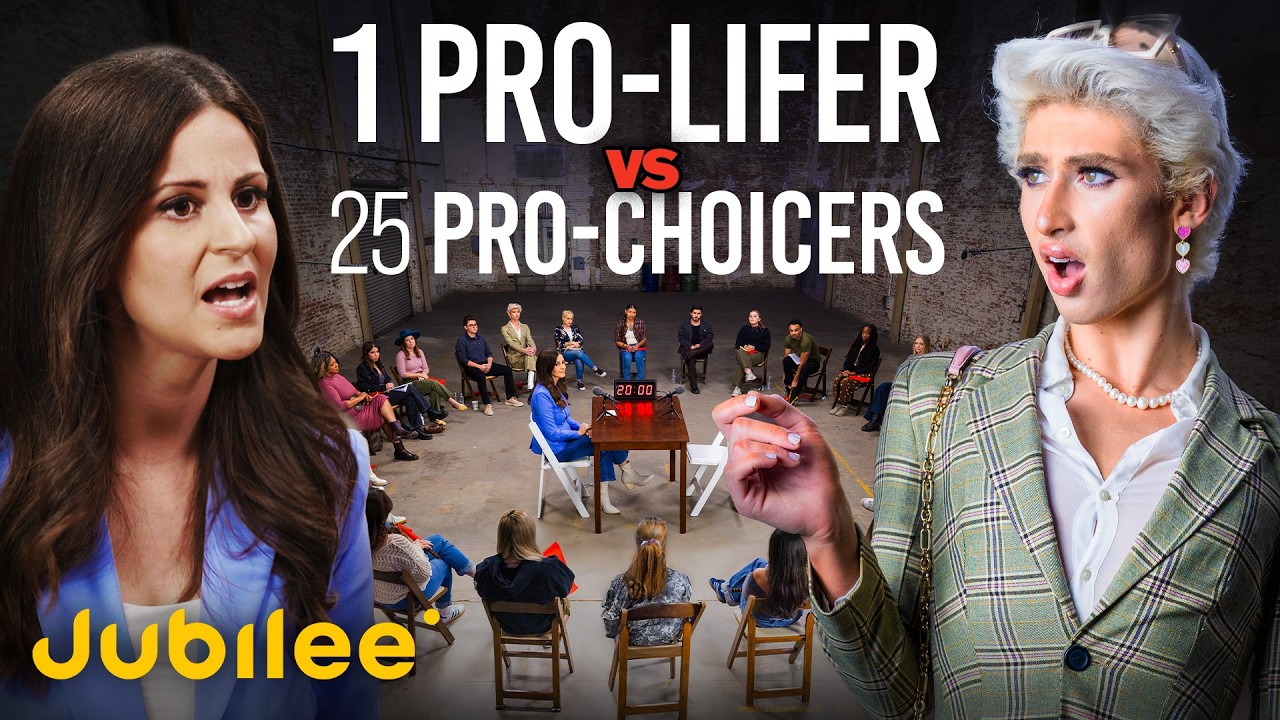
Trent Horn Analyzes Charlie Kirk's Debate With 25 College Students on Abortion and Fetal Viability
Enjoying this? Share it with someone who needs to see it.
Up Next
How Charlie Kirk's Critique of Catholicism Undermines His Own Protestant Defense in Discussion with Michael Knowles
26:28
Charlie Kirk Defends Life at Conception in Intense Abortion Debate with College Student
9:57
Charlie Kirk Defends the Right to Life for Children Conceived in Rape During Campus Debate
9:51
Trent Horn Analyzes Charlie Kirk's Debate With 25 College Students on Abortion and Fetal Viability
Trent Horn reviews Charlie Kirk's debate with 25 college students on abortion, highlighting strong arguments and missed opportunities. While praising Kirk's overall performance, Horn dissects key moments including the viability argument, parasite claims, and hard cases like rape. Horn explains why dependency doesn't determine moral worth, how to handle the claim that fetuses aren't alive, and why rape doesn't justify abortion. Drawing from his own debate experience, Horn offers practical advice for defending life in hostile environments while showing grace to those in the hot seat.
A Pro-Life Commentator Reviews Charlie Kirk's Performance
Trent Horn recently reviewed Charlie Kirk's debate with 25 college students on various topics, with a particular focus on abortion. Horn begins by acknowledging that Kirk handled the discussion well overall, noting that abortion was just one among many issues addressed. Horn emphasizes the importance of showing grace when offering commentary on these types of debates, acknowledging from his own experience that it's easy to critique from the sidelines but much harder when you're actually in the hot seat.
Horn states he will focus on a few key highlights from the abortion portion of the debate rather than covering everything that was said.
The Viability Standard Cannot Determine Moral Worth
The first exchange Horn analyzes involves a student named Naya who brings up the concept of viability. When Kirk asks at how many weeks a fetus is viable, Naya responds with about 20 weeks. Kirk corrects this, noting that it's actually 24 to 26 weeks, though the youngest baby to survive in a NICU was 20 weeks old in San Diego.
Horn points out this exchange demonstrates why the viability standard cannot be used to determine moral worth. Viability doesn't reflect inherent value but rather reflects available technology. In poor parts of the world, 26-week-old unborn children are not viable because the machines and hospitals needed to keep them alive don't exist there.
Horn adds his own perspective: a child is viable the moment he is conceived because he is a human being living in his natural environment, just like you or me. Later, that child can survive outside of his natural environment with assistance as early as 20 weeks of age.
Dependency Does Not Equal Lesser Value
The debate continues with the student arguing that 93% of abortions happened in the first 13 weeks of pregnancy under Roe v. Wade, well before a fetus is technically viable. Kirk then asks a powerful question: What makes a six-week-old baby with a heartbeat, its own DNA, fingerprints, and brain waves of less moral worth than an 88-year-old with dementia who requires assistance?
The student's response is that it's not a baby, it's a fetus. Kirk asks what fetus means, and when the student struggles to answer, he points out that fetus means little human being in Latin. The student then resorts to calling Kirk's smile creepy, which Horn identifies as typical bluster when someone can't prove the other person wrong.
Horn notes this is a good point by Kirk: stay focused on what The Unborn are. If you say it's a fetus, ask what is a fetus. Fetus is just a stage of development in the life of a human being. If The Unborn are human beings, then why don't we treat them humanely?
The Parasite Argument Reveals Spectacular Ignorance
The exchange takes a turn when the student claims a fetus is technically classified as a parasite until it is viable. Kirk challenges this, asking if she's saying a baby is a disease or tumor. She clarifies that a parasite is defined as something that cannot survive outside of its host.
Kirk then extrapolates this logic: Are old people with Alzheimer's and dementia who are being assisted every day parasites? The student says no, they're human beings on the brink of death. Kirk continues: Is a four-month-old that requires mom's breast milk and daily changes and feedings a parasite since it cannot survive on its own?
The student responds that a baby can breathe on its own and drink water, which qualifies it as a living organism, while something that cannot survive outside the womb is not a living organism.
Horn identifies this as a moment where Kirk made good points about dependency not changing value, but he also notes it would have been easy to tear up the bad science in the argument. The woman said a fetus is not a living organism because it is a parasite and therefore doesn't belong to a species. Horn calls this spectacular levels of ignorance.
A parasite is by definition an organism of one species that lives inside or attached to an organism of another species and causes it harm. A parasite by definition is a kind of organism and belongs to a species. Horn suggests that once this is established, we can point out the student is engaged in bigotry. Throughout history, people have called born human beings parasites and used that as justification to harm them. In Nazi Germany, Jews were called world parasites, and this dehumanization helped contribute to the systematic murder of millions.
While it's fair to bring up other dependent born humans we don't call parasites, Horn emphasizes we need to hold accountable someone who denies unborn children are biological human organisms.
DNA and the Question of What Is Alive
The debate continues with discussion about DNA. The student claims the baby is 100% the mother's DNA and therefore it's her choice. Kirk corrects this, noting it's 50% of her DNA after conception.
Horn points out there's a big difference between 100% DNA (which would be a clone) and 50%. Children are not just copies of half their mom and half their dad. When the genes in their parents' gametes (sperm and egg) recombine, they form a brand new individual, a person who has never existed in the past and will never exist in the future.
Regarding the claim that the fetus is not alive, Horn shares a story from his own debate at UC Santa Barbara. An audience member said the fetus is not alive, so Horn asked what abortion does to the fetus. The person answered that it makes the fetus go away. When Horn asked where, the person did not want to say it killed the fetus because you can only kill something if it is alive in the first place. This is a quick way to shut down the claim that The Unborn are not alive: if they weren't alive, you don't need abortion.
Defining Murder and Self-Defense
A different student enters the conversation, noting that defining murder as intentionally killing a human being is poor because if someone breaks into your home and points a gun at you and your family, and you intentionally kill them to prevent them from killing your family, you didn't murder them. The student defines murder as the unjustified termination of a human life. Kirk agrees this is a good point and asks for clarification.
Horn notes there are people who try to argue that abortion is killing in self-defense, which he calls absurd. He offers an analogy: If I own a boat at a dock and a man climbs into my boat, I can remove him because he is trespassing. But imagine I hang up a sign that says free boat rides and a group of children get into my boat. I then pull out into the lake and dump them overboard, which kills them. I cannot say I have the right to do that because they have no right to be in my boat without my permission. That's murder. I invited them into the boat and now I can't just dump them.
Some people might say having sex isn't an invitation to children being in the womb because a person could want to have sex without wanting to have children. Horn responds: I can want to eat chocolate cake every night and not gain weight, but it's still going to happen. It's a natural consequence of actions. Sex is naturally ordered towards creating helpless human beings, and this means those human beings have a corresponding natural right to assistance from the man and woman who engaged in the act that brought them into existence.
Horn agrees with the need to be clear on the definition of murder. The common law definition of murder is killing another human being with malice of forethought, meaning you kill someone because you wanted to kill him. In self-defense, the reason you kill the person is because you don't want him to kill you. If he survived your attack made in self-defense, you should be happy because ideally you didn't want to kill him, you just wanted to stop him. For an act to be murder, there must be premeditated malice.
Horn prefers to say abortion is homicide, which is just the killing of a human being, and then ask what kind of homicide is it. Clearly there is no justification for this homicide of very tiny human beings.
When the Mother's Life Is in Danger
Another student raises the question of what happens when the mother's life is in danger. She states she's still unsure if abortion is murder or not, but asks what to do if the mother gets pregnant knowing that giving birth will kill her due to some health complication. Kirk responds with one word: C-section. When the student doesn't know what that means, Kirk explains they go right below the belly button and deliver the baby, which is technically birth but much safer. He notes that a C-section is actually safer than an abortion procedure.
Horn provides additional context on this issue. When people ask what if the mother's life is in danger, we should focus on answering the question of what are The Unborn first. If The Unborn are not human beings, then it doesn't matter—do whatever you want, have an abortion for that reason or any reason. But if The Unborn are human beings, then we have to ask: What do we do if there are two human beings in danger and one may be threatening the life of the other?
Horn offers an analogy: If there are two drowning people and one is panicking and about to kill the other, you might only be able to save one person as a lifeguard. But you wouldn't push one of these people under the water and purposely use them as a flotation device to save the other person. Sometimes you can only save one of two people in distress, but you cannot directly kill one person in order to save the life of another person, at least according to Catholic moral theology. If two people are in a sinking lifeboat, one cannot kill the other just to keep the boat from sinking. A principle of common law is that necessity is not a defense for murder.
Horn thinks Kirk answered this well and adds clarification: Early in pregnancy we can kill the threat to the mother (like uterine cancer) even if that treatment causes a child's death unintentionally (like through chemotherapy). Later in pregnancy, it's faster and safer to do an emergency C-section than a late-term abortion. Horn rounds this out by noting that nearly all abortions are done to protect lifestyles, not lives, and that every state in the US, even those that ban abortion, have an exception if the mother's life is in danger. For the person who believes in abortion for that case, would they be willing to grant that abortion should be illegal in all other cases?
The Hard Case of Rape
A student then poses a graphic scenario: If you had a daughter who was 10 years old, got raped, and was going to give birth but live, would you want her to go through that? Kirk calls this awfully graphic but acknowledges it's a real-life scenario. His answer is yes, the baby would be delivered.
Kirk then asks a powerful question: If there were two ultrasounds, one of a baby conceived in love and one conceived in rape, which one is which? He asks if anyone in the room was conceived by rape. His point is clear: You don't know, because it's all human rights and all human beings matter. How you were conceived is irrelevant to what human rights you get.
The student protests that forcing the daughter to give birth would torture her for the rest of her life, take away every freedom, ruin her life, and victimize her by the crime.
Horn notes that abortions done for cases of rape and incest are already very difficult to talk about, and the environment Kirk is in doesn't make it easier. One approach is to expose the objection as a smoke screen. You could say: If I agree to allow abortions in cases of rape or if the life of the mother is in danger, will you agree to outlaw all the other abortions that are done just because the child is unwanted? The answer is almost always going to be no. You can then ask why they brought up the issue of rape in the first place if that's not their main issue.
Horn thinks pointing out that there could be people in that room conceived in rape was very powerful, showing you are human no matter how you were conceived. He believes even in that fast-paced environment, you could still say something like: Rape is wrong because it's an act of evil, and many women are victimized by society through victim blaming afterwards. In some societies where so-called honor killing is practiced, you can be executed if you're the victim of rape. But if it's evil to execute a victim of rape, and in this country we don't even execute rapists, how is it fair that we execute The Unborn child created in this act?
When the student says it's not a child, Horn notes that gets us back to the main question: What are The Unborn?
Horn suggests you could also ask: Is there any way to make someone un-raped? The answer is no. Rape is a trauma that rape victims live with. The question is, and Kirk made a good point here, do you want to add the further trauma of being an accomplice to the killing of your own child? The woman's flippant response that they wouldn't even know is rebutted by the thousands of women who have given post-abortive testimonies saying abortion was one of the worst decisions they ever made.
The Extreme Case of a Five-Year-Old Victim
The debate becomes more heated when a student brings up an extreme scenario: a five-year-old child who is pregnant. Kirk corrects her that five-year-olds can't get pregnant, but she insists they have and have given birth. Kirk acknowledges there is one recorded case of a five-year-old girl who gave birth and asks if that's common. The student says it's not common but happens sometimes, and if they get pregnant, they should have medical access to something that could save not only their life but their livelihood.
The exchange ends with the student saying she hopes Kirk's daughter lives a very happy life and gets away from him.
Horn expresses frustration with setups like this because lies are easy to spout and truths take time to explain. When a rhetorical grenade gets thrown out there like a five-year-old pregnant victim of rape (which is extremely rare—only less than a handful of cases in the world, but it has happened), it becomes a tough situation to diffuse.
Horn suggests the best you can do at that point is pull the emergency stop and say: Look, that's absolutely terrible, that's a monstrous thing, and it sounds like you want to do whatever you can to help this girl. But would you agree we don't do everything to help victims of rape? For example, many victims of rape would feel better if their rapists were executed, but in the United States we do not treat rape as a capital offense. Once again, if we don't execute rapists, why would we think it's okay to execute the children created through rape?
Horn acknowledges that in environments like the one Kirk was in, it's tough to have this conversation. It's best to lead with empathy and circle back to bedrock moral principles, then show that the other side is the one that leads to extreme views like abortion for any reason at any stage of pregnancy, or even after birth, because there is no ontological difference between a late third-trimester fetus and a prematurely born infant. In many cases, they're the same being.
Horn concludes by encouraging viewers to check out the second edition of his book Persuasive Pro-Life to learn more about how to talk about this subject.