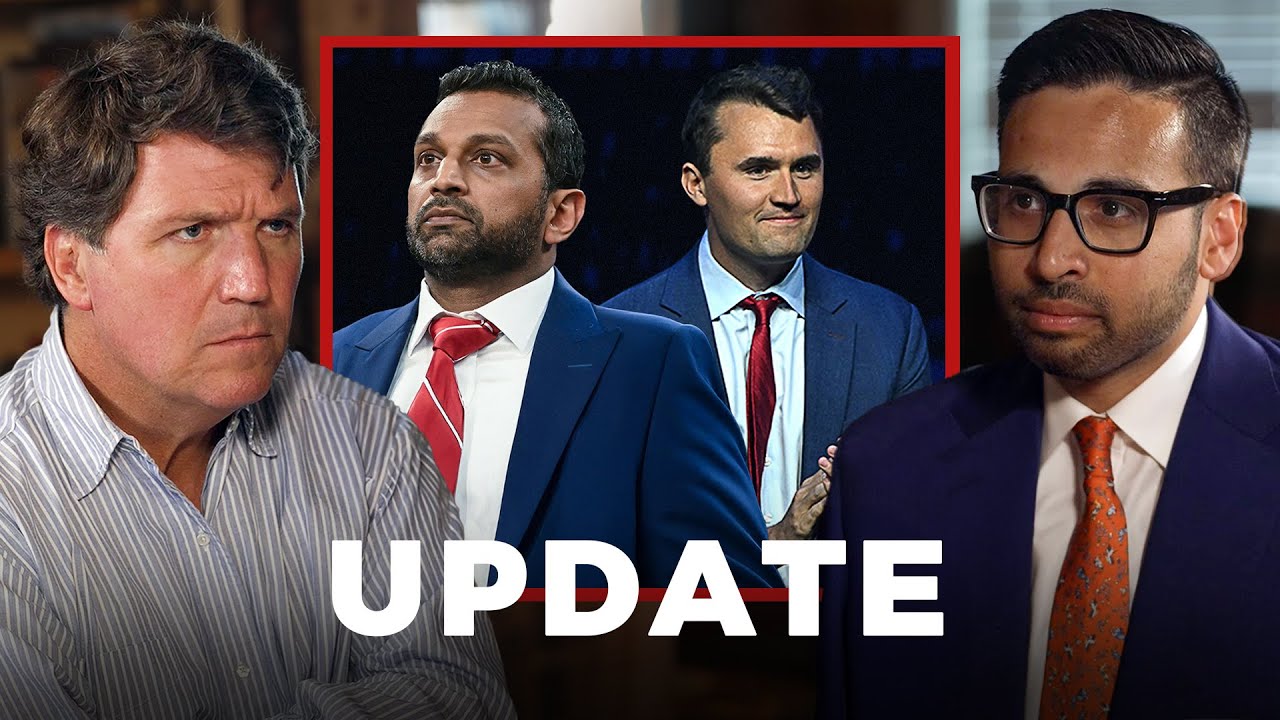
Tucker Carlson on Why Americans Can't Trust Government Investigations and the Death of Honest Journalism
Enjoying this? Share it with someone who needs to see it.
Up Next
Brett Cooper Exposes Hollywood's Double Standard on Violence After Charlie Kirk Assassination and Show Cancellations
19:53
Russell Brand and Jack Posobiec Explore Spiritual Warfare Following Charlie Kirk's Death and America's Fragmentation
29:57
Bill O'Reilly Confronts Evil: Charlie Kirk's Assassination and the Battle for America's Soul
13:53
Tucker Carlson on Why Americans Can't Trust Government Investigations and the Death of Honest Journalism
Tucker Carlson addresses the erosion of trust in American institutions, from law enforcement investigations to legacy media. Speaking candidly about unsolved national tragedies and the failure to declassify critical documents decades later, Carlson argues that when authorities refuse to provide answers, citizens will naturally fill the vacuum with questions. He reflects on his extensive media career, noting how traditional outlets have become irrelevant compared to independent voices online. Trust, he insists, comes from honesty, not institutional credentials. Carlson also weighs in on geopolitics, suggesting that Gulf Arab states could become a global superpower if they unified their foreign policy, but notes both internal disputes and external interests work against such cooperation.
The Obligation to Question When Authorities Won't Answer
Tucker Carlson opens with a difficult topic—addressing questions surrounding an unresolved death that he finds emotionally challenging to discuss. He explains that while he refrains from speculation out of respect for the widow, Erika, the broader issue remains: the responsibility for investigating crimes lies with civil and federal authorities. When those authorities fail to investigate thoroughly or transparently, the internet and ordinary citizens naturally step in to fill that vacuum.
Carlson pushes back against critics who condemn public speculation, pointing out that people are asking questions precisely because there are no answers. And more importantly, Americans have no reason to trust that straight answers will ever come, given the long history of deception from American law enforcement.
From January 6th to 9/11: A Legacy of Unanswered Questions
Carlson points to multiple examples where the government has withheld information or provided incomplete narratives. He mentions January 6th, the Oklahoma City bombing, and most notably, 9/11. Twenty-five years after the attacks that killed 3,000 people and fundamentally changed the country, the files remain classified.
He expresses personal frustration: he lost a friend that day, watched his country transform, and still cannot access the full truth. What is the government protecting, and why? Carlson admits he doesn't know, but insists the American people deserve complete declassification. Some assumptions about 9/11 may be true, others false—but without transparency, there's no way to know.
He extends the same logic to the Kennedy assassination files, still classified 63 years later. His contribution to the conversation, he says, isn't deep insider knowledge—it's a refusal to be afraid and a conviction that American citizens have every right to demand answers. The burden of proof lies with those hiding the documents, not with those asking for them.
The Death of Traditional Media Influence
Shifting gears, Carlson reflects on the current state of traditional media. After 35 years in the industry, working at ABC News, NBC News, PBS, and Fox—and being fired from most of them—he has a front-row seat to its decline. He recounts watching a clip of a polished ABC News reporter interviewing President Trump in the White House. Despite the classic television presentation—chisel chin, sideways shot, voice-coached delivery—Carlson had no idea who the man was. It took him five minutes to identify the reporter online.
This, Carlson says, is evidence that legacy media no longer matters. Random people on Twitter have more influence on public perception and conversation than anyone at ABC News or CNN. He questions why the president would even grant such an interview when nobody cares about the outlet anymore.
What Trust Actually Looks Like
When asked what trust means in an era where institutions have lost credibility, Carlson offers a simple answer: trust derives from honesty. You can feel it immediately when someone is trying to tell the truth versus when they're performing or selling something.
He draws on his experience raising many children, teaching them that their instincts—like a dog's ability to sense good and bad people—are reliable. Women, he notes, are often better at this than men. Women trust their gut: if someone seems like a creep, they don't second-guess themselves. Men, on the other hand, often override their instincts with overthinking.
Trust, Carlson argues, comes from the deep knowledge that someone is trying to tell the truth—not that they're always accurate, but that they're honest. He admits he's been wrong about many things, but he tries to say "I don't know" when he doesn't, rather than pretending. Vanity tempts everyone to act like they have all the answers, but honesty is what gets rewarded in this moment after decades of institutional deception.
Geopolitics and the Untapped Power of the Gulf States
Carlson closes with thoughts on the Gulf Arab countries—Saudi Arabia, the UAE, Qatar, Bahrain, Oman, and Kuwait. He acknowledges ongoing disputes among them but refuses to take sides, emphasizing that he's traveled to these nations, likes them all, and doesn't speak Arabic or fully understand the internal dynamics.
From a big-picture, geographic perspective, however, he sees enormous untapped potential. These six monarchies, collectively known as the Gulf Cooperation Council (GCC), are among the richest countries in the world with small populations and massive advantages. They sit at the center of global trade routes, bridging East and West.
If they ever unified their foreign policy and spoke with one voice to the rest of the world—particularly on trade—they would likely become the third or fourth most powerful bloc globally, behind only China and the United States, and possibly competing with India. But they're not doing that. Carlson attributes this partly to Arab culture—what he jokingly calls a love of fighting with each other, or the Bedouin tribal spirit. But he also suspects that other regional players have a vested interest in ensuring these six nations never unify, as that would pose a serious challenge to existing power structures.