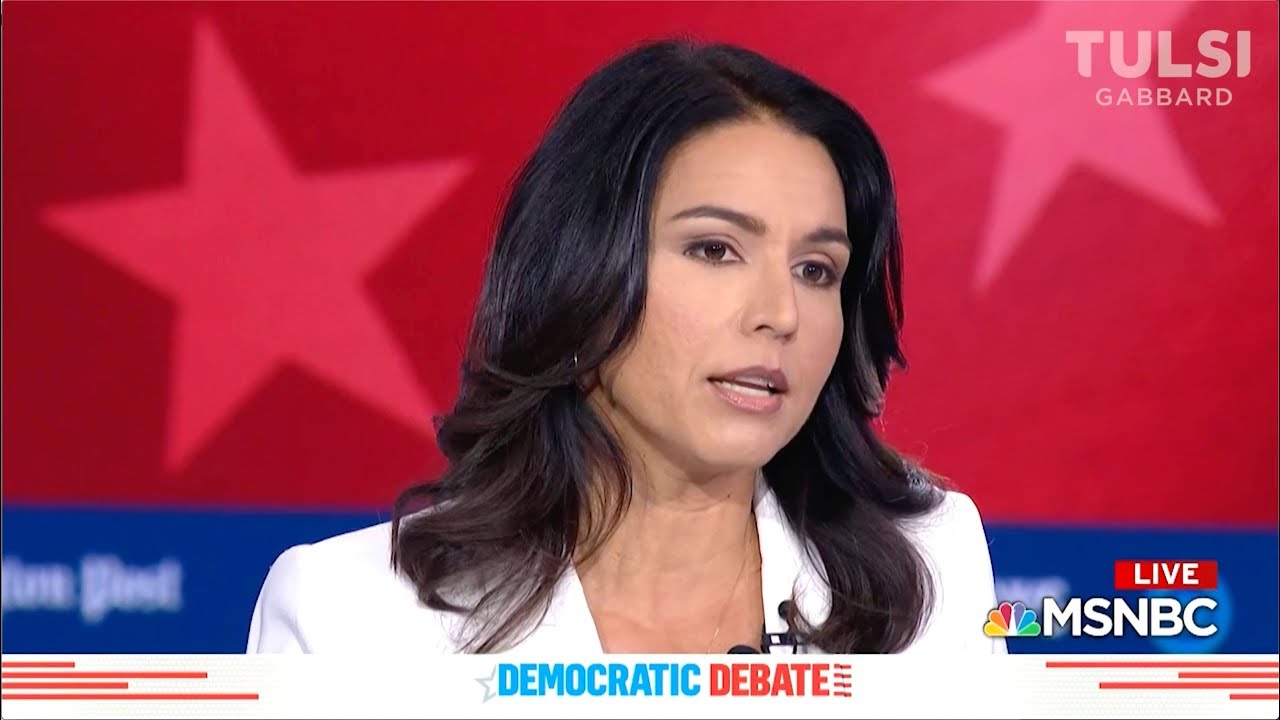
Tulsi Gabbard Confronts Kamala Harris on Criminal Justice Record During Democratic Debate Exchange
Enjoying this? Share it with someone who needs to see it.
Up Next
Devin Gibson Reacts to Post-Election Meltdowns After Trump's Victory Over Kamala Harris
23:47
Charlie Kirk and Tulsi Gabbard Face Off on Election Integrity, Voter ID, and Republican Party Division
10:30
New York Times Confirms Hunter Biden Laptop Authenticity After Media and Big Tech Blocked the Story
4:28
Tulsi Gabbard Confronts Kamala Harris on Criminal Justice Record During Democratic Debate Exchange
Tulsi Gabbard challenged Kamala Harris on her prosecutorial record during a Democratic debate, citing concerns about marijuana convictions, blocking evidence for death row inmates, and using prisoners as cheap labor. Gabbard argued that Harris failed to make a positive impact when she had the power to do so as California's Attorney General. Harris defended her work, claiming she reformed California's criminal justice system and personally opposed the death penalty throughout her career. The heated exchange highlighted fundamental disagreements about Harris's legacy as a prosecutor and what it means to reform a broken criminal justice system.
During a Democratic debate, Tulsi Gabbard directly challenged Kamala Harris on her prosecutorial record, shifting the conversation to what Gabbard described as a broken criminal justice system that disproportionately impacts black and brown communities across America. Gabbard took issue with Harris's pride in her record as a prosecutor and her stated intention to be a "prosecutor president."
Gabbard's Specific Allegations
Gabbard outlined several specific concerns about Harris's record as California's Attorney General:
Putting over 1,500 people in jail for marijuana violations, then laughing about it when asked if she had ever smoked marijuana herself
Blocking evidence that would have freed an innocent man from death row until courts forced her to release it
Keeping people in prison beyond their sentences to use them as cheap labor for the state of California
Fighting to maintain a system that impacts poor people in devastating ways
Gabbard emphasized that there were too many examples to cite, suggesting a pattern of behavior rather than isolated incidents.
Harris's Defense of Her Record
Senator Harris responded by emphasizing that as California's elected Attorney General, she reformed the criminal justice system of a state with 40 million people, creating what became a national model. She drew a distinction between giving speeches and actually doing the work of reform from a position of power.
Harris highlighted specific initiatives she created, including programs focused on re-entering former offenders and providing them with counseling. She pointed to her advocacy for legalizing marijuana as evidence of her understanding that criminal justice systems are broken.
The Death Penalty Dispute
When Gabbard pressed her point about blocking evidence for death row inmates, Harris countered that she had been personally opposed to the death penalty throughout her entire career. She challenged anyone in a similar position to face the people she had faced and make the decision not to seek the death penalty.
Harris argued that people should be judged not by their opinions on a stage, but by the decisions they make when under fire and in positions of actual power. She stated that when she had to decide whether to seek the death penalty in cases she prosecuted, she made the difficult and unpopular decision not to pursue it, and she remained proud of those choices.
The Final Word
Gabbard concluded by asserting that the bottom line was simple: when Harris was in a position to make a difference in people's lives, she did not. Gabbard stated that the people who suffered under Harris's tenure as prosecutor deserved an apology, particularly those innocent people on death row whose exonerating evidence Harris allegedly blocked until forced to reveal it.