Up Next

Defense Questions DNA Evidence in Tyler Robinson Murder Case at Utah Valley University
2:26

Agent Davis Details Tyler Robinson's Arrest, Evidence Collection, and Search Warrant Execution in Utah Investigation
8:01
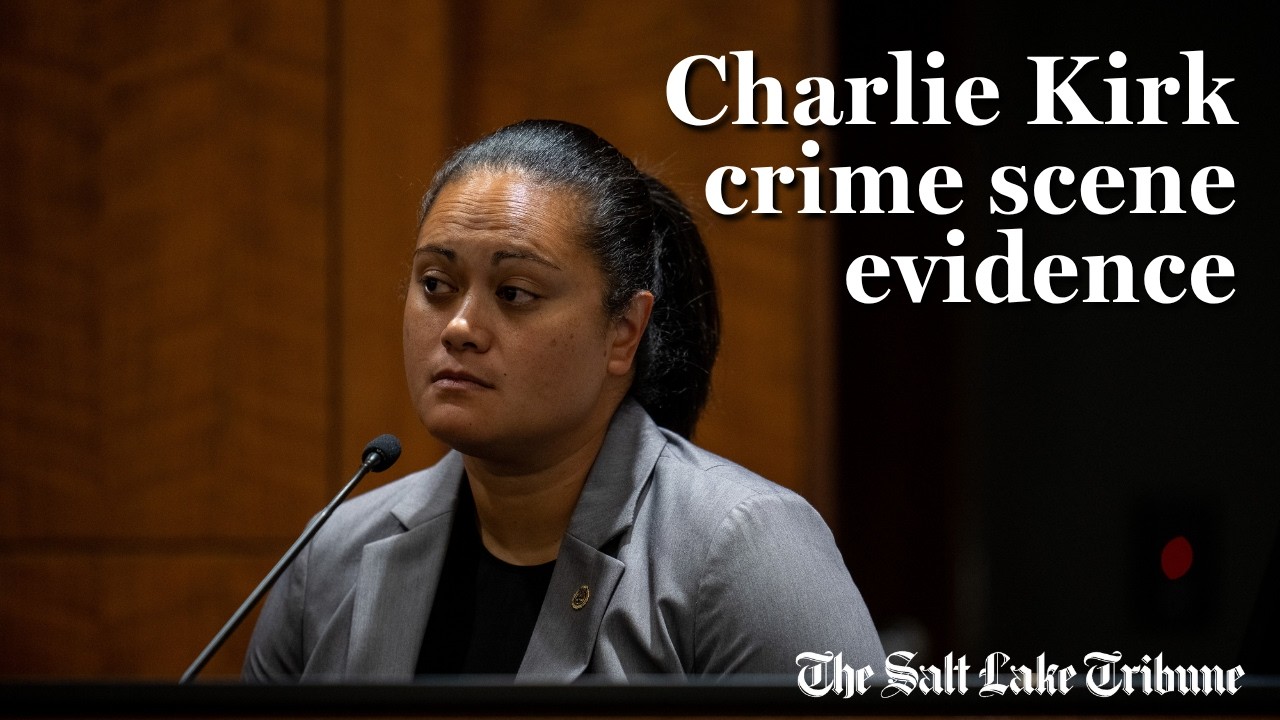
Jennifer Faumuina Testifies on Evidence Collection in Tyler Robinson Case at Utah Valley University
10:55
Tyler Robinson Preliminary Hearing Day 4: Roommate Lance Twiggs Reveals Robinson Confessed to Killing Charlie Kirk
In a dramatic fourth day of preliminary hearings, prosecutors revealed that Tyler Robinson's roommate and romantic partner, Lance Twiggs, testified that Robinson explicitly confessed to shooting Charlie Kirk at Utah Valley University. Text messages shown in court captured Robinson stating "I am. I'm sorry" when asked if he committed the shooting, along with detailed discussions about hiding the rifle and engraving bullets with messages. DNA evidence presented showed Robinson's profile was "at least one trillion times more likely" to be on the recovered rifle and ammunition than any random individual. The hearing revealed extensive physical evidence including engraved bullets reading "notice bulge," "this, you are gay," and other messages, along with surveillance footage tracking the suspect's movements. After four days of testimony, the prosecution rested its case, with Judge Tony Graf scheduling oral arguments for September 1st to determine if sufficient probable cause exists to bind the case over for trial.
Roommate's Testimony Reveals Direct Confession
The most damning evidence in day four came from Lance Twiggs, Tyler Robinson's roommate and romantic partner, who testified via a recorded Zoom interview conducted in April 2026. Twiggs, who was granted limited immunity, described receiving text messages from Robinson on the night of September 10th, 2025, beginning at 11:00 PM. When Twiggs asked "You weren't the one who did it right?" Robinson responded unequivocally: "I am. I'm sorry."
Twiggs explained that he and Robinson had been living together in St. George, Utah, initially as roommates before their relationship became romantic two to three months after Robinson moved in. On September 10th, Robinson left their apartment unusually early—around 4:00 AM rather than his typical 7:00 AM departure—claiming he had a long drive to work. Twiggs didn't hear from Robinson again until receiving the late-night text instructing him to "look under your keyboard."
Text Messages Detail the Aftermath
The text exchange revealed Robinson's detailed account of the shooting and his attempts to recover the rifle he'd hidden. "I had enough of his hatred," Robinson wrote when asked why he committed the act. "Some hate can't be negotiated out." He described attempting to retrieve his rifle from a wooded area near campus, noting there was a squad car parked nearby and worrying about fingerprints he might have left on the weapon.
Robinson revealed he had been planning the attack "a bit over a week" and had left the rifle "wrapped in a towel" in bushes where he changed outfits. When he couldn't locate it, he texted: "I'll bet that K9 sniffed it out. Little snitching bastard." The messages also referenced engraved bullets, with Robinson noting the messages were "mostly a big meme" and joking that if he saw "notices bulge UW on Fox News, I might have a stroke."
In his final message before turning himself in, Robinson instructed Twiggs: "If any police ask you questions, ask for a lawyer and stay silent. My lawyer should be Doug Terry."
Physical Evidence Directly Links Robinson to Crime
SBI Agent Sergeant Jennifer Faumuina provided extensive testimony about the physical evidence recovered from multiple crime scenes. The rifle found in the wooded area across from Utah Valley University campus was wrapped in a dark towel, exactly as Robinson had described in his texts. When crime scene investigators made the bolt-action rifle safe, they discovered one fired cartridge case and three unfired cartridges—all with distinctive engravings.
The engravings on the ammunition included:
- "Notice bulge, Ow, What's, This?" on the fired cartridge case
- "A fascist, Catch, ↑→↓↓↓" on one unfired round
- "O Bella, Chow, Chow" on another unfired round
- "This, you are, gay, lmao" on the third unfired round
Testing revealed these engravings were consistent with marks made by a Dremel tool—the same type of handheld rotary tool recovered from Robinson's apartment during the search warrant execution.
DNA Evidence Proves Overwhelming Match
ATF forensic analysis revealed Robinson's DNA was found on multiple parts of the recovered rifle. Agent Faumuina read from the official reports, which stated Robinson's DNA profile was "at least one trillion times more likely" to be present on the rifle's stock, grips, bolt, butt plate, trigger, trigger guard, and barrel than if the DNA came from random unrelated individuals. The same statistical analysis applied to the cartridges found in the weapon.
Additional DNA testing on the Dremel tool and bits recovered from Robinson's apartment showed his DNA on the tool's buttons, cord, and metal bits. Most significantly, a cartridge case found in Robinson's home with the engraving "test shot" also contained Robinson's DNA and was "identified as having been fired in" the same rifle used in the shooting.
Ballistics Confirm Weapon and Ammunition Match
The ATF report presented in court confirmed that the rifle recovered from the wooded area was the murder weapon. The cartridge case found in the rifle's chamber "was identified as having been fired in" that specific weapon. While bullet fragments recovered from Charlie Kirk's body during autopsy could not provide a definitive match due to damage and deformation, they were consistent with having been fired from the recovered rifle.
Importantly, all five cartridge cases found on top of a safe in Robinson's bedroom were "identified as having been fired in" the same rifle. These cases matched the .30-06 Springfield caliber of the murder weapon, and one bore the "test shot" engraving, directly linking Robinson's home to practice sessions with the murder weapon.
The Note Under the Keyboard
Following Robinson's text instruction to "look under your keyboard," Twiggs discovered a handwritten note. While the contents of this note were not read aloud in the portion of the hearing open to the public (it was shown only in the courtroom per the judge's order), law enforcement obtained a photograph of it from Twiggs's phone during the investigation. The note was subsequently shown to Twiggs during his April 2026 interview, and he confirmed it was what he found that night.
Discord Messages and Final Communications
In addition to texting Twiggs, Robinson sent messages to a Discord gaming server he shared with friends who played Dungeons & Dragons together. Using the username "Tyler Ikum," Robinson posted messages in this thread up until approximately 8:00 PM on September 11th—just one hour before he turned himself in to authorities at the Washington County Sheriff's Office around 9:00 PM.
Twiggs testified that when he saw Robinson in person on September 11th, Robinson was "walking around a lot" and appeared to be keeping himself busy or distracted. When Twiggs asked if what Robinson had said the night before was true, "he said it was. I started crying a little bit and said he wishes he hadn't done it."
FBI Images and Public Identification
During the interview, Twiggs was shown FBI press release photos of the suspect captured by UVU surveillance cameras. While noting he couldn't be "100% certain just because of camera quality," Twiggs identified the person in the photos as resembling Robinson based on "the shoes he's wearing, the sunglasses" and noting Robinson "was usually wearing a hat." He specifically stated the bottom two images "definitely do look like him."
Twiggs confirmed he discussed these photos with Robinson's friends in their group chat, though he noted he didn't have access to his phone for an extended period after the incident and wasn't using social media, so he couldn't confirm broader discussions.
The Shooting Position and Crime Scene
Sergeant Faumuina detailed the findings from the rooftop of the Losee Center, identified as the shooter's position. Crime scene analysts found a screwdriver, disturbances in the gravel marking what appeared to be a "shooter's perch," and swipe marks on the northeast ledge where surveillance video showed someone dropping from the roof.
Measurements taken from this position to the tent where Charlie Kirk was seated showed a distance of approximately 415 feet with a 68-foot vertical drop. Despite finding palm prints and fingerprints on the glass window near where the suspect landed, DNA testing excluded Robinson as the source of these prints. Enhanced video analysis later showed the suspect did not actually touch the windows when jumping from the building.
Search of Robinson's Apartment Yields Critical Evidence
The search warrant executed at Robinson's St. George apartment yielded numerous pieces of evidence connecting him to the crime. Investigators recovered:
- A Dremel tool with bits and container
- Two boxes of Remington .30-06 ammunition
- .30-06 cartridge cases
- Multiple firearms including rifles and a revolver (though notably, no .30-06 rifle)
- Two pairs of Converse shoes (gray with white laces, size 10.5, and gray with gray laces)
- Three shooting targets with bullet holes, found in a first-floor closet
- A burned note recovered from the kitchen trash can
The shooting targets were particularly revealing. The rightmost target showed perforations in the seven, six, and eight rings—missing the bullseye entirely. The center target showed shots closer to the bullseye, "usually to the left" in the nine and eight rings. The leftmost target showed the best grouping, with shots "actually closer to the bullseye as well," including "one being in it." This progression suggested practice and improving accuracy over time.
Tool Mark Analysis Links Dremel to Engravings
ATF analysis of the Dremel tool recovered from Robinson's closet provided a direct link to the engraved ammunition. The report stated that "The exhibit 15A engraving cutter was identified as having made tool marks located on" both the cartridge case found in the murder weapon and the three unfired cartridges recovered from it, as well as the "test shot" cartridge case found in Robinson's bedroom.
This finding definitively established that the Dremel tool from Robinson's apartment was used to engrave the ammunition found in the murder weapon, creating an unbreakable chain of evidence from Robinson's home to the crime scene.
Robinson's Background and Relationship
Twiggs provided context about Robinson's daily life in the months leading up to the shooting. Robinson worked for an electrician company, typically leaving around 7:00 AM and returning between 3:00 and 4:00 PM. On certain days, he attended trade school in the evenings around 5:00 or 6:00 PM to advance his electrician credentials.
The couple shared gaming interests, playing various multiplayer games including "Sea of Thieves," a pirate game that involved "fishing, fighting sharks, skeletons kind of stuff." Years earlier, when Twiggs "was just out of high school," they had played shooting games together online before meeting in person, though Twiggs noted he "didn't know him very well" at that time.
When asked about political discussions, Twiggs said Robinson "did more than me. I didn't really still don't really keep up with politics very much." Robinson would "usually talk about stuff he heard on the radio on his drive to work," often discussing Trump or current policies, but Twiggs stated he never heard Robinson specifically mention Charlie Kirk before the shooting. Twiggs also said they didn't discuss "gender identity issues and LGBTQ rights" despite Twiggs's own identity—he was "going by Luna at some point uh to some people" though "not as an overall thing."
The Grandfather's Modified Rifle
In his text messages, Robinson provided details about the rifle's origin and his concerns about it being traced. He wrote: "I don't fully know what the gun was cuz it was old as shit and Gramps did some modifying. There was a four-digit serial on it. God only knows who it's registered to. Hopefully some dead guy who gave it to Grandpa."
This admission revealed Robinson's awareness of the evidentiary value of the weapon and his hope that any registration would lead to a dead end. He also worried about fingerprints, writing "I worry about prints" after mentioning he'd left the rifle in the bushes.
The Engraved Bullet Planning
Twiggs testified that Robinson had asked him about using a Dremel tool "at most a month before" the shooting. Robinson claimed he was planning to go hunting with his family and "wanted to engrave messages on bullets." Twiggs recalled telling Robinson "where Dremel was and I told him to make sure he doesn't like set off a bullet on accident in the house."
In his texts after the shooting, Robinson referenced this conversation: "Remember how I was engraving bullets? The fucking messages are mostly a big meme." This suggests Robinson intended the engravings as some form of statement or message, though he characterized them as largely humorous or ironic.
Defense Strategy Emerges
The defense's cross-examination focused primarily on challenging the scientific validity of the forensic evidence. Defense attorney Richard Novak extensively questioned ATF agent Samantha Carer about laboratory testing procedures, attempting to establish that the testing methods couldn't definitively distinguish between different weapons that might have fired the ammunition.
The defense sought to show that results characterized as "inconclusive" in lab testing meant the bullets could have come from multiple guns, not just Robinson's. However, prosecutors countered this by emphasizing the ATF's definitive findings that the cartridge cases found both in the murder weapon and in Robinson's home were "identified as having been fired in" that specific rifle.
The defense also questioned Sergeant Faumuina's testimony, establishing that she did not personally witness many of the evidence seizures, particularly on the rooftop, and that other agencies' personnel actually performed much of the physical evidence collection. Defense counsel sought to highlight potential gaps in the chain of custody and documentation.
Charges and Legal Standards
Robinson faces multiple charges related to the September 10, 2025 shooting at Utah Valley University that killed conservative commentator and Turning Point USA founder Charlie Kirk. The charges include victim targeting enhancements under Utah Code 76-3-203.14, alleging Robinson "intentionally selected Charlie Kirk because of Tyler James Robinson's belief or perception regarding Charlie Lee Kirk's political expression."
At a preliminary hearing, the prosecution's burden is significantly lower than at trial. They must only demonstrate probable cause—that the crime probably occurred and that the defendant probably committed it. Judge Tony Graf must determine if there is sufficient evidence to bind the case over for trial, where the "beyond a reasonable doubt" standard would apply.
Standing Objections and Publication Restrictions
Throughout the hearing, the defense maintained "standing objections" to the admission and publication of various pieces of evidence. Judge Graf repeatedly noted these objections while overruling them, allowing most evidence to be both admitted and published at "all three levels"—meaning shown in the courtroom, to media present, and broadcast via camera to the public.
However, certain items received restricted publication. Exhibit 16.3—the photograph of the handwritten note Robinson left under his keyboard for Twiggs—was admitted into evidence but only shown in the courtroom, not captured by media cameras. Similarly, Robinson's Discord messages (Exhibit 16.2) were published only in the courtroom and not distributed electronically.
The judge also addressed concerns raised by defense counsel about Erika Kirk's attorney seeking to have certain evidence shown for the family's benefit. Defense attorney Richard Novak argued that preliminary hearings exist to determine probable cause, "not to educate the public or the victim's family or the world on what evidence the government or the state has." He accused Kirk's attorney of holding press conferences revealing evidence and suggested the family had access to information they could publicize outside the courtroom under the protective order.
Evidence Not Connected to the Case
During cross-examination, defense counsel established that some investigative efforts yielded no relevant evidence. Items seized from the Fulton Library bus stops—including a backpack, jacket, and gloves that investigators initially considered suspicious—were eventually determined not to be connected to the case, and testing was discontinued.
Similarly, a firearms trace request run through the National Integrated Ballistics Information Network (NIBIN) produced nothing of value. A firearm seized from a location on River Street also proved irrelevant to the investigation.
Ongoing Investigation and Monitoring
The 229-page investigative report compiled by SBI indicates that authorities have been monitoring Robinson's mail and communications while he's been held at Utah County Jail. However, Sergeant Faumuina testified she was not involved in this aspect of the investigation and couldn't speak to whether anything of value had been developed from it.
The report also indicates investigators interviewed Robinson's associates to develop a profile of any animosity he might have harbored toward Kirk, though Faumuina stated she wasn't familiar with that aspect of the investigation either.
Technical Issues and Courtroom Procedures
The preliminary hearing experienced several technical and procedural interruptions. During Twiggs's remote testimony, there were audio issues requiring the interview to be restarted to ensure proper recording. Judge Graf repeatedly reminded participants to speak clearly into microphones for the record.
The judge also spent considerable time the previous day and morning of day four reviewing video evidence and determining what portions could be shown, what needed to be redacted, and what level of publication would be permitted. This resulted in extended periods where testimony was delayed while technical and legal issues were resolved.
Prosecution Rests After Three and a Half Days
After presenting testimony from law enforcement personnel, forensic analysts, and the victim's family members over the course of three and a half days, the prosecution formally rested its case on the afternoon of day four. Multiple attorneys who spoke with reporter Nate Eaton indicated the state could have rested much earlier—possibly as soon as Monday—as they had established probable cause well before completing their presentation.
The extensive evidence presented went far beyond the minimum required for a preliminary hearing, suggesting prosecutors wanted to build a comprehensive record early in the proceedings and perhaps preview the strength of their case should it proceed to trial.
Defense Witness and Briefing Schedule
The defense indicated it would call one additional witness—ATF agent Samantha Carer, the forensic analyst who had examined the rifle, ammunition, and cartridges. Rather than calling her as a hostile witness during the state's case, the defense reserved her testimony for their portion of the hearing.
At the conclusion of day four, defense counsel requested the opportunity to submit written briefs rather than having Judge Graf rule immediately on whether probable cause had been established. After discussion with both parties, the judge set an extensive briefing schedule:
- Prosecution: Two weeks from receiving the court transcript to file a brief (maximum 35 pages)
- Defense: Two weeks after receiving the prosecution's brief to file a response (maximum 35 pages)
- Prosecution: One week after receiving the defense response to file a reply
- Oral arguments: September 1, 2026 at 10:00 AM
This schedule means no trial date can be set until at least September 1st, when Judge Graf will hear oral arguments and presumably rule on whether sufficient probable cause exists to bind the case over for trial. This extended timeline is unusual but reflects the complexity of the case and the volume of evidence presented.
The Path Forward
If Judge Graf finds probable cause and binds the case over for trial, Robinson will face formal arraignment where he'll enter a plea. A trial date will then be scheduled, though such proceedings often take six months or more to commence given the complexity of death penalty-eligible cases and the extensive pretrial motions likely to be filed.
The defense has already signaled its intention to challenge the scientific validity of the forensic evidence, particularly the ballistics testing. Additional challenges to the admissibility of various pieces of evidence, the scope of the search warrants, and other procedural matters are likely to follow.
For the Kirk family, who attended each day of the preliminary hearing, the wait continues. Erika Kirk, Charlie's wife, has been present throughout, though she has not made public statements during the proceedings. The family has retained separate counsel who has advocated for their right to observe all evidence presented, creating some tension with defense efforts to limit public disclosure.
Video Transcript
Hi there everybody. Welcome to Courtroom
Insider. It is Thursday the 9th of July,
2026. I'm Nate Eaton and I'm back home
from Provo, Utah. But I was there this
morning at the courthouse. You can see
as Erica Kirk and Charlie Kirk's parents
were walking inside. They didn't uh have
anything to say as they entered the
preliminary hearing. This is day four of
Tyler Robinson's preliminary hearing.
He's the man accused of killing Charlie
Kirk at Utah Valley University last
September. And this was the day where we
saw the key pieces of evidence that the
prosecution has. First of all, the
prosecution rested this afternoon. Uh so
their part is done. The defense has one
more witness who they will call in the
morning and we'll talk about what will
happen next after that. Uh but this was
the uh you could call it damning
evidence as many people have. Tyler
Robinson's roommate, romantic partner
Lance Twigs, who also goes by Luna,
that's what Tyler calls him is Luna,
revealed today that Tyler told him he
did it. that that uh Charlie Kirk was
shot by Tyler Robinson. We saw text
messages. We saw we heard about a note
and Discord chats. If you weren't in the
courtroom, you didn't see it. Uh but
we're going to get to all of that
tonight. I'd love to know where you're
watching from. If you have any
questions, please put it in the comments
and your thoughts about the uh the
pre-trial the preliminary hearing so
far. Quick reminder, a preliminary
hearing is not a trial. Basically, the
state who's who's has the burden of
proof has to prove to the judge, Judge
Tony Graph, that this crime probably
happened and that Tyler Kirk committed
it. Excuse me, Tyler Robinson committed
it. The bar is very low. And I would
argue that the state has definitely
presented that there is enough evidence
to say that Tyler Robinson likely did
it. He's not been convicted. He is
presumed innocent until he is found
guilty. if he is and if this goes to
trial. Um, we saw the text exchanges
which we'll go through in a moment. We
also learned about DNA results from the
rifle and cartridges retrieved from that
wooded area near the campus that I
showed you last night. And guess whose
DNA was on it? Tyler Tyler Robinson.
Now, before we get to the video
there, this video is that, you know, we
talked about it yesterday. That was
mainly everything that was discussed
yesterday. I was in the courtroom
yesterday. They finally agreed. The
judge went back and forth with the
defense, the prosecution, Erica Kirk's
attorney, all of them weighing in on
different things, and the judge finally
said the video can be admitted with
certain redactions, parts that need to
be cut out. That same discussion was
held this morning for 2 hours. Finally,
the judge ruled and said the video will
be played to the public. Thank you,
judge. Not just the people in the
courtroom, but also the uh the the
public, the courtroom, everybody. But
there will be black sections played in
the video. So, in order to get the video
in, agent Brian Davis had to go back to
the stand. Remember, this is the guy 80
18-year vet with the with the SBI, State
Bureau of Investigation. He's the one
that took a plane down to St. George and
um did a whole uh was there when Tyler
Robinson was interviewed, all of that.
So, he's very familiar with the case. Um
and remember that he talked about how
Lance Twigs, his roommate, was given
immunity, limited immunity to do this.
And so, they met with him twice, with
Twigs twice. Once right after Robinson
was arrested back in September, and then
once in April when this video you're
about to see was recorded. It was a Zoom
type of interview setting where Twigs
was there with his attorney and Ryan
McBride from the prosecutor's office
asked him questions. Uh you'll notice
his vocal tone and demeanor as he talks
about what he did and did not know about
Robinson and the killing of Charlie
Kirk. Uh Twig starts off by explaining
how they met in 2023. They moved in as
roommates and then they began a romantic
relationship a few months later. Now,
I'm going to play you this whole
interview because this is like the key
piece. We've heard so much about it. I
want you to hear it, but I'm going to
remove the black out sections, the the
pieces that were redacted. So, this is a
trimmed down version of the whole
interview, which the parts we saw were
around 20 minutes. the redacted
portions. The reason the judge says they
couldn't get in is because it's uh could
could there might be confidential
information on there. It could be extra
prejuditial, which once the trial comes,
we'll see if this whole thing gets in uh
because I'd be fascinated to hear what
we did not hear today. So with that
introduction, here is the exchange with
Lance Twigs
>> is uh to use your statement here instead
of your testimony at a preliminary
hearing. Understand that?
>> Mhm.
>> So um in order to do that to do that, I
need to place you under oath and also
give you a an admonition about false
statements. Okay. First, uh, you do
solemnly swear or affirm that the
evidence you shall give in this issue
shall be the truth, the whole truth, and
nothing but the truth. So, help you God.
>> Yes.
>> Um, I also need to notify you that you
are notified that statements you are
about to make may be presented at to a
magistrate or a judge in lie of your
sworn testimony at a preliminary
examination. Any false statement you
make and that you do not believe to be
true may be sub may subject you to
criminal punishment as a class A
misdemeanor. You understand that?
>> Yes.
>> That potentially could be used as uh for
punishment as a higher offense as
obstruction of justice.
Um,
in addition, I just want to make sure
that our recording here is clear that uh
you've also been given um uh a federal
agreement and a state agreement granting
you immunity from prosecution for
materials that you discuss now. Do you
understand that?
>> Mhm. Okay.
Um, first, uh, we're going to cover some
of the things that we've already talked
about, but to make it, um, as part of
this record,
um, first, what's your name?
>> Full name with middle name or just first
and last?
>> First and last is fine.
>> Okay. My name is Lance Twix.
>> And do you know Tyler Robinson?
>> Yes, I do. Or Yeah, I do.
>> And this is the same Tyler Robinson
that's been charged with the shooting of
Charlie Kurt?
>> Yes. And would you say when you first
met uh Tyler?
>> I think it was 2023. I've known him
longer than that though. That was I
think the first time I met him in
person.
>> Okay. Um
and will you describe your relationship
with with Tyler uh when you first met
him? Anyway,
>> um when I first met him, I didn't know
him super well. He was just a new
roommate. So,
I knew he knew my friend group and I
knew he liked playing games, but that
that's about it when we first uh like
when he first moved.
>> Okay.
>> Um before we go on, I realized my mic
was at the
microphone.
>> Okay. I'm going to repeat those
admonitions just to make sure.
>> Okay. So, um again, I placed you under
oath. Um um just to make a record, I'm
going to do it again. You do solemnly
swear that the evidence you shall give
in this issue shall be the truth, the
whole truth, and nothing but the truth.
So I've begotten.
>> Yes.
>> And again, I'm giving going to give you
the false uh statement.
>> Sorry, hold on. Um
if they're saying that it's echoing, so
I
>> I think this one's mic is on.
>> Okay. Sorry.
>> Okay.
That's fine.
>> Okay.
>> Okay. So, we should be good. All right.
Is that mic on?
>> Yes.
>> Okay, great.
>> All right. Um, okay. Sorry about that
interruption. All right. So, you said
when you first met met you were
roommates.
>> Uh, yeah.
>> Okay. And then, um, at some point, uh,
your relationship progressed to
something more than just roommates. Is
that right?
>> Mhm.
>> When was that? Um, I think we started
dating two or three months after he
moved in.
>> Okay. And where did you live at that
time?
>> St. George. Uh, in an apartment complex.
>> And is that apartment the same place you
lived uh when on September 10th?
>> Yes.
>> Um,
when you lived there uh with Tyler, were
you in the same room? Did you live in
the same room or different rooms?
>> Uh, separate rooms.
And at that time, let's say September of
2025,
um what was what were you doing with
your life? Were you working, school?
>> Uh I was working. Um I was doing like
bathtub and shower repair and stuff in
new construction.
>> Okay. How about Tyler? Um, I think he
was both working I think he was working
for an electric like an electrician
company then and he was also in a trade
school for being a I don't know higher
like ranking electrician. I'm not sure
how the trade system works for that.
>> Okay.
>> But yeah, I think it was both.
>> What was his typical workday like?
>> Um, I think he'd leave around 7
generally and get back around 3 to 4. uh
depending on like where the job was and
how long it was for the day. And then on
certain days of the week during
school like semesters he would then
later in the day I think around 5 or 6
go to school. So yeah.
>> Okay. Let's jump to September 10th. Um
did he spend spend the night in the
apartment the night of September 9th
into September 10th?
>> Into September 10th. Yeah, he did. Uh,
yes.
>> Do you know when he left the apartment
on September 10th?
>> Um, I don't know an exact time. I just
know he left early. Uh, I heard him
leaving and he just said he had a like
long drive to work that day, so he was
leaving early.
>> Okay. So, early. Um, any guess as to
what um
when that was?
>> Uh,
I don't know. I would have thought it
was 5:00 a.m. because that's when like
an early work day was for him, but it
was probably more like 4.
>> Okay.
Have him sp his gum just to make sure
that
>> I can do that.
>> Right in front of your laptop.
>> There you go.
>> Thank you.
>> Thank you.
So, what time did you get up on
September 10th?
>> Probably like 12 to 100 p.m.
>> You didn't have to work that day?
>> Uh, no.
>> And did you hear from Tyler? Did he call
or text you before then?
>> Uh, no. He sent that message in the
group chat I mentioned, but he didn't
message me directly at all that day.
>> Okay. When did you first hear from him?
On September 10th.
Uh, it was at 11:00 with that like
automated message.
>> Okay. 11 p.m.
>> Yeah.
>> He asks you here, remember how I was
engraving bullets? Was he engraving
bullets before this?
>> Uh, yeah. I don't remember exactly when,
but uh he had said he was planning to go
hunting with his family. Um, and he
asked me for a if we had like a Dremel
to cuz he said he wanted to engrave
messages on bullets.
Um, and I just told him where Dremel was
and I told him to make sure he doesn't
like set off a bullet on accident in the
house. Um, but I didn't really think
about it until then.
>> How long before um September 10th was
this that you he asked about the Dremel?
I I don't remember cuz he'd been talking
about the uh hunting/camping
trip for a couple months,
but I I don't remember when he was
specifically asking to engrave the
bullets. So,
>> so are we talking like a year before?
>> Oh, no. Not not that not that long. It
would have been I'd say at most a month
before this was when he was asking.
>> Um you talked about the note that he
left. Um, I want to bring this up and I
should say that um the these text
messages that we've been looking at here
are um bait number 54.
Okay. Uh the notes
have been titled 16.3 with a note
and this is base number 58. Do you
recognize that that on the screen there?
>> Yeah. Yeah. What do you recognize it as?
>> Um, that was the note under his keyboard
that he was referring to in the first
text of that chain.
>> So, where did you find this
>> on on his desk underneath his like uh
computer keyboard?
>> What you I assume you read it.
>> Yeah.
>> And then what did you do with it after
you read it?
>> Um, I believe I just put it back down on
the desk after I took a picture of it.
>> Okay. And again, the time you read it
was probably around 11:00 or so on the
10th.
>> Yes.
>> The night of September 10th.
>> Mhm.
>> And did you ever see that again after
you placed it back on his desk?
>> Uh, no, I don't think I did.
>> And that was a desk in his bedroom?
>> Yes.
>> And that's a separate bedroom than your
bedroom?
>> Yeah.
>> I now want to go to uh what's been
titled 16.2.
And do you recognize
this series of messages here?
>> Yeah, that was the
server like his friend that I was
mentioning.
>> Okay. And this is your phone again?
>> Uh, yeah.
>> And I'm assuming you recognize it cuz
the big crack up at the top.
>> Mhm.
>> And so this is a server. Is this
Discord?
>> Yeah, this is Discord.
>> And who who are members of this server?
I don't want names. just generally who
are these people members of this?
>> This is his friend group. Um they play D
and D together every week.
>> Okay. And I just want to scroll through
this to make sure that uh get a chance
to take a look at it.
Go to the next page.
>> Mhm. Yes.
>> So Tyler I come. Who's that?
>> That's Tyler Robinson.
>> These other people are just others that
they're that are members of the server.
>> Yes. Jug, Barnaby, Marina, DM.
>> Mhm.
>> Yes.
>> Yeah. Like DM means dungeon master. So
this is these are like most of them are
names they're using in the in the game
they're playing currently.
>> Got it. Yeah. It looks like the last
text from Tyler looks like it's um 8:00
p.m. And do you know what day this would
have been 8:00 p.m. on the 10th or the
11th? Uh, I would think that would be
the 11th
>> because on at least I think so because I
don't think on the 10th that he messaged
anyone before me at like 11. So,
>> and he turned himself in on the 11th,
right?
>> I thought so. Yeah. Okay.
>> Again, we're just going to go through
this so that we have a record of the
messages. Is that an accurate recording
of that thread?
>> Uh, to my knowledge, yes.
>> And that was sent looks like between
September 10th and September 12th. Looks
like the last day on this is September
12th. Screen.
>> Uh, yes.
>> Again, those messages covered from
September 10th to the evening of
September 11th. Now, September
um 11th, what time did or did you see
Piler on September 11th? Uh, yes.
>> When did you first see him? On September
11th. So, this is the day after the
shoot.
>> Yeah, I saw him when I woke up. Um, like
I said, he was up and around doing a lot
of stuff around the house.
Um, and then I uh I think I saw him
after that message where I said, "I'll
come home and say I'm doing laundry."
Cuz I didn't want him going to my
parents house right then when he said
there was probably cops outside. So I
went back home and it was just him there
and I said bye to him and then he drove
off. So I just went back to my parents
house.
>> So he acted erratically. Um was he
pacing? Was he just sitting down
relaxing?
>> No, he was he was uh walking around a
lot.
>> And that's within the home.
>> Mhm.
>> Um
and did he talk about what he had done?
>> Uh didn't go into detail. He just I just
asked him in person if what he said was
true the night before and he said it
was. I started crying a little bit and
said he wishes he hadn't done it
and then kept going around and
just doing stuff I think to keep himself
busy or distracted or something.
>> Yeah. So he talk about what he was going
to do next
>> and then eventually said that he would
talk to his parents or turn himself
over.
>> Okay. And uh when you left, was that how
you went you left understanding that he
was going to turn himself in or go to
his parents house?
>> Yeah. And I didn't really want to be at
our apartment while any of that was
happening, regardless of what went down.
>> Okay. Okay. before he came home. Had you
seen the press the press releases um any
of the media on on this?
>> I'd seen one
Instagram like link a friend of mine had
sent in our group chat,
>> but I hadn't really looked into it at
all.
>> And uh had you seen the images that were
released of the suspect?
>> Uh I did the next day. I don't think I
saw any on the 10th.
going to show you a couple of those
images.
Okay, I'm on the FBI's website. Um, you
can see the URL there at the top. This
is some press release about this event.
Um, and
here on the screen, you see these
there's looks like there's two rows of
three images.
>> Mhm.
>> Um, do you recognize the person in these
images?
I wouldn't say with a 100% certainty
just because of camera quality, but that
looks like him in terms of the shoes
he's wearing, the sunglasses.
I don't think I'd specifically seen him
wearing that hat, but he was usually
wearing a hat. Um, and then jeans. So,
it definitely, especially the bottom,
the last two definitely do look like
him.
Oh, they do look like Tyler Robinson.
>> And uh you talked about that with your
friends, right? This like him.
>> Yeah, his his friends. Yeah. I don't um
I don't know if I talked I don't
remember if I talked about it with any
of my friends. Um and then since I
didn't have my phone after that for a
while and I still am not using social
media. I don't I don't know uh on my
friends end.
Okay. Um, all right. I want to back up a
little bit now. We've talked about
September 10th, but let me get a little
bit of, um, context here. So, um, did
you game with Tyler?
>> Uh, yeah.
>> What kind of games?
>> Um,
we played some just kind of party games
together, like stuff, anything that
would be multiplayer with a group of
friends. Uh there was one game he really
liked called Sea of Thieves where you
play as like a pirate and you can uh you
can fight against people but most of
it's just like fishing, fighting sharks,
skeletons kind of stuff. Um we played
some co-op games where it's like uh you
both have to work together to win in
whatever way.
uh way back when, like when I was just
out of high school, when I uh first knew
him online, we played some like shooting
games together, but I I didn't know him
very well, so that was just when we had
like a whole friend group on to play and
he was someone that my friends invited.
>> Okay. Um did you and he ever talk about
politics?
>> Um he did more than me. I
I didn't really still don't really keep
up with politics very much. Uh he'd
usually talk about stuff he heard on the
radio on his drive to work in like their
work car since it sounds like their
whole crew went in the same car most of
the time. But uh I wouldn't say super
consistently because there wasn't a
topic I really contributed much on.
>> What about Charlie Kirk? Did you ever
talk about Charlie Kirk?
>> I I personally had never heard him talk
about Charlie Kirk before specifically.
>> Okay. Um,
how about um
political issues? So, did you ever talk
about gender identity issues and LGBTQ
rights?
>> Uh, no, not not really. Um,
uh, usually if he did talk about
politics stuff, it was uh relating to
Trump or current like policies being uh
like issued or voted voted on, I think.
But yeah.
>> Okay. So before that you have been
>> for for a short time. Yes.
>> Okay. And um I understand you're going
by Luna at some point
>> uh to some people. Yeah. But not as an
overall thing.
>> That's all the questions I have for this
portion. Uh let me check and see if I've
missed anything. Um the Dremel that you
talked about and uh so did you have a
Dremel then?
>> Yeah.
>> Okay.
>> Uh it was in our like we had a our
apartment. We had a section where we
kept all our like random tools for
household stuff uh in our like lower
basement level pantry. Um so yeah.
>> Okay. And did you give that to him or
tell them where it was?
>> I just told him where it was. Yeah.
>> Okay. I'm going to go ahead and end the
recording for the 1102 purposes. Now,
part of that conversation that was
blacked out was text messages and a note
and uh about he talked about the note he
found under the keyboard that Tyler
wrote to him, but also text messages.
And I'm going to play you those text
messages. So, I I wanted to show them to
you, you know, one by one, but I think
it's better they're on the screen here,
and I'm going to let the agent read
them. Again, I'm going to play it for
you in full. There is profanity. Just a
heads up. There's an F-word, at least
one, a couple of swords. Uh, and this is
the back and forth between Robinson and
Twigs after Twig after Twigs was
informed by Robinson that he had shot
Charlie Kirk. Again, the full exchange.
Here it is
>> where it begins Wednesday 11 p.m. Will
you start reading underneath that?
>> Yes. Um, so this would have been from
from Tyler. says, "Drop what you're
doing. Look under your keyboard."
>> And I I apologize. Let me stop you
there. How do you know that this that
message would have been from Tyler
Robinson.
>> Uh that's just so any of the messages in
gray would be from Tyler and message in
blue would be from uh from Lance. It's
just way the iPhone
distinguishes the messages. And also
Lance, Lance in his interview also
acknowledges that um who was saying
what. And up at the top, who do we see
that this thread is is between?
>> Uh, uh, Tyler.
>> All right. Sorry to interrupt you. Uh,
so, so read that again, starting from
look under the keyboard.
>> Uh, so, so, uh, after that, then Lance
responds. He says, "What?" And then he
says, "You're joking, right?" And then
Tyler says, "Fuck, I tried to delete
that."
>> We could scroll down to page two.
And if you can continue reading
along.
>> Okay. Uh, and Tyler says, "I'm still
okay, my love, but I'm stuck in Orm for
a little while longer yet. Shouldn't be
long until I can come home, but got to
grab my rifle still. To be honest, I had
hoped to keep this secret till I died of
old age. I am sorry to involve you."
And then Lance replies, "You weren't the
one who did it right." And Tyler says,
"I am. I'm sorry."
Lance says, "I thought they caught the
person."
And then Tyler says, "No, they grabbed
some crazy old dude and interrogated
someone in similar clothing. I had
planned to grab my rifle from the drop
point shortly after, but most of that
side got side of town got locked down.
It's quiet almost enough to get out, but
there's one vehicle lingering." We could
scroll down to page three.
Continue reading.
>> Uh, Lance says, "Why?" And Tyler says,
"Why did I do it?" And Lance says,
"Yeah."
Tyler says, "I had enough of his hatred.
Some hate can't be negotiated out. If
I'm able to to grab my rifle, unseen, I
will have left no evidence. Going to
attempt to retrieve it again. Hopefully,
they have moved on. I haven't seen
anything in the news about them finding
it. We'll update you shortly or shortly.
We'll update you by midnight. And then
Lance says, "All right, stay safe. How
long have you been planning this?"
>> Scroll down a little bit, please,
Kimberly.
>> And Tyler replies, "A bit over a week, I
believe. I can get close to it, but
there is a squad car parked right by it.
I think they already swept that spot,
but I don't want to chance it." We can
scroll down to page four and continue
reading. Uh about halfway down. I'll
I'll stop you about halfway down.
>> Uh this is while they were spot, but I
don't want to chance it while they were
parked there. If they had found it, I
imagine there would be more commotion.
Again, I'm sorry for roping you into all
of this. You shouldn't have to worry
about this.
And Lance replies, "Does anyone else
know?" Tyler says, "Not to my
knowledge." All right, I'll stop you
there. Uh, let's move to page five. So,
this should be page four. So, just
scroll down one, please, Kimberly.
And if you could read starting
um, sorry, Kimberly, scroll a bit more
down
if you could read. Um, I don't know
about onethird of the way up. That's
that starts with guess.
>> Okay.
Um, Tyler says, "Guess I'm guess I'm
just sitting in my car watching reals
for another hour, hoping this guy [ __ ]
off
>> and continue."
>> And Lance says, "Are you okay still?"
And Tyler says, "Yes, checking spot
again now. Will
>> Sorry, now we're on page six. Continue
reading."
>> Uh, we'll update soon. He continues,
"The squad car was moved further away
enough that I should be able to move in.
I backed off cuz I thought I heard
footsteps, maybe a foot patrol, but the
crickets here are so [ __ ] loud.
Going to see if the if the road closer
to campus is open so I can drive past
and check [ __ ] out. Probably still
closed off though. Getting worried. Hard
to know for sure, but I'm not finding my
rifle. Could be in the wrong spot.
Lance says, "Do you think they found
it?" And Tyler says, "Don't know. They
haven't published anything." if they
have.
And then Lance says, "Why did you leave
it behind?"
>> Oh, sorry, Kimberly, if you could scroll
down
>> originally. Also, does it have a serial
number?
>> We could scroll to page seven
and I'll continue reading. I'll I'll
stop you on this page in a little bit.
>> Okay. Uh, so Tyler continues,
uh, I IDK. If I had, uh, if it had a
serial number, but it wouldn't trace to
me, I worry about prints. I had to leave
it in a in a bush where I changed
outfits. Didn't have the ability or time
to bring it with.
>> And stop there, please. And then if we
could go to the next page, page eight.
And if you could start at the top.
>> Okay. So, Lance says, "Was your change
of clothes there or was that also gone
or did you bring those with you
originally? Anyway, you could replace
the gun or would he notice?"
Then Tyler says, "Only thing I left was
the rifle wrapped in a towel. I'll bet
that canine sniffed it out. Uh, little
snitching bastard. Replace it. Unlikely.
I don't fully know what the gun was cuz
it was old as [ __ ] and Gramps did some
modifying. There was a four-digit serial
serial on it. God only knows who it's
registered to. Hopefully some dead guy
who gave it to grandpa.
And he continues, "Remember how I was
engraving bullets? The [ __ ] messages
are mostly a big meme. If I see notices
uh bulgew
on Fox News, I might have a stroke."
and then continue. I'll I'll stop you in
a moment.
>> It says, "All right, I'm gonna have to
leave it. That really [ __ ] sucks."
>> Let me stop you there. And then if we
could go on to the next page, page nine.
And do you see the the first blue
message we see on page nine? Uh, can you
start there?
>> Yes. Uh, so Lance says, "Do you need it
for hunting?"
And Tyler says, "No, my dad wanted to
use it to use a high caliber for the
rifle hunt. Judging from today, I say
Gramp's gun does just fine. IDK." I
think that was a two a 2K scope.
Uh Lance says, "Gez."
And then Tyler says, "OMW home, uh 3.5
hours." Lance says, "Drive safe." And
then Tyler says, "Delete this exchange."
Now, Robinson sent his last text to a
Discord group chat. These are gamer
friends. Discord is a server where you
go on, you have gamer names or screen
names, and you play games with other
people who have similar interests. This
was 1 hour before he turned himself into
the sheriff's uh office around 9:00 on
September 11th, the day after the
shooting. Uh several minutes of Twig's
testimony was was talking about those
Discord thread messages. If you weren't
in the courtroom, we didn't hear them.
So I again I was not in the courtroom
today and so I didn't hear that. Uh but
it was talking about the note that he
left under the the keyboard.
>> Do you recognize this?
>> I do.
>> What is this?
>> This uh is a handwritten note or letter
uh from Tyler to Lance.
>> How do you know that? Uh, in Lance's
first interview with FBI, he tells them
about this uh, letter note he found
under Tyler's keyboard per message he
received. Um, he states from, you know,
11 p.m. on September 10th. Um, and so at
that point, uh, Lance finds this. This
is the letter he finds under that
keyboard.
>> Okay. So, to clarify, Mr. Twigs gets a
text from Mr. Robinson around 11 p.m. on
September 10th telling him to look under
his keyboard.
>> Yes. Correct.
>> And this is uh what Mr. Twigs
represented was underneath the keyboard.
>> Yes. Yes.
>> How did law enforcement get this
photograph?
>> So, uh following Lance's first
interview, um at St. George PD. His
phone is uh recovered at that point,
taken into evidence. It is uh
downloaded. I believe it was the
following day or shortly after that. Um
the FBI transported that phone to the
RCFL, which is the regional computer
forensic laboratory um in Salt Lake
City. The phone was downloaded uh
through Celbrite and um after that
following that download was that was
complete. U uh SBI received
a a flash drive containing that
download. Um from there it went to a
SCAK analyst to go through that data of
his phone to look for any pertinent
evidence or information that may be on
there. And at that point um that this
image of this letter was uh uh located.
>> The last text that Robinson sent to
Twigs was him telling him to say stay
quiet if contacted by the police and
also giving him the name of his
attorney. In fact, he said, "Ask for an
attorney and reach out to this guy and
he'll be in touch with you." Uh then the
prosecutor said, "Can you identify
Mr. Robinson in the courtroom?" And he
of course pointed to the defense table.
And guess what? The defense had no
questions for Davis. None. They didn't
cross-examine him at all. And I think
it's probably because we were running up
against a time crunch. Uh they had a
witness that had to go on today. And so
they did not question this witness. The
next witness was Sergeant Jennifer
Fmanu. Now, by the way, if you want to
go back and read the texts, I put them
all on my Facebook page, Nate Eaton
Reporter. They're also on YouTube and
the whole video with twigs. Those are
available. You can go watch those if you
want to watch it again. Uh, Sergeant
Fmani
Manua, I'm sorry, I F A M U I N A. She
works for the State Bureau of
Investigation. You may recall the other
day she took the stand. She was back on
there today. She talked about processing
the scene at UVU and the prints that
were gathered on the rooftop of the Luc
the uh Loi Center. And then um what was
interesting is there were prints on the
windows. Well, actually, let me talk let
me let me have her talk about the uh
prints gathered on the rooftop of the
area where they say Tyler Robinson shot
Charlie Kirk.
>> What types of evidence were found on the
rooftop? Uh, one item of evidence that
that was found was a screwdriver.
Another one would have been the what we
believe was the shooter's perch. Um,
that was determined based or that was
easy to see at night. Um, using oblique
lighting, we could see disturbances in
the gravel on the rooftop. And then on
the northeast edge, our team also found
some swipes on the ledge of that rooftop
that was also collected.
Okay. So, northeast ledge. And is this
the dropping off point?
>> Yes, it is.
>> You said swipes. What does that mean?
Swipes.
>> Swipes is um I would describe it as kind
of um handmarks or any type of marks
that that is left by something that
causes some type of disturbance.
>> Okay. And
where on the ledge were those located?
Those were located right on the edge of
that roof off or sorry, excuse me, right
right on the edge of that rooftop. And
then right below we also had some other
swipes as well as well as some other
impressions. And then below that was a
glass window where we also located some
latent prints.
>> Okay. wanted to return to the uh the
what you've referred to as the perch,
the sniper position.
Were measurements taken from that sniper
position to the tent where Charlie Kirk
was seated?
>> Yes.
>> Do you know the distance?
>> Yeah. So, the distance from the perch
area directly to the tent where Mr. Kirk
was sitting was approximately 415 ft. Um
if you take into and this if you break
it down so from the perch to the tent
you're looking at is basically like this
and this is the perch and this is the
tent.
>> And now you're describing I'm sorry I
have to make a record. You're describing
an angle a slope downward from the perch
to the location of the tent. Is that
accurate?
>> Yes, I am. Go ahead.
>> Yeah. So the angle um so again the
distance the perch to the tent was
approximately 415 ft. If you think about
it or without taking into account the
elevation drop, it was actually 410
feet. So just horizontal straight across
and then the elevation difference
between or between that is approximately
68 ft.
>> Okay. 400 ft 410 ft from the perch to
the tent with a 68t vertical drop. Is
that right?
>> The state then turned to evidence
gathered in that wooded area right
across the street from campus. If you
want to see it, I did a tour yesterday.
You can go see it. She goes into detail
about how the rifle uh was wrapped in a
towel and and how it was discovered. And
images were shown to the court and the
media. We were able to see them all
along with the engraved bullets. Here is
what those engravings said.
>> Was anything of evidentiary value found
in the wooded area.
>> Yes. In the wooded area, a rifle that
was wrapped in a dark color towel was
found there.
>> And how did you learn about that? I
found that out because uh just a little
bit before 6 p.m. 6 p.m. that day, I
received a call from Utah County
Sheriff's Office who was tasked with
searching that area.
>> Do you know why they searched that area
in the first place?
>> Yeah. So, they searched that area
because I received a video um that was
from the UVU security footage. Um that
this was received by our command post on
scene and it showed um who we believe
was the shooter on the rooftop, run from
the southwest corner all the way to the
north northeast corner, jump down and
then continue to the northeast side of
that campus and then cross the street to
Campus Drive. And then he was or the
suspect was out of camera's view after
that.
>> Okay. So he ran basically toward and
into that wooded area.
>> Yes. Yes. What we are looking at here is
actually the bushes where the dark
colored towel and the gun were found. Um
you can kind of see the dark colored
towel towards the right hand side of the
screen in the middle. Right middle.
>> Kimberly, can you zoom in to that area,
please?
All right. Is this a better view of the
towel?
>> Yes, it is.
Will you describe what we see here?
>> Yeah. So, what you see here now is a
dark colored towel and a the rifle that
is in the towel and it is in a cardboard
box.
>> Why is the towel still around the gun?
>> We wanted to document as to how it was
found.
>> All right, let's go to 10.3.
>> Is this the rifle?
>> Yes, it is.
>> You
described uh the making the rifle safe.
Will you describe what that is?
>> Yeah. So, what that is is that we ensure
that there isn't anything in the chamber
and that there's no other cartridges in
the gun that would have it go off. So to
do that, because it is a boltaction gun,
we would have to um manipulate the bolt
or the lever back and then from there
see if anything was in the chamber and
then um I say carefully remove anything
that was in the chamber and below it.
>> Do you notice an inscription or an
etching on this cartridge case?
>> Yes, I do.
>> Will you read what that says?
>> Yes. Notice bulge. And if we can go down
to page two of the exhibit,
will you read what this says?
>> Ow. Whats
>> and to page three.
>> This
>> and question mark. Correct.
>> Yes. Question mark.
>> All right. If we go to states exhibit
20.
Is this uh
a photograph of one of the cartridges
that was found in the gun?
>> Yes, it is.
>> And what are we looking at here in this
view of page one on exhibit 20?
>> This is the headstamp of it. And it says
it is a according to the headstamp, it
is a Remington 306 Springfield.
>> Is that a different caliber than a 223
round?
>> Yes, it is.
Will you look at page two of
exhibit 20?
Will you read the the markings here?
>> A fascist
>> and page three.
>> Catch.
>> And page four,
>> up arrow, right arrow, down arrow, down
arrow, down arrow.
All right, let's go to exhibit 21.
>> And was this another round that was
found in the gun?
>> Yes.
>> Will you read the inscription here?
>> O Bellachow.
Page two.
>> Chow. Chow.
>> All right, let's go to exhibit 22.
Another round that was found from the
gun. Correct.
>> Yes.
>> Will you please read the letters here?
If you read
>> page two
>> this comma you're or correction this
comma you are
>> page three
>> gay
>> and page four
>> l mm ao
>> the sergeant went on to detail findings
from the search warrant at Robinson's
apartment that he shared with Twigs and
included a tool that you can use to
engrave on things a Dremel tool. Uh you
can engrave on metal or or whatnot.
They're obviously saying that he had the
tool at home and so he engraved himself
on the bullet. There was Remington
ammunition and cartridges. Cartridge
cases, a long gun, a revolver, two
shoes, both Converse, which he the
photos that we saw from the university
surveillance footage was Converse, and a
cartridge that said testshot
engraved on it on it. Uh, and then they
found that Dremel tool used to engrave
uh, along with three shooting targets
that were inside the closet.
>> Looking at states exhibit 25, I'm going
to ask the question that was objected
to. Um, you said there's perforations in
those are those consistent with bullet
holes.
>> Yes.
>> And I want you to I would ask you to
describe um where those perforations
are uh on exhibit on the there's three
targets here, right? Yes.
>> Let's look at the
let's look at the far right target
first.
>> Where are the perforations in relation
to the bullseye?
>> Uh they're all probably within the
seven, six, and eight ring.
>> Is there is there a perforation up at
the upper leftand corner of that
rightmost target?
>> Yes, there is.
>> Do any of those hit the bullseye?
>> No.
Looking at the center uh target uh will
you describe where the perforations are
in in relation to the bullseye there?
>> It's closer but still not it. Um Momo
most of them are usually are to the the
left of the bullseye and rings I'd say
nine and eight.
>> All right. And then the leftmost target.
Will you describe where the perforations
are there?
>> Yeah. Uh the perforations are al are
actually closer to the bullseye as well.
Uh actually one being in it. All right.
You described also collecting a burnt
note. Will you describe where that note
was found and what it looked like to
you?
>> Yeah, the burnt note was found in the
trash can located in the kitchen. Um,
the way it looked like to me, it looked
like say you're at like a campfire and
someone burns paper.
>> Now, another big DNA reveal. Testing on
the rifle. We didn't know this before.
Testing on the rifle and the cartridges
about what was found. The DNA on those.
They were read to the court. Listen. 1.1
is swabs of the stock and grips of the
rifle. And then 1.4 is swabs of the bolt
of the rifle with possible ridge detail
and or smudging.
>> Okay. Will you read paragraph D?
>> Yes. The DNA profiles are at least one
trillion times more likely if they
originated from Tyler Robinson exhibit
7.1 as a contributor to the major
components and three unrelated unknown
individuals than if they originated from
four unrelated unknown individuals.
>> Again, that's swabs of the grips and the
bolt stock and grips and bolt. Is that
right?
>> Yes.
>> Okay. Number two, calculation number
two. Where is this swab taken from?
>> Exhibit 1.2. two would be swabs of the
butt plate of the rifle.
>> And will you read paragraph D here?
>> The DNA profile is at least one trillion
times more likely if it originated from
Tyler Robinson as a major component and
four unrelated unknown individuals than
if it originated from five unrelated
unknown individuals.
>> Looking at calculation number three,
exhibit 1.3. What's what areas were
swabbed for this comparison? 1.3 is
swabs of the trigger and trigger guard
of the rifle with possible ridge detail
and/or smudging.
>> We read paragraph D.
>> The DNA profile is at least one trillion
times more likely if it originated from
Tyler Robinson as a major component and
three unrelated unknown individuals than
if it originated from four unrelated
unknown individuals.
If we can go to page six,
calculation number four, exhibits 1.5
and 5.1.
>> What are those?
>> Sorry. 1.5 are swabs of the 4 end of the
rifle and 5.1 is swabs of one third 30
odd six cartridge.
>> And again, that cartridge came from
where?
>> From the firearm.
>> Will you read paragraph D? The DNA
profiles are at least one trillion times
more likely if they originated from
Tyler Robinson as the major components
and two unrelated unknown individuals
than if they originated from three
unrelated unknown individuals.
>> The ATF report stated that the rifle and
cartridge case were determined to be
fired and used in the murder of Charlie
Kirk. Again, the ATF said that rifle and
the cartridge matched and they were used
in the crime.
The cross-examination, they had a couple
of questions and that was it. She was
excused from the court after 10 minutes
and then the state rested after 4 and
1/2 days almost. Well, sorry, three and
a half days. The state rested its case.
I have talked to many attorneys today
who said they could have rested Monday.
They had all they needed was this much,
but they definitely went above and
beyond. Um, and I guess they just want
to be sure. Now, the Kirk family
attorney then stood up in court and
asked the judge to
contested a a video. Remember the
enhanced in video with the zoomins and
the circle? We talked about it the other
night how uh the judge ended up not
admitting that, but then he admitted the
the full enhance the well, he didn't
show it, and then he admitted the whole
video zoomed out. the the Kirk family
attorney really wanted this in for the
family and they said we want sorry they
wanted to see it. They wanted it shown
so they could see it. They said we have
a right to the evidence. Well, the
defense stood up and had an issue with
this. And this is what the defense
attorney Robert Novak said.
>> At this point in the proceeding, we're
asking the court to keep focus on the
purpose of this hearing. And as the
justice has said in the Estie's case,
the purpose of a trial,
and I know this isn't a trial, but the
same logic applies, is to determine the
defendants's guilt. It's not to educate
the public or the victim's family or the
world on what evidence the government or
the state has.
As a court knows, we have witnessed uh
availability problems. We spent the bulk
of today and yesterday arguing about uh
nothing to do with the evidence in the
case but with rights of third parties.
And it's appropriate for the court to
consider that. But at some point, I
think the court has to return to the
purpose of these hearings, which is to
uh expeditiously
uh hear the evidence and then determine
probable cause.
And I want to point out to the court,
Miss uh Kirk has been very adept at
holding press conferences at which she
has revealed evidence. She has uh
represented that the state is her
attorney. She has access to all the
evidence that the state has publicized
and that the media and her own lawyer
argues is already in the public domain.
So, they're perfectly free to go outside
this courtroom under the court's uh
protective order. They're free to go out
and hold press conferences and announce
to the world outside the courtroom what
they think the evidence is. They have
ava the availability of that evidence.
But the court's role, I think, at some
point, is to exercise some control, move
the case forward, and especially when we
have witness availability problems.
>> Well, after that, Kirk's attorney got up
and said, "He's completely
misrepresented. we don't have the
evidence. We haven't seen it. After
that, the judge said, "I'm going to rule
on this later. We have to get to this
witness who flew in from the East Coast
to testify." And that's when we met ATF
agent Samantha Carer. She analyzed the
rifle, the ammunition, and the
cartridges. Remember, she was flown in
for the defense.
So they the whole purpose of having her
there is the defense was trying to prove
those bullet cartridges could have been
fired from multiple guns, not Tyler
Robinson's, but other guns, too. And the
testing done in the lab is not reliable.
There's issues with it. The dis the
defense spent hours questioning her. the
validity of the science, the test, lab
testing, the agency's results stating
that they can't even deter determine the
difference of where this bullet came
from with different weapons
>> as in this case that it was
inconclusive. Correct.
>> Correct.
>> Even though the
uh correct answer was that the bullets
did not come from the question. the two
did not match that known in the question
should have been an elimination.
>> The ground truth answer was yes, they
were excluded. However, an inconclusive
result in this comparison was extremely
appropriate. The lack of quality and
quantity of those individual
characteristics never reach sufficient
agreement, nor did it ever reach
sufficient disagreement. So, saying
anything but inconclusive was not
appropriate.
>> And then it went on and on and on. Very
scientific testimony. If you're into
that thing, go watch it. But the defense
was trying to say and get the witness to
say that it's inconclusive
that this bullet these bullets didn't
come from the gun. Uh and that there's a
lot more to it. But um then the the
prosecution came back with questions.
The defense had more. We ended up around
5:30 tonight. Uh the witness was excused
and there will be one more witness
taking the stand tomorrow. Now, I want
to explain what happens next. Before I
get to that, I forgot one thing about
DNA on the windows of the Losi building.
Uh, there was a palm print and some
fingerprints that people thought, "Oh,
were those Tyler Robinsons?" They were
tested. They were not. So, there was no
he didn't or he didn't. There was no
prints. And then on enhanced video, they
realized he didn't touch the windows
when he uh allegedly came down from the
building. Okay. So normally, well, not
normally, but often at the end of a of a
preliminary hearing, the judge will rule
that there's enough evidence to bind the
case over. It happened with Chad Del. It
h happened in other cases, and there
that's it. The defense asked for
briefing,
meaning they want to go and prepare a
brief, a motion,
and they want the judge to then decide.
And then the prosecution said, "If they
brief, we brief back and forth." So what
ended up happening is the def the
prosecution because it's their burden of
proof on Monday will get a court
transcript. They have two weeks to
prepare a brief that can be no longer
than 35 pages. They wanted 30, the
defense wanted 40. They settled at 35.
Two weeks after that, the defense So
they have two weeks to prepare their
brief. The defense then has two weeks to
prepare their response. The state then
has one week to prepare a response to
the response. Then on September 1st at
10:00 in the morning, argument, oral
argument will be held in the courtroom
and the judge will then decide if
there's enough probable cause to bind
this case over. So then once that
happens, a trial date can be set. So no
trial date set until at least September
1st. I imagine the judge will rule on
that day, but you know, this case, who
knows when or if this case goes to
trial. It might take six months. I say
that kind of with sarcasm, but kind of
with reality because it's taking a
while. Um, but that that is the wheels
of justice and that is how our justice
system works and you can't fault it. So,
tomorrow we're back at 8:30. We'll have
the live stream up, the final witness,
then the defense will rest and then
we'll be adjourned. They said everything
should be done by noon. We'll be back
tomorrow night for another courtroom
insider talking about what happens this
mo tomorrow morning and then we'll kind
of I'll go through kind of the key
points of this week and then we wait and
preview ahead next week. We've got some
really good courtroom insiders coming
up. So, I hope you'll stay tuned with us
next week. But I'm jumping ahead of
myself. Uh so, join us tomorrow morning.
Here's where you can find me. on
Facebook, Instagram, X, and YouTube. So
many new subscribers this week. Thank
you all so much for subscribing to us on
East Idaho News and our Courtroom
Insider YouTube channel. That helps. The
numbers are are going up and we I can't
thank you enough for for for supporting
us. Uh your support to us allows me to
go cover these type of things. I was in
Provo for two days. Everybody's so nice
in Provo. Uh and uh I thank you for for
watching. Um, before we go tonight, I do
want to talk about our uh a person who
is missing. Every night we try to
highlight somebody who is missing to get
the word out. This is Haley Brienne
Murphy. It's a name her mother won't let
fade. She's from Austin, Texas. Went
missing at the age of 22. Mother to a
young boy. She's an Army veteran. 3
years in, she had to be medically
discharged from a hip injury. She has
two siblings. The night she went missing
was June 16th, 2023. Her sister dropped
her off at Slick Willy's Bar. Then her
sister received a call from Haley asking
her if she got home okay driving in the
rain. That was the last call her sister
ever received. A witness told police
they saw her later that night at another
bar called Eddie's Tavern in Round Rock.
That's about 15 miles down from where
she started her night out. Both times
she was seen getting into the same car
with the same driver. Now Haley's mom is
in law enforcement and has relentlessly
tried to find her daughter. Police say
they have made some headway, but they
need help. Haley is five feet tall,
short blonde hair, hazel eyes, visible
tattoos, make and model of the car, or
description of the man she was with has
not been officially released. If you
have any information on Haley Brienne
Murphy, please contact the police.
Everybody, thank you so much for being
here tonight, night four, day four of
the Tyler Robinson preliminary hearing.
We will see you tomorrow.
is we were looking to the state was
looking to confer with defense to ensure
that states exhibits 16, 16.1, 16.2 and
16.3
were uh shared.
Miss Hunt,
>> we have reviewed 16,
exhibit 16 with defense and it comports
with the court's order. Um, at this
point, we would like to put Agent Davis
back on the stand and uh continue with
displaying that, publishing that.
>> All right, Agent Davis, if you'd like to
come forward, I remind you you're still
under oath. If you'd like to have a
seat,
there should be a water bottle to your
left. And after you're situated, if you
wouldn't mind adjusting that microphone
and bringing it close to you so the
record can pick up your testimony. Miss
Hunt, your witness.
And just for the the record and the
court's benefit, we have made the edits
that the court has ordered. We have
shown them to defense.
Uh pursuant to the time stamps that the
court ordered, we wanted those to be
reflected very clearly. So there are uh
sometimes large gaps of just black empty
silent space. When there are large gaps,
we will fast forward. Some of those are
short enough that we'll just let it
play. Um if the court is okay with that
with proceeding that way.
>> Thank you. I appreciate uh giving a
heads up so all parties know what's
going on. Thank you, Miss Hunt.
>> So at this time um we would move to
publish on the monitors
states exhibit 16. All right. And to the
media, there is a monitor for your
benefit right there next to you. For the
camera, there is one uh for that
direction as well as for the gallery.
this meeting
is uh to use your statement here instead
of your testimony at a preliminary
hearing. You understand that?
>> Mhm.
>> Okay. So, um in order to do that to do
that, I need to place you under oath and
also give you a an admonition about
false statements. Okay.
First uh you do solemnly swear or affirm
that the evidence you shall give in this
issue shall be the truth, the whole
truth and nothing but the truth. So help
you God.
>> Yes.
>> Um I also need to notify you that you
are notified that statements you are
about to make may be presented at to a
magistrate or a judge in lie of your
sworn testimony at a preliminary
examination. Any false statement you
make and that you do not believe to be
true may be sub may subject you to
criminal punishment as a class A
misdemeanor. You understand that?
>> Yes.
>> That potentially could be used as uh for
punishment as a higher offense as
obstruction of justice.
Um,
in addition, I just want to make sure
that our recording here is clear that uh
you've also been given um uh a federal
agreement and a state agreement granting
you immunity from prosecution for
materials that you discuss now. Do you
understand that?
>> Mhm.
>> Okay.
Um, first, uh, we're going to cover some
of the things that we've already talked
about, but to make it, um, as part of
this record,
um, first, what's your name?
>> Full name with middle name or just first
and last?
>> First and last is fine.
>> Okay. My name is Lance Twix.
>> And do you know Tyler Robinson?
>> Yes, I do. Or Yeah, I do.
>> And this is the same Tyler Robinson
that's been charged with the shooting of
Charlie Kirk?
>> Yes. And would you say when you first
met uh Tyler?
>> I think it was 2023. I've known him
longer than that though. That was I
think the first time I met him in
person.
>> Okay. Um
and will you describe your relationship
with with Tyler
>> uh when you first met him? Anyway,
>> um when I first met him, I didn't know
him super well. He was just a new
roommate. So,
>> I knew he knew my friend group and I
knew he liked playing games, but that
that's about it when we first uh like
when he first moved in.
>> Okay.
>> Um before we go on, I realized my unit
at the
mic.
>> Okay. I'm going to repeat those
admonitions just to make sure.
>> Okay. So, um again, I placed you under
oath. Um um just to make a record, I'm
going to do it again. You do solemnly
swear that the evidence you shall give
in this issue shall be the truth, the
whole truth, and nothing but the truth.
So become
>> Yes. And again, I'm giving going to give
you the false uh statement.
>> Sorry. Hold on. Um
they're saying that it's echoing. So I
>> I think this one might be on.
>> Okay. Sorry.
>> Okay. That's fine.
>> Okay.
>> Okay. So we should be good. All right.
Is that mic on?
>> Yes.
>> Okay, great.
>> All right. Um Okay. Sorry about that
interruption. All right. So, you said
when you first met met you were
roommates.
>> Uh yeah.
>> Okay. And then um at some point uh your
relationship progressed to something
more than just roommates. Is that right?
>> When was that? Um, I think we started
dating two or three months after he
moved in.
>> Okay. And where did you live at that
time?
>> St. George. Uh, in an apartment complex.
>> And is that apartment the same place you
lived uh when on September 10th?
>> Yes.
>> Um,
when you lived there uh with Tyler, were
you in the same room? Did you live in
the same room or different rooms?
>> Uh, separate rooms.
And at that time, let's say September of
2025,
um what was what were you doing with
your life? Were you working school?
>> Uh I was working. Um I was doing like
bathtub and shower repair and stuff in
new construction.
>> Okay. How about Tyler? Um, I think he
was both working I think he was working
for an electric like an electrician
company then and he was also in a trade
school for being a I don't know higher
like ranking electrician. I'm not sure
how the trade system works for that.
>> Okay.
>> But I think he was both.
>> What was his typical workday like?
>> Um, I think he'd leave around 7
generally and get back around 3 to 4.
uh depending on like where the job was
and how long it was for the day. And
then on certain days of the week during
school like semesters he would then
later in the day I think around 5 or 6
go to school. So yeah.
>> Okay. Let's jump to September 10th. Um
did he spend spend the night in the
apartment the night of September 9th
into September 10th?
>> Into September 10th. Yeah, he did.
Yes.
>> Do you know when he left the apartment
on September 10th?
>> Um, I don't know an exact time. I just
know he left early. Uh, I heard him
leaving and he just said he had a like a
long drive to work that day, so he was
leaving early.
>> Okay. So early. Um, any guess as to what
um
when that was?
>> Uh, I don't know. I would have thought
it was 5:00 a.m. because that's when
like an early work day was for him, but
it was probably more like 4:00.
>> Okay.
I'm going to have him spit out his gum
just to make sure that
>> I can do that.
>> Right in front of your laptop.
>> There you go.
>> Thank you.
>> Thank you.
All
right.
>> So, what time did you get up on
September 10th?
>> Probably like 12 to 100 p.m.
>> You didn't have to work that day?
>> Uh, no.
>> And did you hear from Tyler? Did he call
or text you before then?
>> Uh, no. He sent that message in the
group chat I mentioned, but he didn't
message me directly at all that day.
>> Okay. When did you first hear from him?
On September 10th.
It was at 11:00 with that like automated
message. Okay. 11 p.m.
>> Yeah.
What about
he asks you here remember how I was
engraving bullets? Was he engraving
bullets before this?
>> Uh yeah, I don't remember exactly when,
but uh he had said he was planning to go
hunting with his family. Um, and he
asked me for a if we had like a Dremel
to because he said he wanted to engrave
messages on bullets.
Um, and I just told him where Dremel was
and I told him to make sure he doesn't
like set off a bullet on accident in the
house. Um, but I didn't really think
about it until then.
>> How long before um September 10th was
this that you he asked about the Dremel?
I I don't remember cuz he'd been talking
about the uh hunting/camping
trip for a couple months,
but I I don't remember when he was
specifically asking to engrave the
bullets. So,
>> so are we talking like a year before?
>> Oh, no. Not not that not that long. It
would have been I'd say at most a month
before this was when he was asking.
Okay.
Okay.
Right. Um, you talked about the note
that he left. Um, I want to bring this
up and I should say that, um, these text
messages that we've been looking at here
are, um, bates number 54.
Okay. Uh, the notes
have been titled 16.3 with a note
and this is base number 58. Do you
recognize that that on the screen there?
>> Yeah. Yeah.
>> What do you recognize it as?
>> Um, that was the note under his keyboard
that he was referring to in the first
text of that chain.
>> So, where did you find this? un on his
desk underneath his like uh computer
keyboard.
>> And
uh what you I assume you read it.
>> Yeah.
>> And then what did you do with it after
you read it?
>> Um I believe I just put it back down on
the desk after I took a picture of it.
>> Okay. And again, the time you read it
was probably around 11:00 or so on the
10th.
>> Yes.
>> The night of September 10th.
>> Mhm.
>> Right. And did you ever see that again
after you placed it back on his desk?
>> Uh, no, I don't think I did.
>> And that was a desk in his bedroom?
>> Yes.
>> And that's a separate bedroom than your
bedroom.
>> Yeah.
>> And now I want to go to uh what's been
titled 16.2. two
and do you recognize
this series of messages here?
>> Um,
yeah, that was the
server like his friend that I was
mentioning.
>> Okay. And this is your phone again?
>> Uh, yeah.
>> And I'm assuming you recognize it
because the big crack up at the top.
Mhm.
>> And so this is a server. Is this
Discord?
>> Yeah, this is Discord.
>> And who who are members of this server?
I don't want names. Just generally who
are these people members of
>> this is his friend group. Um they play D
and D together every week.
>> Okay. And I just want to scroll through
this to make sure that uh get a chance
to take a look at it.
Go to the next page. I guess.
>> So Tyler Ion, who's that?
>> That's Tyler Robinson.
>> These other people are just others that
are that are members of the server.
>> Yes.
>> Jug, Barnaby, Marina, DM.
>> Mhm.
>> Yes.
>> Yeah. Like DM means dungeon master. So
this uh these are like most of them are
names they're using in the in the game
they're playing currently. Got it.
>> Yeah. It looks like the last text from
Tyler looks like it's um 8:00 p.m. And
do you know what day this would have
been 8:00 p.m. on the 10th or the 11th?
Uh, I would think that would be the 11th
>> cuz on at least I think so because I
don't think on the 10th that he messaged
anyone before me at like 11. So,
>> and he turned himself in on the 11th,
right?
>> I thought so. Yeah.
>> Okay.
Again, we're just going to go through
this so that we have a record of the
messages.
Is that an accurate recording of that
thread?
>> Uh, to my knowledge, yes.
>> And that was sent looks like between
September 10th and September 12th. Looks
like the last day on this is September
12th screen.
>> Uh, yes.
All right. So again, those messages
covered from September 10th to the
evening of September 11th. Now,
September
um 11th. What time did or did you see
Tyler? On September 11th.
>> Uh yes.
>> When did you first see him? On September
11th. So, this is the day after the
shooting.
>> Yeah, I saw him when I woke up. Um like
I said, he was like up and around doing
a lot of stuff around the house.
Um, and then I uh I think I saw him
after that message where I said I'll
come home and say I'm doing laundry
because I didn't want him going to my
parents' house right then when he said
there was probably cops outside. So I
went back home and it was just him there
and I said bye to him and then he drove
off. So, I just went back to my parents
house.
So, he acted erratically. Um, was he
pacing? Was he just sitting down,
relaxing?
>> No, he was he was uh walking around a
lot.
>> And that's within the home.
>> Mhm.
>> Um,
and did he talk about what he had done?
>> Uh, didn't go into detail. He just I
just asked him in person if what he said
was true the night before and he said it
was. I started crying a little bit and
said he wishes he hadn't done it
and then kept going around and
just doing stuff I think to keep himself
busy or distracted or something. Okay.
Could you talk about what he was going
to do next?
Uh
and then eventually said that he would
talk to his parents or turn himself
over.
>> Okay. And uh when you left, was that how
you went you left understanding that he
was going to turn himself in or go to
his parents house?
>> Yeah. And I didn't really want to be at
our apartment while any of that was
happening, regardless of what went down.
Okay.
Um,
okay. Before he came home, had you seen
the press the press releases um any of
the media on on this?
>> Uh, I'd seen one
Instagram like link a friend of mine had
sent in our group chat,
>> but I hadn't really looked into it at
all. And uh had you seen the images that
were released of the suspect?
>> Uh I did the next day. I don't think I
saw any on the tech.
I'm going to show you a couple of those
images.
I'm on the FBI's website. Um you can see
the URL there at the top. This is some
press release about this event. Um, and
here on the screen you see these there's
looks like there's two rows of three
images.
>> Mhm.
>> Um, do you recognize the person in these
images?
>> I wouldn't say with 100% certainty just
because of camera quality, but that
looks like him in terms of the shoes
he's wearing, the sunglasses. I don't
think I'd specifically seen him wearing
that hat, but he was usually wearing a
hat. Um, and then jeans. So, it
definitely, especially the bottom, the
last two definitely do look like him.
>> Oh, they do look like Tyler Robinson.
>> And, uh, you talked about that with your
friends, right? This him.
>> Yeah. his his friends. Yeah. I don't um
I don't know if I talked I don't
remember if I talked about it with any
of my friends. Um and then since I
didn't have my phone after that for a
while and I still am not using social
media. I don't I don't know uh on my
friends end.
>> Okay. Um All right. I want to back up a
little bit now. We've talked about
September 10th, but let me get a little
bit of um context here. So um did you
game with Tyler? Uh yeah.
>> What kind of games?
>> Um
we played some just kind of party games
together, like stuff, anything that
would be multiplayer with a group of
friends. Uh there was one game he really
liked called Sea of Thieves where you
play as like a pirate and you can uh you
can fight against people, but most of
it's just like fishing, fighting sharks,
skeletons kind of stuff. Um, we played
some co-op games where it's like uh you
both have to work together to win in
whatever way.
Uh, way back when, like when I was just
out of high school, when I uh first knew
him online, we played some like shooting
games together, but I I didn't know him
very well. So, that was just when we had
like a whole friend group on to play and
he was someone that my friends invited.
>> Okay. Um, did you and he ever talk about
politics? Um, he did more than me. I
I didn't really still don't really keep
up with politics very much. Uh, he'd
usually talk about stuff he heard on the
radio on his drive to work in like their
work car since it sounds like their
whole crew went in the same car most of
the time. But, uh, I wouldn't say super
consistently because there wasn't a
topic I really contributed much on.
>> About Charlie, correct? Did he ever talk
about Charlie Kirk?
>> I I personally had never heard him talk
about Charlie Kirk before specifically.
>> Okay. Um,
how about um
political issues? So, did you ever talk
about gender identity issues and LGBTQ
rights?
>> Uh, no, not not really. Um
uh usually if he did talk about politics
stuff, it was uh relating to Trump or
current like policies being uh like
issued or voted voted on I think. But
yeah,
Okay. So before that you have been
>> for for a short time. Yes.
>> Okay. And um I understand you're going
by Luna at some point
>> uh to some people. Yeah. But not as an
overall thing.
Sure.
Okay. Um,
I think that's all the questions I have
for this portion. Uh, let me check and
see if I've missed anything.
Okay. Um the Dremel that you talked
about and uh so did you have a Dremel
then?
>> Yeah.
>> Okay.
>> Uh it was in our like we had a our
apartment we had a section where we kept
all our like random tools for household
stuff uh in our like uh lower basement
level pantry. Um so yeah.
>> Okay. And did you give that to him or
tell him where it I just told him where
it was. Yeah.
>> Okay. I'm going to go ahead and end the
recording for the 11:02 purposes.
All right. That concludes states exhibit
16. Miss Hunt.
>> Thank you, Judge.
Agent Davis, I asked you yesterday, but
I want to remind the court and those
present, were you physically present at
the interview we just watched in States
exhibit 16?
>> Yes, I was there.
And aside from the court-ordered
redactions,
did it appear to you to be fair and
accurate about what you remember that
interview that day?
>> Yes. Yes, I do.
>> During that interview, did Mr. Twigs,
was he shown or or referenced certain
items of evidence?
>> Yes, he was.
>> What types of items of evidence was he
shown? Uh, it was the text messages
between himself and L Tyler between
himself and Tyler Robinson, a Discord me
discord chat messages and a handwritten
note.
>> And then we also saw in the video he was
also shown the FBI release press release
photos of the potential suspect.
>> That's correct. Yes.
>> Have you reviewed all of those items as
part of the investigation?
>> Yes, I have.
>> You're familiar with them?
>> Yes.
>> All right. Okay, I want to put just on
the witness's screen what's been marked
for identification as states exhibit
16.1.
And for the record, this is this
includes the edit that the court the one
edit that the court has uh previously
ordered.
>> Thank you.
>> Let me know when you see that on your
screen.
I see it. I see it now.
>> Do you recognize this?
>> Uh, yes, I do.
>> What is it?
>> This is a a photograph of uh screenshots
of text messages between uh Tyler
Robinson and Lance Twigs. This is a
photograph of uh Lance's uh phone.
>> So, sorry, you said photograph, you also
said screenshot. Uh can you can you
differentiate or or clarify there?
>> Yeah. Yeah. Sorry. Um yeah, these are
photographs directly from Lance's phone.
>> How do you know that?
>> Uh in Lance's first interview, he is
shown he's showing the FBI agents these
u these text messages. um describes them
to the agents. Um and at that time those
those uh his phone is photographed.
>> And you testified, I believe yesterday,
that Mr. Twig's first interview was the
morning of September 12th, 2025. Is that
correct?
>> That's correct. Yes.
>> Were you physically present at that
interview?
>> No, I was not there.
>> Have you spoken with the officers or
agents that that were? Uh, yes. I've
spoken to to one of those agents that
was there.
>> And you stated that that first September
12th interview of Mr. Twigs was
recorded.
>> Uh, yes, audio video recorded.
>> Have you reviewed that recording?
>> Yes, I have.
>> So, you stated that we're looking in
States exhibit 16.1 at a picture of Mr.
Twig's phone.
>> Yes.
>> Do you know who took these photos? Yes,
it was Agent Larson with FBI.
>> Did you speak with Agent Larson and
confirm that?
>> I did.
>> And you you kind of made reference to
this already, but how did Mr. Twigs
initially show law enforcement the
relevant text messages?
>> Yeah. During that first interview on
September 12th, um he physically they he
he shows them the phone and then
allows them to photograph the phone.
And does he identify it as his phone in
that interview?
>> Yes, he does.
>> Does he refer to any particular uh
features of the phone that allows him to
make that identification?
>> I believe the second interview he refers
to the the the large crack in the upper
left screen that uh so he he identifies
that from in the his second interview
that was given on April 20th. And
according to your review of the
recording of his first interview and in
speaking with the agents that were
there,
did he have his personal phone with him
at the time of the September 12th
interview?
>> Yes, he did.
>> And was this same text thread that we're
seeing in States exhibit 16.1 shown to
him during his second interview um in
sorry, let me get the date right.
April 20th, 2026 at the Utah County
Attorney's Office that we just observed
part of in states exhibit 16.
>> Yes, it was shown to him.
>> Was he asked how Tyler Robinson is is
saved in his phone like as a contact?
>> Yeah, just as Tyler
>> uh without saying it obviously. Did he
identify Tyler Robinson's phone number?
>> Yes, he did.
>> Did you check the number that Mr. Twigs
gave as Tyler Robinson's phone number
against law enforcement records.
>> Yes, I did.
>> And do they match?
>> Yes, they match.
>> Is states exhibit 16.1 a fair and
accurate representation of the text
thread between or the relevant text
thread between Mr. Twigs and Mr.
Robinson?
>> Yes, it is.
>> As part of the investigation, was a
Celebrite extraction performed on Mr.
Twig's phone?
>> Yes, it was.
>> Did you personally review that
extraction? Yes, I have.
>> And according to that extraction, did
Mr. Robinson and Mr. Twigs exchange text
messages on September
10th through 11th, 2025?
>> Yes, they did.
>> What time was that first text sent?
According to the Celebrate Extraction,
>> uh the first text was September 10th at
11 p.m.
>> All right, judge. I would move to admit
uh states exhibit 16.1
and I and then pursuant to court order I
would I would move to publish
it to the monitors
noc
>> we have no further objections beyond
those that the court of course is very
familiar with at this point in time
>> all right I'll note standing objections
made by defense those objections are
overruled
This 16.1 is admitted into evidence and
may be published to the gallery as well
as electronically
distributed through the camera.
>> All right, Asian. I want to I'm not
going to go through every single
message, but I do want to have you read
aloud certain portions of them. And I
apologize to council the these are not
actually given a page number. Um, I have
page numbers, but I'm happy to confirm
that that we're on the same page as we
go. So, here we're looking at page one
of states exhibit 16.1.
If you could start, if you could read
a little more than halfway down
where it begins, Wednesday 11 p.m., will
you start reading underneath that?
>> Yes. Um, so this would have been uh from
from Tyler says, "Drop what you're
doing. Look under your keyboard."
>> And I I apologize. Let me stop you
there. How do you know that this that
message would have been from Tyler
Robinson?
>> Uh, that's just so any of the messages
in gray would be from Tyler and message
in blue would be from uh from Lance.
It's just the way the iPhone
distinguishes the messages. And also
Lance, Lance in his interview also
acknowledges that um who was saying
what?
>> And up at the top, who do we see that
this thread is is between?
>> Uh uh Tyler.
>> All right. Sorry to interrupt you. Uh so
so read that again starting from look
under the keyboard.
>> Uh so so
uh after that then Lance responds. He
says, "What?" And then he says, "You're
joking, right?" And then Tyler says,
"Fuck. I tried to delete that.
>> We could scroll down to page two
and if you can continue reading
along.
>> Okay. Uh and Tyler says, "I'm still
okay, my love, but I'm stuck in Orm for
a little while longer yet. Shouldn't be
long until I can come home, but got to
grab my rifle still. To be honest, I had
hoped to keep this secret till I died of
old age. I am sorry to involve you."
And then Lance replies, "You weren't the
one who did it, right?" And Tyler says,
"I am. I'm sorry." Lance says, 'I
thought they caught the person.
And then Tyler says, "No, they grabbed
some crazy old dude and interrogated
someone in similar clothing. I had
planned to grab my rifle from the drop
point shortly after, but most of that
side got side of town got locked down.
It's quiet, almost enough to get out,
but there's one vehicle lingering." We
could scroll down to page three,
continue reading.
>> Uh, Lance says, "Why?" And Tyler says,
"Why did I do it?" And Lance says,
"Yeah."
Tyler says, "I had enough of his hatred.
Some hate can't be negotiated out. If
I'm able to gra to grab my rifle,
unseen, I will have left no evidence.
Going to attempt to retrieve it again.
Hopefully, they have moved on. I haven't
seen anything in the news about them
finding it. We'll update you shortly or
shortly we'll update you by midnight.
And then Lance says, "All right, stay
safe. How long have you been planning
this?"
>> Scroll down a little bit, please,
Kimberly.
>> And Tyler replies, "A bit over a week, I
believe. I can get close to it, but
there is a squad car parked right by it.
I think they already swept that spot,
but I don't want to chance it." We can
scroll down to page four and continue
reading. Uh about halfway down. I'll
I'll stop you about halfway down.
>> Uh this is while they were spot, but I
don't want to chance it. While they were
parked there. If they had found it, I
imagine there would be more commotion.
Again, I'm sorry for roping you into all
of this. You shouldn't have to worry
about this.
And Lance replies, "Does anyone else
know?" Tyler says, "Not to my
knowledge." All right, I'll stop you
there. Uh, let's move to page five. So,
this should be page four. So, just
scroll down one, please, Kimberly.
And if you could read starting
um, sorry, Kimberly, scroll a bit more
down
if you could read. Um, I don't know
about onethird of the way up. That's
that starts with guess.
>> Okay.
U Tyler says, "Guess I'm guess I'm just
sitting in my car watching reals for
another hour, hoping this guy [ __ ] off
>> and continue."
>> And Lance says, "Are you okay still?"
And Tyler says, "Yes, check in spot
again now. Will
>> That's right. Now we're on page six.
Continue reading."
>> Uh, we'll update soon. He continues,
"The squad car was moved further away
enough that I should be able to move in.
I backed off cuz I thought I heard
footsteps. Maybe a foot patrol, but the
crickets here are so [ __ ] loud.
Going to see if the if the road closer
to campus is open so I can drive past
and check [ __ ] out. Probably still
closed off though. Getting worried. Hard
to know for sure, but I'm not finding my
rifle. Could be in the wrong spot.
Lance says, "Do you think they found
it?" And Tyler says, "Don't know. They
haven't published anything if they have.
And then Lance says, "Why did you leave
it behind?"
>> Oh, sorry, Kimberly, if you could scroll
down
originally. Also, does it have a serial
number?
>> We could scroll to page seven
and I'll continue reading. I'll I'll
stop you on this page in a little bit.
>> Okay. Uh, so Tyler continues,
uh, IDK. If I had, uh, if it had a
serial number, but it wouldn't trace to
me, I worry about prints. I had to leave
it in a in a bush where I changed
outfits. Didn't have the ability or time
to bring it with.
>> And stop there, please. And then if we
could go to the next page, page eight.
And if you could start at the top.
Okay, so Lance says, "Was your change of
clothes there or was that also gone or
did you bring those with you originally?
Anyway, you could replace the gun or
would he notice?"
Then Tyler says, "Only thing I left was
the rifle wrapped in a towel. I'll bet
that K9 sniffed it out. Uh, little
snitching bastard. Replace it. Unlikely.
I don't fully know what the gun was cuz
it was old as shit." and Gramps did some
modifying. There was a four-digit serial
serial on it. God only knows who it's
registered to. Hopefully some dead guy
who gave it to Grandpa.
And he continues, "Remember how I was
engraving bullets? The [ __ ] messages
are mostly a big meme. If I see notices
uh Bulge UW on Fox News, I might have a
stroke."
>> And then continue. I'll I'll stop you in
a moment. says, "All right, I'm going to
have to leave it. That really [ __ ]
sucks."
>> Let me stop you there. And then if we
could go on to the next page, page nine.
>> And do you see the the first blue
message we see on page nine? Uh, can you
start there?
>> Yes. Uh, so Lance says, "Do you need it
for hunting?" And Tyler says, "No, my
dad wanted to use it to use a high
caliber for the rifle hunt. Judging from
today, I say Gramp's gun does just fine.
IDK, I think that was a two a 2K scope.
Uh, Lance says, "Geez."
And then Tyler says, "OMW home, uh, 3.5
hours." Lance says, "Drive safe." And
then Tyler says, "Delete this exchange."
>> And I'll stop you right there. And then,
sorry, we're on page nine. If we can
scroll to page 15.
and then the second grade message on
page 15. If you could start there.
>> Okay. So, this is Tyler. I'm going to
turn myself in willingly. One of my
neighbors here is a deputy for the
sheriff. We hope to keep things sort of
quiet here
>> and then I'll stop you there.
>> Okay.
>> And we can remove
the exhibit from the screen. Thank you,
Kimberly.
>> Uh we mentioned a celebrate extraction
of Mr. Twig's phone. Do you know what
time that last uh text was sent?
>> Yeah, I recall it was just before 8:00
p.m. on uh September 11th. It was I
think 7:42 p.m. is my recollection.
>> I'm sorry, September 11th.
Yes.
>> Um, would September 12th
>> make more make sense or you're saying
September 11th?
>> So September 11th was when he turned
himself in September 11th. Yeah.
>> Thank you.
>> Y
>> All right. I'm going to show just for
the witness states exhibit 16.2. to
>> let me know when you see that.
>> Okay, I see it.
>> Do you recognize this?
>> I do. Yep.
>> What is it?
>> Uh, this is just more photos of Lance's
phone.
And these are sorry these are the the u
uh
>> sorry I had to blank. Uh sorry go with
your question please.
>> Um I'm just asking what it is. So you
said it's photo of Lance's phone. Do you
know if that's from the same time period
as the exhibit we just looked at?
>> Uh yes.
>> And what is it of?
>> These are the Discord uh messages of uh
that Lance had talked about.
>> How do you know that? Uh so Lance in the
first interview with FBI shows the phone
the photos are taken by agent Larson and
then these images are shown to Lance
during a second interview and it
confirms that these are those same
messages and this this is uh photos of
Lance's phone.
>> You mentioned an agent Larson took the
photos. Um do you know if he's the same
agent that took the photos of this
exhibit 16.2?
>> Uh yes, same agent.
>> And you spoke with him to confirm that?
Yes, I did.
>> Are you aware if Mr. Twigs is actually
part of this Discord thread?
>> Uh, he Yes, he is a part of it. Um, he
doesn't in in this section, he doesn't
reply to it, but he does state in his
statement that he was part of that
thread.
>> Does he identify whether Mr. Robinson is
part of that thread?
>> He does.
>> And when did that happen?
Uh he identifies that in this first
interview uh with the two FBI agents and
then he again confirms that in the
second interview.
>> Did Mr. Twig say what username on
Discord Mr. Robinson used at least with
respect to this thread?
>> Yes, it's the uh Tyler
Ikum.
>> And is 16 exhibit 16.2 a fair and
accurate representation of that Discord
thread?
>> Yes, it is.
Did law enforcement send, as part of
your investigation, did law enforcement
send a subpoena to Discord?
>> Yes, they did.
>> Were these messages recovered via that
subpoena?
>> They were.
>> Did you review that?
>> Yes, I did.
>> And in
states exhibit 16.2 that is before you,
uh, when is the first message from Tyler
sent? uh 7:57 p.m.
>> And it says yesterday. Do you have uh
any knowledge of what day that would
have been?
>> Yes, this would have been September
11th.
>> So Tyler sends the first message that
you're seeing on exhibit 16.2 September
11th at 7:57 p.m.
>> Yes, that's correct.
>> You testified earlier that Mr. Robinson
arrived at the Washington County
Sheriff's Office approximately at 900
p.m. Is that right?
>> Uh yes, that's correct.
>> And although you weren't physically
present there yet because you were
flying down, uh how do you know that he
arrived approximately around 9:00 p.m.?
uh just based on the just the police
reports I reviewed and and then go back
looking at the video and such
a judge the state moves to admit
states exhibit 16.2 and publish it
pursuant to court order.
>> Thank we've already lodged all of our
objections on all three phases. All
right. Noting the objections standing
objections by defense. Uh
states exhibit 16.2
is admitted into evidence and may be
published only in the gallery, not for
distribution on electronic media.
I see it.
>> Do you recognize this?
>> I do.
>> What is this?
>> This uh is a handwritten note or letter
uh from Tyler to Lance.
>> How do you know that? Uh, in Lance's
first interview with FBI, he tells them
about this uh, letter note he found
under Tyler's keyboard per message he
received. Um, he states from, you know,
11 p.m. on September 10th. Um, and so at
that point, uh, Lance finds this. This
is the letter he finds under that
keyboard.
>> Okay. So, to clarify, Mr. Twigs gets a
text from Mr. Robinson around 11 p.m. on
September 10th telling him to look under
his keyboard.
>> Yes. Correct.
>> And this is uh what Mr. Twigs
represented was underneath the keyboard.
>> Yes. Yes.
>> How did law enforcement get this
photograph?
>> So, uh following Lance's first
interview, um at St. George PD. His
phone is uh recovered at that point,
taken into evidence. It is uh
downloaded. I believe it was the
following day or shortly after that. Um
the FBI transported that phone to the
RCFL, which is the regional computer
forensic laboratory um in Salt Lake
City. The phone was downloaded uh
through Celbrite and um after that
following that download was that was
complete. Uh uh SBI received
a flash drive containing that download.
Um from there it went to a SCAK analyst
to go through that data of his phone to
look for any pertinent evidence or
information that may be on there. And at
that point, um, that this image of this
letter was, uh, uh, located.
>> All right. I'm going to break down a few
things. You mentioned I just want to
make sure the record's clear. You
mentioned Celebrate a few times. What is
Celebrate?
>> It's a It's a downloading software
that's commonly used by law enforcement.
I I don't do that myself, but it's
commonly used um to recover data to
download electronic devices,
particularly cell phones.
>> And then you mentioned SCIAK. What does
that mean?
>> It's the statewide information analysis
center. It's a vision a division uh
within DPS. It's a fusion center. They
assist uh law enforcement with
intelligence, various u intelligence uh
uh information for for our
investigations. You mentioned that you
don't personally do celebrate phone
extractions. Have you spoken to the law
enforcement officers that performed the
celebrate extraction on Mr. Twig's phone
in this case?
>> Um I don't believe I specifically talked
to to those uh individuals at RCFL that
did that. Um
um but uh but but they yeah that was
then provided to SBI. Did you speak with
officers at SBI that have recovered this
photo that we're seeing in states
exhibit 16.3?
>> Yes. Yes, I've spoken to Yeah, I have
spoken with uh um an SIAK analyst who
particularly in particular found this
image. I've spoken to her personally as
well.
>> Was Mr. Twigs shown what's been marked
as it states exhibit 16.3 during his
second interview?
>> Yes, he was.
>> And again, you were present for that?
>> Yes, I was there. Is exhibit 16.3 a fair
and accurate representation of the photo
law enforcement obtained from Mr. Twig's
phone um and that he was subsequently
shown in the second interview.
>> Yes, it's fair and accurate.
>> Your honor, the state would move to
admit uh exhibit 16.3 and then also
publish pursuant to court order.
>> Mr. Novak
>> just noting the objections that have
previously been made and I think that
the court's order is that it may be
published in the courtroom only.
>> Thank you. Noting the standing objection
by defense uh 16.3
correct.
>> Correct.
>> Is admitted into evidence and may be
published only in the courtroom and not
be uh shown or videoed.
This
>> I do.
>> What is it?
>> These are the uh images that the FBI
released to the public. That would have
been on September 11th when those
released. And this was uh Yeah, those
were those images that went public of
the suspected EVU shooting suspect.
>> How do you know that? Uh, I've viewed
the FBI's website um and I I recall
seeing these images released on
September 11th.
>> Does states exhibit 16.4? Is that a fair
and accurate representation of what you
reviewed from the FBI and that the FBI
released?
>> Yes, it is.
>> The state moves to admit exhibit 16.4
and publish uh according to court order.
>> Mr.
No further objections. Thank you.
>> All right. Noting the standing objection
by defense over ruling that objection
states exhibit 16.4 is admitted into
evidence and may be published
in the courtroom.
>> And again in the in the Discord
as it relates to 5.1. The court
previously, I the day that I did it, I
believe it was day two perhaps.
>> That sounds correct. Uh the court
provisionally admitted it uh contingent
on additional foundation being laid
whether through testimony or through
evidence
and the court uh notes that such
foundation and testimony has been laid
uh in order for the foundation to be
laid for 5.1 to be admitted into
evidence for full consideration by this
court. And so that is received.
as it relates to publication
and uh taking in consideration the
argument by Mr. Novak. Well, first
noting the objection the standing
objections by uh defense that is
overruled as it relates to the admission
to 5.1. But going to the publication,
the court uh understands the argument
made by defense that this is going
toward perhaps religion
uh and that the enhancement and let me
just read that from the information
victim targeting enhancement in
violation of Utah code annotates
annotated 76-3-203.14
sub 2. Tyler James Robinson
intentionally selected Charlie Kirk
because Tyler James Robinson's belief or
perception regarding Charlie Lee Kirk's
political expression
and that was also
uh noted as an enhancement for count two
and count seven.
The court is not going to engage. The
court can weigh how this is applied, but
it finds it relevant whether
how it relates to the enhancement is for
the court to weigh as it looks at the
bindover decision and it's not engaging
in that decision making today but finds
that it is relevance. It is admissible
to the court and is publishable to the
gallery as well as to the public. And
so, uh, if the state wishes to publish
states exhibit 5.1, it may do so at this
time.
>> Thank you. Yes, we do.
>> And Kimberly, I don't know if we want to
use the same kind of slow scrolling.
Thank you.
All right, I believe that should be
sufficient.
And
Agent Davis, I apologize. I'm going to
take you very briefly back to states
exhibit 16.1 which is the text thread
between Mr. Robinson and Mr. Twigs.
Kimberly, if you could turn to page
17.
And because this has already been
admitted
and
court, correct me if I'm wrong,
published not only to the gallery, but
to cameras at large. I'd ask that it be
displayed in that fashion again.
>> All right. Any input from any other
party on that request?
>> All right. Thank you. It may be
published and u
the media may pick this up as well.
Agent Davis, if I can direct you to the
very last message on that page, starting
with if any, if you could read that out
loud.
>> Okay. Uh, this is Tyler. He says, "If
any police ask you questions, um, sorry,
let me start over. If any police ask you
questions, ask for a lawyer and stay
silent. My lawyer should be Doug Terry.
I'll see if he can reach out to you and
make sure the police the police follow."
>> Okay. Thank you. That That's all I need
from that exhibit.
And then finally, Agent Davis, you
testified before that you flew down to
Washington County Sheriff's Office and
observed Tyler Robinson there. Correct.
>> Correct.
>> You got his name there.
>> Uh, yes.
>> You stated that you transported or
assisted transporting him up to Utah
County Jail.
>> Yes. and that you were the booking
officer.
>> That's correct.
>> Do you recognize Tyler Robinson here in
the courtroom today?
>> Yes, I do.
>> If you could point him out and briefly
describe something that he's wearing.
>> Uh his individual seated at the
defendant's table in the center chair
with a a a gray suit coat and a a green
tie.
>> Your honor, if record could reflect
identification of the defendant.
>> Council,
>> no objection.
>> All right. I'll note for the purposes of
this hearing only that uh Agent Davis
has identified Mr. Robinson in court.
Thank you.
>> And judge, if I can just have a moment.
>> You may.
>> Ready to pass the witness. Thank you.
And I don't know if now would be a good
time for lunch.
>> All right.
We'll go ahead and break right now for
lunch uh for 1 hour. Well, 1 hour and 5
minutes. Let's come back at 1:30.
uh we'll resume uh we'll pick up with
defense for a crossexamination if they
choose for agent Davis. Does either
party need the benefit of the record
before we go on our lunch break?
>> Not the state.
>> No cross-examination for agent Davis. So
I don't want him to wait here if he has
other things to do.
>> Thank you.
>> Thank you, Mr. Novak.
>> Thank you. No crossexamination. May this
witness be excused?
>> Yes. Asian Davis, you may step down and
then we'll resume with the state on
their next witness. Court is now in
recess.
pulling that microphone toward you to
ensure that the audio is picked up. Mr.
McBride, your witness,
Sergeant Falamina, good afternoon.
>> Good afternoon.
>> We briefly covered some of uh your
involvement in this case the other day.
Uh, I want to return back to your
initial assignment to this case.
When were you first assigned to go to
the campus of Utah Valley University?
>> On September 10th of 2025.
>> What time did you get that assignment?
>> I believe it was approximately 1:30 p.m.
>> And where were you where were you when
you received that assignment?
>> I was at a headquarters office in Salt
Lake.
>> And did you go directly down to the
campus?
>> Yes, I did.
And will you describe what you're seeing
as you arrived there?
>> Yes. When I arrived there, I actually
arrived on to or near the south end of
campus and that's where I saw multiple
police cars as well as multiple officers
from various agencies. Um then I was
asked to respond to the to our command
post which was in the Fugal building
there. and the Fugal building. We've had
some testimony about this, but is that
just to the south of the courtyard?
>> Yes, that is.
>> And uh were you there while officers
were securing campus?
>> Yes, I was.
>> And do you know generally how that was
done?
Um, I don't know the specifics, but I do
know that officers were canvasing the
area. Um, trying to look for a suspect,
but also trying to um see if anyone else
was injured and then making sure that um
the scene was secure and that no that no
unauthorized people were allowed in.
>> And
you you I think you testified earlier.
What was your primary assignment? My
primary assignment um at the campus as
well as throughout the case was to
oversee the crime scenes as well as the
physical evidence.
>> Before you could do your work on the
crime scenes, did the scene have to the
campus have to become secure?
>> Yes, it did.
>> And did that involve making sure there
was no active shooter on campus?
>> Yes.
>> And did that involve officers searching
buildings and clearing buildings
throughout campus?
>> Yes.
You mentioned that there were were there
multiple areas that were processed by
you and other crime scene analysts in
this case.
>> Yes, there was. Um would you like me to
go over them?
>> Let me direct you to a few of them.
Well, yes, please mention the the
scenes.
>> Yes. So, one scene was a courtyard area
or I guess what we could also refer to
as the amphitheater where the event took
place. The other scene would have been
the Fulton lie library where there were
two bass and then another would have
been the wooded area and then the last
one would have been the lloi center
as well as the ground below.
>> All right, let's start with uh well
let's start with the rooftop.
What was the first who was assigned to
process the rooftop area? Yeah, the team
that was assigned to process that was
the Utah Bureau of Forensic Services or
also known as our state crime lab.
>> And generally, what does processing an
area involve?
>> Processing includes documentation,
sketching as well as taking photographs,
um marking as well as labeling evidence
and then determining how to package them
properly. Um, as well as also just
trying to ID anything probitative
>> on the rooftop. Was evidence found?
>> Yes.
>> What types of evidence were found on the
rooftop?
>> Uh, one item of evidence that that was
found was a screwdriver. Another one
would have been the what we believe was
the shooter's perch. Um, that was
determined based or that was easy to see
at night. Um using oblique lighting we
could see disturbances in the gravel on
the rooftop and then on the northeast
edge our team also found some swipes on
the ledge of that rooftop that was also
collected.
>> Okay so northeast ledge and is this the
dropping off point?
>> Yes it is.
>> You said swipes. What does that mean?
Swipes. Swipes is um I would describe it
as kind of um hand marks or any type of
marks that that is left by something
that causes some type of disturbance.
>> Okay. And
where on the ledge were those located?
>> Those were located right on the edge of
that roof off or sorry, excuse me, right
right on the edge of that rooftop. And
then right below we also had some other
swipes as well as well some other
impressions. And then below that was a
glass window where we also located some
latent prints.
>> Okay. Want to return to the uh the what
you've referred to as the perch the
sniper position.
Were measurements taken from that sniper
position to the tent where Charlie Kirk
was seated?
>> Yes.
>> Do you know the distance?
>> Yeah. So the distance from the perch
area directly to the tent where Mr. perk
was sitting was approximately 415 ft. Um
if you take into and this if you break
it down so from the perch to the tent
you're looking at is basically like this
and this is the perch and this is the
tent.
>> And now you're describing I'm sorry I
have to make a record. You're describing
an angle a slope downward from the perch
to the location of the tent. Is that
accurate?
>> Yes, I am. Go ahead.
>> Yeah. So the angle um so again the
distance the perch to the tent was
approximately 415 ft. If you think about
it or without taking into account the
elevation drop it was actually 410 ft.
So just horizontal straight across and
then the elevation difference between or
between that is approximately 68 feet.
>> Okay. 400 ft 410 ft from the perch to
the tent with a 68t vertical drop. Is
that right?
uh on the rooftop. Were shoe impressions
found on the rooftop?
>> Yes, there was.
>> Did those who process that area of the
crime scene collect the latent prints
and the shoe impressions that you've
talked about?
>> Yes, they did.
>> And this is a good point to read a
stipulation into the record.
>> All right.
Uh this the language of this has been
agreed upon by the parties. The parties
stipulate that investigators at the
crime scene observed latent fingerprints
and a palm print on a grass glass window
near the area where the individual
landed when the individual jumped from
the rooftop of the Losi center at UVU.
SBI invest fingerprint examiner Alisa
Farmer
examined images of these latent
fingerprints and the palm print and
determined that only three of the latent
prints 11B, 11C, and 11D were of
comparable or of poor comparable value.
She excluded Tyler Robinson as the
source of any of these three latent
prints. Miss Farmer reviewed other
prints on the window and found that they
did not have adequate value for
comparison.
Subsequent examinations of these three
latent or actual latent prints by the
FBI were inconclusive.
That area that was described in that
stipulation, is that uh the area in the
glass window that you're talking about?
>> Yes, that is.
>> That's the on the northeast corner of
the Loi Center.
>> Yes.
>> And that's the area where we see in a
video an individual drop from the roof.
>> Yes.
>> Want to move on to another area, the
courtyard. First, will you describe what
that area of the crime scene looked
like?
>> Yeah. So, when I arrived on scene, you
have different steps. Uh, I believe
there were maybe like I five or six um
covered in grass. Um, when I and again,
when I was there, there were personal
belongings spread throughout. Uh there
was a tent uh towards the west end of
that courtyard area um as well as some
banners and some some barriers as well.
>> Was that area processed for evidence as
well?
>> Yes, it was.
>> What was done to process that area?
>> Uh photography um as well as just
examining the tent area to see if
there's anything there.
And who is assigned to process the
courtyard area?
>> The FBI.
>> Right. I want to take you to another
area, uh, a wooded area. Was there a
wooded area that was processed as well?
>> Yes, there was.
>> Will you describe first off where that
area is?
>> Yes. So, this area is located northeast
of the Lois Hinter Building. Um, and it
is across from Campus Drive. Your honor,
>> could we publish exhibit 35, please?
Yes.
And if I may approach the witness, I'll
put up the hard copy of this exhibit as
well. All right.
We publish the the Oh, thank you.
>> All right. On the screen in front of
you, uh, will you take a look at exhibit
35?
>> Yes.
>> Do you recognize that?
>> Yes, I do.
Will you take a moment to orientate
orient yourself on that map and tell me
when you've found the relevant points
that help you understand what this map
is of?
>> Yes.
>> Do you see the courtyard on that map?
>> Yes, I do.
>> Um
>> Kimberly, can you zoom in uh to the
courtyard area of kind of the center of
the There's a pointer on the screen. Is
that the courtyard?
>> Yes, that is.
>> All right. Now, the low sea center, will
you describe? Um, well, let's jump to
the wooded area. Where is the wooded
area that you're talking about seeing
that was processed?
>> Yep. The wooded area. If you go from the
courtyard and you go northeast, you're
going to come across this big parking
lot. And then if you just go directly
north to that.
>> Okay. This is at this point it might be
easiest for you to actually indicate on
the physical map. If you don't mind just
standing up. Is
give you a handheld mic here.
>> Yes. So, the wooded area is
approximately right here in this area.
>> Okay. So, just just to make a record of
the area um on the northern I guess I'll
say and north is up on this map. Is that
right?
>> Yes.
>> Uh do you know where Campus Drive is?
Yes. He drive is this road that winds
right along here.
>> Okay. And so that's kind of the windy
road that begins in the upper left hand
uh corner of the exhibit and winds down
through the center of the map and kind
of exits to the middle right side of the
map. Is that right?
>> Yes.
>> And the wooded area uh where is it in
relation to c uh to the campus drive?
>> Uh it is north of campus drive.
>> Okay. kind of in the in that
uh probably the center right of the map.
Is that right?
>> Yes, that's correct.
>> Um will you describe first off what is
on the south side across the street from
the wooded area?
>> Yes. So on the south side of camp or the
south side of the wooded area, we have
the computer science building which is
to I guess east and then we have a
parking structure and we have a a
walkway along here in between that
connects the computer science building
and the Loi Center building and then
right uh on to the southwest of the
parking lot area is going to be the Loi
Center building.
>> Okay. Now, you referred to the area
across the street from the wooded area
as a parking structure. That's a parking
lot, right?
>> I'm sorry.
>> And there is And there is a parking
structure on campus, correct?
>> Yes, there is.
>> But that's different than the parking
lot you just mentioned.
>> Yes.
>> Okay. Um
All right. Uh back to the wooded area.
What was found? Was anything found in
the wooded area of evidentary value? You
can sit down. Thank you.
>> You can take that.
May you repeat your question.
>> Was anything of evidentiary value found
in the wooded area?
>> Yes, in the wooded area, a rifle that
was wrapped in a dark colored towel was
found there.
>> And how did you learn about that? I
found that out because uh just a little
bit before 6 p.m. 6 p.m. that day, I
received a call from Utah County
Sheriff's Office who was tasked with
searching that area.
>> Do you know why they searched that area
in the first place?
>> Yeah, so they searched that area because
I received a video um that was from the
UVU security footage. Um that this was
received by our command post on scene
and it showed um who we believe was the
shooter on the rooftop run from the
southwest corner all the way to the
north northeast corner, jump down and
then continue to the northeast side of
that campus and then cross the street to
Campus Drive and then he was or the
suspect was out of camera's view after
that.
>> Okay. So he ran basically toward and
into that wooded area.
>> Yes.
>> All right. Uh what did what did what
were you told when from the sheriff's
office?
>> I was told that they found a gun and
from there I asked them to hold the
scene and that myself and FBI ERT team
the lead um special agent Kamak would be
in route.
>> Okay. Uh FBI ERT FBI evidence response
team. Right.
>> Yes.
>> All right. Did you go to that area?
>> Yes, I did.
>> Did you observe the the weapon?
>> Yes.
>> Will you describe what you saw?
>> Yeah. What I saw was a a rifle that was
or at the time before even having
removed it, we found or in the bushes we
found all you could really see was just
a dark towel there. Um so pictures were
taken of that and then eventually the
gun or the towel was removed and then
once we removed the towel from the
bushes is when we uncovered that the
towel was wrapped was actually used to
wrap the gun in. Uh, have you reviewed
states exhibits 10, 10.1, 10.2, and
10.3?
>> Do you remember reviewing these?
>> Yes.
>> Um, and are they accurate uh photographs
of the weapon when it was recovered and
shortly thereafter?
>> Yes.
>> I move the admission of states exhibits
10, 10.1, 10.2, and 10.3.
>> Defense.
>> No additional objection.
>> All right. And as it relates to
publication, if any.
>> Yes. I would ask these be published at
all three levels.
>> Right. Any input, Mr. BS?
>> All right. I'll note the standing
objections from defense. Those are
overruled and 10
>> 10
>> 10 10.1 10.2 10.3 are admitted uh for
into evidence and may be published both
in the courtroom and uh through the use
of the camera.
If we can please publish number 10.
Thank you.
Uh you have in front of you on the
screen plaintiff exhibit 10.
Will you describe what we're looking at
here?
>> Yes. What we are looking at here is
actually the bushes where the dark
colored towel and the gun were found. Um
you can kind of see the dark colored
towel towards the right hand side of the
screen in the middle, right middle.
>> Kimberly, can you zoom in to that area,
please?
All right. Is this a better view of the
towel?
>> Yes, it is.
If
>> we can go to exhibit 10.1.
>> Will you describe what we're looking at
in exhibit 10.1?
>> Yes. This is a mid-range shot of again
the towel that was used or of the towel
and within the bushes.
>> All right.
when when this was found and you arrived
on scene, what happened with that
weapon?
>> Um, we remove moved it from the bushes
or say FBI special agent come removed it
from the bushes. We then placed it on a
cardboard box, took pictures of it, and
then we removed the towel, packaged the
towels separately, took additional
pictures of the gun and then rendered it
safe on scene.
>> Okay, I'll ask you about that more in a
minute, but let's go to number 10.2.
Will you describe what we see here?
>> Yeah. So, what you see here now is a
dark colored towel and a the rifle that
is in the towel and it is in a cardboard
box.
>> Why is the towel still around the gun?
>> We wanted to document as to how it was
found.
>> All right, let's go to 10.3.
Is this the rifle?
>> Yes, it is.
>> You described uh the making the rifle
safe. Will you describe what that is?
>> Yep. So, what that is is that we ensure
that there isn't anything in the chamber
and that there's no other cartridges in
the gun that would have it go off. So to
do that, because it is a boltaction gun,
we would have to um manipulate the bolt
or the lever back and then from there
see if anything was in the chamber and
then um I say carefully remove anything
that was in the chamber and below it.
>> All right. Uh what is the difference
between a bolt action and an auto
ejecting
uh gun?
>> Yeah, a bolt action is one where the
user actually has to manipulate the
bolt. So they would actually have to
turn or they would actually have to pull
it back um and forward to whether it be
to load it, lock it as well as extract
anything that's in it. Unlike a
semi-auto gun, that is when every single
time you pull the trigger, um a bullet
will be fired and then from there um a
casing will be extracted out as well as
a new cartridge will then be
automatically fed into the chamber. So,
if you shoot a boltaction rifle, does
that spent shell casing automatically
exit the gun?
>> No, it does not. It will stay stay in
there until the person that is handling
the gun actually removes the or actually
pulls the bolt back and then the casing
will be extracted out.
>> Were you present when this weapon was
made safe?
>> Yes, I was.
>> Will you describe what was found when
that happened?
>> Yeah. So when we rendered the gun safe,
we found in it when we removed the bolt
back, we found one one cart or one 306
cartridge case or safe a fired cartridge
case and we also found three unfired
cartridges all with engravings on them.
>> Okay. I want to make sure we understand
the language you're using. When you say
cartridge case and you say cartridge,
what do you mean?
>> Yep. So a cartridge is basically the
round itself, right? the whole round.
Um, and the round consists of the
cartridge case and then the powder and
then the bullet on top. So, the
cartridge case, the term is used for um
something that has been fired already. A
cartridge is is an unfired round.
>> Okay. Cartridge is the unfired round
that still has the bullet, the powder,
and all that.
>> Yes.
>> Cartridge case is the fired is a is a
round that has been fired and it's just
the empty brass casing. Is that right?
Yes.
>> Okay.
Was there any So, there was I just want
to make sure I understand a fired
cartridge case and three unfired
cartridges.
>> Yes.
>> Was there anything distinctive about
these items?
>> All four of them had engravings on them.
>> Did you observe those engravings?
>> Yes, I did.
>> Did you observe them right there on
scene?
>> Yes, I did.
>> And what was done with Let's talk about
each of those things. Uh the
first the towel, what was done with the
towel?
>> The towel was packaged in or it was
packaged and then it was eventually
provided to the FBI.
>> What was done with the firearm?
>> The firearm was also packaged and pro
and then provided to the FBI as well.
>> Was the firearm did the firearm go to
the FBI or the HF?
>> Oh, sorry. Correct. It went to it first
went to the FBI and then um for to be in
their capacity and then it was then sent
to the ATF lab.
>> Okay. And the the rounds the cartridge
and cartridge cases. The cartridges. The
cartridge case.
>> Yes. All those were packaged originally
provided to the FBI then was sent to the
ATF lab.
>> Right. And were each of those items
tested?
>> Yes, they were.
>> And in the testing were they
photographed?
>> Yes.
Have you reviewed the photo? And were
they photographed by the ATF when they
were tested?
>> Yes, they were.
>> Have you reviewed their photographs?
>> Yes.
>> And uh
were you previously shown states
exhibits 19, 20, 21, and 22?
>> Yes. And are those the photo are those
photographs that the ATF or that you
received back from the ATF of those cart
cartridges and the cartridge case?
>> Yes.
>> Did they say have the same appearance
and etchings that you saw when you
observe them removed from the gun?
>> Yes.
>> And did those photographs accurately
capture those etchings?
>> Yes.
>> I move to admit states exhibits 19
through 22.
>> Mr.
Additional objections.
>> All right. I'll I'll note the standing
objections.
Those objections overruled and 19, 20,
21, and 22 are admitted. And as to
publication, Mr. McBride,
>> I would move to publish these exhibits
at all three levels.
>> All right. Any further objection from
>> No further objection.
>> Thank you. Again, I note the standing
objections as are overruled. They may be
published both in the courtroom and
captured by the media camera. Let us
start with exhibit 19, please.
What are we looking at here in exhibit
19?
>> This is the cartridge case that was
recovered from the gun.
>> And what position was this in in the
gun? This was the or this is what was in
the chamber.
>> Okay. In the chamber meaning uh that's
where that's where a cartridge is before
it's or when it is fired. Correct.
>> Yes.
>> Do you notice an inscription or an
etching on this cartridge case?
>> Yes, I do.
>> Will you read what that says?
>> Yes.
>> Notice bulge. And if we can go down to
page two of the exhibit,
will you read what this says?
>> Ow. Whats
>> and to page three.
>> This
>> and question mark. Correct.
>> Yes. Question mark.
>> All right. If we go to states exhibit
20.
Is this uh
a photograph of one of the cartridges
that was found in the gun?
>> Yes, it is.
>> And what are we looking at here in this
view of page one on exhibit 20?
>> This is the headstamp of it. And it says
it is a or according to the headstamp,
it is a Remington 306 Springfield.
>> Is that a different caliber than a 223
round?
>> Yes, it is.
>> Will you look at page two of
Exhibit 20.
Will you read the the markings here?
>> A fascist.
>> And page three.
>> Catch.
>> And page four,
>> up arrow, right arrow, down arrow, down
arrow, down arrow.
>> All right, let's go to exhibit 21.
And was this another round that was
found in the gun?
>> Yes.
>> Will you read the inscription here?
>> O Bella Chowo,
>> page two.
>> Chowo Chow. All
right, let's go to exhibit 22.
Another round that was found from the
gun. Correct.
>> Yes.
>> Will you please read the letters here?
If you read
>> page two,
>> this comma you're or correction this
comma you are
>> page three
>> gay
>> and page four
>> l M All
right. After processing uh the scenes
there at Utah Valley University in Oram,
did you did you go to St. George?
>> Yes, I did.
>> And what was your role in St. George?
>> My role was overseeing the execution of
the search warrants at both Mr.
Robinson's residence as well as his
parents residence.
>> Was Miss and we found testimony that Mr.
Robinson was uh arrested there. Um, was
he fingerprinted and his DNA taken?
>> Uh, they were actually taken at the at
the Utah County Sheriff's Office jail
>> after he was transported to Utah County.
>> Okay. You said that there was uh Oh, and
was were items of evidence collected
from him after he was arrested?
>> Yes, there was.
>> From his person. What were those things?
They were his clothing that he that he
was wearing at the time of his arrest to
include shirts, pants, um underwear, as
well as shoes, and anything that were in
his pockets.
>> Do you remember what uh tops he had on?
>> I believe it was a maroon top.
>> And was there any other uh top layer
that he that was collected that you
recall?
>> I don't recall.
>> Okay,
let's go to You said there were a couple
of homes that were searched there. Is
that right?
>> Yes. Whose homes was that?
>> One of them was where Mr. Robinson and
Mr. Twigs resided and the other was
Robinson's parents' residence. I
>> want to ask you about the defendant's
home.
What items were Will you describe some
of the items that were collected from
that home?
>> Yep. Some items collected in that home
were a Dremel tool and its bits
container as well as uh two or two
Edmonington boxes of 30 odd 6 ammunition
as well as some uh 306 cartridge cases
and a handful of long guns or rubber
rifles, a revolver as well as a burned
paper.
>> All right. I want to ask you about
clothing as well. Was any clothing
collected from the town home? Yes, there
was.
>> How about shoes?
>> Yes.
>> What kind of shoes?
>> Uh, two shoes were collected from the
home. One was a Converse shoes, gray in
color with white laces, I believe a size
10 and a half. And then another Converse
shoes that were also gray but had gray
laces instead, but uh were of a
different um size that I can't remember.
>> I think you said that you collected uh
boxes of ammunition. Do you remember
what caliber that ammunition was?
>> Yes, sir. a handful, but um the one that
I recall was 30 odd six.
>> And you also said you found some
cartridge cases.
>> Uh do you remember what caliber those
cartridge cases were?
>> Yes, those were also 30 out six.
>> If we can display just to the witness
exhibit 23.
Do you recognize states exhibit
plaintiff's exhibit 23?
>> Yes, I do.
>> And uh is that an accurate photograph of
the cartridge casings and some of the
bullets that you found?
>> Yes.
>> I would move the admission of plaintiffs
exhibit 23.
>> Mr. Bert,
>> no further objection. I'll note the
standing objections by defense overruled
those objections and admit into evidence
stakes exhibit 23 as to publication. Mr.
McBride,
>> I would move to published at all three
levels.
>> All right. It is published to the uh
courtroom as well as maybe broadcast via
the camera.
>> As that's coming up, um,
where did you find these? I found these
in uh what we would consider the spare
bedroom right next to Tyler's bedroom um
on top of a safe.
>> How do you know which bedroom was
Tyler's bedroom?
>> Um we determined that based off of some
documents we found in what we believe
was Tyler's bedroom such as mail that
was addressed to him as well as some
school documents as well.
>> And again in relation to will you
describe the layout of the house in that
area?
>> Yeah. So, this was on the second floor.
As you're coming up the stairs, if you
turn the left up the stairs, you're
going to run into two bedrooms, and that
is on the south end of that residence.
Um, the souththeast bedroom would be
Tyler's, and then the southwest would be
the spare bedroom. Um, again, if you go
back to the Sears and you make a
righthand turn, that is where um you're
now on the known, you're now on the
north end of that residence, and that is
now Twig's bedroom. And where were these
these items here in 23 found?
>> These were found on the southwest or in
the southwest bedroom. The one right
next to Tyler's bedroom.
>> And you said on top of a safe.
>> Yes.
>> Okay.
All right. Uh, will you describe what
we're looking at in exhibit 23?
>> Exhibit 23 are the five cartridge
casings we found on top of the safe. um
all with her Springfield caliber and one
of them had an engraving that said test
shot on it.
>> Um
you've talked about Springfield
Remington. Um are these is this these 30
sixes um
are they the same type of round as was
found in the gun?
>> Yes.
Right. Did you find any 306 weapons in
that house?
>> No, I did not.
>> All right. Uh,
did you search uh the closet on the
first floor?
>> Yes, I did.
>> What did you find in the closet?
>> In the closet, we found on the ground um
some shooting targets with perforations
in it, as well as on the shelf, we found
a Dremel tool with bit with bits
container. All
right. A Dremel tool with bits. What is
a Dremel tool?
>> It's basically like a handheld device
where you can make etchings or
engravings on things.
>> What are bits?
>> Bits would be um the I guess like a
sharp edge or something that you could
that would actually cause the etchings
that you would put into the tool.
>> Is this kind of like a drill bit?
>> Yes.
>> And what did you do with the Dremel and
the bits? We collect or we've
photographed them in place, took adho
pictures, um packaged them, then sent
them for testing to the ATF.
>> All right. You also mentioned targets.
Uh were those targets uh photographed?
>> Yes, they were.
>> I want to show you on your and have you
reviewed planters exhibit 25 before?
>> Yes.
>> And is that an accurate photograph of
those targets that you found?
>> Yes.
>> I move the admission of states exhibit
25.
>> Mr. No further objections.
>> All right. I note the standing objection
and those objections are overruled.
>> Excuse me. Sorry.
>> Oh, well, did you want to in regards to
publication?
>> Yes. I'm so used to admission before
publishing. I would move to publish
those at all three levels.
>> Any further comment, Mr. B?
>> No further objection
>> again. All right. Noting the uh standing
objections. Those are overruled. Uh
Stacy Cippet 25 is admitted into
evidence and may be published in the
courtroom as well as captured by the
media camera.
>> Will you describe what we're looking at
here?
>> Yes. So these were shooting targets we
found in the closet and each of them
have perforation uh sorry excuse me have
perforations in them.
>> You say perforations what do you mean?
>> Uh holes in them.
>> Those holes consistent with
>> objection foundation on this opinion.
>> Mr. McBride, do you want to weigh in
upon that objection?
>> Um,
no. I'll submit it. I'll lay the
foundation if uh the objection
sustained.
>> I'll sustain the objection.
>> All right. Uh, holes. Um, have you ever
seen Have you ever shot a gun before?
>> Yes, I have.
>> When you hit a target, what happens to
the target when it's hit with a bullet?
>> Hit with a bullet. Um, there's holes in
it or what we call perforations because
there's a entrance as well as an exit.
Uh looking at states exhibit 25, I'm
going to ask the question that was
objected to. Um you said there's
perforations in th those are those
consistent with bullet holes?
>> Yes.
>> And I want you to I would ask you to
describe um where those perforations
are uh on exhibit on the there's three
targets here, right?
>> Yes.
>> Let's look at the
let's look at the far right target
first.
Where are the perforations in relation
to the bullseye?
>> Uh, they're all probably within the
seven, six, and eight ring.
>> Is there is there a perveration up at
the upper leftand corner of that
rightmost target?
>> Yes, there is.
>> Do any of those hit the bullseye?
>> No. Okay, looking at the center uh
target uh will you describe where the
perforations are in in relation to the
bullseye there?
>> It is closer but still not it um Momo
most of them are usually are to the left
of the bullseye and rings let's say nine
and eight.
>> All right then the leftmost target will
you describe where the perforations are
there?
>> Yeah. Uh the perforations are al are
actually closer to the bullseye as well.
Uh actually one being in it.
>> Okay.
>> All right. You described also collecting
a burnt note. We can take down 25. Thank
you.
Will you describe where that note was
found and what it looked like to you?
>> Yeah. The burn note was found in the
trash can located in the kitchen. Um the
way it look looked like to me it looked
like say you're at like a campfire and
someone burns paper.
>> Uh what was done with that?
>> That was also collected and that was
sent to the FBI for analysis.
>> Was it photographed?
>> Yes, it was.
>> And have you reviewed states exhibit 24?
>> Yes.
>> Is that a photograph of the note?
>> Yes.
>> I move the emission of plaintist exhibit
24.
>> Mr. Bert.
>> No further objections.
>> All right. and to publication.
>> I move to publish at all three levels.
>> All right. Uh I'm going to note the
standing objection by defense over rule
those objections
and states exhibit 24
is admitted into evidence and may be
published in the courtroom and may be
captured by the media camera.
>> Do you see here on the screen pl exhibit
24? Yes, I do.
>> It looks like as to the evidence tag,
it's actually upside down. Is that
right?
>> Yes.
>> Is there any Does it look like there's
any um writings on that note on that
burnt paper?
>> Yes.
>> Will you point that out for the judge
where where the writing is?
>> Yep.
>> And describe and describe what you're
pointing at kind of the general location
on the image.
>> Yeah. So, um the part that I'm pointing
out is the paper that you can kind of
you can still see um the lines in them
and
as well as some handwriting as well to
the edge the the left edge edge of that
piece of paper.
>> All right.
Have you also observed the
the image of a note that was recovered
from last Twig's phone?
>> Yes.
And I'd like to show you um side by side
exhibit 24.
And there on the left you see exhibit
Well, let's there on the left we see
exhibit 24. Do you see that?
>> Yes, I do.
>> And on the right you see excuse me on
the right is 24. On the left it's 16.
>> Let me stop you, Mr. McBride. I'm not
sure. Is this being broadcast?
>> Let's Let's take that down.
Um,
all right.
>> Exhibit 24. Thank you, your honor. Um,
excuse me. Exhibit 16.3.
I would move to publish exhibit 16.3 and
24 side by side. I think they're
currently on the uh council monitors.
So 16.3
has already been admit admitted
>> without
>> and and I don't remember the court's
order if this was to be captured by
electronic media or not.
>> No, it was not. Okay.
>> Is is that the does that comport with
defense's memory as well?
>> It does.
>> All right. So 16.3 was published to the
courtroom but not to be captured by the
media. So very well
>> as it's and what is your request
>> to comply with court's order?
>> All right. So 16.3
and um exhibit 24 may be published side
by side only to the courtroom itself and
not on to be captured by the camera.
acknowledging that the magistrate can
weigh the evidence and is not weighing
in on this evidence solely admitting it.
Uh well, it's already been admitted, but
as it relates to the testimony,
uh the the court is going to overrule
the objection and allow the testimony to
be given. Again, whether the court
accepts or doesn't accept that will be a
determination made when determining
probable cause.
>> Thank you. Do you see any consistencies
that you're able to
Uh, did you also collect
uh the defendant's car?
>> Yes.
>> Where did you collect that from?
>> That was collected at the Robinson's
parents' home.
>> And will you describe that vehicle?
>> Yep. That vehicle is a
say a graycoled uh Dodge Challenger.
All right. You you've mentioned that you
you sent several items for to the ATF
and the FBI for testing. Uh, and did you
receive reports back from both of those
entities with results of their testing?
>> Yes, I did.
>> I'd like to show you on the witness's
screen only right now or council screens
exhibit 30.
>> All right. While you're doing that, Mr.
McBride, and also uh could we go ahead
and take down states exhibit 35? I know
it's just in the background, but just to
be consistent on displaying of exhibits.
All right. Thank you. You may proceed.
Plant plaintiffs exhibit 30.
Do you know what this is?
>> Yes. This is the ATF report that I
received regarding the DNA testing on
the gun and cartridge and cartridge
casings
or sorry, correction, cartridge case and
cartridges.
>> Thank you. And is this in the same
condition as it was when you received
it?
>> Yes, I'd move the admission of exhibit
30.
>> Mr. No further objection, your honor.
>> All right. I note uh the standing
objections well and and as to
publication, Mr. McBride.
>> Yes, your honor. This exhibit deals with
uh DNA testing on the rifle and the
cartridges, uh we would move to have it
published at all three levels.
>> All right. So, noting the standing
objection by defense, I'm going to
overrule that objection pursuant to Utah
rule of evidence 11:02.
uh states exhibit and this is uh 30
>> 30
>> states exhibit 30 uh
is admitted into evidence and may be
published on screen in the courtroom and
for the media camera.
I want to ask you a little bit about the
format uh because it may be helpful to
understand here. But on page one under
the exhibits uh
we have here uh a list of items that
were sent in for testing and comparison.
Is that right?
>> Yes.
>> And throughout the report, the report
refers to the items compared by the lab
number. Is that right?
>> Yes.
So if we can scroll down just to the
bottom of this first page
and here in the DNA analysis section
again we see that uh the report or the
author refers the items by their
exhibits numbers. Right.
>> Yes.
>> Okay. Now, if we can go to page two
and same question here, the exhibit
number on the left, if we want to know
what exhibit number that is, we have to
refer back to page one for the
description, right?
>> Yes.
>> Okay. And let's keep going to page
three.
If we can just scroll through page
three, four,
and land on page five. Actually,
pause right there if you will. This is
page four. Uh there's a description
section here as well. And that
description talks about where the
swabbing that's used to compare
what was swabbed for the comparison. Is
that right?
>> Yes.
>> Okay. Let's go to page five.
So, as we look at uh this first
paragraph here under statistical
analysis,
if let's see if if you have this notated
or no, um exhibits 1.1 and 1.4. Do you
know what that is referring to?
>> Yep. They're referring to 1.1 is swabs
of the stock and grips of the rifle and
then 1.4 is swabs of the bolt of the
rifle with possible ridge detail and or
smudging.
>> Okay. Will you read paragraph D?
>> Yes. The DNA profiles are at least one
trillion times more likely if they
originated from Tyler Robinson exhibit
7.1 as a contributor to the major
components and three unrelated unknown
individuals than if they originated from
four unrelated unknown individuals.
>> Again, that's swabs of the grips and the
bolt stock and grips and bolt. Is that
right?
>> Yes.
>> Okay. Number two, calculation number
two. Where is this swab taken from?
>> Exhibit 1.2 would be swabs of the butt
plate of the rifle.
>> And will you read paragraph D here?
>> The DNA profile is at least one trillion
times more likely if it originated from
Tyler Robinson as a major component and
four unrelated unknown individuals than
if it originated from five unrelated
unknown individuals.
Looking at calculation number three,
exhibit 1.3. What's what areas were
swabbed for this comparison?
>> 1.3 is swabs of the trigger and trigger
guard of the rifle with possible ridge
detail and/or smudging.
>> We read paragraph D. The DNA profile is
at least one trillion times more likely
if it originated from Tyler Robinson as
a major component and three unrelated
unknown individuals than if it
originated from four unrelated unknown
individuals.
>> If we can go to page six,
calculation number four, exhibits 1.5
and 5.1.
>> What are those? Sorry. 1.5 are swabs of
the fore end of the rifle and 5.1 is
swabs of one third 30 odd six cartridge.
>> And again, that cartridge came from
where?
>> From the firearm.
>> Will you read paragraph D? The DNA
profiles are at least one trillion times
more likely if they originated from
Tyler Robinson as the major components
and two unrelated unknown individuals
than if they originated from three
unrelated unknown individuals.
>> All right, let's look at calculation
number five, 1.6 and 3.1. What are
those?
>> 1.6 is swabs of the barrel of the rifle
with possible ridge detail and or
smudging. And 3.1 is swabs of one 3006
cartridge.
>> And that 3006 cartridge came from where?
>> From the firearm.
>> We read paragraph D.
>> The DNA profiles are at least one
trillion times more likely if they
originated from Tyler Robinson as a
contributor to the major components and
two unrelated unknown individuals than
if they originated from three unrelated
unknown individuals.
>> Okay.
Statistical analysis calculation number
six, exhibit 1.9. Where is that from?
>> 1.9 is the swabs of possible ridge
detail and or smudging on the optical
access or on the optical accessory on of
the rifle.
>> Is that a scope?
>> Yes.
>> Okay. Uh will you read paragraph D?
>> The DNA profile is 6.28 28 billion times
more likely if it originated from Tyler
Robinson as a contributor to the major
component and three unrelated unknown
individuals than if it originated from
four unrelated unknown individuals.
>> Okay. On number seven, I'm not going to
read that. I think we've gone through
this enough. That's the last one in this
report. Is that correct?
>> Yes.
>> All right. Uh
we can go to exhibit 32. 31 was
previously received.
and just display this on the screen of
the witness, please.
I think it might be display. It might
display on the gallery video. Okay.
>> All right. Thank you. Can you see
exhibit 32 on your screen, Agent?
>> Yes.
>> What is this? This is an ATF report that
I received in relation to the gun as
well as cartridge case and cartridges.
>> And is this uh is this report in the
same condition as it was when you
received it?
>> Yes.
>> I move the admission of states exhibit
32.
>> So question for you. Was this the report
that was previously disclosed in one of
the early motions?
>> Yes.
>> All right.
All right. to um Mr. Birds.
>> No further objection.
>> All right.
And for publication level,
>> all three levels.
>> All right.
As it relates to states exhibit 32
is accepted into evidence, may be
published in the gallery as well as
electronic.
The media camera can capture it. And I
note that this has been previously
disclosed publicly from an earlier
filing uh I believe from either late
last year or early this year. So for
those reasons, it's accepted into
evidence and may be published at all
levels.
>> Um
your honor, uh it's it's 2:30. I
probably have 10 more minutes. Would you
like to take a recess now or after I
finish?
>> Let's just do the 10 minutes.
>> All right. Uh, exhibit 32 is in front of
you. Um, and what was what was being uh,
analyzed in this test?
>> What was being analyzed would have been
the cartridge case as well as the bullet
fragment and the lead fragments that
were recovered from Mr. Kirk at autopsy.
>> Right. Same question on structure of the
exhibit. Um, the lab numbers and agency
numbers are listed here on the first
page, right?
>> Yes. And if you want to know what the
report is talking about, you have to
refer back to there, right?
>> Yes.
>> All right. I want to have you read um if
you can scroll down to the bottom of
page one. Thank you. I would ask you to
read the second line under results of
examination.
>> Yes. The exhibit one rifle was test
fired and found to be in operable
condition. The test fires were
designated as exhibit 1.11.
>> And again, exhibit one rifle is what? is
the one that we found um on campus.
>> Okay.
Exhibit two. Uh if you'll look at the
next uh
skip the next line and then go to the
exhibit 2 cartridge case. Will you read
that sentence?
>> Yes. The exhibit 2 cartridge case was
identified as having been fired in the
exhibit one rifle.
>> Okay. Now, I want to jump back up to the
top where it lists the exhibits two
through five. Will you explain what
those are and where they came from?
>> Yes, that would be the um the items we
found in the gun on um on scene. Um and
this was the gun that was found in the
wooded area.
>> And so the cartridge case is the round
that had been is the rem is the case
that had been fired.
>> Yes.
>> Okay. So that's number two. All right.
Uh
I can't remember. Did we already read
exhibit that line? Exhibit two cartridge
case.
>> Yes. Okay, thank you. Um,
will you also look at or read uh the
last paragraph on this page?
>> Yes. The exhibit 2 cartridge case and
exhibit 3 through five cartridges were
examined for the presence of comparable
two marks. Two marks were located on the
exterior of the exhibit 2 cartridge case
and exhibit 3 cartridges
and print the scribe marks that are
consistent with being produced by
engravings and or rotary cutting tips
commonly found.
Scroll down please Kimberly
>> installed in handheld rotary tools such
as a Dremel tool. These two marks
contain marks of value for comparison if
a suspect tool is located.
>> Okay. I'd ask to scroll back up to show
the exhibit list
number six. Uh what was what is exhibit
six?
>> Exhibit six is uh the bullet fragment or
sorry the bullet jet jacket fragment as
well as some other fragments that were
recovered from Mr. Kirk at the time of
autopsy.
>> Thank you.
Going back to page two,
will you read the first full paragraph
there beginning with exhibit six?
>> Yes. Exhibit six consists of one 30
caliber class deformed damage bullet
jacket fragment and four lead fragments.
>> Will you read the next paragraph as
well? The exhibit 6A bullet frag or
bullet jacket fragment could not be
identified or excluded as having been
fired from the exhibit one rifle based
on an agreement of all discernable class
characteristics and neither sufficient
agreement nor sufficient disagreement of
individual characteristics. The results
of the comparison was inconclusive.
And if you'll look at uh the the line
starting with the exhibit 6B through 6E,
will you read that sentence as well?
>> The exhibit 6B through 6E lead fragments
are not suitable for microscopic
comparison.
>> Thank you. We can take ex 32 down.
Exhibit 33. If we can show that just to
the witness, please.
>> You recognize exhibit 33?
>> Yes.
>> What is that? This is an ATF um biology
report on the DR Dremel tool as well as
um the cartridge cases that were found
on top of the safe in Tyler's home.
>> Did you receive this from the ATF in
response to your uh request for testing?
>> Yes, I did.
>> I move the admission of states exhibit
33.
>> No further objections.
>> Thank you, Mr. Berts. Noting the
standing objections by defense and level
of publication. Mr. Mc
>> all three levels
>> court overrules the standing objections
and states exhibit 20
>> I'm sorry 33 is admitted into evidence
and may be published in the courtroom as
well as captured by the media camera.
What was what was being tested here?
>> Uh the Dremel tool, the bits container,
as well as the cartridges and cartridge
casings we found in Tyler's home.
>> And up in the top right, it says
forensic biology. Is this DNA testing?
>> Yes, it is.
>> Okay. Format of this is the same as the
other report that we already looked at,
right?
>> Yes.
>> Let's jump to page four.
Calculation number one.
Uh
it's it mentions here exhibit 15.1. Do
you know where that swab is from?
>> Yep. It is swabs of the buttons of the
Dremel tool.
>> And will you read paragraph D?
>> Yes. The DNA profile is at least one
trillion times more likely if it
originated from Tyler Robinson as a
contributor as a contributor to the
major component and two unrelated
unknown individuals than if it
originated from three unrelated unknown
individuals.
>> We also read paragraph E.
>> The probability of an unrelated
individual in the population who has not
contributed DNA to this sample yielding
this level of support is less than one
in one trillion.
>> Thank you. I'm not going to ask you to
read those paragraphs for the rest of
the uh statistical calculations, but I
will ask you to go through and identify
where the swabbing came from. Exhibit
15.3, which is calculation number two.
Where's that swab from?
>> As swabs of the cord of the Dremel tool.
>> Exhibit 15.5,
>> that would be swabs of the longest metal
bit of the tool.
>> Going on to page five. Um, calculation
number four, exhibit 15.6. Six
>> 15.6 is swabs of the shortest metal bit
>> and calculation number five uh at uh
18.1
>> this is swabs of one etched third yacht
six cartridge case.
>> What is that? Where did that come from?
>> That come from on top of the safe.
>> Okay. Is that the one that had the
etching test shot?
>> Yes.
>> Will you read the the paragraph D as it
relates to the test shot swab?
>> Yes. The DNA profile is at least one
trillion times more likely if it
originated from Tyler Robinson as a
major component and two unrelated
unknown individuals than if it
originated from three unrelated unknown
individuals.
Thank you. We can take exhibit 33 down.
The final report is 34. If we can
publish that just to the witness.
>> What is uh states exhibit 34?
>> This is an ATF uh report I received that
was comparing tool marks.
>> Uh and is this um I move the admission
of plaintiffs exhibit 34 and publication
at all three levels.
Mr. Bert,
>> no further objections.
>> All right.
And um All right. So, states exhibit 34
is admitted. Uh the objections, the
standing objections by defense are
overruled. They may be published in the
courtroom and captured by the media
camera.
Okay. looking at the uh exhibits.
Um
might have to go back and forth here,
but let's go to page two.
And
will you read the paragraph that starts
with exhibit 18 consists?
>> Yes. Exhibit 18 consists of five 3006
Springfield caliber fired cartridge
cases designated exhibits 18A through
18E and 15 45 autoc caliber unfired
cartridges designated exhibits 18F
through 18T.
>> Okay. Um 18A do you know what 18A is?
>> Yes. This would have been the 306
cartridge case with the engravings test
shot on it. Okay.
>> Will you read the paragraph beginning
with the exhibit 18A?
The exhibit 18A cartridge case was
examined for the presence of comparable
to marks. Numerous sets of tomb marks
were located on the exterior of the
exhibit 18A cartridge case that are
consistent with being produced by
engravings and or rotary cutting tips
commonly found installed in handheld
rotary tools such as a Dremel tool.
These two marks contain marks of value
for comparison.
>> Okay. The next paragraph I asked you to
read is the one that starts with exhibit
16. But first I want to ask you, do you
know do you know what exhibit 16 is?
>> I do not off the top of my head.
>> Okay. 18. It also says uh exhibit 18 A
through 18E. Do you know what those are?
>> 18 A through 18E would be the cartridge
cases that were found on top of the
safe. Okay.
um
if you'll read um
paragraph or that paragraph
exc uh which one again sorry
>> uh the one the the one starting exhibit
16 and
>> yes the exhibit 16 uh the exhibit 16 and
exhibit 18A through 18E cartridge cases
were identified as having been fired in
the exhibit one rifle.
Okay, let's now jump to um the paragraph
beginning the test tool marks. Kimberly,
if we could scroll down.
Will you please? Uh well, first off, 15A
and 15B. Do you know what those are?
>> Yes, those would be the longest metal
bit and then the shortest metal bit.
>> Okay, if you would read Okay. And then
also exhibits two, the exhibit two
cartridge case. What is that?
>> This would have been the cartridge case
that was found in the gun.
>> And exhibits three, four, and five
cartridges.
>> They were the ones also found in the
gun.
>> In exhibit 18A
>> is the one that was found on the safe.
>> Okay. If you'll read the first bullet
point there, the exhibit 15A.
>> Yes. The exhibit 15A engraving cutter
was identified as having made tool marks
located on the exhibit 2 cartridge case,
exhibit 3 through 5 cartridges, and
exhibit 18A cartridge case.
>> And will you
Okay,
we can go ahead and take that down.
Uh, your honor, I want to uh before I
ask to um enter my final line of
questioning, uh I would like to show the
the witness exhibit 12.1. And this is
the video, the UVU surveillance video.
Um
let's see, I think it's 12.4 Four was
the surveillance video actually that was
a proof of publication.
>> That's correct. That's the unmarked
non-zoomed version. Correct.
>> That correct?
>> Yes.
>> Yes. That's the one that
>> Yes.
>> Uh and just for now, let's do this on
the witnesses screen.
12.4. And I'll ask you to jump to the
804 mark.
Okay. Uh
I'd move to publish uh we intend to play
about 10 seconds of this video. Um I'd
move to publish that
at all three levels.
>> Mr. Bert,
>> I'm not sure what the relevance is at
this point. So it's hard to object or
not would ask for a profer as to what
it's shown because it's not apparent
from the exhibit.
>> Understood. Profer is uh there's been
testimony about the
about prints being found on the glass uh
window of this building. This exhibit
demonstrates the suspect's behavior in
that area.
>> All right. Anything further
>> with that? I don't have any further
objections.
>> All right. So that that uh it it may be
published. This is already admitted and
it may be published at all levels.
>> Okay. Before you pause, before you hit
play here,
uh Sergeant Fina, do you see what's on
the screen in front of you?
>> Yes, I do.
>> Um can you see the suspect in this
image?
>> Yes.
>> Will you describe where that suspect is?
He's on the rooftop. Um let's say on the
gravel part and this would have been
close to the northeast side of that
building.
>> Time stamp is 12:2347 p.m. Is that
right?
>> Yes.
>> And uh that portion of the image that we
see there, the video is uh the top
portion of the image slightly to the
left of center. Is that right?
>> Yes.
>> Okay, we're at 801. Kimberly, will you
please hit play there?
Let's go ahead and pause it. Pausing it
at 8:20. Were you able to determine if
the suspect touched the glass when he
dropped from the roof?
>> Not at the time when we first saw the
the video. No.
>> Okay. Um were you later able to make any
determination on that?
>> Um yes, because um the video we had was
pretty grainy at the time on the comm at
the command post and it wasn't until
we're actually able to get the footage
um directly from UVU.
>> And when you actually got that footage,
could you zoom in and get a better
picture?
>> Yes.
>> And were you able to determine at that
time whether the suspect touched the
window?
>> Yes.
>> What was your determination?
>> Uh we determined that he was not or he
did not touch it.
Thank you. Nothing else.
>> All right,
let's go to a break. Uh to defense, I I
realize that you began uh talking about
your concerns. You have a witness that
needs to leave today. Um 10 15 minutes.
What's your request? I want to maximize
your ability to have time with your
witnesses as well as cross if you choose
to.
>> Thank you.
>> How much of a break you want? Just 10
minutes is would be fine.
>> All right, let's break for 10 minutes
and then come back in cross examination.
Court is in recess.
Please be seated.
Court is back in session.
noting the presence of all parties. We
just ended with a uh direct examination
of the sergeant. Turning to defense, Mr.
Bert.
>> Thank you.
>> Good afternoon.
>> Good afternoon.
>> Your role in the case was kind of as the
traffic uh manager of the whole
operation, right?
>> That's a good way to put it. Yeah.
>> And we're talking about multiple
agencies besides the SBI, correct?
>> Yes.
Your agency, if I'm correct, wrote a
massive report, 229 pages long.
>> Yes.
>> You've read that. You're familiar with
it.
>> With most of them. Yes.
>> Okay. And it's a compilation, right? You
authored some reports, but a lot of
other people wrote reports about aspects
of the investigation.
>> Yes.
>> And as those reports were getting done,
you would kind of read them and decide
what needed to get done further.
>> Yes. Was that one of the roles that you
performed in this case?
>> Uh yeah. Yes. As well as consulting with
the case agents.
>> Okay.
Now, if my count is correct, nine of
those reports in that larger body of
reports was written by you, correct?
>> Yes.
>> Did I miss any?
>> Uh there.
>> Does that sound about right?
>> Yeah.
>> Okay. Um I want to ask you about a
couple of those reports. The first
report
was a report that you uh wrote on
September 22nd that documented the
overview of the crime scenes. Correct.
>> Yes.
>> And there were various crime scenes that
you've described on direct examination.
Correct.
>> Yes.
>> One of them was the uh Fulton Library.
>> Yes.
>> Tell us why that was a potential crime
scene.
>> Yeah, of course. Um when officers were
canvasing the scene, um they were also
trying to see right uh the route of the
shooter as well as just trying to find
the shooter. And they deem or they
determined that the Fulton Library stood
out because there were um unattended
items there at the bus stops that were
away from the courtyard area. And so to
them they thought it was suspicious.
>> And were certain items seized from and
what were they? Yes, you had a backpack,
um, a jacket, as well as some gloves,
and there may have been some other
things. I just don't recall them right
now.
>> And do you recall what the item numbers
were of those seizures? Was it nine?
Does that ring a bell?
>> I don't remember.
>> Uh, those whatever was seized was sent
to the FBI lab for processing.
>> Yes.
>> Um, and along with some information that
the suspect may have uh shed some of
this these items as he fled. Correct.
>> Yes. Was a decision at some time made
and and you were requesting that both
DNA and other type of analysis get done?
>> Yes.
>> At some point did you decide to pull a
plug on that?
>> Um at the time when it was already sent,
we didn't have more information as far
as whether or not whe whether or not the
evidence that were collected there were
probative.
But eventually you communicated to the
lab that those items were not in fact
connected with a case and there was no
need to do further testing.
>> I don't remember communicating that.
>> Okay. If that's in the notes of the FBI
or the ATF, would that be inconsistent
with what you know?
>> Uh no.
>> Okay. I'm mentioning because some of the
reports, the lab reports have those
items listed.
>> Okay. I just want to be clear that those
items eventually you determined were not
related to this case. Would that be
fair?
>> Yeah, that would be fair.
>> Okay. The second report, at least as far
as I can see, that you wrote
uh was on September 24th and it had to
do with a
looks like a request for a search of
firearms.
Do you recall that? Um could you
elaborate for me on the firearms?
>> This document uh documents the NIBIN
request for firearms.
>> Yes. So that was the request um to
conduct um what that stands for. The
NIBIN is the National Integrated
Ballistics Information Network. Um, it
is run by the ATF and that is where we
test or we input test fires or cartridge
casings, the head stamps and whatnot
into a machine that that is the then run
through the ATF um to see if there's any
other uh cartridge casings that match.
>> Um, and nothing of value came from that
u part of your investigation. Correct.
>> Correct.
>> Um, now going back for a minute to the
crime scenes. Um, you talked about the
wooded area and you used the phrase we
seize the towel.
Who is we? Who are you referring to when
you say we seize the towel?
>> We would be SBI as well as FBI. So that
would be uh myself as well as FBI
evidence response team lead Michelle
Kamak or special agent Michelle Kamak.
>> So you both reached into the bushes and
you both grabbed it and pulled it out.
She did, but I was there with her and we
were communicating that entire time.
>> Okay. So, when you say we sees a tell,
what you really mean is she sees a tell
and you observed her season.
>> Yes.
>> And when she sees a tell, um, how did
can you describe a little a little bit
more detail of how that process took
place
>> as far as when it was found or when she?
>> Yeah. The photographs you showed us,
were those the best photos you've got of
of that process?
>> That was taken by the FBI. So, that's
all we got.
>> That's all we got. And nobody was
videoing the discovery and recovery of
that evidence?
>> I believe um one of the officers on
scene actually had his body camera on.
>> And And have you seen that?
>> I have not.
Do you know if there's any documentation
of the exact process by which that towel
got removed from the rifle and then I
guess put back on the rifle, right?
>> No, it was not.
>> It was not put back on.
>> No.
>> Didn't one of the photos show the rifle
in the box with a towel over it?
>> Yes. It wasn't over. It was still
wrapped around the gun.
>> Okay. But as I understood your
testimony, the towel was seized by the
FBI agent and then somebody must have
reached in and got the gun out, right?
>> No, I'll clarify for you. So the entire
time when we retrieved it, um the gun
was wrapped in the towel. So when
special agent command reached in, she
grabbed not only the towel but also the
gun. Um, and it remained and the towel
and the gun remained basically intact, l
l l l l l l l l l l l l l l l l l l l l
l l l l l l l l l l l l l l l l l l l
lack of a better word and then was
placed onto the cardboard box which is
one of the photos that was shown earlier
uh once we documented that and then the
towel was removed from the gun. You also
mentioned as to the other crime scenes
that we processed it, but uh was your
role in terms of your
actual participation limited to the
wooded area or did you uh were you
involved in actually seizing evidence at
the other locations like the roof?
>> Yeah, I was involved in um coordinating
all that as and then determining from
there where the evidence would go.
uh involved in is that the same thing as
actually being on the roof and seizing
the items or are we talking about
something else?
>> Talking about something else.
>> And what is that something else?
>> So after the teams would have packaged
all the items, sealed them properly, um
create an evidence log. Uh they will
then bring it back to the command post
and from there we would compile
everything and then there was a
discussion that was had as to who would
take custody. Fair to say that you did
not observe yourself the seizure of the
screwdriver from the roof.
>> Correct.
>> Um, and who were the people who were
actually conducting that part of the
crime scene processing?
>> That would have been our state crime
lab. Um, who um those two people are
part of our state crime lab's crime
scene response team.
When did you review the video of the
suspect running toward the area from
which he jumped off?
>> Uh, that would have been I don't know
the exact time, but it would have been
that day on September 10th.
>> You saw that? On September 10th?
>> Yes.
>> And when was the when were the windows
processed for the latent fingerprints?
>> The windows were processed on September
11th, the next day. And was uh the
reason that those latent lists were
taken was because you wanted to rule out
whether the suspect had touched that
window.
>> Yes.
>> That's what the notes say, right?
>> Yes.
>> You were not present when that scene was
processed either. Correct.
>> Uh not the entire time. No.
>> Okay. Now, the other reports that I have
that you did, and correct me if I'm
wrong, is one U report dated September
24th. documenting the forensic analysis
as of September 24th,
summarizing what the what you were
hearing back from the ATF and the FBI.
>> Yes.
>> Okay. And then the fifth report was
um
again about the crime scene pro uh pro
progress of the forensic testing. Right.
>> Yes.
>> Right.
Um
and then you have a report here which
documents
a firearm trace and a firearm seized at
um River River Street.
>> Yes.
>> Nothing of value came of that. Correct.
>> Correct.
>> Um you have a report that has to do with
the latent print uh report from your
people SBI.
>> Uh yes. It's not SBI. It's actually the
state crime lab. But yes, same
department.
>> Same department. Just detailing the
results of that examination which the
stipulation addressed.
>> Yes.
>> Right. Um
you have a report documenting the
transfer of evidence from the FBI to
your department.
>> Yes. And then the last one that I have
that you personally wrote has to do with
um
again summarizing forensic reports.
>> Yes.
>> Okay.
The larger 229 page report indicates
that there was some investigation done
by your agency that involved
interviewing associates of Mr.
Robinson to see if uh you could develop
some profile of him having animosity
toward Mr. Mr. uh Kirk. Correct.
>> I'm not familiar with that.
>> So you weren't involved in that at all?
>> No.
>> Uh some of this documents in that large
report indicates that your agency has
also up to the present time been
monitoring Mr. Robinson's mail and
communications at the jail.
Correct.
>> Correct.
>> And are you have you kept a breast of
that investigation?
>> No.
>> Do you know whether anything of value
has been uh developed as a result of
that?
>> No.
>> That's all I have. Thank you.
>> Thank you, Mr. Bird. Redirect.
>> Right. May this witness be excused.
Sergeant, thank you. Thank you.
Turning to the
Related Books
Browse Conservative Books