
Up Next
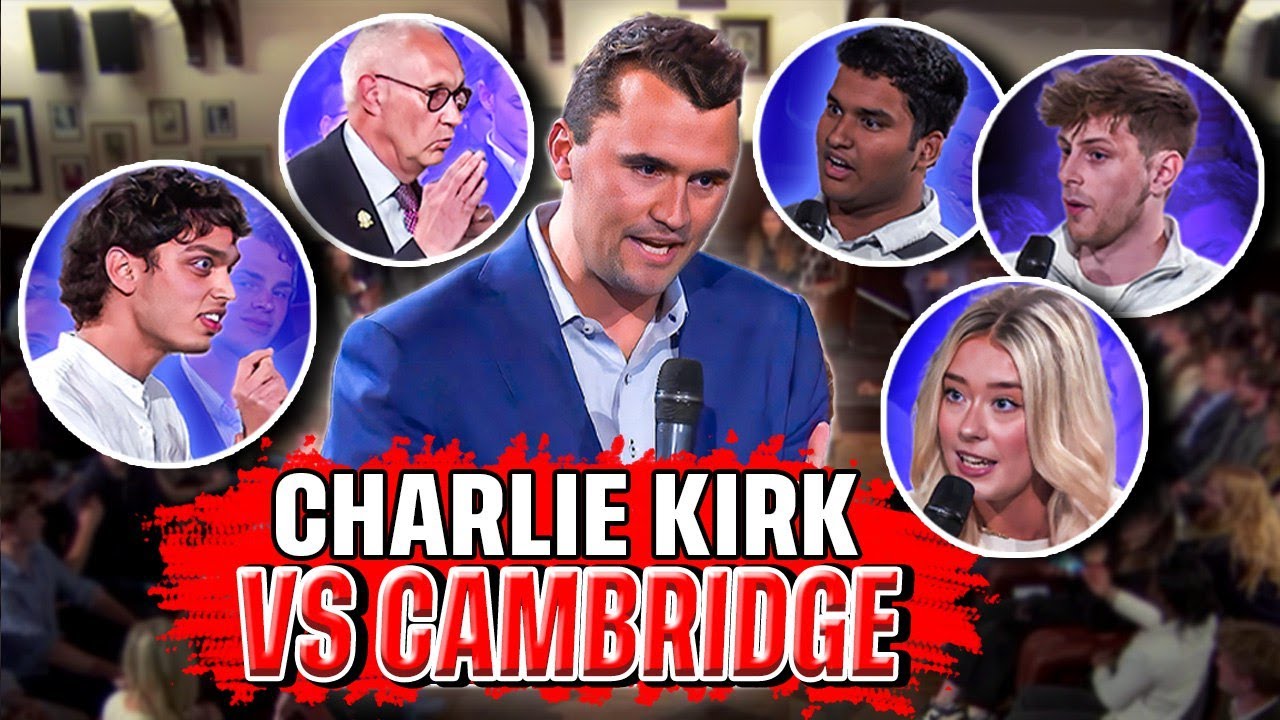
Charlie Kirk Defends Trump, Debates Abortion and Feminism at Cambridge Union in Heated Exchange
1:06:27

Brandon Tatum Reacts to Shooting at Charlie Kirk Event: Fear and Uncertainty Grip Conservative America
1:28:37

A Nation Mourns: Remembering Charlie Kirk After a Devastating Loss That Shook America
21:09
Related Books
Browse Conservative Books







Winston Marshall on the Assassination of Charlie Kirk and What It Reveals About America
Winston Marshall, host of the Winston Marshall Show, reflects on the tragic assassination of Charlie Kirk and the deeply troubling reactions that followed. Kirk, the figurehead of young conservative and MAGA movements in America, represented mainstream conservative thought. Marshall argues that the gleeful responses from Kirk's detractors, and the public celebration of violence, exposed a disturbing reality about ideological divisions in Western society. Drawing parallels to October 7th, Marshall explains how moments like these reveal who our neighbors truly are and force us to confront the anti-Western ideology that celebrates such tragedies. This conversation explores free speech, political violence, media activism, and the cultural battle for civilization itself.
Charlie Kirk: The Face of Young Conservative America
Winston Marshall, recently returned from America, shared his perspective on the assassination of Charlie Kirk, describing Kirk's opinions as "mainstream conservative thought in America." Kirk was not merely a voice for older conservatives but served as the figurehead of the young conservative movement and the young MAGA movement. Marshall emphasized that Kirk represented ideas that resonated across generations within American conservatism.
The tragedy, Marshall explained, was compounded not just by the horrific nature of the assassination itself, but by the reactions that followed. People across social media witnessed how Kirk's detractors responded with glee and happiness. This reaction horrified many ordinary people—"normies" who don't typically pay close attention to politics—and forced them to see their friends and neighbors in a new light.
Free Speech Reveals Who We Are
Marshall pointed to an important dimension of free speech that this tragedy illuminated: the ability to see what other people are truly thinking. He drew a parallel between September 10th, 2025, and October 7th, 2023, when celebrations erupted in London following the attacks in Israel—even before Israel had responded. These celebrations of violence revealed the true nature of those participating.
"It's helpful to see who your neighbors were because it helps us to understand how best to act next," Marshall explained. The public celebration of Kirk's death raised a fundamental question: how can there be reconciliation or compromise with people who are gleeful about such violence? Marshall argued that these reactions demonstrate a group of people who "don't want the same future as us" and who "want to tear this all down."
Statistics on Political Violence and Justification
Marshall addressed the tendency to compare right-wing violence with left-wing violence, acknowledging that violence exists at both extremes. However, he pointed to a crucial difference revealed in recent polling data. According to Marshall, a recent poll showed that among those who identify as left of center in American politics:
- 48% believed that the murder of Elon Musk was somewhat justifiable
- 55% believed that the murder of Donald Trump was somewhat justifiable
"That means the majority of those who are left or center in politics think in some circumstances murder is okay, that violence is okay," Marshall stated. He emphasized that these attitudes do not play out the same way on the right, representing "a completely different story."
Marshall concluded that society is now awake to what it faces, thanks to free speech allowing people to see these attitudes openly expressed.
A Vigil Interrupted by Hostility
Marshall recounted his experience at a vigil for Charlie Kirk in Washington Square Park in New York City two nights prior. About 30 people gathered in the evening darkness—some young students, some crying, holding candles. A small choir and string section played and sang hymns as mourners grieved together.
Halfway through the vigil, Marshall described how "like demons," several black-clad individuals appeared, smiling and filming the mourners' faces. They then began shouting "He was a fascist" before backing up and chanting "Free, free Palestine."
Marshall connected this seemingly random invocation of Palestine to a broader ideological framework: "They don't want free Palestine from Hamas. They want free Palestine from Israel. They're not pro-Palestine. They're pro-Hamas. That's exactly what's going on. It's part of the same ideology. It's anti-Western. It's anti-British. It's anti-American. They wanted to tear down everything that Charlie was about."
Charlie Kirk's Approach to Conversation and Ideas
Marshall shared his personal experience appearing on Charlie Kirk's show multiple times. Even when they disagreed, Marshall described the conversations as great because they were able to go deeper on issues and "chiseled each other's ideas." Looking back at messages exchanged with Kirk, Marshall noted that even in disagreement, Kirk was "so curious" and wanted to understand different perspectives, asking "Why do you think that way? What am I missing?"
"He came at it with total humility," Marshall reflected. While acknowledging that Kirk might have been "a little bit more pugilistic" in his college campus debates, Marshall emphasized that anyone who saw Kirk on his show or in private saw a different person than the caricature his detractors created. Much of what Marshall saw circulating on social media about Kirk—including statements from figures like Alastair Campbell—was simply not true. Some, like author Stephen King, had to backtrack after taking things out of context.
Media Activism Disguised as Journalism
Marshall argued that the tragedy exposed not just neighbors but also the media class. He noted the stark difference in how media figures respond to different types of violence. When far-right violence occurs—Marshall cited January 6th as an example—there's no "what-aboutism" from media commentators regarding BLM riots or the 25 people killed during those events. But when violence comes from the left, suddenly these same voices engage in exactly that kind of deflection.
"These are not journalists. They're political activists," Marshall declared. "And this is another thing that this heinous assassination has exposed to us."
The conversation revealed how certain members of the cultural and media class absorb information: they take snippets that seemingly fit whatever narrative they've been told—in this case, that Kirk was a "far-right white supremacist"—and they're willing to spread misinformation based on that preconception.
A Turning Point for Western Civilization
Marshall acknowledged the irony of using the term "turning point"—the name of Kirk's organization—but argued that this moment represents exactly that. The question facing society now is how to move forward when one side has revealed such willingness to celebrate violence and murder. The gleeful reactions expose people who are fundamentally opposed to the foundations of Western civilization that Kirk championed.
The tragedy, Marshall suggested, has clarified the stakes of the current cultural and political battle. Free speech has allowed everyone to see clearly what ideologies and attitudes exist in society, and that clarity—however painful—is essential for understanding how to act next.
Video Transcript
[00:00] Joining me now is the host of the
[00:02] Winston Marshall show, Winston Marshall
[00:04] himself. Hello, Winston. Welcome to the
[00:06] show. Thank you for joining us. You've
[00:08] just flown in from America. You've been
[00:11] there these last few days. What was the
[00:14] response when this tragedy happened?
[00:16] Well, perhaps we can just go straight to
[00:19] what I think the the significance of
[00:20] this heinous assassination is. Charlie's
[00:24] opinions were mainstream conservative
[00:27] thought in America. Not just of the
[00:29] boomer generation, but also of young
[00:32] conservatives in America. In fact, he
[00:33] was the figure head of the young
[00:35] conservative movement, of the young MAGA
[00:37] movement. It wasn't just the horrific
[00:40] assassination that we all saw on social
[00:43] media. It was the reaction to it. We saw
[00:47] how his detractors, those who have
[00:50] vilified him, reacted with glee, with
[00:53] happiness. And not only did we see it, a
[00:56] lot of normal people, a lot of normies,
[00:58] a lot of people who don't normally pay
[00:59] attention to politics didn't just see
[01:01] the murder, they also saw how their
[01:04] friends and neighbors were reacting to
[01:06] that ner murder. And it's and it
[01:08] horrified them. It made them understand
[01:11] exactly what was going on around them.
[01:13] And actually this is maybe the
[01:14] significance of free speech. One of the
[01:16] other important parts of free speech. We
[01:18] can see what other people are thinking.
[01:20] And and I think this is a similar
[01:22] moment. September 10th, 2025 is a
[01:24] similar moment to October 7th, 2023
[01:26] where here in London, I remember seeing
[01:28] as soon as October I think October 8th
[01:30] maybe. Celebrations. Israel had not
[01:33] responded. celebrations of what had
[01:35] happened on October 7th in Israel, that
[01:38] pogram, that horrible pogram of the the
[01:40] the heinous uh uh violence and and and
[01:44] murder we were seeing then. We saw who
[01:46] our neighbors were. And actually, it's
[01:49] helpful to see who your neighbors were
[01:50] cuz it helps us to understand how best
[01:52] to act next. And I think what will what
[01:56] would transpire is that we're at a point
[01:59] now and I I don't want to use the the
[02:02] term turning point because that was the
[02:04] name of his organization but it seems it
[02:06] is a turning point because when people
[02:08] act this way how exactly are we supposed
[02:10] to be reconciliatory with them if we
[02:12] know how gleeful they are in such times
[02:16] how exactly are we supposed to form any
[02:18] sort of alliance any sort of compromise
[02:21] to build they don't want the same future
[02:22] of us as They want to tear this all
[02:24] down. We saw this. In fact, this
[02:26] actually plays out in statistics because
[02:28] a lot of people are comparing right-wing
[02:30] violence with leftwing violence. And I
[02:32] think it's it's pretty clear that at
[02:34] both extremes, I hate to do what
[02:36] aboutism, but at both extremes, there is
[02:39] a lot of violence that that goes on. But
[02:41] what's the difference I think between
[02:42] the right and left? And and this is
[02:44] there's a recent poll that shows this in
[02:47] America. Those who identify as left of
[02:51] center in politics, this is a recent
[02:53] poll, 48%
[02:55] said they believed that murder of Elon
[02:58] Musk was somewhat justifiable. 55% said
[03:02] murder of Donald Trump is somewhat
[03:05] justifiable. That means the majority of
[03:07] those who are left or center in politics
[03:09] think in some circumstances murder is
[03:12] okay, that violence is okay. That's not
[03:14] that doesn't play out at all on the
[03:16] right. It's a completely different
[03:18] story. So, we're really now awake. And I
[03:22] I I sound awfully woke saying that,
[03:24] saying we're awake, but we're we now see
[03:26] because of free speech, we now see what
[03:29] we're facing. Yeah. I mean, those
[03:31] statistics, but also their gleefulness
[03:34] in that reaction. I guess it speaks to
[03:37] the most incredible thing here is how
[03:39] how proud they are with their opinion.
[03:43] How they're not ashamed by any means by
[03:45] by actually the fact that they think
[03:47] that they're going to be celebrated
[03:49] within their bubble for having these
[03:53] terrible reaction.
[03:54] It's I was two nights ago I was at a
[03:56] vigil for Charlie in Washington Square
[03:59] Park in New York City. There was
[04:01] probably about 30 of us. It was evening
[04:03] time. It was getting dark. There were
[04:05] some young students there. Some were
[04:07] crying. Some had candles. Uh there was a
[04:10] a little choir. There was a string
[04:11] section playing hymns and and singing
[04:14] hymns and mourning him. And and really
[04:17] there was a lot of grief for these these
[04:19] some of the kids were really upset. And
[04:21] about halfway through like demons,
[04:25] some some couple of guys blackclad came
[04:28] in smiling like this, coming up into our
[04:31] faces, filming us, going like this, and
[04:33] then started shouting. He was a fascist.
[04:35] I mean, they were acting like demons and
[04:37] then they backed up and said free, free
[04:38] Palestine as if that had anything to do
[04:41] with what Charlie Kirk was about. What
[04:43] on earth? But then actually it makes
[04:44] sense because it's all part of the same
[04:46] ideology. This they say free Palestine.
[04:48] They don't say they don't want free
[04:49] Palestine from Hamas. They want free
[04:51] Palestine from Israel. They're not uh
[04:53] pro Palestine. They're they're pro-
[04:55] Hammad. That's exactly what's going on.
[04:56] It's part of the same ideology. It's
[04:58] anti-western. It's anti-British. It's
[05:00] anti-American. They wanted to tear down
[05:03] everything that Charlie was about. Not
[05:04] because he was pro- free speech. They
[05:06] didn't care about that. It's because of
[05:07] his ideas which are fundamentally pro-
[05:11] our civilization.
[05:13] Yes. But I guess that argues the
[05:15] opposite of what I was saying, which is
[05:16] that um that that what the one of the
[05:19] foundations of our civilization of
[05:21] course is this idea of free speech that
[05:23] he embodied so well. And when you watch
[05:26] these clips that have sort of they've
[05:29] they've been on social media for a long
[05:30] time now, but they've just absolutely
[05:32] been pushed out there these last few
[05:34] days, but how he was so willing to talk
[05:37] to everybody and how um how scared
[05:42] people must be that that he was willing
[05:44] to go out there and express these ideas.
[05:46] Do you think that the fact that they're
[05:48] so willing to go to murder and celebrate
[05:51] it just shows how they're just how
[05:53] afraid they are, how rubbish their ideas
[05:55] are, frankly.
[05:55] Yeah, clearly that's obviously the case.
[05:57] Look, I um had the at this privilege of
[06:01] going on Charlie's show a couple of
[06:03] times and we disagreed and and I'm going
[06:06] to have to dig up these old clips when
[06:07] we dis disagreed about a couple of
[06:09] things, but it was such a great
[06:12] conversation cuz we able to go deeper on
[06:14] the things. We we both chiseled each
[06:16] other in our ideas uh chiseled ideas
[06:18] rather and I even looked back at some of
[06:21] my messages with him again. We were
[06:23] disagreeing on stuff but he was so
[06:24] curious. He wanted to understand he
[06:26] pushed me why do you think that way?
[06:28] What is it? What am I missing? His he
[06:30] came at it with total humility. Now it
[06:33] might be the case that in some of those
[06:34] debates you see on college campuses that
[06:37] he was a little bit more pugilistic and
[06:38] that's the kind of nature of it. that if
[06:40] you see him on his show, if you see him
[06:42] in private, you see a different Charlie
[06:45] this the the his detractors only saw the
[06:48] very worst of him. And perhaps the most
[06:50] viral things they they might not even be
[06:53] true about him.
[06:53] Well, the lot of stuff I'm seeing on on
[06:55] on X that have been said about him, like
[06:58] what Alistister Campbell said, just was
[06:59] not true. And so they've they've
[07:01] misportray with Stephen King and they've
[07:03] had to backtrack because they've taken
[07:05] something out of context. Doesn't that
[07:07] also reveal how information has been
[07:10] absorbed by certain members of our kind
[07:12] of cultural media class where they just
[07:14] will take a snippet and if that
[07:16] seemingly fits with whatever they've
[07:18] been told this guy is a far-right white
[07:21] supremacist then that's what they're so
[07:23] willing to spread.
[07:24] As well as exposing our neighbors, it's
[07:27] also exposed the media classes. It's not
[07:29] just these these types who who have
[07:31] behaved this way jumped to conclusions
[07:33] but I note when there's let's say a
[07:36] incident of farright violence let's say
[07:40] Jan sik for example we don't hear
[07:42] Louisis good suddenly going what about
[07:44] the BLM riots what about all the
[07:45] far-left what about the the 25 people
[07:48] killed in the BLM right so they don't do
[07:49] any what abouty then but now they're
[07:51] doing it now that well there's left
[07:53] there's there's violence from the left
[07:55] as well you know it's not just from from
[07:57] one side we These are not journalists.
[07:59] They're political activists. And and
[08:01] this is another thing that this heinous
[08:04] assassination has has exposed to us.
[08:07] Yeah. Well, look, it's been a terrible
[08:09] week. I'm very grateful to you coming to
[08:11] join us and give us your perspective.
[08:12] Ladies and gentlemen, big round of
[08:13] applause, please, for Windsor Market.


Comments
Be the first to comment on this video.