2,387 videos 1,376,944,188 views US Joined Aug 30, 2018
Charlie Kirk is the Founder and President of Turning Point USA, the largest and fastest growing conservative youth activist organization in the country with over 250,000 student members, over 150 full-time staff, and a presence on over 2,000 high school and college campuses nationwide. Charlie is also the Chairman of Students for Trump, which aims to activate one million new college voters on campuses in battleground states in the lead up to the 2020 presidential election. His social media reaches over 100 million people per month and according to Axios, he is one of the "top 10 most engaged" Twitter handles in the world. He is also the host of “The Charlie Kirk Show,” which regularly ranks among the top news shows on Apple podcast charts.
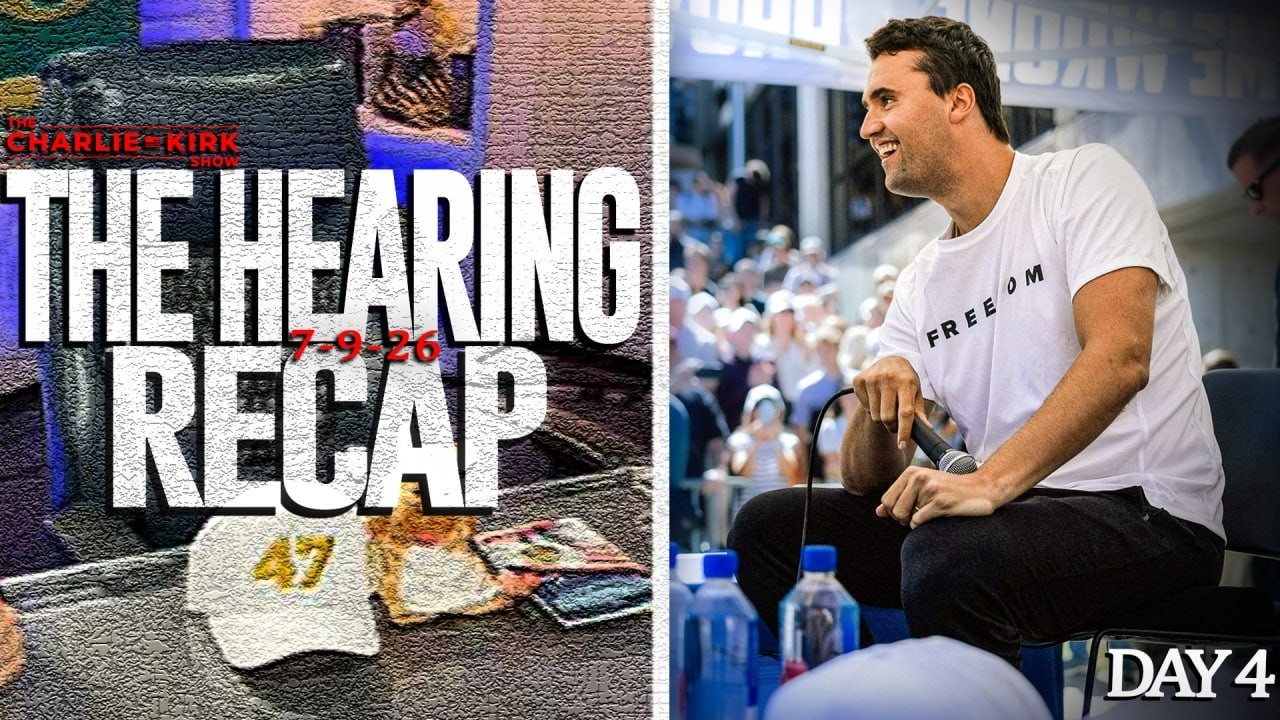
Andrew Kolvet Recaps Tyler Robinson Preliminary Hearing Day Five: Enhanced Video Shows Shooter in Prone Position Taking Fatal Shot at Charlie Kirk
Andrew Kolvet leads a comprehensive recap of the final day of Tyler Robinson's preliminary hearing in Utah, joined by Steve Deace and Jack Posobiec who witnessed the enhanced surveillance footage firsthand. The enhanced video, shown only in the courtroom, reveals crystal-clear footage of the shooter assembling a rifle, running across the rooftop, taking a prone position, and firing the shot that killed Charlie Kirk at 12:23:28. Witnesses describe the footage as "the most damning piece of evidence" in the case, showing Tyler Robinson's face, vehicle license plate, and every movement in stunning clarity. The Kirk family, Erika, Rob, and Kathy, watched the enhanced video and broke down as they witnessed Charlie's final moments. The family's legal representative filed a motion urging Judge Tony Graf to issue a probable cause determination by September 1, 2026, noting they are approaching the one-year anniversary of Charlie's death without resolution.
The preliminary hearing for the State of Utah versus Tyler Robinson concluded with what multiple witnesses described as the most damning evidence yet: enhanced surveillance footage showing the shooting of Charlie Kirk in crystal-clear detail. Andrew Kolvet recapped the proceedings alongside Steve Deace from The Steve Deace Show and Jack Posobiec from Human Events Daily, who was present in the courtroom.
After the defense finished questioning their final DNA witness from the ATF, Judge Tony Graf allowed the Kirk family to view enhanced, zoomed-in surveillance video from Utah Valley University. The footage was not broadcast to the public but was shown to family members, legal teams, and members of the press in the courtroom.
Enhanced Video Reveals Shocking Detail
Multiple witnesses who saw the enhanced footage described it as transformative compared to the publicly available video. Jack Posobiec, who was in the courtroom, said the video quality "changes everything" and described watching it as "like watching Charlie die all over again."
The enhanced video shows a person believed to be Tyler Robinson walking across the Utah Valley University campus, going over a guard rail onto the rooftop of the Losee Center, crouching down to apparently assemble a rifle, running across the gravel roof, taking a prone shooting position, and firing at 12:23:28—the exact time Charlie Kirk was shot and killed.
According to KUTV reporter Heidi Hatch, who was also present, "Even zoomed in, the quality of the video is surprisingly high. You could see the man on the roof, reportedly Tyler Robinson, getting down into that prone position before the shot was fired." She added that the video showing Robinson returning to campus "shows that very distinct limp with the rifle likely in the leg of his pants."
Benny Johnson, another witness to the footage, reported: "Every moment, every movement of Tyler Robinson that day captured in full quality HD, zoomed in, some footage in 4K, tracking all his movements. You can see crystal clear Tyler Robinson's face, the license plate number on his vehicle, details on his clothing, and his actions on the rooftop."
Emotional Impact on the Kirk Family
The emotional toll on Charlie Kirk's family was evident throughout the viewing. Heidi Hatch described the scene: "As that came up on that video, that zoomed-in video, Erika Kirk breaking down in tears as well as Katherine, her mother-in-law, Charlie's mother, clinging to each other, hugging each other as that video played."
Benny Johnson added: "What the public couldn't see was the emotion in the courtroom. Charlie's family sobbing uncontrollably, Erika in Mrs. Kirk senior's arms, Charlie's father comforting them. Just feet away sat a pale, lifeless, emaciated Tyler Robinson who stared at the floor with no remorse as he listened to the weeping."
According to multiple witnesses, Robinson has never once looked at Erika Kirk during the entire preliminary hearing, and reportedly had his monitor turned off during the playing of the enhanced video, refusing to watch footage of his own alleged actions.
Defense's DNA Witness Backfires
Earlier in the day's proceedings, the defense called an ATF DNA section chief as a witness, but the testimony appeared to strengthen the prosecution's case rather than help the defense. When cross-examined by the state, the expert testified that DNA evidence found on key items was "at least one trillion times more likely" to have come from Tyler Robinson than from unrelated individuals.
The expert explained that the laboratory caps probability statistics at one trillion, meaning the actual likelihood could be substantially higher. She confirmed: "The probability of an unrelated individual in the population who has not contributed DNA to the sample yielding this level of support is less than one in a trillion."
Steve Deace, commenting on the defense's strategy, noted: "If you're trying to frame your own witness to the point that you're getting frequent objections against your own questions, then I think you can see the shaky ground the defense is on here because of just how overwhelming this evidence is."
Family Requests Prompt Resolution
Immediately following the conclusion of the preliminary hearing, the Kirk family issued a statement through their representative, Jeffrey Neiman: "The conclusion of the preliminary hearing marks an important step forward in the pursuit of justice for Charlie. Our family is grateful for the prayer, support, and kindness that has been extended to us, especially through these unimaginably painful next phases. We pray that truth will continue to be heard through a process that is fair, transparent, and grounded in the facts."
Nyman then filed a motion urging Judge Graf to issue a probable cause determination no later than September 1, 2026. The filing stated: "We are approaching the one-year anniversary of Charlie's assassination. Ten months have passed since the defendant's arrest and the five-day preliminary hearing has now concluded. The defendant is entitled to a fair trial and he must receive one, but he is not entitled to cause undue delay in the criminal justice process. The family is likewise entitled to a speedy resolution."
The filing referenced Utah code 77-38-7, which provides that "the victim of a crime has the right to a speedy disposition of the charges free from unwarranted delay caused by or at the behest of the defendant."
Concerns About Delays in Justice
The timeline of the case has raised concerns about whether the family will receive timely justice. The preliminary hearing was originally scheduled for May 2025 but was delayed until July 2025. Judge Graf has scheduled a hearing for September 1, 2026, which would extend the process beyond the one-year anniversary of Charlie Kirk's death.
That September hearing is expected to include at least four hours of oral arguments plus 35 pages of briefs from each side, potentially delaying a probable cause determination even further.
Steve Deace expressed frustration with the timeline: "This is very abnormal, the amount of time that it takes to get to this juncture. I can't imagine how the judge can possibly watch the family go through witnessing that and then say, 'But we're going to hold you off here for about two more months to try to get the first phase of closure.' We're way over that line. The Kirk family has deserved at least stage one of closure as soon as absolutely possible here."
Legal experts and observers noted the unusual length of the preliminary hearing process, especially given what many describe as overwhelming evidence.
Andrew Kolvet noted that he received messages from legal professionals who were "unrelated to the case, but they're watching it" expressing concern about the defense's strategy and its potential to "exasperate the judge" and "turn a jury off."
Evidence of Enhancements for Potential Death Penalty
Throughout the week, the defense fought to exclude what are legally called "enhancements"—aggravating factors that would justify seeking the death penalty in Utah. These enhancements require showing that the crime was politically motivated, endangered minors, or constituted a hate crime.
Despite defense objections, Judge Graf allowed the admission of a statement from David Englehart, a Turning Point USA board member, explaining the organization's mission and detailing how deeply Charlie Kirk's Christian faith was integrated into his political positions, particularly on issues like transgender ideology.
Additional evidence supporting enhancements includes text messages from Robinson stating "Some hate just can't be negotiated out. I had enough of his hate," as well as bullet casings engraved with "Bellachow" (an Italian anti-fascist song) and "Hey Fascist Catch."
Overwhelming Physical and Testimonial Evidence
Beyond the enhanced video and DNA evidence presented on the final day, the week-long preliminary hearing revealed extensive physical evidence linking Tyler Robinson to the shooting:
Confession to Lance Twiggs, who testified that Robinson admitted to the shooting both in text messages and in person while crying
Recovery of a burned note that Robinson had referenced in text messages
Robinson's distinct limp visible in footage, consistent with concealing a rifle in his pants
Forensic evidence matching bullets and casings to Robinson's rifle
Surveillance footage tracking Robinson's movements throughout the campus before and after the shooting
Text message evidence showing premeditation and political motivation
Steve Deace emphasized the strength of the evidence: "We've had murder convictions of people who were definitely guilty where they don't have a body. We don't have a body, we don't have a murder weapon. You just have overwhelming contextual circumstantial evidence. And here we have that. And we also have the confession, the weapon, the parents turning over evidence, the video, everything."
Shift in Public Perception
The week's proceedings appeared to mark a turning point in public opinion, with numerous social media users expressing regret for having believed alternative theories about Charlie Kirk's death.
One representative comment stated: "I would like to admit I drank some of the Candace Kool-Aid and now I feel so gutted for ever believing Erika had anything to do with it."
Another wrote: "I watched several of Candace's podcasts. I was one of the people who believed Israel was somehow involved. It was extremely convincing and I do not blame anyone for believing it as I did. Lesson learned to wait for actual evidence. I will never make this mistake again. I regret it and I stand with Erika."
Even Sean Strickland, an MMA fighter known for controversial views, issued an apology for having promoted alternative theories about the case.
Donald Trump Jr., who visited the courtroom earlier in the week with Erika Kirk, stated publicly that after seeing the evidence, it was "very clear that Tyler Robinson is absolutely guilty."
Addressing Conspiracy Theories and Trust in Institutions
The panelists discussed the broader implications of the case for public trust and the spread of conspiracy theories. Steve Deace acknowledged the legitimate reasons for skepticism of institutions while drawing a distinction between healthy questioning and harmful conspiracy mongering.
"A lot of our institutions are deserving and have worked hard to earn all this skepticism that has been pent up over the last few years," Deace said. "The question is where do we go for answers. It would be one thing if these people were just going to question the official narrative. The other thing to try to shift the guilt of this crime even to Charlie's widow herself, even as this evidence mounts, is just particularly reprehensible and despicable and just wicked and evil."
He added: "There's a thing called cynicism which is against a biblical worldview. If your worldview begins with the premise that God supernaturally intervened in human history to raise a dead man to life, then cynicism is not permitted for the believer. But there's healthy skepticism when you are in a time, in the age of the judges like we are now, when everyone does what is wise in their own eyes."
The Role of Evidence vs. Speculation
The discussion emphasized the importance of waiting for evidence rather than rushing to judgment based on speculation or political bias. Andrew Kolvet noted: "I totally understand that sometimes giving proper scrutiny to an official narrative is the right position to take. But there is a huge difference between that and then turning around and recklessly accusing innocent people of wrongdoing, of heinous evil acts when the evidence is right in front of you."
Steve Deace shared his approach to covering controversial topics: "When I wrote two bestselling books debunking the COVID narrative, I didn't offer alternative theories or projections. I interviewed witnesses. I looked at data and facts. I didn't just wing it because I didn't want to get sued by Anthony Fauci and everybody else. So I used often their own data against them, their own assumptions against them."
He continued: "We don't really have to all be in a hurry to be wrong. There's going to be a process and it's going to be somewhat transparent and we're going to get answers and you don't have to look like a clown when it's all over. You can just say, 'You know what, I kind of just want to wait and see what the evidence says.'"
Path Forward for Those Who Spread False Theories
The panelists discussed what accountability should look like for those who promoted conspiracy theories about Charlie Kirk's death and baselessly accused Erika Kirk and others of wrongdoing.
Steve Deace invoked Christian principles while acknowledging the harm done: "All three of us represent a worldview that makes it very clear that mercy triumphs over judgment. For those who have sincerely want to come forward, sincerely want to apologize, sincerely want to repent, first and foremost apologize to Erika and the entire family. I think they deserve an honest hearing in terms of the integrity and the sincerity of that apology and that repentance. But forgiveness and trust are not necessarily the same thing."
Blake Neff added: "There's room for people to come back on side. There's room for people to say, 'I goofed it up.' But I do think we need some perspective. If you're a voice, if you have a platform, you have a moral obligation to show good leadership. The evidence in this case was so clear for so long and so all-encompassing that if a person who had a platform is going to come back, I think there has to be some expectation of not merely acknowledging that they were incorrect, but they have to apologize and say I made a moral mistake in going this far down and I have to try to atone for that."
Charlie Kirk's Legacy and the Movement He Built
The discussion touched on the broader impact of Charlie Kirk's death and the memorial service that followed, which Steve Deace described as "the most viewed proclamation of the gospel that this world has ever seen."
"Coming out of that memorial was the first time I thought there was a real chance we might be able to unite around first principles as believers," Deace reflected. "I'd be willing to bet that Don Jr. told more people about who Stephen was than they've heard in the American church anywhere, Catholic or Protestant, the last 30 years. More people came out of that with more church and more Bible than they have from any singular event in the history of this hemisphere."
Deace suggested that the subsequent wave of conspiracy theories was a deliberate spiritual attack: "I don't think it's any coincidence at all that the enemy said, 'Oh snap, can't let that happen,' and mobilized as fast as he could."
When asked about rebuilding the coalition Charlie Kirk had built, Deace emphasized the need for closure in the legal case first: "I think we're going to have a hard time answering that question until there's a more definitive outlook on the outcome of this case. What's opened up the fissure of what he was holding together is his death and the aftermath of it. I think the certainty of what caused that death and then the outcome for Tyler Robinson is the first step in letting a lot of people—you can already see just from the volume of notes you guys are getting—the amount of people who are coming in from like a fog, from like a spiritual malaise that is clearing up now. Like a spell has been broken here."
Next Steps in the Legal Process
The case now awaits Judge Graf's probable cause determination, which the Kirk family has requested be issued no later than September 1, 2026. If probable cause is found, the case will proceed to a full trial where a jury will determine Tyler Robinson's guilt or innocence.
Given the strength of the evidence presented during the preliminary hearing, legal observers suggest the defense may be focused primarily on avoiding the death penalty rather than securing an acquittal.
The enhanced surveillance footage, while shown in court, has not yet been released to the public. However, witnesses expect it will eventually become public record, likely during trial proceedings.
Andrew Kolvet closed the recap by noting the historical significance of the week's proceedings: "This is a really important week. We're going to look back on it and think of it as a really important week."