Andrew Wilson Dismantles Candace Owens' Claims About Charlie Kirk's Death in Heated Debate
Enjoying this? Share it with someone who needs to see it.
Up Next
Candace Owens Reveals Exclusive 4K Photos From Tyler Robinson Case That Challenge Official Narrative
55:43
Andrew Wilson Caught in Multiple Lies During Candace Owens Debate on Charlie Kirk Case
31:30
Officer Tatum Breaks Down FBI Director Kash Patel's Interview on Charlie Kirk Murder Investigation and Evidence
15:54
Andrew Wilson Dismantles Candace Owens' Claims About Charlie Kirk's Death in Heated Debate
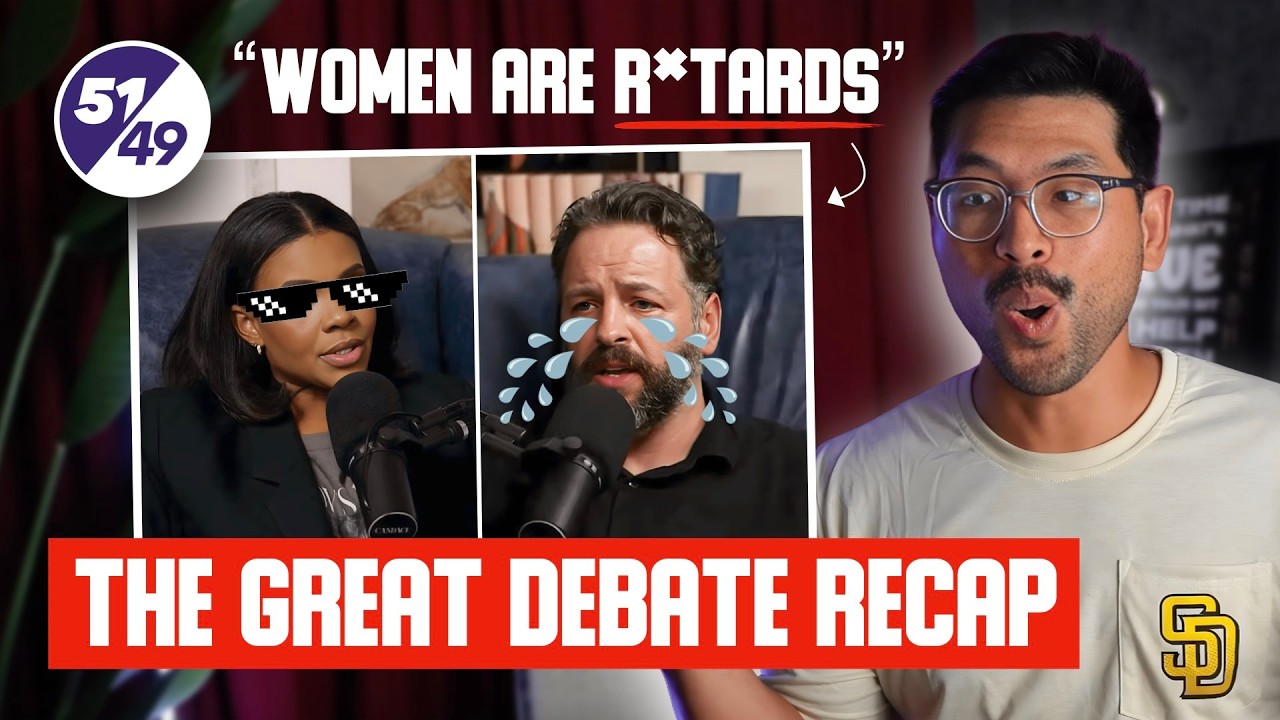
Andrew Wilson systematically challenges Candace Owens' conspiracy theories surrounding Charlie Kirk's death, exposing contradictions in her claims about Israeli involvement, TPUSA complicity, and Erika Kirk's alleged participation. During this detailed examination, Owens repeatedly backs away from her most serious allegations, admits she lacks concrete evidence, and refuses to directly state whether she believes anyone in TPUSA facilitated Kirk's murder. Wilson demonstrates through legal analysis and direct questioning that Owens' case relies on inference and speculation rather than facts, while she simultaneously misunderstands basic legal procedures like preliminary hearings versus trials. The exchange reveals a pattern of making inflammatory public claims without the evidence or courage to stand behind them when challenged.
Andrew Wilson opened this examination with a direct challenge to Candace Owens: does she actually believe that anyone in TPUSA, Erika Kirk, or others participated in, had foreknowledge of, or facilitated the murder of Charlie Kirk? Owens' response was telling: "I'm not going to get myself into a legal pickle here." This refusal to commit to her own implications became the foundation of Wilson's criticism throughout the debate.
Wilson made his position clear from the start: Owens had nothing. No solid evidence. No positive proof of Israeli involvement, French involvement, TPUSA involvement, or Erika Kirk's participation in anything related to Kirk's death. When pressed on her claims about Erika Kirk specifically, Owens retreated to "it's just for fun" before quickly pivoting to suggest she does think questions need to be answered, but couldn't articulate what those answers might be.
The Israeli Connection Claims
Owens attempted to build a case for Israeli involvement by citing several pieces of circumstantial information. She mentioned that someone had noted there were 12 Israeli cell phones detected at the location that day, suggesting this warranted investigation. She acknowledged these could have been Israeli students in Utah but insisted the narrative needed probing.
She also referenced what she called a "weird" phone call in the Hamptons around August 5th or 6th, and claimed the Israeli government and prime minister's denial of involvement was suspicious and "wasn't really necessary." According to Owens, the way Israel was immediately inserted into the narrative felt forced, including a photo posted to the president's feed showing Kirk with American and Israeli flags.
When Wilson pressed her for positive evidence that Israel killed Charlie Kirk, Owens couldn't provide it. She admitted she couldn't say "Israel was on the ground and shot and killed Charlie Kirk." Instead, she focused on establishing motive, rejecting the Tyler Robinson theory as unconvincing since she didn't believe Kirk was deeply invested in LGBTQ issues, noting he ate at Chick-fil-A and that Lance Twiggs testified they never discussed LGBTQ issues.
Despite these admissions, Owens had previously stated with "full confidence" that she believed France and Israel were involved in Charlie Kirk's assassination. When confronted with this contradiction, she appeared to walk back the certainty of her claims.
Misunderstanding Legal Procedures
A significant portion of the debate centered on Owens' misunderstanding of preliminary hearings versus trials. Owens criticized the prosecution for not presenting what she considered sufficient evidence, demanding to see "the smoking gun" and questioning why certain details weren't being revealed.
Wilson brought in expert analysis explaining that Owens had "got it exactly backwards." A preliminary hearing in Utah is designed to determine if there's enough probable cause to take a case to trial, not to present the entire case with every detail. The prosecution only needs to show enough reason to proceed, presenting just enough to overcome a very low hurdle.
The expert clarified that prosecutors deliberately don't present every piece of evidence at this stage because they must share everything with the defense through discovery, and they don't want to tip their hand completely before trial. The defense will have opportunities to impeach witnesses, question credibility, and challenge evidence during the actual trial, but that time hadn't come yet.
Owens was exploiting this procedural reality to suggest the prosecution had a weak case or was "concocting something," when in fact the limited presentation was standard legal strategy. The expert emphasized: "You may want to see the smoking gun now, but they're waiting for the 12 jurors to give them every little piece of detail."
The Hearsay Confusion
Another legal misunderstanding emerged around Rule 1102 and the admissibility of hearsay. Owens argued that the entire preliminary hearing was based on "reliable hearsay," suggesting this validated her approach of presenting inference as evidence.
She claimed that just as the state was "inferring" from evidence, she had the right to extrapolate from facts. She used an example of inferring that Tyler Robinson might have been set up based on fingerprint evidence showing his prints were "the most degraded."
Wilson countered that not all hearsay is admissible and that preliminary hearings allow certain evidence because they're meant to be probative. However, Owens was conflating the legal standards applied to state prosecutions with the standards she should meet when making public accusations. The issue wasn't that she was asking questions or examining evidence, but that she was making definitive claims without supporting evidence.
The Text Message Evidence
Owens presented what she called "never before seen messages" from Charlie Kirk to his security team on September 9, 2025. In these messages, Kirk's security team informed him that law enforcement had agreed to the security plan and that campus police would provide coverage. Kirk responded: "Okay, great. Remind them that they are there for one person's security only because I'm somewhat worried the left is trying to kill me."
Owens presented this as concrete evidence supporting her position. However, Wilson pointed out that this wasn't concrete at all because the defense hadn't had a chance to examine or authenticate these messages, and there were questions about the phone's condition (it was described as "cracked").
This exchange highlighted a pattern throughout the debate: Owens would present something as definitive proof, Wilson would point out why it wasn't definitive, and Owens would shift to saying she was merely asking questions or presenting possibilities.
Attacks on Erika Kirk
Despite claiming she avoided "pettier things," Owens did comment on Erika Kirk's appearance and clothing choices. She mentioned people talking about "her outfit, her wearing the glitter pants and things like that," acknowledging it "does kind of build a profile of somebody." She added that she personally thought "her stylist just deeply dislikes her, whoever it is deeply dislikes her."
When Wilson directly asked if Owens believed Erika Kirk participated in, had foreknowledge of, or facilitated her husband's murder, Owens again refused to commit, citing concerns about getting into a "legal pickle." Wilson pointed out the hypocrisy: Owens wouldn't state these beliefs directly, yet her supporters with smaller platforms were making these exact claims based on her content.
"All the people out there with YouTube channels, your theories she won't back up because she says she won't get in a legal pickle," Wilson observed. "She doesn't have the courage that you do on your profile. She won't do it. You need someone better."
The Tyler Robinson Theory
Owens dismissed the prosecution's theory that Tyler Robinson killed Charlie Kirk over LGBTQ issues. She found it unconvincing that Robinson, described as having a "trans furry" identity, would kill Kirk over these issues when Lance Twiggs testified they never discussed LGBTQ topics, and Kirk had stopped to eat at Chick-fil-A, which she suggested someone truly passionate about LGBTQ issues wouldn't patronize.
However, Wilson and others pointed out that Owens was ignoring substantial evidence in the case. The fingerprint evidence, text messages, and even the father's admission when questioned that his son did it and he advised him to speak to a youth pastor all pointed toward Robinson's guilt.
Owens attempted to dismiss each piece of evidence: fingerprints weren't conclusive because Robinson's weren't "the most notable," text messages weren't reliable because they came from a cracked phone, and the father's admission was questionable because he didn't come forward voluntarily. Yet Wilson noted that none of these facts were actually in dispute, even by Owens herself when pressed.
Sources and Credibility
Throughout the debate, Owens referenced unnamed sources who had provided her with information. When questioned about what validated these sources, she pointed to footage and information she had released. Wilson challenged this circular reasoning: releasing some footage doesn't validate unrelated claims from the same sources.
This became emblematic of Owens' approach throughout the examination. She would make sweeping claims based on unnamed sources or personal interpretation, but when asked to provide the underlying evidence or explain her reasoning, she would retreat to vaguer positions or admit she couldn't prove her assertions.
The Champion Who Won't Stand
Wilson's most pointed criticism was that Owens positioned herself as a champion for people questioning the official narrative, yet she lacked the courage to stand behind her own implications. While smaller content creators were making definitive claims about TPUSA and Erika Kirk's involvement based on Owens' content, Owens herself wouldn't commit to these positions when directly challenged.
"Either she doesn't know or she's a coward and you need a better champion," Wilson stated. "These are all things that I'm not even disputing. We never get to the thing that I am disputing."
Wilson emphasized that he wasn't opposed to conspiracy theories in principle. The federal government has hundreds of thousands of laws about conspiracies because they're real and common. The problem arose when Owens made claims beyond "just asking questions" or "examining evidence," asserting there was good reason to believe certain theories, only to back away when the evidence was cross-examined.
The Debate's Aftermath
Wilson acknowledged that audiences would be divided. PBD's crowd largely thought Owens won the debate, while Wilson's audience would likely see it differently. He recognized that people come to these discussions with existing biases that are difficult to overcome.
However, Wilson believed the debate marked "the beginning of a snowball effect." By challenging Owens directly and getting her to admit she lacked evidence for her major claims, he hoped other creators promoting similar theories would feel compelled to defend their positions in similar forums. This, he suggested, would create accountability and help separate legitimate questions from baseless speculation.
The fundamental issue Wilson identified was simple: Owens had made numerous serious allegations but, when given the opportunity to present her evidence, "she just admitted that she didn't have any evidence for anything." She went back on her claims, couldn't support her sources, and refused to stand behind the implications of her own content.
"What made this an easy debate for me was that she didn't have nothing," Wilson concluded. "She literally had nothing. And so what do you want me to do?"