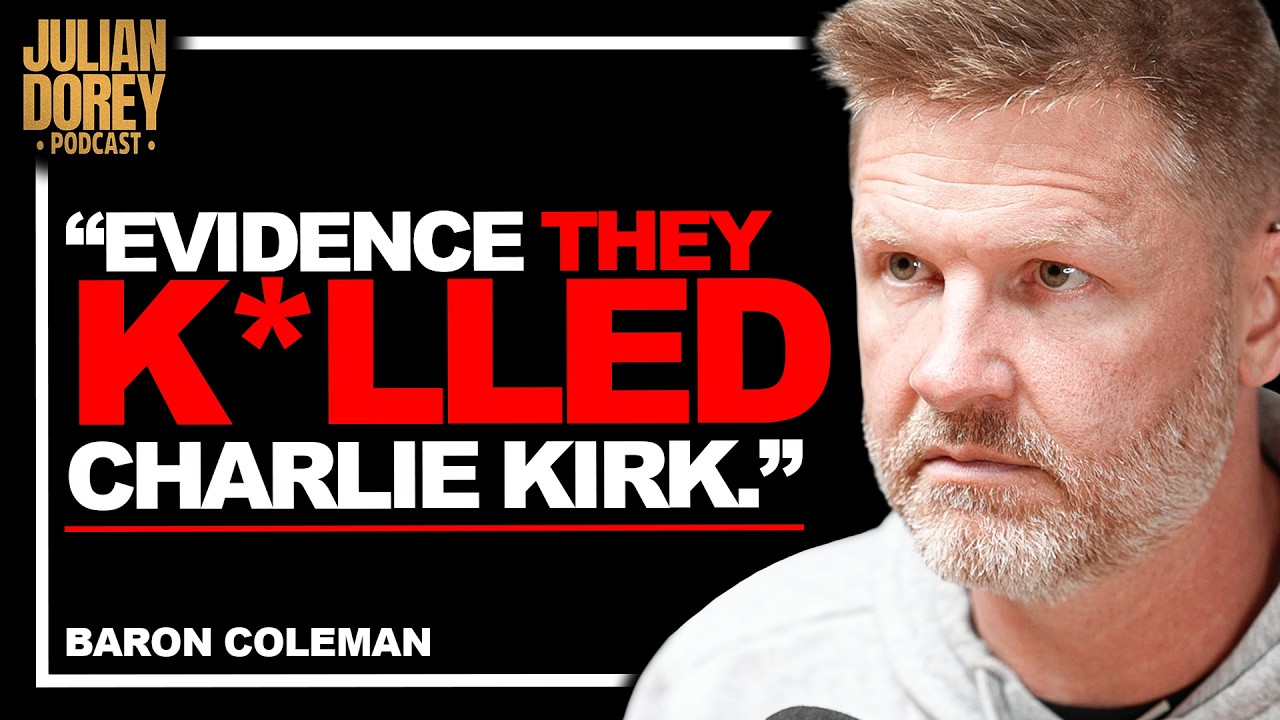
[00:00] Between zero to 100, what is the
[00:02] likelihood that you think Tyler Robinson
[00:03] shot Charlie Kirk and killed him?
[00:05] >> Based on the evidence right now, um, I
[00:08] don't know. I'd say 75 85%.
[00:10] >> Candace,
[00:12] >> 0%.
[00:13] >> 0%.
[00:13] >> I'm at zero. So, with what we've seen in
[00:15] terms of the evidence, I'm at 0%.
[00:17] >> So, not not only, you know, that maybe
[00:20] somebody was behind him as a pathy
[00:22] influencing him, you're not even saying
[00:23] that he didn't even shoot Charlie Kirk,
[00:25] >> right? I would if you said was he
[00:26] involved that day as I have consistently
[00:28] said on my platform I would say yes he
[00:29] was.
[00:30] >> I I don't know what role he played but
[00:32] as the shooter 0%.
[00:34] >> Do you have any evidence for it?
[00:36] >> Uh for what my percentage
[00:37] >> the fact that he didn't he didn't shoot
[00:40] and kill Charlie Kirk?
[00:41] >> Yes. Which I'm hoping we're going to get
[00:42] to all of the evidence that he feels
[00:44] that he has. I mean I don't I'm not even
[00:46] convinced that Charlie was shot from the
[00:49] rooftop on Losi that day based on the
[00:51] evidence that has been
[00:52] >> Do you think he was shot? I I do not
[00:56] think that Charlie was shot from a 30
[00:58] six from
[00:59] >> just shot at all.
[01:00] >> I don't I don't know. I I think that a
[01:03] projectile hit Charlie and I'm open to
[01:06] other people's presentations, but I have
[01:08] not seen any compelling evidence that
[01:10] Charlie was shot by a 30 six.
[01:12] >> Can we see maybe if we're going to uh
[01:14] have an olive branch to each other if
[01:16] maybe we can establish what we consider
[01:19] the facts of the case to be first?
[01:20] >> Yeah, sure.
[01:21] >> Okay. So you don't you you're not sure
[01:24] if he was actually shot. You're open to
[01:27] alternative theories.
[01:28] >> I he was definitely hit with a
[01:29] projectile of some description. If we're
[01:31] talking about was he shot from a gun, a
[01:34] 306, I would say definitively no.
[01:37] >> Okay.
[01:37] >> It defies it defies common sense to
[01:39] think that he had a Superman neck. And
[01:41] even if he did have a Superman neck,
[01:43] which has been demonstrated, I think
[01:45] actually recently a YouTuber actually
[01:47] set up Spalhalla steel cages and shot it
[01:51] and it went through. So
[01:52] >> under no circumstance will I
[01:54] >> So at least not a 30 six
[01:56] >> definitively not a 300
[01:59] ft. No,
[02:00] >> but you're not necessarily closing off
[02:01] the avenue that he could have been shot
[02:03] at all
[02:03] >> with maybe a smaller
[02:05] >> smaller caliber. Okay. And then um
[02:09] there's some things that I'm going to
[02:10] make concessions on that I do think we
[02:12] need more answers on and I'm fine with
[02:13] that and we can get to those things as
[02:15] well. The other thing is in the
[02:17] timeline, one of the things that we
[02:19] dispute I think on the timeline
[02:21] >> is that you think that uh Robinson drove
[02:26] hours away to a steakhouse
[02:28] >> in the timeline. Is that correct?
[02:29] >> Yes.
[02:29] >> Okay. And what's the compelling evidence
[02:32] that you think you have there?
[02:34] >> I spoke to the owner of the restaurant.
[02:36] Mhm.
[02:36] >> Um and I u have seen the receipt. I know
[02:40] the conversation that I had and uh I
[02:42] think it's enough that you know it will
[02:44] be presented obviously if this goes to
[02:46] trial but yes I do believe that he was
[02:49] in Panguage which is near his
[02:50] grandparents home.
[02:52] >> Did he give you an unedited copy of that
[02:54] receipt?
[02:55] >> I have seen an unedited copy copy of
[02:57] that receipt. It was not given to me
[02:58] from the owner. But I want to before you
[03:00] we get into like all the timeline stuff,
[03:01] I want to address what you think is
[03:02] evidence so we can keep this on par with
[03:04] what your claim is since
[03:06] >> Well, I think that that's a piece of
[03:07] evidence that's in dispute and that's
[03:09] why I'm
[03:09] >> Yeah, but we're we're trying to get to
[03:11] whether there's overwhelming evidence
[03:13] that Tyler Robinson did this. Yeah.
[03:16] If you want to use the first part of
[03:17] that for the internal critique,
[03:19] >> we should go over the actual evidence
[03:20] that we feel
[03:21] >> the first reason that I think and I
[03:23] think it's compelling evidence is that
[03:24] Tyler Robinson's rifle was found uh near
[03:28] the crime scene. So, I would consider
[03:31] that to be very good evidence. And also,
[03:34] the fact of the matter is is that I
[03:35] dispute this claim that a 306 could not
[03:38] have made this wound. I think that
[03:40] that's absurd. 150 grain Remington
[03:42] corlocked. absolutely could shatter when
[03:45] it hits the neck of any human being.
[03:48] When you say that there's some steel
[03:49] neck and it's a smaller caliber, you
[03:51] have to make a counter explanation. Why
[03:53] wouldn't a smaller caliber also go
[03:55] through bone?
[03:55] >> It could. I didn't say it can't.
[03:57] >> Right. Exactly. So, if that's the case,
[03:59] then ammunition is going to be the
[04:01] critical key here. And if we have
[04:03] frangible ammunition, which we do in
[04:05] this case, a flex tip round, well, I'm
[04:07] sorry, not a flex tip, a soft point
[04:09] round from a 150 grain Remington core
[04:11] lock, that's just a small jacket that
[04:13] goes around the actual lead piece.
[04:15] These, this thing could have split apart
[04:17] in air for all we know, but definitely
[04:19] upon impact. And we have the medical
[04:21] examiner who confirms this in a summary,
[04:23] and my team can bring that up, the
[04:25] summarization, which means he would have
[04:27] to be a part of some kind of conspiracy
[04:29] as well.
[04:29] >> Okay. So, just to start with your point
[04:32] about saying that the gun was found near
[04:34] him, I mean, uh, near Loy Center or I
[04:38] guess off in the woods. That gun, did
[04:41] you watch the the testimony? Did you I'm
[04:43] Did you watch the preliminary hearing?
[04:44] >> Covered it live. Yeah.
[04:45] >> Okay. So, forgetting what the summary of
[04:46] the medical report was, did you watch
[04:48] the testimony that was given by the uh
[04:52] Caitlyn Oliver, the ATF woman, Samantha
[04:54] Carer, any of those people who went into
[04:56] the science of
[04:58] >> Yes, I recall. You're talking about
[05:00] >> the bullet analysis.
[05:01] >> Yeah. When they went into the DNA.
[05:02] >> Okay. So,
[05:03] >> that's kind of the most relevant part.
[05:05] Okay.
[05:05] >> I'm not denying I've never denied on my
[05:07] platform or anywhere else that a gun
[05:09] owned by Tyler Robinson was found near
[05:11] the crime scene, right?
[05:13] >> That doesn't that doesn't remove if you
[05:15] think somebody set up as a psy you could
[05:17] take a gun out of this room right now
[05:19] and you could walk out and plant it in a
[05:20] woods near a crime scene. That's not
[05:22] convincing evidence to me.
[05:23] >> I concur. I concur with the fact that
[05:25] that's a possibility. So you are you I
[05:28] think have said on a platform that you
[05:29] were a gunsmith.
[05:30] >> Mhm.
[05:31] >> Okay. And for how many years?
[05:33] >> Many many years.
[05:34] >> For many years. You also said that you
[05:36] were an army sniper.
[05:37] >> I wasn't a sniper in the army. Okay.
[05:38] >> And I never said that. But
[05:39] >> sorry. Your wife tweeted that you were
[05:41] an army sniper.
[05:42] >> Yeah. I don't know. Like 15 years ago,
[05:44] she said something. Does it change 15
[05:46] years later?
[05:46] >> She said that it was colloquial. So
[05:49] >> Army sniper is a colloquial term.
[05:50] >> Yeah. I'm not an I was never an army
[05:52] sniper.
[05:53] >> Okay. Um what did you do in the army?
[05:54] Did you teach this? She then I corrected
[05:55] it and said you taught rifles in the
[05:56] army.
[05:57] >> Not no I didn't teach rifle. No, I
[05:59] taught rifles as a private citizen.
[06:03] >> Okay.
[06:04] >> Mhm.
[06:04] >> Uh
[06:05] >> and I was an NRA instructor for many
[06:06] many many years alongside my my gun shop
[06:09] >> as with your expertise when
[06:12] >> she uh gave testimony on the stander
[06:18] that there was dust and there was debris
[06:22] >> that was found in the gun barrel. Y
[06:25] >> and then when we had the person who and
[06:28] this was I believe Caitlyn Oliver who
[06:31] explained painfully about the DNA the
[06:35] prince.
[06:35] >> Well, let's start with a point.
[06:36] >> I'm not done. You you said something so
[06:38] I'm going to finish my thought. Right.
[06:39] >> You don't want to do a point in time.
[06:40] >> No. Well, sure. If you want to respond
[06:42] to I want you to respond to two points.
[06:44] I want I want you to start with two
[06:45] points. Okay.
[06:46] >> Dust and debris in the gun barrel.
[06:48] >> Yeah. Secondly, the fact that there were
[06:50] five sets of prints, five plus actually
[06:53] by the end of the testimony, five sets
[06:55] of prints, uh, for which we already had
[06:57] the woman who worked for the FBI
[06:59] forensics testify that above two prints,
[07:01] if you're taking a sample,
[07:03] >> it it's no longer a science, right? She
[07:06] testified that when they took the sample
[07:08] of what was on the trigger, they saw
[07:09] five plus prints. And among those five
[07:12] plus prints, Tyler Robinson's was the
[07:15] most degraded. Mhm.
[07:17] >> So, I would like you to explain how
[07:19] Tyler Robinson's prints could be the
[07:21] most degraded when she said, "Actually,
[07:24] you could have DNA on something that
[07:26] you've touched. You could have DNA on
[07:27] something that you've never touched."
[07:29] And to get DNA degradation, we've
[07:31] they've looked at pieces um items 20, 40
[07:36] years on that don't have degradation.
[07:38] Yet, Tyler Robinson's prints amongst
[07:40] five plus other prints were the most
[07:43] degraded on that weapon.
[07:44] >> Yeah. So, let's get into all three of
[07:46] the claims. First with debris. When it
[07:48] comes to debris, firing a rifle doesn't
[07:50] always blow the debris out of the
[07:51] barrel.
[07:51] >> Okay. That I I
[07:53] >> You think there could be debris? Uh I'm
[07:56] sorry. Debris and dust.
[07:58] >> Yeah.
[07:59] >> He just fired the weapon.
[08:00] >> Okay.
[08:01] >> Not only that, he left it in a forest.
[08:03] >> Now, I don't know if if you agree with
[08:05] me, but if you leave a rifle in a wooded
[08:07] area, it's also possible that debris
[08:09] could get in that way. But I'm not even
[08:11] sure that that's what the case is. I
[08:13] think it's far more likely that he fired
[08:15] the shot. It just didn't blow all the
[08:16] debris out. And it often doesn't. You'll
[08:19] find this if you if you take Grand
[08:21] Papy's, you know, dirty rifle and it's
[08:24] all dusty inside the bore and you go
[08:25] fire it. You'll often look down the
[08:27] board and there's still dust.
[08:28] >> Okay.
[08:28] >> Happens all the time.
[08:29] >> Okay. And the prince?
[08:30] >> Yeah. So, the prince we don't know all
[08:33] of the details on just yet.
[08:34] >> We do. It was It was excruciatingly long
[08:37] testimony.
[08:38] >> We don't because they haven't gone to
[08:40] trial. So, we don't know uh on the print
[08:42] front, but Tyler Robinson's DNA was on
[08:44] there. You made the claim that Lance
[08:45] Twig's DNA was on there and it was not.
[08:47] >> Uh, well, when she gave the testimony.
[08:49] No, hold on. First, let's go to your
[08:51] first point cuz that's wrong. We can get
[08:52] a fact check on that. What do you mean
[08:53] we don't know until it goes to trial
[08:54] about the degraded prince? She testified
[08:56] and this is the person who who took the
[08:58] prince.
[08:58] >> Yes. But the problem is is that inside
[09:00] of this particular testimony, you agree
[09:02] with me that there's going to be much
[09:03] more of the DNA analysis trial, right?
[09:06] >> But you also would agree that her fact
[09:08] is not going to change that among the
[09:09] prince, his was the most degraded. So,
[09:11] I'm asking you to address that. How
[09:12] could that be possible? Let's give it um
[09:14] let's just grant this for a second as a
[09:17] possibility that his fingerprints were
[09:19] degraded.
[09:20] >> It's not a possibility. It's it's a
[09:21] fact. The person who took I'm just
[09:23] granting it for the sake of argument.
[09:24] >> You should grant it because it's a fact.
[09:26] >> So now So now So now it's granted. So
[09:28] what?
[09:30] >> What do you mean so what?
[09:30] >> Yeah. So what? What does that prove?
[09:32] >> It proves that if his prince were the
[09:35] most degraded amongst five of them.
[09:37] >> You're going to have to explain how
[09:38] that's possible if he's the one that
[09:40] recently fired the weapon.
[09:43] Yeah. So, wait a second. You're saying
[09:45] that it's an impossibility that if his
[09:47] fingerprints are the most degraded,
[09:50] you're you're the gunsmith.
[09:51] >> Well, wait a second. How would a
[09:52] gunsmith give an analysis on
[09:53] fingerprints or DNA? Do you think that
[09:55] I've worked in a DNA laboratory?
[09:57] >> So, your answer is I don't know. You can
[09:59] just say you don't know. You don't have
[10:00] to.
[10:01] >> But I did. But I did.
[10:02] >> No, you said so what? So say I don't
[10:04] know. I actually don't have an
[10:05] explanation for that. Candace is my
[10:07] question. Well, I think that what it
[10:08] would prove is that it is a more viable
[10:11] theory that people who had stronger
[10:13] prints on the gun may have used it more
[10:16] recently.
[10:16] >> Did they tell did they say who else had
[10:18] fingerprints on the gun?
[10:19] >> They named Matt Robinson explicitly and
[10:22] then and this was a part of the
[10:24] testimony where she was speaking about
[10:26] how they got samples of um elimination
[10:29] samples from the home of Amber Robinson,
[10:32] Matt Robinson, and Lance Twigs. So,
[10:34] those were the three names they named.
[10:35] So, are you saying that Twix?
[10:36] >> Would you like me to finish my
[10:37] statement?
[10:38] >> I just want to make sure I'm clarifying.
[10:39] >> I'm I'm I'm trying to finish the answer,
[10:41] but it can't be clarified until the
[10:42] answer comes out of my mouth.
[10:43] >> Okay. So, go ahead. This was a portion
[10:45] of her testimony where she was
[10:47] explaining how they got elimination
[10:49] samples from the home. And she named
[10:51] Matt Robinson, Amber Robinson, and Lance
[10:54] Twigs as the elimination samples that
[10:55] she was using. Um, and so she explicitly
[10:58] said she said some of them some, so we
[11:00] can assume two out of the three
[11:02] >> uh were their prints were found on the
[11:05] gun. She explicitly named Matt Robinson
[11:08] um as someone who had prints on the gun
[11:10] and then said there were five people
[11:12] that they had taken that sample from.
[11:14] And again, what's also relevant here is
[11:17] the earlier testimony uh which came from
[11:21] uh the FBI forensics analyst. I believe
[11:24] it was on day two where she said that
[11:26] when you're using those mixtures and
[11:28] those samples and you get up to five
[11:30] plus, it's really hard to make any sort
[11:32] of a determination. So, both of those
[11:34] things are relevant. If you can't
[11:36] explain why his prints are the most
[11:38] degraded and you're saying he is the
[11:40] shooter, it's not really a so what, it's
[11:42] an open-ended question that people have
[11:44] a right to pursue. It's not a
[11:45] conspiracy. It's actually proof of my
[11:47] claim that there is evidence that he was
[11:49] set up as a pathy.
[11:50] >> That wouldn't prove anything about him
[11:52] being a psy. It said it's evidence it to
[11:55] support the claim that he could have
[11:56] been set up as a
[11:58] >> patchy. So this is why I said earlier,
[12:00] so what because even if it's the case,
[12:02] this doesn't have an explanation for it
[12:04] yet. That doesn't actually give you any
[12:05] evidence in your corner for Tyler
[12:07] Robinson being a psych.
[12:08] >> Hang on, hang on, hang on. I didn't cut
[12:10] you off,
[12:10] >> right? You would need to actually
[12:12] explain how this would demonstrate Tyler
[12:14] Robinson. This is tied into to Robinson
[12:16] being a pathy. Are you claiming that
[12:18] these fingerprints were Lance Twigs or
[12:20] that he had any DNA there? I I'm saying
[12:22] that it could be Matt Robinson. It could
[12:24] be Amber Robinson. That sort of
[12:26] information is going to come out during
[12:27] the trial.
[12:27] >> How would that tie into the idea that
[12:29] he's a psych?
[12:30] >> Yes. Because if his is the most degraded
[12:31] prince and the information that I shared
[12:33] on my platform is true that this gun was
[12:35] given to Tyler Robinson as an heirloom.
[12:37] I had conversation with members of the
[12:40] Robinson family, Twigs family, both of
[12:43] them. You know, like I said, we're not
[12:44] just dreaming. Um, and if we're having
[12:46] those conversations and they told me
[12:49] that that gun was only given to Tyler
[12:50] Robinson because it was a family
[12:52] heirloom. Okay. So, it was his
[12:53] grandfather's gun or great-grandfather's
[12:55] gun. I don't remember the difference.
[12:56] Uh, I don't remember which one it was.
[12:58] And so, he got it because he's the
[12:59] firstborn. So, but he's not much of a
[13:01] shooter is what I was told. Uh, and so
[13:04] he has this because he inherited it
[13:06] essentially. So, if I get something from
[13:08] my grandpa and I put it up on the shelf
[13:10] and I own this, you could see that could
[13:11] be
[13:12] >> How do we get to the patchy part? But
[13:14] you don't let me ever get to the end of
[13:15] the sentence. So, how could we get to
[13:16] the psy part if I can't get to the end
[13:18] patiently till we get
[13:19] >> So, that could be a reasonable
[13:20] explanation as to why there was dust in
[13:22] the barrel because he doesn't often
[13:24] shoot this weapon and he is indeed a
[13:25] fisher. Um, and it could also be a
[13:27] reasonable explanation for why we have
[13:30] Matt Robinson's prints on this.
[13:31] Obviously, Lance Twigs, even if he has
[13:33] prints on things, they live together.
[13:34] That doesn't really mean anything. But
[13:36] that could demonstrate that somebody
[13:38] took his weapon and put it somewhere.
[13:40] His prints are the most degraded.
[13:41] somebody else's prints there. There's
[13:43] more presence of somebody else's prints
[13:45] and that could demonstrate that somebody
[13:47] is taking items from his house and
[13:48] putting it into very
[13:49] >> but it also could demonstrate nothing.
[13:51] So the problem the problem that you have
[13:52] here is that this is pure conjecture.
[13:55] This is hang on. This is not evidence
[13:58] that Tyler Robinson is Apache. It's only
[14:00] evidence that you have conjectured up
[14:02] that uh well if it's the case that these
[14:06] are the the more degradated prints then
[14:08] therefore that means must be psy
[14:12] parents finger dad's fingerprints on
[14:14] guns must be
[14:16] >> describe how this actually links in to
[14:18] Robinson being a psy
[14:20] >> okay I just described that for you so
[14:22] I'm not I can explain it to you but I
[14:23] can't understand it for you so I'm going
[14:24] to move on from that uh but to just go
[14:26] back to your point about this is not
[14:28] evidence uh You can't make that claim
[14:30] because you're the entire basis for why
[14:32] you think that there is evidence for
[14:33] Tyler Robinson being the person that
[14:35] took the shot is based off of a hearing
[14:37] under Utah 1102 rules. Meaning that they
[14:40] are doing the exact same thing that I am
[14:42] doing. This is the state. You said
[14:43] you're here to represent the state.
[14:44] Well, did you watch the preliminary?
[14:46] >> No, I didn't say I was here to represent
[14:47] the state.
[14:47] >> The state's position you think is strong
[14:49] and convincing.
[14:50] >> What I'm here to do is represent my own
[14:52] opinion, which is said in your opening
[14:53] statement based on the evidence
[14:55] presented so far by the state. state has
[14:57] presented evidence under Utah's 1102
[15:01] rule.
[15:02] >> But this doesn't demonstrate any
[15:03] patching.
[15:03] >> No, that's very important because that
[15:05] rule is hearsay. So you can't say at the
[15:07] same time, Candace, you're not allowed
[15:08] to. And and what that means under the
[15:10] Utah rule, which I'm sure you know cuz
[15:12] I'm sure you watched the preliminary
[15:13] hearing and yourself understand what
[15:15] that means is that the entire hearing
[15:17] was hearsay. It means none of that
[15:18] information that was presented is going
[15:20] to be allowed. The majority of it, the
[15:22] overwhelming majority of it is is not
[15:24] going to be allowed at the trial.
[15:25] They're allowed to present when it's
[15:27] this appropriative hearing.
[15:28] >> I don't think all the evidence that was
[15:29] that was put in was hearsay.
[15:31] >> Okay. You didn't watch this case.
[15:33] >> But not only that. No,
[15:34] >> no, no. That's this is a huge point.
[15:35] This
[15:35] >> I want you call for a fact check if all
[15:37] the evidence need more than a fact
[15:39] check. This was every single day.
[15:42] They want to go there. So they said they
[15:43] had there's a medical examiner's
[15:45] explanation of the shooting
[15:47] >> that's in the back. Rob, if you want to
[15:49] pull it up and then Candace, if anybody
[15:52] from your team wants to pull something
[15:53] up, no problem as well, but they're
[15:54] requesting it. If you guys got it, pull
[15:56] it up uh so we can show it. And in the
[15:59] interim, can is that it?
[16:00] >> Yeah. So, I'll read this.
[16:02] >> Just what what are we looking at? Just
[16:03] so we know.
[16:04] >> Yeah. So, the this says the bullet or at
[16:07] least part of it sequentially perforated
[16:09] the interior left of Mr. Kirk's neck,
[16:12] strap muscles of the left side of the
[16:13] neck. This is a summary, by the way. Uh
[16:16] left common uh carttoid on the left
[16:19] internal external jugular veins. The
[16:20] bullet also obliterated the left side
[16:23] C27 vertebrae, transacted the cervical
[16:26] spinal cord. Medical examiner observed a
[16:29] significant portion of Kirk's cervical
[16:31] spinal cord was traumatically absent.
[16:34] Mr. Kirk suffered from other severe
[16:35] injuries including bilateral apical and
[16:38] posterior intercausal hemorrhages,
[16:41] pulmonary apical hemorrhages, multiple
[16:44] disruptions to the thyroid, etc., etc.
[16:46] So there the summary of the examination
[16:48] is that he was shot. Okay,
[16:50] >> that was what they were pulling that up
[16:51] for.
[16:52] >> Okay. And I don't I'm not disputing that
[16:54] he could have been hit with a
[16:55] projectile. I we're not disputing that.
[16:57] So, I don't know why this was brought up
[16:58] as a fact check. Uh could you bring up
[17:00] 1102 Utah rule? Cuz this is an
[17:02] unbelievable point that you're making by
[17:03] saying that I am not allowed to infer
[17:05] off of evidence.
[17:06] >> You can infer. I'm trying to follow the
[17:08] inference.
[17:09] >> No, but your your entire reason like you
[17:11] you asserted that you believe there's
[17:12] overwhelming evidence on the basis of
[17:14] what we saw in the preliminary hearing.
[17:16] The entire preliminary hearing was
[17:19] hearsay.
[17:19] >> Yeah, I'm fine with your inference.
[17:21] >> But no, no, you just literally said I
[17:23] couldn't do that. Yes, I can.
[17:24] >> No, I didn't. I'm just saying from your
[17:25] inference, how do we get to PY?
[17:28] >> This is how you got to shooter. The
[17:30] Tyler Robinson did it. The same way you
[17:31] got to shoot from that. Yes, you did.
[17:33] You You again, we This is something
[17:35] important. So, we should pull up a fact
[17:37] check about what the 1102 Utah under
[17:40] their constitution for the sake of a
[17:42] preliminary hearing. They do not have to
[17:44] have hard evidence. They don't have to
[17:46] put people on the trial for them. But
[17:48] no, no, that's why the entire hearing
[17:50] was basically hearsay. Officer back and
[17:52] not all of it. Like I said,
[17:53] >> the overwhelming majority I mean outside
[17:57] of the one that you don't that you
[17:59] [clears throat] don't want to give me
[18:01] though outside of No, that is what's in
[18:02] dispute. It means that your entire brand
[18:05] of saying you don't have evidence, you
[18:07] don't have evidence falls apart when the
[18:09] entire preliminary hearing is based off
[18:11] of hearay. In fact, Lance's testimony
[18:13] before they had about an hour debate,
[18:15] actually maybe it was more than an hour
[18:17] debate before he sat and they said,
[18:18] "This is not going to be allowed. You
[18:19] wouldn't even be allowed to do this.
[18:20] We'd be able to cross-examine him. Uh
[18:22] the questions that they're asking,
[18:23] Lance, are all leading." And what did he
[18:25] say? Well, I'm the magistrate under Utah
[18:28] Constitution. You know, 11:02 it is my
[18:30] job to allow all of this so we can see
[18:32] if the state has enough here that we can
[18:35] then move to a trial, which will then
[18:37] they would not allow this stuff. They
[18:38] would say we get to cross-examine Lance.
[18:39] Lance will disputing.
[18:42] >> No, but the entire substance of your
[18:44] argument is that people can't infer off
[18:47] of evidence. That's what you're saying
[18:48] to me. You when you say Candace,
[18:52] which is a fact infer off of that that
[18:55] Tyler could have been a psych
[18:57] making stuff up. So here's what the
[18:59] position is. I'm making 112.
[19:04] I am doing exactly what the state did. I
[19:07] am looking at a piece of evidence and I
[19:08] am saying
[19:08] >> But you're not showing me how you get
[19:09] there. you describe to the audience what
[19:11] rule 112.
[19:12] >> So this just so everybody who's watching
[19:13] this at home understands what I am
[19:15] saying even if he doesn't what Andrew is
[19:18] arguing is that I don't have the right
[19:20] to extrapolate from a stand like um
[19:23] making it up
[19:24] >> just purely making it up. I'm asking
[19:26] based on based on your show my evidence.
[19:29] You just showed yours. Reliable hearsay.
[19:32] Reliable hearsay and criminal prelim
[19:34] preliminary examinations. The entire
[19:38] >> uh preliminary hearing that you just saw
[19:40] was on the basis of reliable hearsay.
[19:42] And what that means essentially is the
[19:44] people who are making the statements can
[19:45] just say Patrick told me that he did
[19:48] this on Monday. Patrick's not here. Uh
[19:51] and that is they they can allow that
[19:53] into the hearing. That's just it because
[19:55] it's just meant to be probitative and so
[19:57] it's the state saying here's what we
[19:59] have inferred. So you are allowed to
[20:01] take a piece of evidence and then you
[20:03] are allowed to infer off of that
[20:05] evidence. Okay,
[20:06] >> case in point that's a demonstration of
[20:08] to give you that's a demonstration of
[20:10] what I just did. I said the prince were
[20:12] the most degraded off of Tyler Robinson.
[20:15] And from that what I am inferring is
[20:17] that it's plausible that Tyler Robinson
[20:18] was set up.
[20:19] >> That doesn't that's the point in
[20:21] contention.
[20:21] >> That's not a point in contention. That's
[20:23] the point in content.
[20:24] >> It's not a point in contention. If
[20:25] you're saying it's a point, it is the
[20:26] point in contention.
[20:26] >> It's not the point in contention. I'm
[20:28] telling you that was what the entire
[20:29] hearing allowed for. So the evidence
[20:30] that he is describing that he is using
[20:33] to argue his case is all based on
[20:36] inference, not fact.
[20:38] >> Inference, not fact. So what they are
[20:40] inferring off of the facts.
[20:42] >> When we set out to create a shoe that
[20:44] blends comfort, [music] function, and
[20:46] luxury, we had the choice to make it
[20:49] fast. We had the choice to make it
[20:51] cheap. We chose neither. Instead, we
[20:54] chose Tuscano. We chose true Italian
[20:56] [music] craftsmanship. Each pair touched
[20:59] by 50 skilled hands. We chose [music]
[21:01] patience, spending two years perfecting
[21:04] every detail. And we chose the finest
[21:06] quality at every step. Introducing the
[21:10] future looks [music] bright collection.
[21:12] Not rushed, not disposable, not
[21:15] ordinary. rather intentional, luxurious,
[21:20] timeless.
[21:25] If you enjoy this video, you want to
[21:27] watch more videos like this, click here.
[21:28] And if you want to watch the entire
[21:30] podcast, click here.