Up Next
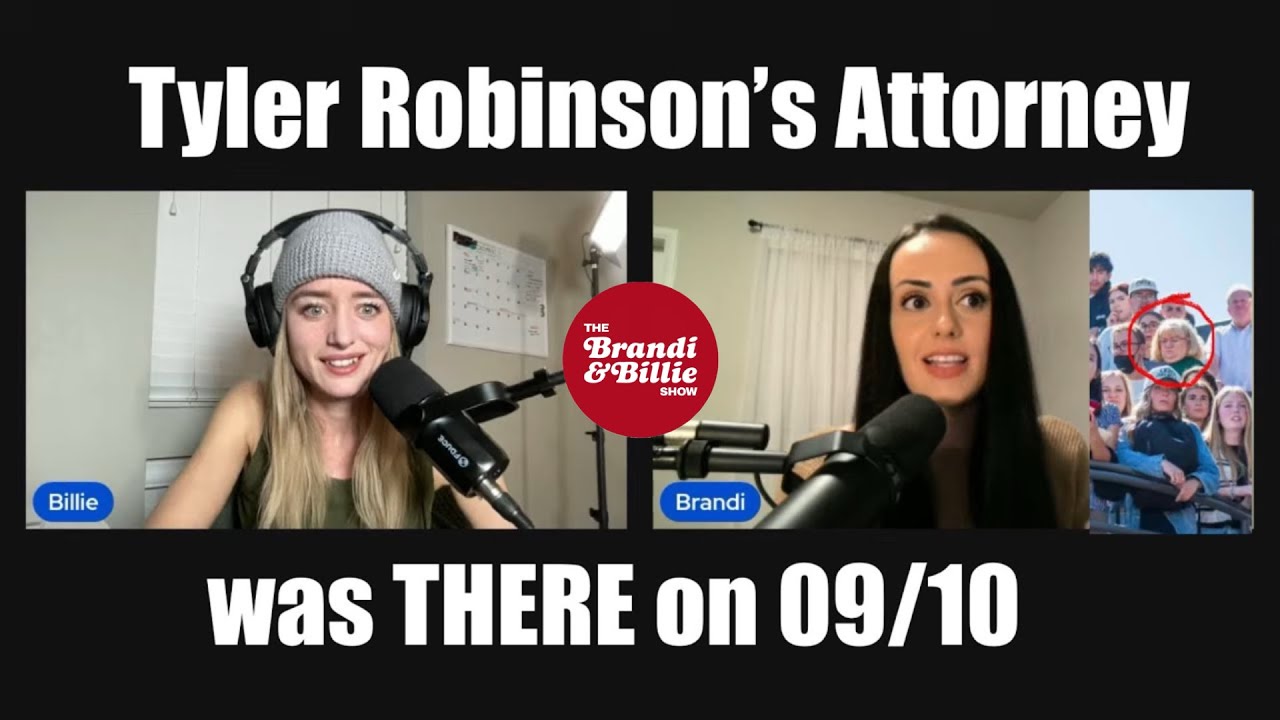
Brandi and Billie Expose Shocking Conflicts of Interest in Charlie Kirk Investigation
1:38:44

Candace Owens Exposes Disturbing Questions Surrounding Charlie Kirk Assassination and Erika Kirk's Suspicious Behavior
21:05

Candace Owens Reveals Explosive 911 Call Evidence and Utah Medical Examiner's Sudden Resignation in Charlie Kirk Investigation
49:39
Candace Owens Exposes Overwhelming Evidence Manipulation in Charlie Kirk Assassination Trial
Candace Owens returns from Spain to dissect the Tyler Robinson preliminary hearing, revealing how influencers coordinated identical messaging about 'overwhelming evidence' while critical forensic testimony told a different story. She exposes degraded DNA samples, misidentified vehicles, and Ben Shapiro's shocking admission that his security received live updates from Charlie Kirk's car during the critical minutes after the shooting. With detailed analysis of ATF testimony, blurry surveillance footage presented as definitive proof, and questionable timeline inconsistencies, Owens argues this represents a coordinated psychological operation to obscure the truth about what happened on September 10th.
The Coordinated Influencer Campaign
After returning from Spain, Candace Owens immediately noticed something disturbing about coverage of the Tyler Robinson preliminary hearing. Multiple influencers, including Benny Johnson, Graham Allen, Brandon Tatum, and others, all used the exact same adjective to describe the evidence presented: 'overwhelming.' This coordinated messaging felt less like organic observation and more like a scripted campaign.
Owens points out the strangeness of Erika Kirk inviting social media influencers—people whose job description is literally to influence the masses—to the preliminary hearing rather than close family friends or relatives. Benny Johnson explicitly stated that Erika requested his presence, raising questions about the intent behind these invitations.
The repetition of 'overwhelming' echoed previous psychological operations, similar to how phrases like 'wear a mask, save lives' and 'six feet social distancing' became mantras during COVID-19. This type of repetitive messaging has proven effective in shaping public perception, even when it contradicts common sense or available evidence.
What the Federal Narrative Claimed
Going into the hearing, the established narrative maintained several key points. Tyler Robinson was allegedly turned in by his own family, with his mother recognizing him on news footage and his father making official police statements against him. Bill Ackman even pledged $1 million to Tyler's father for the 'brave act' of turning in his son.
The narrative characterized this as a politically motivated killing by someone on the left targeting Charlie Kirk over LGBTQ rights, particularly trans rights, because Tyler had a trans furry boyfriend named Lance Twiggs. The text message 'some hate just can't be negotiated' was presented as his motive.
Authorities claimed they had footage of Tyler taking the shot, though it hadn't been released to the public yet. They reported that Tyler's fingerprints and DNA were found on the gun, presented as definitive proof. Erika Kirk herself stated in interviews with Bari Weiss that she had seen the evidence and was convinced it was Tyler Robinson, with no foreign involvement or involvement of others.
Candace Owens' Counter-Narrative
From the beginning, Owens maintained a different version of events based on months of investigation. She asserted that Tyler's parents did not turn him in, but rather that he was pressured to come in by Mike Mitchell, a former undercover detective and family friend who had been Tyler's Boy Scout leader. Mitchell allegedly told the family they could do it 'the easy way or the hard way,' convincing Tyler to turn himself in voluntarily to avoid a potentially violent home raid.
Owens reported that Tyler was not political and came from a family of Trump supporters. While she never denied the gun found was Tyler's, she insisted it was not fired that day and was not used to kill Charlie Kirk. The gun was a family heirloom inherited as the firstborn son, though Tyler was more of a fisherman while his brothers were hunters.
She suggested Lance Twiggs is a federal asset who gathered Tyler's belongings to frame him, with Lance possibly being blackmailed due to involvement in dark web activities. Every piece of evidence relied on Lance Twiggs, who was granted immunity by the feds and was not allowed to be cross-examined at this preliminary stage.
Owens theorized that the feds intentionally flooded the zone with multiple decoys—different young men, all brunette, wearing similar outfits—which she termed 'maroon boys.' Her most significant claim was that Tyler Robinson did not set foot on campus that day, as he told his family he was around campus but not physically on it.
The Blurry Surveillance Footage
What was actually presented in court as evidence was exhibit 12.4, a compilation video of unidentifiable brunette males walking up and down the Losee Center steps at various points throughout the day. Owens describes this footage as blurry and impossible to definitively identify as Tyler Robinson.
The footage could plausibly be Tyler Robinson, Lance Twiggs, or any of the decoy boys on campus that day. Lance Twiggs' testimony about recognizing the person in the images was vague at best, stating he recognized the shoes, sunglasses, and jeans—items worn by millions of people. He didn't even recognize the hat as one Tyler owned.
The surveillance system apparently failed to capture clear images of faces or license plates, raising questions about its purpose and effectiveness. If the goal was to identify individuals and vehicles, why install a system that accomplishes neither?
The Vehicle Discrepancy
Court testimony presented what was claimed to be Tyler Robinson's Dodge Challenger on campus surveillance footage. However, Owens points out a critical discrepancy: the car in the footage has dual exhaust pipes, while Tyler's actual car that was towed from his driveway has a single exhaust pipe.
This is not a minor detail but a significant manufacturing difference. When ordering a Dodge Challenger, different exhaust configurations are available as options. The cars are fundamentally different in this regard.
Adding to the confusion, a witness who captured Nest camera footage at 12:47 a.m. testified that she saw a bald man accompanied by three other people in the gray Challenger. When police interviewed this witness to verify the video's authenticity, she clearly stated the driver was bald and there were three other occupants. Yet this crucial detail was omitted when the footage was presented in court.
The Penguitch Steak Timeline Problem
Owens broke the story that Tyler was eating a steak in Penguitch and paid with his debit card at 9:47 p.m., creating a timestamped alibi. Penguitch is three hours away from the campus, making it impossible for him to have been texting Lance at 11 p.m. about 'babysitting his rifle' on campus.
The text messages presented lack timestamps, which is suspicious. If Tyler concluded his meal at 9:47 p.m. and began a three-hour drive home, he couldn't have been on campus observing K9 officers as the messages suggest. The timeline simply doesn't work.
The messages themselves read strangely, with phrases like 'I am still okay, my love, but I am stuck in Orem for a little while longer yet' sounding more like non-native English translation than natural American speech. The message 'If I'm able to grab my rifle unseen' is grammatically correct but not how Americans typically phrase things.
Owens is requesting information about when K9 units were actually on scene, as this could provide exculpatory evidence regarding the timeline of these text messages.
Forensic DNA Evidence Destroyed the Prosecution
The most devastating testimony came from Caitlyn Oliver, the ATF's forensic biologist. She explicitly admitted that media assertions claiming 'Tyler Robinson's DNA was found on the gun' were 'scientifically indefensible statements.'
Oliver explained that the term 'major contributor' was intentionally misrepresented to the public. When DNA experts say someone is a 'major contributor' to a sample, it doesn't mean their DNA dominates the entire object. It means that in one specific mixed sample taken from one small area, that person's DNA was more prevalent than others in that particular sample.
Using an analogy: if you drink from a mug daily, your DNA covers most of it. But if someone else touches one spot with two fingers, and forensics swab only that spot, the other person becomes the 'major contributor' to that specific sample, even though the mug is overwhelmingly covered with your DNA. This is exactly what happened with the gun evidence.
Oliver confirmed there were a minimum of five sets of DNA on mixed samples from the gun, possibly more. These included Lance Twiggs, Matt Robinson (Tyler's father), and likely Tyler's brothers. The gun was a family heirloom, so multiple family members handling it over time makes sense.
The Most Degraded Sample
Perhaps the most explosive revelation was that Tyler Robinson's DNA was the most degraded of all samples on the gun. This is critical because DNA can remain on objects for decades, but it degrades over time due to exposure to humidity, dust, and environmental factors.
DNA would not suddenly degrade immediately after someone allegedly shoots a person, jumps off a rooftop, and tosses the gun into nearby bushes. Degradation takes considerable time. The fact that Tyler's DNA showed the most degradation while Lance Twiggs' and others' showed less degradation suggests Tyler's DNA was older—consistent with him having handled the family heirloom in the past but not recently.
Oliver also testified that she couldn't determine when DNA was deposited on the trigger guard or trigger, nor could she specify whether the sample came from the trigger itself or just the trigger guard—a significant distinction that prosecution glossed over when claiming his DNA was 'on the trigger.'
The Wrong Caliber Bullet
ATF ballistics expert Samantha Carner provided testimony on day four about bullet fragments recovered from Charlie Kirk's body. Of seven fragments mentioned, she received only four in a manila envelope. Three fragments disappeared.
Of the four received, three were unusable, leaving only one fragment labeled 6A for analysis. Carner gave a diameter range for this bullet jacket fragment of .286 to .301 inches. This range is too small for a .30-06 rifle, which Tyler allegedly used. A .30-06 cartridge has a diameter beginning at .308 inches and ranging upward to .471 inches.
The defense attorney went through great lengths to get this on record because the bullet fragment recovered from Charlie Kirk's body is not consistent with Tyler Robinson's rifle. This is not a minor technical detail but fundamental evidence that the weapon used may not have been Tyler's gun at all.
Lance Twiggs Destroys the Political Motive
Lance Twiggs' testimony contradicted the entire narrative about Tyler being politically motivated. When asked if they discussed politics, Lance stated Tyler didn't talk much about politics beyond occasionally mentioning something he heard on the radio during his work commute. Lance himself admitted he didn't keep up with politics much.
Most significantly, Lance testified he had never heard Tyler talk about Charlie Kirk specifically. When asked about discussions regarding gender identity issues and LGBTQ rights—supposedly Tyler's motivation for the assassination—Lance said no, not really. Tyler occasionally discussed Trump or current policies being voted on, but that was the extent of his political engagement.
This testimony completely undermines the leftist rage narrative that Tyler killed Charlie Kirk over trans rights. The supposed motive evaporates when the person closest to Tyler—his boyfriend and roommate—confirms Tyler wasn't political and never discussed the issues he supposedly killed over.
The Influencer Deception
After these devastating testimonies, influencers went into overdrive claiming they witnessed crystal-clear 4K footage definitively showing Tyler Robinson committing murder. Benny Johnson's reaction video is particularly revealing.
Johnson claimed they saw footage on giant screens in the courthouse showing 'crystal clear' images of Tyler Robinson's face and license plate, his movements on the rooftop timed to when Charlie was murdered. He described Erika Kirk sobbing while Tyler Robinson sat 'pale, sallow, bony, emaciated, staring at the floor the whole time, twitching.'
Johnson stated the judge played 20 minutes of high-definition security footage and 'the whole courthouse gasped when it was over.' He claimed it was 'the most overwhelming presentation' and that once the public sees this video, it will 'cast out all of the demons that have been attacking the Kirk family.'
The problem is this footage doesn't exist. The enhanced video (exhibit 12.1) was shown only to the judge and witness, but Court TV accidentally captured some of it when the state left their computer open. The 'enhanced' footage is simply exhibit 12.4 zoomed in, with some red circles added and faces of bystanders blurred. The person on the rooftop remains a pixelated blur.
The court explicitly stated on day two that exhibit 12.4 does not show Tyler Robinson taking the shot. When asked directly if there was footage of the alleged shooting, the answer was 'there is not, judge.' Yet multiple influencers—Benny Johnson, Josh Hammer, Graham Allen, and others—claimed to witness definitive footage that doesn't exist.
Ben Shapiro's Shocking Admission
Perhaps the most disturbing revelation came from Ben Shapiro himself. During a discussion about the case, Shapiro casually mentioned that during the approximate seven-minute car ride to the hospital, while Charlie Kirk was bleeding in the backseat, someone in that vehicle was providing Ben's security team with live updates over the phone.
This is extraordinary for multiple reasons. First, Ben Shapiro and Charlie Kirk were not friends. According to Owens and others who knew Charlie well, Charlie actively disliked Ben Shapiro because Ben had worked behind the scenes to prevent Charlie's rise in conservative media. This is reportedly a pattern with Shapiro, as Megyn Kelly recently experienced similar treatment.
Second, during those critical minutes when every second counted, someone prioritized updating Ben Shapiro's security over focusing entirely on saving Charlie's life. The question becomes: who made that call?
Breaking down who was in the vehicle: Brian Harpole claims he was packing 40 feet of gauze into Charlie's neck wound. Rick Cutler was holding Charlie with both hands because Charlie was so tall he was hanging out the open door. Frank Turek left his kids on FaceTime and was praying aloud. Justin Davis was driving at speeds up to 100 mph. That leaves Dan Flood as the most likely person who contacted Ben Shapiro's security.
But why? Why would Ben Shapiro's security need immediate updates about Charlie Kirk's condition? Ben was in Los Angeles having a 'breakfast-lunch meeting' when this occurred. Owens is offering a $10,000 bounty for information about who Ben was meeting with that day.
The Missing 911 Call
Another troubling detail is that the released 911 calls don't show Justin Davis or Dan Flood calling emergency services, yet someone from that car must have called 911. This is public information that should be available. Where is the missing 911 call?
Someone in that vehicle called 911 and also either called or answered a call from Ben Shapiro's security to provide updates. These actions should be traceable, yet the information remains obscured.
Israel Connection Theories
Owens maintains her belief that Israel is involved in Charlie Kirk's assassination. She points to multiple factors: Charlie's complicated relationship with supporting Israel, the mysterious phone call from Benjamin Netanyahu while Charlie was in the Hamptons, and the subsequent change in Charlie's willingness to uncritically support Israeli actions.
She references a statement from Andrew Kolvet suggesting 'it was supposed to be you,' implying Owens was the original target. She questions whether Charlie became a liability after refusing to do something Netanyahu asked, possibly related to continuing attacks on Owens or unconditional support for Israeli policies.
The involvement of Ben Shapiro—whose security has former IDF members and whose company has deep ties to Israel—receiving real-time updates during Charlie's final moments adds another layer to these suspicions. The fact that text message evidence was extracted by a Tel Aviv-based company further reinforces concerns about Israeli involvement in the investigation.
The Psychological Operation
Owens characterizes the entire media campaign around this case as a psychological operation designed to manufacture consent for a predetermined narrative. The coordinated messaging, the strategic use of influencers, the misrepresentation of scientific evidence, and the suppression of contradictory testimony all point to a sophisticated information warfare campaign.
The goal appears to be creating such strong public conviction of Tyler Robinson's guilt that any questioning of the narrative can be dismissed as conspiracy theory. By having dozens of influencers repeat 'overwhelming evidence' in lockstep, they create an illusion of consensus that pressures people to accept the official story without critical examination.
This technique has historical precedent. During COVID-19, similar coordinated messaging created social pressure to comply with mandates without questioning their scientific basis. The repetition of phrases like 'trust the science' and 'safe and effective' worked to silence legitimate questions and concerns.
The Trial's Future
Owens expresses both optimism and concern about the trial moving forward. She believes the evidence presented at the preliminary hearing actually undermines the prosecution's case, despite the influencer campaign claiming otherwise.
However, she worries about several possibilities: that Tyler Robinson might be eliminated before trial, that Erika Kirk might be harmed and blame placed on Owens' investigation, or that the trial will be delayed for years to diminish public attention and memory of contradictory evidence.
She notes the strangeness of a new narrative suggesting there may be danger to Erika Kirk, warning that if something happens to Erika, it won't be because of Owens' investigation but because of the dangerous game being played by those controlling the narrative. She explicitly states she does not want any harm to come to Erika and has never called for violence against her.
What Comes Next
Owens commits to continuing the investigation with renewed energy after her time away. She's requesting specific information from her audience, particularly regarding the timing of K9 units being brought to the scene, as this could provide exculpatory evidence for Tyler Robinson's timeline.
She promises more revelations about what happened in the car during those critical minutes, including information about a piece that looked like cardboard in the back seat. She believes this detail has caused mass panic among those involved, leading to the coordinated influencer attack campaign.
Most significantly, she views this case as an opportunity to expose the systems and structures that control American society. She believes Charlie Kirk himself predicted his death would be associated with a wider awakening, and she's committed to ensuring that awakening happens.
Owens sees this investigation as the culmination of everything in her life leading to this moment. She feels fortified, rested, and ready for the battle ahead. Despite the coordinated attacks, she maintains that truth doesn't require a marketing campaign or budget—it simply requires persistence in asking questions and refusing to accept narratives that don't align with evidence.
Video Transcript
All right, you guys. I am finally back.
I am so happy to be back. Things tend to
get a little crazy when I go away. Um, I
have to tell you, when I jumped online
and I saw all of the X-T trends, I
wasn't exactly certain whether last week
represented the preliminary trial of
Tyler Robinson or Candace Owens, I mean,
is everybody okay? What Why do I seem to
have this sort of an effect on
middle-aged men? Did you see this? This
is real. These are those are my former
employers, ladies and gentlemen. And
ladies, can I just say that if your
husband is striking poses in the mirror
to look like Candace Owens, you have got
to get him off of the internet. Anyway,
can I just begin by saying the quiet
part out loud. Please forgive me. I have
to say it. Regarding the preliminary
hearing, if you find yourself having to
invite literal social media influencers
into a courthouse, Erica, as in the
actual job description of these human
beings is to influence the masses about
products or ideas. If you feel compelled
to invite Benny Johnson, Department of
War consultant Graham Allen, Brandon
Tatum, people who you for for whatever
reason, I'm not judging, did not choose
to invite to Charlie's private funeral
mass, but extended an invitation for
them to come to the courthouse. The
public may rightfully have some
questions about your intent. Like right
off the bat, that's an interesting move,
Erica. Right. Benny Johnson came right
out of the gate and said, "Erica asked
me to be here." Okay. Really? Why?
Why did Erica Kirk request your presence
there? I I would have asked my cousins,
my close friends, some people I went to
high school with, some aunts and uncles
that don't annoy me to be there, but
influencers, I don't think so. It's
giving I'm finally going to wear black,
but I'm going to invite the glittery
pants suit. You know what I mean? It
still feels like a show. And you guys, I
have to tell you, I'm getting old. I
really am. And one thing that I have
learned in my ripe old age is that the
truth never requires a marketing
campaign, there's just never a budget
line item for truth. Of course, the
single craziest piece of news over the
last week and plausibly since the day
that Charlie Kirk was assassinated, is
that Ben Shapiro, who just makes
everyone's skin crawl in a unique way,
has offered up an unusual confession.
But as Charlie Kirk, his enemy, lay
dying and bleeding in the backseat of
the car in route to the hospital, an
approximate 7-minute ride, someone in
Charlie's car, was providing Ben's
security with updates over the phone
while Charlie was in the car. That's
massive. I I got to say, for those of us
who believe that there is mounting
evidence that Israel put a hit on
Charlie Kirk, Ben Shapiro receiving
updates while Charlie was dying is not
going to go a long way in terms of
clearing up any conspiracies. So,
welcome back to Candace.
Obviously
not enough time in the day. We have so
much to unpack this week. But you know
what? Let's begin with a basic
definition class. What does it mean to
be overwhelmed? Like actually, let's
just start with the root word.
The verb towelm. Let's just pull a
definition of that. To welm is a verb
meaning to submerge, to engulf, or to
completely cover something, often with a
disastrous effect. It can also mean to
overpower, or to overcome someone in
thought or in feeling. So, right now,
there is a seemingly infinite number of
influencers on social media who watched
the Tyler Robinson preliminary hearing
last week, and they reported back to us
common folk that they they came away
from it, and they were they were
effectively drowning. They were
submerged. They were engulfed. They were
completely buried by the avalanche of
undeniable evidence that Tyler Robinson
murdered Charlie Kirk. I mean, they were
they were so consumed that they all just
began using that exact same adjective to
express themselves. It is overwhelming.
In fact, that has really been the key
word since last year, right? It is the
new wear a mask, save lives, six feet
social distancing. The evidence against
Tyler Robinson is overwhelming. Check
out this little collage we put together
of influencers who apparently uh need to
pop a Xanax, right? The evidence is
becoming overwhelming against Tyler
Robinson. Thanks, Graham. Uh Steve D.
The podcast's podcast and overwhelming
evidence against Tyler Robinson.
Paramount not so tactical. The evidence
against Tyler Robinson is overwhelming.
Gunther Eagleman, the evidence is
overwhelming to say the least. kind of
feels like he's saying the most. Uh Jack
as uh is quoting Don Trump Jr. as having
said the evidence against Tyler Robinson
is overwhelming. That's just one page.
Ali Beth Stucky uh Mike Lee, the
evidence against Tyler Robinson could
not be more overwhelming. He couldn't be
more submerged. Uh Andrew Kovat, it's
overwhelming against Robinson. Whoever
Brent is, it's it's overwhelming. Susie,
it's overwhelming. Clay Travis, it seems
overwhelming.
Some people even went so far as to
report that it was actually the most
overwhelming thing that they have ever
witnessed in their entire lives in the
courtroom. Uh, take it away, Josh
Hammer, who happens to look like a bond
villain. Take a listen.
So to reiterate and and to summarize
what we've already said, the evidence
presented this week just during the
pre-trial evidentiary hearings in the
Charlie Kirk assassin trial, the trial
of Tyler Robinson is the most
overwhelming presentation that I have
ever seen this early on during a legal
proceeding in my entire life. My entire
life,
>> whoa, like his whole life. This is it.
This is that moment.
So I was in Spain and I said, "Let me
buckle in. I too wish to experience that
title wave of the exact same emotion
being shared by all of these people.
Apparently though me and Carrie Priene
Bowler who I was traveling with, we
watched an entirely different hearing. I
don't know if it's different in Spain. I
I had wondered is it different if you
don't have the eyes of Zionists? Because
I did notice a little correlary right
amongst Zionists there is an increased
sense of the whelming happening when it
comes to Tyler Robinson. Well, let's not
get ahead of ourselves, right? Let's
begin with a refresher on what exactly
the Fed narrative was going into this
hearing. Like, let's you have to
remember the stuff that they say because
they very quickly move on from these
things. Okay, foremost, we were told
over and over again that Tyler Robinson
was turned in by his own family and that
he confessed to the crime at various
points. Uh, we were told his mother
recognized him on the news. His father
turned him in uh and made they both made
official police statements against their
son. In fact, Bill Aman, King of the
Hamptons, immediately pledged $1 million
to Tyler Robinson's father, Matt
Robinson. Someone should check in on
that $1 million. By the way, uh he
pledged that for the brave act of Matt
Robinson having turned in his son.
Anyways, uh here's a little clip of
people telling us that that's what
happened and we were going to find that
out.
I was having a discussion about how I
you know just as a father how incredible
it was to see and just just just
you know almost unbelievable it was to
see Tyler Robinson's parents play a role
in turning over their son Tyler Robinson
and the video and footage of him were
identified also by his parents as being
Tyler Robinson.
>> Tyler Robinson's parents see that photo
and think that looks like Tyler. They
begin asking him things like, "Where is
your I believe it was his grandfather's
gun?"
>> They start asking him this. Tyler
Robinson starts talking like he might
kill himself. They get a friend of the
family to sit down with him. He actually
he admits that it's him. They get him to
drive up to Orm and turn himself in. His
parents helped him turn him in.
>> They say no face, no case. No, his
parents said, "That's my son." And then
he turned himself in taking
responsibility for shooting Charlie
Kirk.
>> So, we have three confessions here. one
to his parents, one to his roommate, and
one on Discord. Those local sheriffs
were the ones who took the first
statements from Robinson's parents,
which identified Robinson as the shooter
and provided the motive. By the way,
Ally, do you think that the parents of
Tyler Robinson, if he was not guilty,
would be making a stink about this if he
was innocent?
Have you heard a word from the parents?
No. The parents were the ones that
turned them in.
turned him in, made statements against
their son. Okay. The Fed narrative also
stipulated that this was the left,
right? We were supposed to instantly go
to war over this, the right versus the
left. It was a politically motivated
killing. Tyler Robinson murdered Charlie
Kirk, first crime he's ever committed.
decided to do that in broad daylight uh
in a burning rage over LGBTQ rights,
particularly trans rights because he has
a trans furry boyfriend named Lance
Twigs. "Some hate just can't be
negotiated," he wrote via text. Like,
"This is why I did it. Charlie Kirk, I
took my shot because I can't I can't
stand to hear the hatred that Charlie
Kirk spews um regarding trans people."
But we were constantly reminded uh that
there was going to be footage also of
Tyler Robinson taking that shot, that it
had simply not been presented to the
public yet because it wouldn't have been
appropriate at that early phase. We just
had to wait. Be patient. Erica herself
told us back in November or December
that she had seen the evidence and she
was convinced it was Tyler Robinson. By
the time she sat down for that interview
with Barry Weiss, her mind was made up.
That's the guy. No foreign involvement,
no involvement of others. She doesn't
need to see anything. Now, we were also
told that Tyler's fingerprints and his
DNA were found on the gun and that was
presented rather exclusively. They never
wanted to mention any other prints. Just
case closed. This is our guy or
overwhelmed. Okay. Now, what was our
narrative here on the show? Because
after months and countless hours of
working on this case, chasing down every
plausible lead, I maintained that Tyler
Robinson's parents did parents did not
turn him in. Okay, that was a
mainstreamed lie. I said rather he was
peer pressured to come in by Mike
Mitchell, the former undercover
detective with the police force and also
a family friend of the Robinsons because
he was Tyler Robinson's boy scout leader
growing up. Um, I maintained that Mike
Mitchell actually was the one who was
told that they were going to bring in
Tyler Robinson and he then went to Tyler
Robinson's parents and said, "Look, you
can do this the easy way or you can do
this the hard way. No matter what,
they're going to bring you in. So,
you're going to have a circumstance
where they're going to bust in the door.
Your parents could get hurt. You could
get hurt in that process or you can
willfully come in." and he agreed to
willfully go in, not confessing to a
crime, but not wanting them to burst
into his home and potentially harm him
or his parents because he wasn't
suicidal. Um, I also expressed to you
that Tyler Robinson was not political,
crucial, and that he came from a family
of Trumpers. I want to be clear that I
have never denied that the gun found was
indeed Tyler Robinson's gun, but rather
I have asserted that the gun was not
fired on that day and was not used to
kill Charlie Kirk. Particularly, we
stressed on this show that he had simply
inherited the gun as a family heirloom
because he is the firstborn son, but
that Tyler himself was actually more of
a fisherman. His brothers were the
hunters. I also have suggested heavily
from the beginning that Lance Twigs is a
federal asset who gathered Tyler's
belongings to pin the crime on him. A
very easy feat because he was his
roommate and his boyfriend. And I
suspect that Lance himself is heavily
blackmailed because he was into some
dark web stuff. I also uh noted the
rather strange predicament that every
single piece of evidence that the
influencers are pushing relies on Lance
Twigs, who himself probably should be
considered a person that might be guilty
of participating in the events on that
day, who for some reason was immediately
granted immunity by the feds and was not
allowed to even be cross-examined at
this stage for this hearing. despite
arguments made um that his testament
would amount to hearsay. They allowed it
to fly at this phase of this is
preliminary. We're just going to see if
we go on. Now, regarding what took place
on that day, we suggested
that the feds
intentionally flooded the zone with
multiple decoys, different young men,
all brunette, all wearing similar
outfits. We termed these our maroon
boys, right? Decoys. photos of three of
them in a row right here. I said, "Why
were so many men dressed like Tyler
Robinson on this day? We showed you
footage of many more of these men
wandering, all of who fit the
description of what we're about to see."
And our biggest claim uh that we
probably made on the show was that Tyler
Robinson did not step foot onto campus
on that day. At least that is what he
told his family, that he was around
campus, but not physically on campus
himself. So in short, it should have
been remarkably easily easy for people
to debunk us right on this very easy.
Well, I was sitting there actually
expecting open and willing to have to
concede at least one point for my
investigation. I mean, I worked really
hard to be perfectly accurate, but I was
like, maybe maybe he lied to his parents
and he was actually driving on campus
that day. All they needed to present to
make me look foolish was one clear photo
of Tyler Robinson on campus. What we got
instead was footage of unidentifiable
brunette males, brunette males walking
up and down the Loy Center steps at
various points throughout the day. Um,
what was presented in court was a
compilation video which I would like to
note was exhibit 12.4
in court. Exhibit 12.4. 4. That's going
to become relevant later when we talk
about the influencers who have sold
their souls to the devil. Uh 12.4 was a
compilation of blurry male or males
plural going up and downstairs and
people said that's that's Tyler
Robinson. Um let's let's take a look at
that. Let's take a look at this video of
the males in 12.4 moving throughout the
day um going up and down the steps.
Here we go. And we're we're speeding
this up, I think, right? Or we cut it
short. This is this is the undeniable
evidence um that it's Tyler Robinson.
This is And by the way, if you're
feeling overwhelmed, please sit down and
have a glass of water. We don't want
anybody passing away looking at this
undeniable. They're like, "This is Tyler
Robinson. This is just like attempt at
hypnosis. This is You're getting very
sleepy. That's Tyler Robinson. That's
Tyler Robinson. That's him. There is
that's him. And by the way, I want to be
clear.
I can't meaningfully deny that that
could be Tyler Robinson.
It could also be Lance Twigs. It could
be Ethan Hawk, Tom Holland, Timothy
Shalamé in preparation for the d the
final uh installment of Dune. could be
any of I I couldn't reasonably deny that
it's any of those young men or any one
or number of the decoy boys on campus
that day who I speculated all looked to
me like they belonged in a military
unit.
Speaking of which, I think I forgot to
mention to you guys that on the top
floor of the Loy Center of all things,
it's uh UVU's military affiliated
student hub known as their MASH center.
It's literally a dedicated student
center for student veterans and their
families. So that's it. That's what we
we saw. We saw brunette males, maybe
brunette males. I mean, I could even
could be a dirty dirty blonde. I'm not
ruling any A-listers out of being
involved on this day. Actually, I'm just
not convinced.
Now, Lance, the star possible Fed
witness, basically says it looks like
Tyler in terms of his clothes. Like, I I
recognize some of these clothes. He He
liked to wear jeans. I kid you not. That
was his testimony. Take a listen.
>> Do you recognize the person in these
images?
I wouldn't say with a 100% certainty
just because of camera quality, but that
looks like him in terms of the shoes
he's wearing, the sunglasses.
I don't think I'd specifically seen him
wearing that hat, but he was usually
wearing a hat. Um, and then jeans. So,
it definitely, especially the bottom,
the last two definitely do look like
him.
Oh, they do look like Tyler Robinson.
>> Well, I I say it's open and shut. He
said he made it very clear that Tyler
wears jeans that he wears those shoes.
Shoes worn by We should probably look up
how many millions of people wear those.
I mean, I think I had 20 pairs of those
shoes uh throughout my lifetime. But he
he doesn't recognize the hat. Not one of
his hats. But he does like to wear
jeans.
And what are those Chucks he's wearing?
Like there we go. That rules it out.
Really convincing. So I'm thinking let's
move beyond that. Okay. Blurry video
compilation 12.4. Surely they're going
to be able to show us Tyler's car on
campus because what would be the point
of a parking lot surveillance system
that doesn't capture the license plates
on cars? That would just be foolish and
a waste of our time. Why would you even
have an entire surveillance system
installed on campus that can't identify
any faces or any cars at all? So, the
question is, did we get that a clear
photo? I was like, maybe he was actually
driving around camp. No, we got more
blurry images of what appears to be,
judging by the car's exhaust pipes, a
totally different Dodge Challenger from
the one that Tyler Robinson was driving.
Okay, here is what was shown. This is a
car that this is his Dodge Challenger.
And I want you to pay attention to those
exhaust pipes at the bottom. We're going
to zoom in there. Okay.
You are noticing that that is a dual
exhaust pipe. You see two, right? These
are your eyes. I know the final
instruction is don't believe your own
eyes, but I'm asking you to believe your
own eyes here.
Well, Robinson's car, here's a still of
the car, which is clearer, which was
towed out of his driveway, features
not a dual exhaust pipe exhaust system,
but it's just it's singular. Okay,
that's a major discrepancy that people
are rightfully pointing out amongst
other things. I got tons of emails from
car people giving me specifics about why
this you you basically when you order
the car, you can order different things.
We don't need to get into the
nitty-gritty. Just believe your own eyes
on the car front. Now, if you're
thinking, Candace, are you suggesting
that someone else could have, I don't
know, rented a Dodge Challenger and been
driving around a gray Dodge Challenger
just so they could get images and say
that it was Tyler Robinson's car? Well,
actually, you don't need me to suggest
it. Actually, a witness confirmed that
they saw someone else driving a gray
Challenger, particularly uh a bald guy
driving the Challenger late at 12:47
a.m. You know, there was that uh Nest
video that captured him returning to
campus um or at 12:47 a.m. around
campus. The woman who captured that
footage testified to police that she saw
a bald man accompanied by three other
people in the car. Take a listen. Now,
I'd like to talk a little bit about the
Ring camera that um you obtained and you
interviewed a woman named Miss Noble. Is
that right? To get that ring camera that
we watched with the car on the outside.
>> Uh she we interviewed her to verify the
authenticity of the video. Yes.
>> And were you involved in that interview
>> with Miss Noble?
>> Yes.
>> And do you recall what they told you
about what they remember seeing in and
around that car that night?
>> Uh I don't recall. I I just know we were
there to verify the video. I didn't
conduct an interview with Miss Noble at
that time.
>> And do you remember that the nobles told
you that the driver of the vehicle was
bald?
>> I I do remember that being in the
report. Yes.
>> And you didn't mention that today when
you were talking about that ring camera,
did you?
>> I did not.
>> And did they also tell you there were
three other people in the car?
>> Yes. I believe they they thought that
was the case.
forgot to mention when we showed you
this evidence of Tyler Robinson's car
that the person who captured it said
that they saw a baldman and three other
people. By the way, paging Blake Nef,
he did this weird ex live that we're
going to talk about tomorrow where he
doesn't his memory gets really fuzzy
that evening. Apparently, a few of the
people at Turning Point USA, despite
Charlie dying, went out later that night
and don't necessarily recall what they
were doing. I think we got to try to
help them figure it out. Okay. Anyway,
we told you early on that it is highly
unlikely, despite what looks to us to be
like Fed drafted text messages, that
Tyler returned to campus to, as his text
messages say, watch the K9 officers
uh to babysit his rifle because we broke
the story that Tyler was eating a steak
down in Penguitch. He concluded and and
paid at 9:47 p.m. There's a literal
receipt for that because, as we said, he
paid with his debit card. So, we can
timestamp him 3 hours away at 9:47 p.m.
when he's apparently texting Lance. Uh,
it's three-hour ride. So, when Lance
says that he gets his phone um and he's
getting an automated message and they're
they start talking and Tyler, he says
the first message came in at 11 p.m.
Well, 11 p.m. I can tell you right now
that drop everything and look under your
keyboard at 11 p.m. He says that's an
automated message. And then him and him
and Tyler begin texting and he's like,
"Oh, I'm babysitting things out here in
Oram. I'm waiting to go back and get my
like, how is that possible if at nearly
10 p.m. he's leaving Penguish? He He
couldn't have been babysitting the
campus. This is the problem. The
messages are problematic, and that's why
they're not timestamped. He could not
have been doing what he said he was
doing, texting Lance after 11 p.m. Or he
decided not to mention that he got
pulled over by a police officer around
12:30 and he just was just texting him
in earnest. None of the text messages
make sense and we're going to need
timestamps. By the way, just a little
fun ad that the messages were apparently
extracted uh by a company based in Tel
Aviv. Israel is taking care of the Lance
messages. Guys, trust the science. Let's
pull these up. By the way, let's pull
pull these messages up. Okay.
11 p.m. Allegedly automated. Nobody
knows why he sent an automated message.
Drop what you're doing and look under my
keyboard. He says, "Lance, what?
You're joking, right? F. I tried to
delete that." Tyler comes back with, "I
am still okay, my love, but I am stuck
in Orum for a little while longer yet."
It's very gone with the wind. I love
that. I'm stuck in Orum for a little
while longer yet. Uh, it shouldn't be
long until I can come home, but I got to
grab my rifle still. To be honest, I had
hoped to keep this secret till I died of
old age. I'm sorry to involve you. Oh
gosh, I know. He shouldn't have said old
age because um the fed narrative is that
he was suicidal. I just It's a bad thing
to say that you weren't the one who did
this, right? I am. I'm sorry. I thought
they caught the person. No, they grabbed
some crazy old dude. They interrogated
someone in similar clothing. I had
planned to grab my rifle from my drop
point shortly, but most of that side of
town got locked down. It's quiet almost
enough to get out, but there's one
vehicle lingering. Like, I'd like some
time stamps here. I'd like to make it
work with Tyler going to get a steak in
Panggu, driving 3 hours to Panguage, and
then turning around and coming back.
Just 6 hours of driving and eating
is not coming across in these messages.
And then we have here, I had enough of
his hatred. Some hate just can't be
negotiated out. Um, if I'm able to grab
my rifle unseen, this feels to me like a
person who is not native to speaking
English, American English, is
translating. If I'm able to grab my
rifle unseen is not not what we say.
That's just not how we how we speak. You
can say it, but it's not how we would
say it. I will have left no evidence.
Going to attempt to retrieve it again.
Hopefully, they have moved on. I haven't
seen anything of a news about them
finding it. I will update you by
midnight. Here is what I would like to
do. It is very important for us to
establish because he is speaking about
the canines and I think I can by the way
I can back channel um because I talked
about the kines's on the show and I can
go back to that source. But if you have
information related to when the kines
were brought on to the scene, please
email us tips at kennace.com. that will
allow us to get a timestamp in there
because he says he's observing the
canines going back and forth and I this
could be exculpatory evidence
the penguish steak and I think my gut
has been right from the beginning our
gut everyone's gut that these messages
feel a little fed sloppy little fed
sloppy Joe more tips at kennace.com or
tips@canniswowens.com if you know what
time um the officers had the canines
there on the scene.
Anyway, uh noticeably missing was any of
that shock testimony regarding Tyler's
parents' statements turning their son
in. Again, we got to get an update from
Bill Aman on on the mill. That's a cool
mill. It's a lot of money. To the
contrary, there was plenty of testimony
regarding how Lance Twigs's prints were
on everything. The towel, the gun, the
Dremel that was used to carve out the
messages on the cartridges. Uh, Lance
claims, I know his alibi is for that day
when Charlie was shot, um, or had an
exploding mic. Lance claims that he
slept in until 100 p.m. How convenient.
Charlie gets hit at 12:23 and Lance
actually slept 37 minutes beyond that on
September 10th. So convenient. Um, and
then he woke up.
Here are some more devastating points of
this hearing. Okay, Lance confirmed my
report that Tyler was not political. If
Lance is to be believed, then their
entire entire leftist rage motive about
LGBTQ rights virtually just disappeared.
Okay, take a listen.
>> Did you and he ever talk about politics?
>> Um, he did more than me. I
I didn't really still don't really keep
up with politics very much.
Uh he'd usually talk about stuff he
heard on the radio on his drive to work
in like their work car since it sounds
like their whole crew went in the same
car most of the time. But uh I wouldn't
say super consistently because it wasn't
a topic I really contributed much on.
>> About Charlie Kirk? Did you ever talk
about Charlie Kirk?
>> I I personally had never heard him talk
about Charlie Kirk before specifically.
>> Okay. Um, how about um
political issues? So, did you ever talk
about gender identity issues and LGBTQ
rights?
>> Uh, no, not not really. Um,
uh, usually if he did talk about
politics stuff, it was uh relating to
Trump or current like policies being uh
like issued or voted voted on, I think.
Yeah.
>> Oh, I think we reported that this was a
family filled with Trump supporters and
you're telling me just he would maybe
hear something on radio and talk about a
policy issue. Didn't see massity hated
Trump there. uh you never heard him
speak about LGBTQ issues that like are
you telling me that people were trying
to essentially launch a civil war
between the left and the right and the
very people who claim to be fighting
that sort of stuff were actually trying
to instigate it. Trying to instigate
that left versus right gay versus
straight. This was being initiated by
the right because they just couldn't
wait to hear anything beyond what the
Fed was serving. But there was even more
explosive testimony, believe it or not.
Um, and it got really scientific, and it
came from the ATF on the final day. This
is actually my view of the reason that
the influencers went positively insane
and suddenly pretended that they were
made privy to some 4K HD video footage
of Tyler Robinson taking the shot on the
roof. They, of course, were lying
through their teeth. We're going to get
to that later, but I believe that the
reason they did it, the reason why they
went insane was to overcome the
testimony of Caitlyn Oliver. Okay,
Caitlyn Oliver was the ATF's forensic
biologist. And she gave a devastating
testimony uh for the it was devastating
to the um prosecution. These are the
major points from that testimony. Okay.
First, she explicitly admitted that the
media's assertion that Tyler Robinson's
DNA was found on the gun was, and I
quote, a scientifically indefensible
statement. Take a listen.
>> From a scientific standpoint, you
couldn't read the paragraph that sets
out the likelihood ratio in your report,
whatever the number, and then blast a
headline in the media, Mr. Robinson's
DNA is found on this item. That's a
source attribution, is it not?
>> Correct. Yes.
>> And that would not be scientifically
defensible, would it?
>> Correct.
>> Tyler Robinson's lawyer then goes
through great pains to to show that the
media and the influencers took what was
essentially scientific jargon and they
lied. And I'm going to explain that to
you. So, I want you to lock in. Okay?
You may have heard them over and over
again stipulating that Tyler Robinson
was a major contributor to the DNA
sample. Right? So, if you're uninitiated
and you hear that, it sounds like it
means Tyler Robinson's DNA was all over
the gun. He's a major contributor to the
DNA sample. But it actually does not
mean that at all. And I want you to take
a listen to what she says, and then I'm
going to break it down for you further
so that you can understand what they did
here.
>> And you can't tell us anything about
when
the DNA was deposited on the trigger
guard or the trigger. Correct.
>> Correct. You can tell us anything about
whether when you say it's at least four,
it could be five, six, or seven people
with DNA on that trigger or trigger
guard. Correct.
>> Correct. Which is why we have the major
contributor that is suitable for
comparison and the minor contributor is
not suitable for comparison due to that
complexity.
>> And again, major minor just has to do
with the levels of DNA you were seeing.
has nothing to do with someone being
engaged in activity that is major in
relation to the minor contributor.
>> Yes. So the major contributor is the um
majority of the DNA contributed to that
sample.
>> Okay. Okay. So I'm going to break that
down further and and why this is is
really big and we're building on
something else that she's going to say
that is explosive. So the idea of what
she's explaining is that like let's this
is my mug. I drink out of this mug every
day. So, I definitively would have the
most DNA fingerprints all over this mug.
But occasionally, um, Ashley, my
producer, will go fill up the mug. So,
let's say Ashley, when she fills up the
mug, I'm all on the handle. Maybe Ashley
just touches her two fingers here when
she fills up the water. Okay. She is
saying that these are mixed samples. So,
let's say they just took a sample right
here of where Ashley happens to have
touched it, but it still also has my um
fingerprint on it. Ashley could be
described as a major contributor to the
DNA sample. Despite the fact that this
is my mug and the majority of this mug
has my DNA on it, Ashley could be
described because they just carved out
that one portion which happens to have
Ashley's DNA on it. So they com
intentionally misconstrued the intention
of the ATF report when they were relying
on a sample in which Tyler Robinson was
the major contributor of that particular
mixed sample. And he also went through
great lengths to explain to people why
they don't use since 1996 they actually
don't rely on mixed samples for that
very reason because it confuses matters.
They try to isolate samples. She then
confirms our repeat report as you just
heard her that there was a minimum of
five sets of DNA on some of these mixed
samples. Four sets of DNA could be more
people that actually were a piece of
were also found on the gun, but prints
which are found on the gun which of
course included Lance Twigs. Uh it also
included Matt Robinson, Tyler's father.
I'm going to guess that it also included
his brothers. Um, and of those multiple
sets, and this is what is crucial and is
explosive, and everyone should have
reported on this, they reported that she
reported that Tyler Robinson's DNA
sample was the most degraded. Okay, I'm
going to say that again. Tyler Robinson,
despite all of these prints on the gun,
Tyler Robinson's prints were the most
degraded or his DNA was the most
degraded. And I'm going to explain that
in a second. Take a listen to her say
that.
The 1.3 sample
is described as swabs of trigger and
trigger guard. Right.
>> Correct.
>> You didn't do the swabs, but um am I
correct that you have no way of knowing
which part was from the trigger and
which part was from the trigger guard?
>> Correct. So, they were swabbed together.
So, I wouldn't be able to say um where
the DNA came from. Um and that's one of
the samples that was degraded. Correct.
>> Uh there were signs of degradation
present in that sample. Yes.
>> And you said with regard to that sample
that that was a sample
consistent with at least four
contributors.
>> Correct.
>> Correct.
And did the what you term the major
profile
have the largest amount of degradation
in that sample?
>> There was Yes.
>> Exhibit 1.3. Do you know where that swab
was taken from?
>> I'd have to refer back to page two.
>> Can we refer back to page two, please,
Kimberly? Thank you.
>> 1.3 is the swabs of the trigger and
trigger guard of the rifle. All
>> right. Going back to page five
and
we've had some talk uh some testimony
from you and some questions for you
about the likelihood ratios.
What was your conclusion as to uh
[clears throat]
the likelihood
ratio that you analyzed in this question
in calculation number three? I don't
think we need this.
>> The DNA profile was le at least one.
>> Okay. So, you heard her say that that
his was the most degraded of the
firearms. And she and she's talking
about the trigger guard and the trigger.
She's not sure where they got the sample
from. And that's a huge difference
because they kept saying that his DNA
was on the trigger. And she's admitting
it could be the trigger guard. That's
just the that's just the cover for the
trigger. And of all of the samples that
were on there, Tyler's was the most
degraded. That is an absolute bombshell.
And let me explain why, okay?
Because it's not possible.
For clarity, earlier on she discusses
that DNA can stay on an object um for a
very long time. She doesn't get
specific. I can tell you, and you can
research this on your own, DNA can stay
on an object for decades. Decades. Okay?
But over time, it can certainly degrade.
It can degrade because it's been
exposed, and she does testify to
humidity over time. uh dust part
particles begin to set in. If you just
put up your grandpa's gun and dust
particles are just sitting in your house
because you don't use it, uh that would
be a reason that it might degrade. It
maybe you had water on it, it might
degrade. It does not seem to me that DNA
would suddenly degrade immediately after
someone shoots a person, jumps off a
rooftop, and tosses the gun into a
nearby bush. Okay, this registers to me
as more evidence that Lance Twigs simply
took Tyler Robinson's family heirloom of
a gun and helped the feds set him up as
a psy. There is no reason why Lance
Twigs's prints are less degraded than
Tyler Robinson's prints on this gun. If
Tyler Robinson is the shooter, it is a a
a massive admission by her that his
prints were degrading. G giving how much
it takes to degrade those prints. So
that was something that I felt that they
were intentionally trying to gloss over
and realizing that she's basically kind
of asserting like
Matt Robinson and Tyl and and Lance
Twigs had stronger DNA had a stronger
DNA sample than Tyler Robinson did. he
was the most degraded. And then of
course when you couple this with the day
earlier the ATF's every time the ATF
spoke it was devastating um for the
prosecution. The ATF ballistics ex
expert was a woman named Samantha
Carner. She spoke on day four and she
similarly gave testimony that was very
in the weeds and scientific and whenever
they do that I just start researching
the numbers they're saying is I know
that there's a point being made and
Tyler Robinson's defense did a very good
job of asking her to read her report of
the diameter the diameter range for the
bullet jacket jacket fragment. By the
way, it was weird off the bat that they
said they took seven bullet uh seven
fragments from Charlie's body. She
testifies that she only received four of
them in an envelope, in a manila
envelope. So, three disappeared. Of the
four that she got, three of them were
unusable and then she was left with one
uh which she labeled 6A. And that's what
they're discussing, this bullet jacket
fragment. And she gives this a range of
diameter. and it describes in detail why
she gave it that range and how confident
she was that you were looking for a
bullet that would be um in this range of
a diameter. Take a listen to this
testimony and the range that she gives.
>> The range of the diameter for the 6A
bullet jacket fragment was 286 to301
in.
The reason why that matters is because
it's too small for Tyler's 306. That's
why he was going through great lengths
to get her saying that on record. Um
because a 30 6 would begin at 308
and then it goes upward. The cartridge
diameter goes upward to 471. So she's
basically admitting it's not Tyler
Robinson's gun. I I would love to see
this go on. I would love to see this go
further. Uh because well if people are
going to be able to see the full extent
of this trial you are going to really
appreciate the psychological campaign
further that is being um employed right
now. The audacity of these influencers.
We return now to exhibit 12.4. Okay.
12.4 again is the original compilation
footage. It's the footage of Tyler
Robinson or Timothy Chalamé,
right? Or Timothy Chalamé.
Maybe it's Bench Pier. I don't know.
Maybe Ben's a little too short. But any
brunette male, right, of a of a decent
height could be walking up these stairs.
And they're giving us this compilation
of parking garage footage plus footage
of Tyler Robinson uh jumping onto the
rooftop. They made it clear clear on day
two of the trial that 12.4 this
compilation does not show Tyler Robinson
taking the shot. Okay, they made that
perfectly clear and take a listen to
that
>> if you wouldn't mind uh just describe in
a bit more detail uh what this
compilation includes.
>> Uh the compilation uh shows the
movements of what you're believed to be
Mr. Robinson on Utah Valley University
campus.
uh arriving and leaving in a vehicle,
arriving and leaving on foot, and then
returning and leaving, and then
attempting to gain access again in a
vehicle. And uh his movements throughout
the day uh are included in the videos
also.
Is there any uh footage of
of the of the alleged shooting?
>> There is not judge.
>> Okay. I just want to clarify that.
>> Okay.
So, 12.4 does not have any footage, did
not capture footage of Tyler Robinson
actually taking a shot, who they believe
is Tyler Robinson actually taking a
shot. Also on day two, they discussed a
a piece of footage that was born from
12.4. Okay, they discussed it and it was
an exhibit that was labeled 12.1. It was
the same footage as 12.4, which we've
all seen. That is available. You can go
watch that entire footage. You can watch
that day two of the trial. It is the
same footage, but except they claim that
they enhanced the footage. And they were
very clear about what that meant. They
went, this was a whole back and forth
about what does it mean? You took you
took 12.4 and you enhanced it. And here
is what they said 12.1 was. Take a
listen.
>> Let's return again to what's been marked
stakes exhibit 12.1
>> again. You've reviewed that video.
>> Yes.
>> And the difference between 12.1 or
what's been marked stakes exhibit 12.1
and 12.4 for are are if I understand you
correctly are these enhancements that
we've been talking about.
>> Yes.
>> And and specifically what what be
specific be specific about the
enhancements and let's go one at a time.
>> Okay.
>> Um I think there's a reference to either
red circles or red highlights. Correct.
That's how uh Mr. Olsson described it.
Red highlights.
>> Yes.
>> Do you know do you know what he's uh
what is what's he referencing by the red
highlights or what do you believe he's
referencing? I believe he's referring to
red ovals or circles that were placed
over the image to identify specific
individuals of note.
>> I think the next uh enhancement that
that has been mentioned that we've
talked about is there's some blurring.
>> Yes.
>> Do do you know what that tell us what
that is? What blurring do you see in
state what's been marked as states
exhibit 12.1
uh that you now don't see in 12.4? If I
recall, there were some individuals uh
in the parking garage footage and their
faces were blurred.
>> Is is any anything other than faces
being blurred? And then the last thing
is I believe is there some zooming in
and zooming out that's in 12.1 that has
been removed uh yes 12.4. What can you
tell us about the zooming in and the
zooming out?
>> Uh predominantly it's in the area that
was uh referred to as viewing the Losi
building rooftop.
I believe it focuses on the area where
Mr. Robinson comes up the stairs and
onto the rooftop. Uh those portions of
that particular footage were zoomed in
for clarity.
>> So to reiterate,
12.1 is simply an enhanced video of
12.4. What enhanced means is that it
zooms in at the end on the Loy Center
portion when we just see a blur running
across. They said, "We zoomed in on
this." And I don't know about you guys,
my experience is that when you zoom in,
things become less clear on my phone,
but I've never claimed to be a tech
genius. We're also told that it features
highlights and they've added some red
circles like we do often on this show.
And they also decided to blur some faces
of other people that were in the
background during the parking lot shots.
They made this clear. Beyond that, they
actually showed 12.1 already in court,
but it was for the judge and the witness
only, except they made a mistake and
they accidentally left their computer
open. So, Court TV captured some of that
footage and you can see that it is
literally the exact same video as 12.4,
but it's been zoomed in. So, great work
from this ex user at Cancon for catching
that. I don't know if we can pull that
up. Sky around the 235 mark, he zooms in
and shows the video actually. Did you
Did you pull that link by any chance?
Yeah, let's play that. Let's let's let's
play this link so you can actually see
it yourselves before we watch how the
influencers reacted.
>> There they are watching it on the
screen. Okay, now you can see now you
can see that this is the top right
quadrant that you would be looking at
when the camera moved to where Robinson
jumps off. Allegedly Robinson jumps off
the the roof. Now, you can't see this
here because it's a little difficult.
I'll zoom in as much as I can so you
guys can see, but the clear like the
clear identifying image of Tyler
Robinson, you're going to see it on this
screen.
And again, this is at 1 hour 16 minutes
and 27 seconds on Court TV's day two of
the trial. Okay, so you're going to see
here, correction, it's 1 hour 17 minutes
and 30 seconds.
He's running across now. I don't know if
you can see it because all he is is a
pixel. That's all he is is a pixel. He's
running across right now. Watch.
>> I can see it. You saw the pixel.
That's it. That's the enhanced version
that everybody wants to condemn this guy
on.
Again, I'm not saying one way or the
other here. I am not saying one way or
the other here,
but that's the enhanced photo that
everybody has seen in the courtroom.
That's it. It's it was leaked by the
state. It was on one of the state at
>> Fantastic work. He is correct. I fact
checked that. We looked at it. We saw
them go back and forth about why they
didn't want to play it for the public
and sure enough they made a mistake and
accidentally played it for the public.
That blur that you just saw. Now
granted, obviously we're looking at a
video of a video, but that's the video
that that's it. And 12, it's born of
12.4, which you are free to watch
yourself on day two of the trial and you
can zoom in yourself and you can see
it's still blurry. There was nothing
identifying about Tyler Robinson. But
that's not why Erica asked the
influencers to come, right? She didn't
ask the influencers come to demonstrate
the truth or be honest about what they
saw. So, here is Benny Johnson's
reaction to the video. Take a listen.
>> We're outside of the fourth district
courthouse here in Utah. The Charlie
Kirk preliminary murder trial just
wrapped. We were there and witnessed
everything and you have to hear this
because it was devastating what we
watched. And the judge ruled that you
can't see the highdefin quality video 4K
of Tyler Robinson committing the murder
of Charlie Kirk, but we saw it and they
played it on giant screens inside of the
courthouse. You can see clearly Tyler
Robinson's face. You can see crystal
clear the license plate number on his
vehicle, his movements on the rooftop.
You can time it up to when Charlie Kirk
was murdered. And what you also couldn't
see was what happened inside of the
courthouse. Erica Kirk was sobbing in
the arms of her mother-in-law, Charlie's
mother, Mrs. Kirk, feet away as Tyler
Robinson, pale, salow, bony, emaciated,
staring at the floor the whole time,
twitching and looking straight ahead,
refuses to watch the video, refused to
make eye contact with the family.
Emotional day. The judge played all 20
minutes of the highde security footage
and the whole courthouse gasped when it
was over.
It was really tough to watch. The
prosecution has a demonstrable
overwhelming case. They said that
multiple times. The defense has nothing.
They asked minutiae questions about DNA
evidence, but the judge was just chewing
him along as we get to this 4K video
reveal that will eventually be made
public. It's already a case that is
overwhelming against Tyler Robinson. But
once you see this video, you will cast
out all of the demons that have been
attacking the Kirk family. It has been
one of the most grotesque demonic evils
that have been visited upon innocent
people has happened to this beautiful
family. Once you see all of the evidence
that we saw today, it's over. And that's
what the lawyers said today. Please
pray. Erica Kirk asked us to do this.
Pray for a speedy trial. We have a right
to a a speedy trial here. It's in our
constitution. We don't have to wait
years in order to get to a trial phase
here. We want justice to be done.
Justice
has to be done in this case and done
immediately. So, please pray for the
Kirks. They've been through enough time
for justice for the widow. And just a
word to all the Christians out there. Uh
the Bible calls us in the Old Testament,
the New Testament to defend the widow,
to defend the orphans, to provide for
her, and and to stand up for her. And
so, be a Christian today. Be upright.
Please pray for justice in this case.
and speedy trial. Thank you. God bless
you.
>> I don't know. It's so shameless and
grotesque and dishonest and the amount
of money being spent on this for these
emotional assets to come out and wax
poetic and then not realize they made a
mistake and now they're all kind of
backtracking being like oh no it doesn't
actually show him gets shot but it shows
him getting into the prone position and
oh they didn't realize that they had no
idea when they all started making these
videos to cover up the the minutia of
the DNA de they you know they were
talking about the DNA evidence don't pay
attention to that pay attention
attention to the video that we're
telling you was exclusively shown to us,
which is it's crazy, but it was so clear
at the very end of day five. They showed
the influencers
4K HD perfectly perfectly clear.
Everyone else was spending nine hours a
day watching every day of the hearing,
but they waited till the end to give
this gift to the same influencers who
have been trying to
help the government wage a war against
our minds. This is a psychological
operation. It is failing. It is, like I
said, requiring an unbelievable amount
of money. And now I get why they had to
file for FAR, right? Like I mean, people
are getting paid. There is no other
explanation for how people could lie
like this. I mean, I'm shocked. I'm
shocked at Benny Johnson. I've never had
an issue with Benny Johnson. This gives
me an issue with Benny Johnson. How do
you lie like that? All of the
influencers who came out and lied this
word overwhelming. Overwhelming. The
reason why they do that sort of
repetition, just so you guys understand,
is because it's proven effective in the
past. It used to work. It How many of
you guys watching this right now did
actually lock down at home and believe
that you were going to die from CO wear
a mask, 6 feet social distancing.
The evidence is overwhelming against
Tyler Robinson. They have shown right
over the course of many decades that
these sorts of psychological operations
work. If you repeat something enough
times, it can become true for some
people, even if it defies common sense.
Like I said, I was willing to concede
points like I've been investigating.
It's possible we got something. Nothing
that they presented. In fact, the
contrary was presented. It's not No,
it's not minute when they're talking
about the DNA. It's not minute when the
ATF is saying that the most degraded
sample was Tyler Robinson's on not the
trigger or not clear if it's the trigger
or the trigger cover. That's not minute.
That is a crucial detail in which
somebody's going to have to explain.
Somebody's going to have to explain why
Lance Twigs is not being considered a
suspect
when his DNA is on everything more of
his DNA than Tyler's on the gun. That
requires a logical explanation, not a
unit of influencers that are taking
money trying to convince us of the
opposite. This, ladies and gentlemen, is
a war for your mind. I think you
understand that. And they put me on
trial in a variety of ways. And I don't
I don't actually care because I'm I'm
built for this. I am not going to watch
Charlie Kirk, my friend, be assassinated
in broad daylight, watch everyone turn
their back on him for money and sit back
idly and allow it to still go. That
doesn't that doesn't work for me. And
actually I am so rested right now and so
ready for war
that they have if the last 9 10 months
was basically me feeling weakened having
watched that in a state of mourning and
feeling like every day I was just sort
of coming up for air. They're not going
to like what comes next cuz I'm 100%
ready for it. And one of the biggest
bombshells which we're going to cover
when we get back from a break. I know
we're over time, but we got to do it. Is
Ben Shapiro's admission. We'll be right
back. All right, you guys. So, you know,
I recently went on a trip to Russia and
it completely shattered my
preconceptions because I was always told
Russia was some miserable cultural
backwater. Then you actually go there
and realize how much we just don't know
about what's really happening in the
world. Like how Russia is a part of the
reason why the dollar has lost nearly
onethird of its value since 2020. That's
true. And here's why. Because when Biden
administration froze hundreds of
billions of dollars that belonged to
Russia in response to the Russian
invasion of Ukraine, countries around
the world took notice. They realized
that the United States could use the
dollar as a political weapon. And for
decades, America's economic strength has
really depended on the rest of the world
using US dollars and investing in
America. But now many countries are
waking up and they're trying to rely
less on the dollar. Instead, they're
buying gold at record levels. Central
banks now hold more gold than dollars.
Even billionaire investor and founder of
the world's largest hedge fund, uh, Ray
Dalio has recommended holding up to 15%
of your investments in gold. Based on
the growing demand for gold, Deutsche
Bank projects gold could reach $8,000 an
ounce by 2031. Today, it's around
$4,000. Central banks and some of the
world's biggest investors are buying
more gold. Maybe it's worth considering
doing the exact same thing. I'm a proud
partner with the most honest source for
gold, which is Battalion Metals, the
company that Tucker Carlson co-founded.
Visit battalionals.com/candis
to explore their collection of
fairpriced gold and silver. No upsells,
no gimmicks. That's battalion.com/candis
and enter code candace at checkout so
they know that it was me that sent you.
I also remind you guys about dose
because did you know that more than half
of the average American diet is made up
of ultrarocessed foods? Every day we're
eating foods that didn't even exist a
generation ago and we expect our bodies
to keep up with all of it. Your liver is
your body's daily filter, performing
more than 500 functions every single
day. And when it gets overworked, you
feel it. You might wake up tired, even
after a full night's sleep, feel bloated
after meals, or notice that you're more
sluggish, foggy, and just not quite
yourself. A lot of people chalk it up to
just getting older, but feeling that way
should not be something that you accept.
That's why I take Dose for your liver.
Dose is a highly absorbable liquid
supplement taken in a daily 2 oz shot
that tastes like fresh orange juice.
It's a plantforward formula that is
clinically backed to promote liver
function and cleanse liver of unwanted
stressors that may be slowing it down.
People who take Dose consistently report
less sluggishness, fewer midday crashes,
better digestion, and even less
bloating. New customers can save 35% on
their first month subscription by going
to dosedaily.co/candis
or by entering code candace at checkout.
That's dosedaily.co/candis
for 35% off your first month
subscription. And I want to remind you
guys about Cozy Earth because being
pregnant in the middle of the summer,
it's no joke. Between the heat, restless
nights, and constantly trying to get
comfortable, getting good sleep can feel
almost impossible. That's why I've been
loving our Cozy Earth sheets because
they are unbelievably soft, lightweight,
and they are breathable, which makes
such a difference on those hot summer
nights when I'm already overheating.
They've helped make sleep so much more
comfortable. And the best part is that
Cozy Earth stands behind everything that
they make with a 100 night sleep trial
on their sheets that you can try them
out risk-free. So, if you're looking for
a simple way to make summer nights a
little more comfortable, especially if
you are pregnant, I cannot recommend
them enough. Made from viscous bamboo,
breathable, soft, and built for summer,
head to cozyearth.com and use my code
candace for an exclusive 20% off. That's
code candace for an exclusive 20% off.
And if you see a post-purchase survey,
mention that you heard about cozyear
right here.
Charlie Kirk was betrayed. That is
evident. He's being betrayed every
single day. I I can't wait to get into
Turning Point USA and the crash out they
had online. Andrew Kovette finally
coming up to the surface. Um, deceitful,
the Judas, no question, my dream was on
point about who he is. And everyone is
now seeing his character. So much so
that Ben Shapiro actually ventured out
to tell the truth about him and
Charlie's relationship while Andrew
really was going to say that Charlie and
Ben were friends. It is actually one of
the markers for me that something was
very wrong was how instantly involved
Ben Shapiro was. I said this on the
show. I said Ben Shapiro is acting
really weird. He does he never liked
Charlie. Charlie never liked him. This
is a known fact. Anybody who knows
Charlie Kirk knows that he did not like
Ben Shapiro because Ben Shapiro
attempted to stop Charlie from rising.
It's just a fact. Like everybody else
when he began his career. Oh, that's
cool. It's Ben Shapiro. I'd love to work
with him. And then you find out about
Ben Shapiro's character and how he
operates behind the scenes to stop
people. Just like Megan Kelly has had
that experience recently. It is just who
Ben is. It is how he was raised. Um and
apparently it has a lot to do with his
father who controls accounts and uses um
pen names to write nice stuff about his
son and follows him wherever he works.
Um there there there is a
psychopathology there without question.
Now, I kept saying that I don't know
how, but I do feel that somehow Ben
Shapiro was set up in this. I'll pick up
the bloody mic. He races to give a
million dollars. The com his company is
suffering, but he's giving a million
dollars Turning Point USA. Erica allows
him to open despite what she knows,
which is that her husband didn't like
this guy at Amfest. What is going on
here? What is actually happening here?
Then there was this really strange phone
call that I had with Matt Walsh and I
did not know that Ben Shapiro was in
town on this date when I had the phone
call. Um, I'll talk about that another
time because we are pressed for for
time, but I explained to my team and I
made it clear to them on that December
day that I just feel like Daily Wire is
somehow more involved in this and I
don't really know how. Well, guess what?
The answer arrived. Ben Shapiro shared
something that is stunning. It is crazy.
When we left, we were talking about this
car ride. Something is not right about
this car ride to the hospital, which
Brian Harpole is suing me over and using
Ben Shapiro's lawyers and Ben Shapiro's
brother-in-law to do so. Right. Ben
Shapiro lawyers, who have been suing me
and my family for years because he can't
earn. He has to steal. And the courts is
is a great way to do that. Violations.
You violated a non-disparage. I'm going
to sue you. I'm going to sue you. I'm
going to sue you. I'm gonna sue you into
bankruptcy.
You can't win uh without stealing. Well,
Ben Shapiro made this admission which
was shocking um about what took place in
that very short car ride, approximate 7
minute car ride to the hospital after
Charlie got hit. Ben Shapiro was
receiving live updates from somebody in
that vehicle. Take a listen.
>> I remember where I was when all this was
happening. I was in Los Angeles. I had
sort of a breakfast slunch meeting with
somebody
and my uh I got the news that Charlie
had been shot and my security was on the
phone with Charlie's security because
nobody knew what the hell was going on
while Charlie was still in the back of
the car and we were sort of getting
updates along the way. There's visual
timelines that show Charlie's body being
carried to a vehicle within minutes of
being shot. Apparently, he was still
alive at the time. Again, I know that
only because my security was talking to
his security in the car.
Somebody make that make sense.
Go ahead. You're going to have to become
a conspiracy theorist to make that make
sense. This is the the enemy of Charlie
Kirk is telling you that he was
receiving live updates during seven
minutes, critical minutes, while Charlie
was bleeding in the back seat while
Brian Harpole, let's go back and
actually show our diagram. Brian Harpole
stipulates that it couldn't have been
him that was providing those updates
because he was just packing like 40 feet
of gauze into Charlie's neck. And it
couldn't have been Rick Cutler because
Rick Cutler had him. He had the tattoo.
He was holding his brother. He saw the
tattoo with two hands because the door
was wide open because Charlie's so tall.
He was hanging out. And there's evidence
of that because they caught a police
tale. Um then we have Frank Turk. Now,
his story, I will say, is a little
complicated. We are told he is was
praying in the back seat, but also Frank
says that he started CPR, but Brian
Harpell says no such thing took place
because CPR would have been the wrong
thing to do uh while he was bleeding.
Gets a little Frank Turk is an option
for sure. Yeah, Frank Turk is an option
of someone who could have been statusing
Ben Shapiro's
security during this time. We've got Dan
Flood and Justin Davis. Justin Davis was
driving upwards to 100 miles per hour.
I'm going to say he he didn't phone Ben
Shapiro's or answer the phone call of
Ben Shapiro's security to update him
because he was focused on the road. That
would make the most sense if the story
that Brian Harpole told was true. That
leaves us with Dan Flood.
Either Dan Flood or Frank Turk were
providing updates,
but it couldn't have been Frank Turk.
I'm sorry. I've lost my mind. Frank Turk
left left his kids on FaceTime.
I'm so sorry. We're We're playing Guess
Who right now. Frank Turk's down. He's
down. Remember his phone. He just didn't
even realize while he was praying out
loud. His kids were just left on the
phone on FaceTime because that's what he
was doing. So, it can't be Frank, you're
down. Bye-bye, Brian. Bye-bye, Rick
Cutler. Justin.
Justin and Dan
in this dark game of guess who.
Which one of you guys called 911?
Because they've never said who called
911 because the 911 calls that were
released show that neither of them
called 911. Is there missing 911 call?
Why would we not have it? That's public
information. Who called 911? Someone
called 911 and then called Ben's
security or answered Ben Security's
call.
and provided updates so Ben knew what
was happening before the rest of the
world found out around 12:38 p.m. By the
time that video began making the rounds,
it was 12:38 p.m. If you go back and
check on X, Ben knew sooner
because someone in that car informed his
security that Charlie had been hit.
Rather than focusing on the chaos of
trying to save Charlie's life, they
said, "You know what? 911 can wait. Ben
needs an update right now.
I know what my gut is telling me about
Charlie's assassination. I've been clear
on the fact that I believe Israel is
involved and I've been clear on the fact
that there is something very dark about
the history of Ben Shapiro. The way that
he stalks and obsesses. I've made it
clear on this show that it's getting to
a point when you leave, when you get
fired from a company and for two and a
half years they stalk you via the court
system. There's something that feels
starts to feel dangerous about it. And
I've been saying he's too close to this
situation. Ben is just too close to this
situation for someone who was not
friends with Charlie Kirk. and the panic
of which a bunch of influencers then
tried to come out and persuade the
public that this was normal, that they
were all receiving up that they're lying
through their teeth. Tim Pool is lying
through his teeth. He did not receive
updates from somebody in that car about
Charlie's status. Jeremy Boring, who
just wanted to insert himself, jumped in
and tried to pretend that it was my
security that was was getting those
updates. I confirmed that that is a lie.
They said they were not on the phone
with anybody in that car during those
crucial minutes. Okay. Jeremy Boring
lied through his teeth.
So, who on Ben's IDF Israeli Msad
Security apparatus team, former IDF,
was receiving updates about Charlie's
condition and why? And who was Bench
Crew at lunch with? In fact, I'd like to
know so much that if somebody can
provide evidence of who he was at lunch
with, because I have a hunch I have a
hunch of who he was with in LA when this
happened.
I will put up $10,000 bounty on that
piece of information.
Tips at candace.com. 10,000 bounty. Just
want to know who he was at lunch with.
So, I don't like this.
I know what my gut has told me about
this situation from the moment that it
took place. I know what beyond my gut
and beyond my dreams the statement from
Andrew Colbeat it was supposed to be you
was it
was it
is it fair to ask if it's plausible that
when Charlie was taken to the Hamptons
the the phone call no one wants to
address from BBNet and Yahoo is it fair
to to ask the question if it was
literally supposed to be me who was
supposed to be back on tour with Charlie
did he did Did he say no to killing
Candace Owens?
And then did he become a liability
because he said no? What did what did
Charlie turn down from BB Netanyahu
while Erica was there?
Again, the people that were present
don't even want to acknowledge the phone
call. I only got an acknowledgement that
it happened from Erica in person who
then said, "Oh, he was just following up
on a letter that Charlie wrote in May."
Really, Bill Aman? put BB9 and Yahoo on
the phone and he's just like, "Hey, I
got your letter. I want to talk about
that letter from months ago. This feels
like a good time." I don't buy it, guys.
I think this is uh darker than we could
ever imagine. I think Baron Coleman put
it in the correct terms when he said
Charlie said no
to something way deeper and darker, to
the prince of darkness himself. I do
believe that.
We're going to find out more. I am on
top of that car. Do not stop
investigating, okay? All of these
sidetracking stuff, these reports coming
out trying to say this person, oh, even
even looking into this makes you puts a
target on. Ignore the noise. Ignore the
influencers. They have chosen a side.
Okay? They have made a decision to sell
their souls.
and their reward for that. Selling your
soul will be eternal. Okay? Ain't the
reward you want, but it will be eternal.
Eternal damnation is a reward of sorts,
I suppose. That's my belief.
Stay focused on this investigation. We
will have so much more this week in
terms of uh where we left off on what
was going on in that car. We got an
unbelievable tip about that piece which
we describe as looking like cardboard
that was in the back. I believe this is
what has caused the mass panic, the
reports, the influencers attacking,
naming me. It is meant to be a
distraction, but I feel fortified right
now. And I need the rest of you guys to
as well. I need everybody to be focused.
Go Max. Get more information. Keep
pressing. They're already going to allow
the trial to go through. Good. We will
never get an opportunity to understand
what rules over us
than right now. Like that. This is the
biggest opportunity for us to really
stare this beast in the face. Everything
is being exposed just as Charlie
expected. He said his death would be
associated with a wider awakening. And
let me tell you right now, my eyes are
wide open. Your eyes are wide open. Keep
them wide open. Keep sending tips.
Again, I am looking for specific
information regarding the timing of when
the K9 units were around. I know they
were eventually uh sent on their way.
they were not allowed to enter the
courtyard. That also became clear in
testimony that they immediately closed
the courtyard off to anybody but the
feds. The FBI took over that region. So,
we can now reasonably assume uh that the
PA was telling the truth when he said
that the FBI made the call because only
the FBI was allowed to make calls about
what was going on in the courtyard. The
FBI then kept the bomb dogs away from
the courtyard. the FBI is evident
evidentially to me um in my opinion
engaged in a massive cover up. I will
tell you that I had a sense immediately
that Charlie was betrayed on September
10th. Immediately I said he was
betrayed, but I also had a sense they
wouldn't get away with it. And I want to
leave you with that optimistic note um
because we're not going to have maybe we
have time today to get into comments. I
don't know. We will take a a brief break
here and we'll come right back and do a
few comments actually. All right, you
guys. I recently announced that my
family is growing. I feel like it's
always growing and we are of course
expecting another baby boy. It is an
exciting season, but it is also a
reminder that every new chapter comes
with new responsibilities. When more
people are counting on you, protecting
their future starts to matter in a whole
different kind of way. And that's why
life insurance has been one of those
things that I have made a priority. It's
an important step toward helping make
sure that people you love have financial
support if the unexpected ever happens.
Life insurance is one of those things
that's easy to put off. But having the
right coverage can help provide
financial protection and peace of mind
for people that you love the most.
Getting covered today is actually
simpler, faster, and more affordable
than many people actually realize. And
that's why I love Ethos, because with
Ethos, you can apply online in just
minutes. There's no medical exams, no
waiting rooms. Just answer a few health
questions and you could be covered the
very same day. What really stands out to
me is that Ethos helps match with
coverage that actually fits your life,
your goals, your budget. With up to $3
million in coverage and plan starting
around $30 a month, protecting your
family can feel much more doable. Peace
of mind should not be complicated. So,
take 10 minutes to get covered today
with life insurance through Ethos. Get
your free quote at ethos.com/candis.
That is ethos.com/candis.
Application times may vary and rates may
vary as well. I also want to remind you
guys about American financing because it
is no secret that everything is starting
to feel a lot more expensive. If those
daily essentials are ending up on a
credit card, those double-digit interest
rates are quietly draining your bank
account. If that debt is starting to
feel heavy, you should know that you're
not alone. If you're a homeowner, you've
likely looked at your mortgage rate and
thought, "I can't touch that." But with
American Financing's smart equity loan,
you should know that you don't have to
because it allows you to wipe out high
interest debt and lower your monthly
overhead while keeping your primary
mortgage intact. is a surgical strike
against debt. Unlike a fluctuating
heliloc, the smart equity loan is a
fixed rate loan, giving you a
predictable monthly payment. At American
Financing, there are never any upfront
fees to find out what you qualify for.
So, you can talk to a salary based
consultant today. Experts who are paid
to help you save, not to sell you more
than you need. There are no upfront fees
to find out if you qualify. So, call
8007951210.
Again, that's 8007951210
or visit americananfinancing.net/owens.
Again, that is
americananfinancing.net/owens.
The influencers are the mockingb bird
media of our day. Like CIA, mockingb
bird, everyone say the same thing. I
think we all see that now. Uh but it's
just not working. So, I guess we're
going to come to a point where what what
are they going to do? What are they
going to do? No one's believing them.
They're spending a ridiculous amount of
money on influencers. They've lost the
crowd because they don't have the truth
behind them. It's going to be
interesting to see. comments from
today's episode. Melissa writes, "I
don't care what anyone says. The wait
will be worth it." Welcome back from
vacation, Candace. I can't wait to
listen to this episode. I am wearing my
strike a pose hoodie while tuning in
tonight. I love you, Candace, and the
team. And thank you for all that you've
done. The fact that he texted quote,
"Some hate can't be negotiated out.
People don't speak like that. It's
ironic af that Charlie was negotiating
with Bobo, I mean BB, and couldn't be
negotiated into supporting Israel any
longer. I love you, Candace. Thank you
so much. And I totally agree with you.
It just reads to me like when you're new
to a language and you're too formal.
That's what it sounds like to me. And
like I said, we have so much more to
unpack this week. Going back to the
investigation. Um I I I do think some
heads are going to roll. We will see.
Zamut writes, "We are Charlie indeed."
Uh new writes, "Don't hold back Candace.
You're a last voice that he's got. Go
Max Girl." I'm not. It's actually all of
you guys around the world too. It's a
chorus now. And that's their problem is
I may have been maybe the loudest uh
because it mattered deeply to me, but I
am certainly not alone and I appreciate
you guys for that. Amy Riddle writes,
"I'm from New Zealand. I have a first
class honors law degree and accounting
degree, so I am not stupid. I have yet
to see any clear evidence, just
screenshots and hearsay. But what I do
see is highly suspicious behavior from
Turning Point USA and Erica. I cannot
wait to get into Blake Nef not
remembering a lot of important things
regarding what he did on the morning of
September 10th and the evening of
September 10th. That's interesting.
We're going to get into Turning Point
falling apart uh tomorrow and their
blatant lies. Crazy the covering that's
going on. I very much sense that they
are nervous and it feels like back
against the wall lashing out. Um, yeah,
I will leave it at that. And it's
incredible what what he admitted to or
didn't admit to.
Tarmac hug. It's all back on the table,
ladies and gentlemen. Um, blatant
writes, "Greetings, beautiful people."
Um, uh, Christos vincet Christos renat
Christos impirat Christ conquers, Christ
reigns, and Christ commands. And I
really need to work on my Latin. Sarah D
writes, "Found an Australian article
reporting police were investigating an
accomplice, but that angle disappeared.
Some other stuff disappeared, too. There
was some other stunning testimony that
we're going to get in tomorrow. Now,
Andrew Kulat is reviving it, likely due
to growing support for Tyler Robinson
throwing Lance Twigs to the wolves.
Yeah, I saw that, too. They're like,
"Well, what do you guys mean?" Like, do
you think that maybe Lance Twig? Yeah,
we've been saying for a long time that
Lance Twigs is a federal asset. Like,
why are you guys acting like all you
guys kept saying was, "Oh, they dreamed
it." Like, we have not spent hours upon
hours upon hours upon for serious
research that's been happening. people
driving down to locations taking
speaking to people. Um, amazingly,
Diligent Dennison went and spoke to the
waiter uh down at in Penguish. More was
going to be coming out about that. And
and then they just keep pretending like
it's all a joke, like they were just
going to keep this up and and and feed
slop. Oh, Candace is Miss Cleo. She
dreamed it. Oh, look at this old clip.
This old clip of Candace making fun of
herself regarding thunder and lightning.
See, she's dumb. Did you guys really
think that was going to work?
Who's who's making these decisions in
the boardroom? Like, who's the idiot
that thinks that that is going to be
sufficient enough to stop this
investigation? I told you guys from the
very beginning.
Charlie went out and a light bulb came
on. Dreams he was having in 2018 that
were vivid. I started having vivid
dreams right after he was taken out. And
no, I'm not ashamed of them. Keep
playing the clips. Keep playing the
clips.
because this feels so much bigger right
now. It's definitely bigger than me.
It's it's as big as Charlie predicted
it. Like I said, Cheryl Wells writes,
"My mom died this past Christmas Eve and
was a strong supporter of Israel.
Watching this, I hope in heaven that she
finally no knows. Thank you for all that
you do." Yeah, I I I think about that
sometimes too of people who just
genuinely didn't understand how evil
that nation is and now just so much is
being revealed and it's for them. and
they don't they don't know how to put
the toothpaste back in the tube. Um,
Amaramusa writes, "You can't do CPR on a
car seat without a backboard." Yep, we
mentioned that the order should have
been call 911 and stop bleeding,
stabilize the neck. Anything else is
criminal medical malpractice? Did the
team have EMT licenses? If so, we can
report them to the licensing board. I
think somebody emailed me and said they
dug up Brian's and it was from like 1996
and that he should have had one in the
state of Utah. I mean, we're looking
into I don't know if any of that's true,
but I would agree with you. Obviously,
I'm being sued for saying that what they
did was incompetent. And now, when you
add a call to Ben Shapiro's security
team in those critical moments, I think
I have a pretty strong case that it was
incompetent what they did. Just looking
at the photos of how they didn't hold
his neck at all because I think they
were trying to hold his shirt. Again,
more on that this week. Truth prevail
writes, "Missed you the past two weeks.
If the trial is televised, you should do
a live stream with Baron. There was so
much in the prelim that screamed slop,
like how the kid with a limped with the
limp switched legs. Lance is sus and he
seems like a MK Ultra OP. Keep going,
Max. I personally think that Lance is
blackmailed.
Based on the conversations I've had
about Lance, he was into some weird
internet stuff. Easy person to
blackmail. And to get himself out of
something, he threw in Tyler Robinson.
That's my opinion. I do believe that
Tyler Robinson was around campus on that
day. I I do believe he was at the Dairy
Queen, that he was depositing clothes,
um, which could have been his part. I
don't know, maybe Lance told him to do
that, showing up for his boyfriend. All
of that will come out in the trial if
they allow the trial to go forward for
the next 5 years. That's what trials
take. That's going to be the length of
the trial, right? And what I mean by
that is I believe the judge will grant
it, but what I am wondering is
are they going to take Tyler out? What
is this weird narrative they're now
trying I I think Erica's life um if
there's ever any danger toward Erica's
life, it's not on the basis of what I've
said. It's on the basis of what they're
now putting out as a narrative.
This whole idea um I just I have a bad
feeling about that. We're going to talk
about more that tomorrow, but I want to
be very clear as I always have been. I
don't want any harm to happen to Erica
Kirk. I have never call called for
people to harm Erica Kirk. I don't even
believe in the death penalty. I think
the death penalty I've always maintained
is just too easy for people who harm
children. Like I pedophile, they just
get like to go to sleep effectively and
people have to deal with the trauma of
what they've done to them. That's just
one example. Um so no, I uh have never
called for Erica to be harmed. But the
fact that they are trying to
aggressively assert that narrative,
somebody said to me like, "What if they
try to harm Erica and then blame you?"
Like that's what it kind of seems like
they're planting seeds for. Is that
possible?
Yeah, it is possible.
Desperate feds, desperate measures. So,
if I was Erica, I wouldn't be trusting
the people around me. I want my own
security for sure. These people are
dangerous. She knows that.
I wouldn't want them to get desperate.
And I think they are desperate and they
showed that this past week. So, um I
will leave it at that. Um this person
writes,
"Oh, I think I read that. We are
Charlie." I got that. I want to make
sure I read everybody's comments here.
Oh, I think that was it. That is that's
it. So, if you would like to support our
show, we have merch available on our
website as always. You can go to
kennison.com. It's the easiest way to
support the show. You can sign up for
book club. I am, like I said, feeling
very refreshed finally for I think the
the first time since September 10th, I
didn't realize how badly I really needed
to take a break. And um yeah, I I I feel
I really do feel stronger than ever. I I
was just literally sitting in a spa with
Carrie and we were just like firing off
tweets like like I'm just ready for
this. I am I'm built for this. I'm ready
for this. I feel like everything in my
life has brought me to this moment and I
have so much more to share this week,
you guys. So, I'm really excited about
that. Thank you guys at home um just for
your continued support and I see you
guys fighting for me especially this
week when it the simulation could not
have been more obvious. Attack Candace
with everything you've got. Okay, great.
I'm ready for it. We will uh see you
guys tomorrow.
[music]
Related Books
Browse Conservative Books