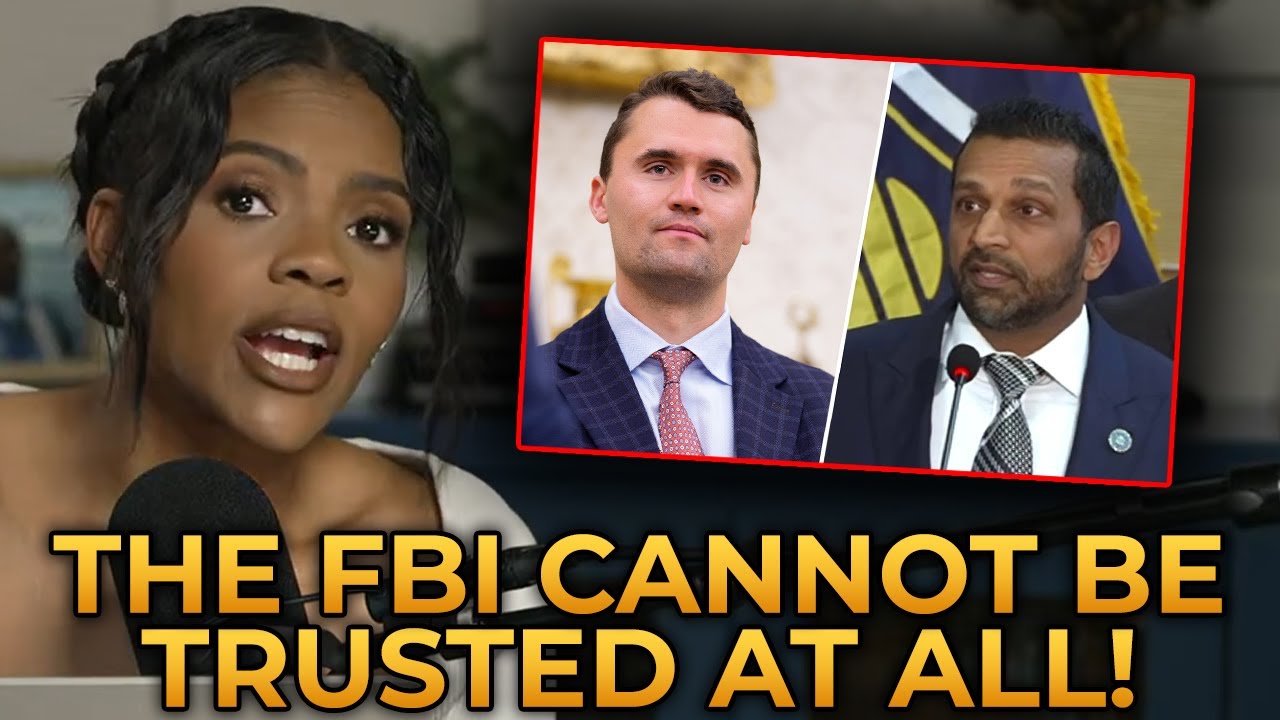
Candace Owens Slams Turning Point USA Response to Mikey McCoy Phone Call Controversy After Charlie Kirk Murder
Enjoying this? Share it with someone who needs to see it.
Up Next
Sam Parker Exposes Mikey McCoy's Strange Behavior After Charlie Kirk Shooting as Turning Point USA Launches Damage Control
1:30:23
Candace Owens Exposes Egyptian Military Planes Tracking Erika Kirk Before Charlie Kirk Assassination
56:32
Frank Turek Was There When Charlie Kirk Was Murdered: Death Threats, Candace Owens, and the Truth About That Horrible Day
50:36
Candace Owens Slams Turning Point USA Response to Mikey McCoy Phone Call Controversy After Charlie Kirk Murder
Candace Owens dissects Turning Point USA's explanation for why Charlie Kirk's chief of staff, Mikey McCoy, appeared to be on a phone call immediately after Kirk's murder. The organization claims McCoy was following Kirk's instructions to call his wife Erika in an emergency, but Owens questions the plausibility of their narrative, pointing out inconsistencies in positioning, behavior, and the lack of direct testimony from McCoy himself. She argues that asking questions about suspicious circumstances doesn't make investigators conspiracy theorists, pushing back against attempts to pathologize legitimate inquiry into what happened at the event.
Turning Point USA's Explanation for Mikey McCoy's Actions
Candace Owens analyzed Turning Point USA's response to viral footage showing Mikey McCoy, Charlie Kirk's chief of staff, appearing to be on a phone call within seconds of Kirk's murder. Andrew Kolvet explained on behalf of TPUSA that Kirk had given McCoy specific instructions over the years: if anything ever happened to Kirk, McCoy was to immediately call Erika Kirk, Charlie's wife. Kolvet stated that Kirk had drilled this instruction into McCoy's brain so that in a moment of trauma, he would know exactly what to do.
According to Kolvet's account, McCoy was not initially on the phone at all. He was supposedly taking social media videos to send to group chats for posting on Charlie's social accounts during the event, which was standard practice at every Turning Point USA event. Kolvet explained that the gunshot was so loud that McCoy, in a state of shell shock, put his fingers in his ears while his phone was still in his hand. He then walked away from the scene and only after getting some distance beyond the car that Kirk would be carried into did he call Erika first, then his father Rob McCoy.
Owens Questions the Video Evidence
Owens acknowledged that having a staff member take behind-the-scenes video content was absolutely standard practice at Turning Point USA. She confirmed that before McCoy, Sarah Schmackenberger did this, and during her time there, Savannah handled these duties. However, she pointed out a critical flaw in the explanation: McCoy's positioning doesn't match what would be expected if he were filming Charlie asking a question.
In the footage, McCoy is standing behind Charlie, not to the side. Owens noted that if someone were trying to capture video of Charlie asking a question at an event, the best position would be where you could see both Charlie and the person asking the question. McCoy's position behind Charlie wouldn't provide that angle. She also observed that she never sees McCoy take the phone down from his ear position, though she acknowledged that maybe he does and it's just not visible in the available footage.
Behavioral Analysis and Plausibility
Owens found it plausible that someone's first reaction to a gunshot might be to cover their ears, though she questioned whether someone would continue holding their ears all the way out of the area rather than ducking down. She also noted that other people visible in the footage were running away from the scene more quickly than McCoy walked away, which contradicts Kolvet's explanation about a choke point that forced everyone to slow down.
Regarding the claim that Charlie Kirk had instructed McCoy to call Erika in an emergency, Owens characterized this as essentially common sense rather than a special directive. She pointed out that calling a first of kin when something happens to someone is standard practice, not requiring specific instructions. However, she emphasized her skepticism about the idea that Kirk would have said, "If I get shot, don't help me, calmly walk away and call Erika first."
The Absence of Direct Testimony from Mikey McCoy
Owens found it curious that all the explanations were coming from Andrew Kolvet rather than from Mikey McCoy himself. She argued that it would be very easy to dispel internet speculation by simply being transparent. As an example, she referenced when she was accused of colluding in the Blake Lively lawsuit situation. She responded by going live on her show, opening her phone, searching for "Blake Lively" in her messages, and showing the only two times she had ever texted about the actress, proving there was no collusion.
According to Owens, this kind of transparency is far easier than fighting a back-and-forth war in the media. She suggested that McCoy could simply show the timestamps on his phone calls if he wanted to put the speculation to rest, though she acknowledged he's under no obligation to do so since he hasn't been accused of committing a crime and the FBI apparently hasn't felt the need to interview him despite stating they would explore every angle.
Alex Marlow's Comments and Psychological Operations
The discussion took a turn when Alex Marlow of Breitbart News appeared as a guest on the Turning Point USA show. Marlow suggested that people questioning the official narrative were creating content for the sake of it or were addicted to conspiracy theories in the same way people become addicted to social media or pornography. He characterized those asking questions as getting a "high" off the idea that they're doing something daring or out there.
Owens strongly rejected this characterization, calling it a psychological operation. She explained that when powerful entities don't want people looking into something, they employ a two-step process: gaslighting and then diagnosing. In this case, she argued, they were gaslighting the public about what happened and then diagnosing those who ask questions as being akin to drug addicts who are high on conspiracy theories.
She drew parallels to how government institutions label dissidents as extremists to dismiss their concerns without having to address the substance of their arguments. Owens pointed out that this same line of reasoning is never applied to the FBI itself, which she argued deserves far more scrutiny given its documented history of gaslighting the public, withholding information, and maintaining narratives with abnormalities and contradictions.
The Natural Response to Tragedy and Suspicious Circumstances
Owens defended the response of those asking questions, characterizing it as perfectly rational given what the public witnessed. She pointed out the strange reactions—or non-reactions—from Kirk's peers, some of whom were asking for donations shortly after his death. She also found it peculiar that Susie Wiles was chosen to eulogize Kirk rather than perhaps his parents, though she acknowledged they were quite private people who may have declined.
Responding to the accusation that questioners are like porn addicts getting high on conspiracy theories, Owens firmly stated: "Yes, we are asking questions. No, we are not akin to people that watch pornography all day. And no, we're not getting high on it. We're going to get high when we find out what actually happened. That's going to feel like a high to us, right? That's going to be that natural rush that we feel when we've actually solved what happened to Charlie Kirk."
The Broader Context of Institutional Distrust
The commentary extended to why this type of independent investigation has become necessary. The distrust of the FBI stems from its long history of misconduct, including covering up child sex trafficking operations connected to Jeffrey Epstein and Ghislaine Maxwell, entrapping people in schemes like the Whitmer kidnapping plot, attempting to undermine sitting presidents, wiretapping dissidents like Stokely Carmichael, Malcolm X, and Martin Luther King, murdering Fred Hampton, attempting to convince Martin Luther King to commit suicide, and engaging in warrantless wiretapping that violates the Fourth Amendment.
This history explains why many people don't trust the FBI's narrative about Kirk's murder and why independent investigations like Owens' have emerged. When federal institutions and legacy media have lost public trust, citizen journalists and independent investigators step in to fill the void. This represents a shift in how information is gathered and disseminated, with the new independent media rising to challenge and potentially displace legacy institutions that have repeatedly proven themselves untrustworthy.
Disagreements Within the Independent Investigation Community
Even within the community of people investigating Kirk's death independently, there are disagreements. Some believe Tyler Robinson, the accused shooter, is a patsy rather than the actual perpetrator. Others, while sympathetic to independent investigation, believe the evidence against Robinson—particularly text messages that appear damning—is substantial enough that unless the defense can prove they're fabricated, he will likely be convicted.
These text messages allegedly contain nearly every element of the crime, making them central to the prosecution's case. The defense will have subpoena power and every opportunity to challenge their authenticity, but absent a successful challenge, these messages present a significant obstacle to Robinson's acquittal. Some have suggested that if the messages are too perfectly incriminating, they must be fabricated, but this argument awaits the defense's response during trial proceedings.
The Value of Unapologetic Investigation
Regardless of disagreements on specific conclusions, Owens' approach has been characterized as fearless and unapologetic. Despite being close to Charlie Kirk and facing attacks from multiple directions, she has continued to pursue answers when official channels have proven inadequate. This persistence, even when it leads to conclusions others may disagree with, has been recognized as valuable in an environment where official narratives are increasingly questioned.
The argument concludes that people have every right to conduct whatever investigation they want, and if there are aspects of these investigations that prove problematic or incorrect, the blame ultimately rests with federal institutions like the FBI that have failed to earn public trust through decades of documented abuses of power. The criminal organization that is the FBI, dating back to J. Edgar Hoover, has created the environment where citizens feel compelled to investigate major crimes themselves rather than trusting official accounts.