2,422 videos 1,389,747,653 views US Joined Aug 30, 2018
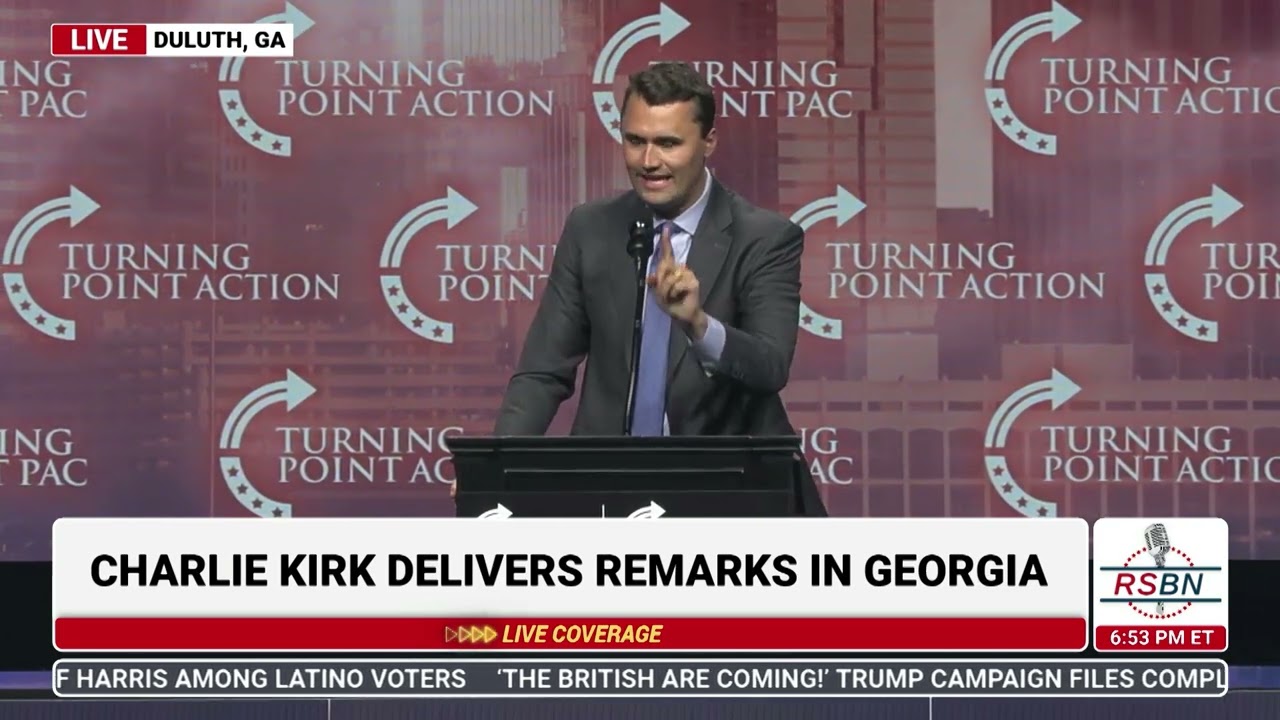
Charlie Kirk is the Founder and President of Turning Point USA, the largest and fastest growing conservative youth activist organization in the country with over 250,000 student members, over 150 full-time staff, and a presence on over 2,000 high school and college campuses nationwide. Charlie is also the Chairman of Students for Trump, which aims to activate one million new college voters on campuses in battleground states in the lead up to the 2020 presidential election. His social media reaches over 100 million people per month and according to Axios, he is one of the "top 10 most engaged" Twitter handles in the world. He is also the host of “The Charlie Kirk Show,” which regularly ranks among the top news shows on Apple podcast charts.
Charlie Kirk and Vivek Ramaswamy Defend the Electoral College Against Students Advocating for Popular Vote
Charlie Kirk and Vivek Ramaswamy engage with students who challenge the legitimacy of the Electoral College, arguing it functions as "DEI for the Republican party." The exchange explores fundamental questions about American governance: Are we a democracy or a constitutional republic? Should states maintain sovereignty in presidential elections, or should popular vote determine outcomes? Kirk and Ramaswamy make the case that the Electoral College forces candidates to engage with diverse regions beyond coastal cities, requires civic responsibility from voters, and preserves the bottom-up structure that distinguishes America from European nations. The discussion also touches on rank choice voting and whether smaller states like Wyoming deserve proportional influence compared to population centers like Texas and California.
A student opened the discussion by framing the Electoral College as fundamentally unjust, comparing it to DEI programs. The student argued that the Electoral College disproportionately empowers rural states, allowing candidates like Donald Trump to win the presidency while losing the popular vote, as happened when Hillary Clinton won more total votes but lost the Electoral College.
Vivek Ramaswamy responded by first establishing a foundational question: What is the definition of justice? He drew a parallel to the Senate, asking if the student also considered that institution unjust. When the student acknowledged the Senate's legitimacy, Ramaswamy highlighted the inconsistency in the argument.
Constitutional Republic vs. Direct Democracy
Ramaswamy explained that America is not a direct democracy but a constitutional republic, a distinction with significant implications. The United States functions as a union of sovereign states, not merely an assemblage of geographic territories. This structure requires balancing direct representative democracy with ensuring states maintain a voice in the federal system.
The Electoral College, like the Senate and House balance, reflects this principle. Ramaswamy emphasized that in a constitutional republic, citizenship involves not just rights but responsibilities. The founders envisioned informed voters with civic knowledge—a standard he suggested most modern voters would fail to meet if tested on basic civics, something every legal immigrant must pass before voting.
Charlie Kirk reinforced this point, noting that the Electoral College prevents two cities in New York and California from governing the entire nation. He argued that the current system forces candidates to engage with the most diverse cross-section of America, including states like Georgia, one of the blackest states in the country, and Pennsylvania, which receives attention precisely because of the Electoral College.
The Wyoming Question: Does Size Matter?
The student pressed on what they saw as a fundamental inequity: Wyoming's 700,000 residents receive three electoral votes while Texas's 30 million receive 38, making each Wyoming vote worth more proportionally than each Texas vote.
Kirk challenged the premise, noting that small blue states like Rhode Island and Hawaii also benefit from this structure, so it doesn't exclusively advantage Republicans. He emphasized that the Electoral College doesn't help one party—it helps ensure state-based representation.
Ramaswamy pointed out that the proportional representation issue applies to the constitutional amendment process itself, which requires three-quarters of states to ratify changes. If the student wanted to abolish the Electoral College, there's a mechanism for doing so, but it hasn't succeeded because most Americans, when they think through the implications, support the current system.
States Rise and Fall as Battlegrounds
Kirk noted that the battleground states constantly shift. Ohio used to be the quintessential swing state but no longer is. Arizona and Georgia have become battlegrounds. Florida once was but may not be anymore. This dynamic nature means the Electoral College doesn't permanently advantage any region or party—it forces campaigns to adapt to changing demographics and voter preferences.
The system requires candidates to go beyond the coastal corridor and win over voters in places that make the country work: Pennsylvania, Wisconsin, Georgia, and Michigan. These states offer diverse populations and perspectives that would be ignored in a pure popular vote system.
Bottom-Up vs. Top-Down Government
When the student continued to question why Wyoming voters should matter more than Texas voters, Kirk reframed the question entirely. The issue isn't about individual votes mattering more or less—it's about the fundamental structure of American government.
America operates as a bottom-up government, not a top-down one. This distinguishes the United States from European nations like France, Germany, and Belgium. Kirk cited COVID-19 as an example: American states made different policy decisions based on local conditions and preferences, while in Germany, edicts came from the centralized government regardless of regional differences.
States in America retain sovereignty and the ability to govern according to their citizens' preferences. The Electoral College reinforces this decentralized power structure.
The Popular Vote Scenario
Ramaswamy described a hypothetical electoral map if the Electoral College were abolished: two blue dots around New York and the West Coast of California, with the entire rest of the country colored red, yet resulting in a blue president. While the student correctly noted that Texas would also be blue in this scenario, the broader point stood: vast geographic areas could be completely ignored if elections were determined purely by population centers.
Kirk noted that while the top 10 cities represent only about 10% of the total population, metropolitan areas account for more than half of Americans. The distinction between city limits and metropolitan regions matters. Chicago proper has about 3 million people, but Chicagoland includes 7-8 million. In a popular vote system, campaigns would focus on running up scores in these metropolitan areas while ignoring rural regions entirely.
Rank Choice Voting Enters the Discussion
A second student introduced rank choice voting as an alternative to the Electoral College, expressing support for RFK Jr., who they felt was suppressed under the two-party system. The student argued that rank choice voting would allow voters to specify their preferences more clearly, ranking candidates from favorite to least favorite.
The student also cited what they saw as Electoral College flaws: territories can't vote, conservatives in blue states are ignored due to winner-take-all systems, and the vote distortion makes Wyoming voters four times as powerful as California voters.
Kirk responded that rank choice voting and the Electoral College are separate issues. Rank choice voting, he argued, has been employed primarily by liberals in red states to eliminate Republican candidates by advancing the "first loser" through successive rounds of counting.
Wisconsin Values vs. Coastal Elites
Kirk emphasized the beauty of the current system: Wisconsin, a state representing middle America, has become one of the most important states in the election. Wisconsin values and Wisconsin voters must be heard by both candidates. The swing states—Nevada, Arizona, Georgia, North Carolina, Pennsylvania, Michigan, Wisconsin—represent an incredibly diverse cross-section of America.
Without the Electoral College, candidates would focus exclusively on Seattle, Chicago, San Francisco, Los Angeles, and New York. While the student correctly noted that the top cities don't contain enough voters to win alone, the metropolitan areas surrounding these cities do contain the majority of Americans.
Kirk argued that requiring candidates to compete in states like Wisconsin forces them to address the concerns of farmers and working-class Americans, not just coastal urban populations. This gives states like Wisconsin a seat at the table in determining national leadership.
The Constitutional Amendment Solution
Ramaswamy concluded by emphasizing that if Americans truly wanted to abolish the Electoral College, the founders provided a mechanism: constitutional amendment. If three-quarters of states agreed, the system would change. The fact that this hasn't happened in 240 years of American history suggests that most citizens, when they consider the alternatives, prefer the current structure.
The Electoral College embodies the principle that America is fundamentally different from other nations. It's a union of sovereign states that choose to work together as a national project, not a top-down centralized government that dictates to provinces. This structure, while sometimes producing outcomes that don't align with the popular vote, ensures that diverse regions and perspectives have a voice in selecting the nation's leadership.