
Up Next

Charlie Kirk Exposes Kamala Harris's Far-Left Record and the Democrat Honeymoon Period Following Biden's Exit
8:02

Charlie Kirk on How RFK Jr's Endorsement Changed Everything and Led to Historic HHS Confirmation
9:46

Charlie Kirk Releases Full Conversation With Gavin Newsom From California Viral Debate on Trans Athletes and Wokeism
1:22:50
Related Books
Browse Conservative Books






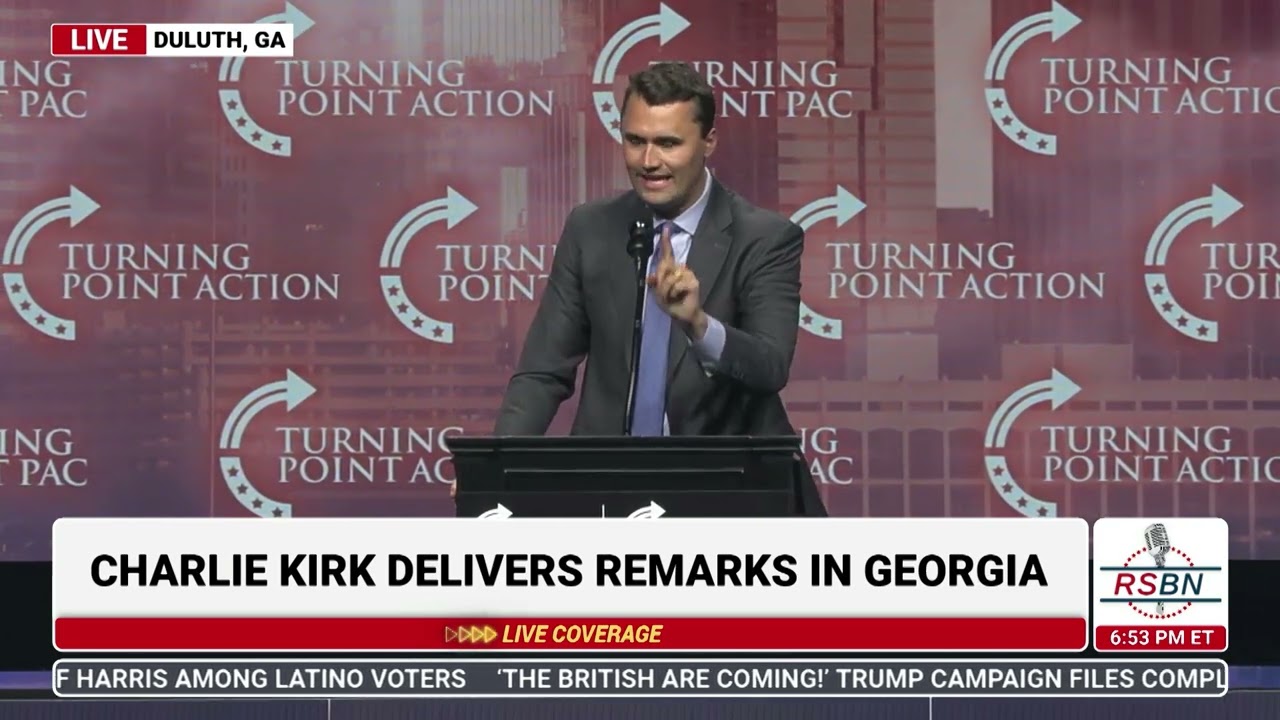
Charlie Kirk Reveals Why Trump's 2024 Electoral Map Is Better Than 2016 and 2020 Combined
Charlie Kirk breaks down why Donald Trump's path to victory in 2024 starts from a stronger position than previous elections. With Florida, Ohio, and Iowa no longer battleground states, Kirk explains how Trump only needs to win three states, Pennsylvania, North Carolina, and Georgia, to secure the presidency. Kirk also discusses the remarkable new coalition of RFK Jr., Tulsi Gabbard, Elon Musk, and Bret Weinstein rallying around Trump, the Democrats' coup against Biden, and why abortion and immigration remain the most contested issues heading into November.
A Transformed Electoral Landscape
Charlie Kirk opens with a striking observation about how the 2024 electoral map has fundamentally shifted in Trump's favor. Florida, Ohio, and Iowa—once critical battleground states requiring massive campaign resources—are no longer competitive. Kirk credits Governor Ron DeSantis for transforming Florida through effective governance and voter registration efforts, forcing Democrats to abandon the state entirely. Ohio now shows Trump up by 11 points, and Iowa has similarly moved out of reach for Democrats.
This transformation means the Trump campaign can focus resources on a narrower set of states. Kirk explains that in previous cycles, the campaign had to work its way up through Iowa, Ohio, and Florida before even reaching second and third-tier threshold states. Now, the starting position is far superior, with North Carolina, Pennsylvania, and Georgia as the primary targets.
The Path to 270 Electoral Votes
Kirk lays out the clearest path to victory: if Trump wins Pennsylvania, North Carolina, and Georgia, he becomes president. Kirk emphasizes this is a remarkably strong position—two of these three states Trump won in previous elections, and Georgia he lost by only 10,000 votes in 2020. The math becomes even more favorable when considering Wisconsin, where Trump fell just 21,000 votes short in 2020, and Arizona, where the margin was 10,000 votes.
However, Kirk acknowledges North Carolina presents challenges due to controversies surrounding Mark Robinson and other factors, making it "shakier" than it should be given the national environment. Despite Trump's improved position, Kirk refuses to sugarcoat the situation, maintaining the race remains a genuine 50-50 proposition.
The Kamala Harris Threat
While Kirk believes Trump is in a better position than 2016 or 2020, he expresses frustration that the race isn't more decisive given the economy, southern border crisis, and general public dissatisfaction with the country's direction. He credits Kamala Harris's campaign team as "brilliant" and notes she's receiving exceptional coaching, constantly uploading new one-liners while attempting to suppress her characteristic cackle and laugh.
Kirk emphasizes the importance of not underestimating the Harris team's ability to chase ballots, register voters, and engage in early voting operations. This is why he maintains his 50-50 assessment rather than projecting confidence that could lead to complacency among Trump supporters.
The Remarkable Unity Coalition
One of the most exciting developments Kirk identifies is the organic formation of what he calls an "Avengers Unity team" around Trump. This coalition includes RFK Jr., Tulsi Gabbard, Elon Musk, Bret Weinstein, and others who don't traditionally identify as conservative or Republican. Kirk notes this phenomenon had no equivalent in 2016 or 2020—there was no central casting director orchestrating these alliances.
The common thread connecting these figures is their personal experience with what Kirk calls "the left-wing blue beast." Each has a story of being scorned or targeted by progressive institutions, which led them to extrapolate broader concerns about concentrated power, censorship, and anti-democratic impulses within the Democrat Party. Bret Weinstein faced mob rule at Evergreen State University. Jordan Peterson fought forced pronoun legislation in Canada. Elon Musk saw his companies targeted while defending free speech on Twitter. Tulsi Gabbard went from DNC co-chair to pariah for disagreeing on foreign policy.
Kirk argues this coalition represents people who love America and free speech, even while disagreeing on abortion, foreign policy, and other specific issues. He suggests this demonstrates a healthier, more vibrant conservative movement focused on macro agreement rather than micro disagreements—a philosophy he and Dave Rubin tried to demonstrate through campus work years ago that has now crescendoed into the presidential election.
The Democrat Coup and Machine Politics
Kirk remains amazed by the Democrat Party's ability to execute what he characterizes as a coup against Joe Biden while simultaneously quelling any internal rebellion. The party that claims to champion democracy installed a candidate who received zero primary votes, and the rank-and-file accepted it without significant protest. Kirk believes this coup was planned months in advance, likely beginning around April or May.
The early summer debate with Biden, Kirk suggests, was likely a sabotage operation designed to force Biden out. Looking back, Kirk acknowledges Trump may have fallen into a trap by agreeing to debate so early, giving coup plotters the forcing function they needed. While he doesn't blame Trump—understanding the personal and strategic calculus involved—he notes this should be filed in the political strategy playbook for future generations: when your opponent isn't doing well, don't give them an early debate opportunity to make a change.
What Kirk finds most chilling is how the media and millions of Americans simply accepted this process. Kamala Harris—who didn't even make it to Iowa in the 2020 primary—suddenly became the most popular person in the party, complete with pre-workshopped slogans and branding that clearly indicated advance planning. The Trump assassination attempt briefly disrupted the timing, but Democrats memory-holed it quickly to shift the news cycle to Harris.
Concerns About Election Integrity
When asked about potential "shenanigans" on election day, Kirk acknowledges the concern while offering a nuanced perspective. He believes there are limits to cheating, pointing to Ron DeSantis winning Florida by 20 points in 2022 despite Democrats presumably wanting to defeat him. When there's sufficient public consensus and a strong ground game, Kirk argues, there's only so much the opposition can do.
The Turning Point Action strategy focuses on mobilizing people who agree with conservatives but don't vote—tens of millions of potential voters whose ballots never enter the system. Kirk sees driving record turnout as the best remedy to a broken system, creating margins too large to overcome through irregularities. However, he refuses to sugarcoat the situation, acknowledging that suspicious outcomes could occur. He frames this reality not as cause for cynicism but as motivation for greater urgency in turning out voters.
The College Campus Transformation
After twelve years of campus activism, Kirk reports the most significant generational shift he's witnessed: young men are the most conservative they've been in 50 years, while young women remain very liberal. Recent events at Penn State University and University of Wisconsin-Madison drew crowds of 3,000 students—genuine young people, not GOP meeting attendees—demonstrating substantial interest in conservative ideas.
The opposition still exists, but the energy and numbers on the conservative side have dramatically increased compared to years ago when Kirk and Rubin regularly appeared on campuses together. This generational gender divide represents both an opportunity and a challenge for conservatives moving forward.
The Abortion Political Reality
Kirk, a self-described pro-life absolutist, offers a clear-eyed assessment of abortion as a political issue. While he never moves an inch on the moral topic when advocating on campus, he acknowledges that politically, you have to win elections by persuading majorities in states to agree with you—and the majority of the country is nowhere near his position.
He pushes back on the idea that abortion will "always" be a loser for Republicans, suggesting the culture may shift, but acknowledges it's currently a political problem. Kirk notes that many self-described pro-life voters aren't actually as pro-life as committed activists, defining the term to include first-trimester exceptions and other carve-outs.
The real stakes, Kirk argues, involve Kamala Harris's promise to use the filibuster to nationalize Roe v. Wade, eliminating state sovereignty on the issue. As California Attorney General, Harris targeted David Daleiden, journalists, and Pregnancy Resource Centers. Kirk warns she would use the IRS and Department of Justice to go after pro-life organizations as nonprofits spreading "medical disinformation."
Kirk praises Trump's navigation of this difficult issue, particularly his debate answer with Biden as the best he's ever given on abortion, including discussion of late-term abortion. Trump could have simply adopted a 12-week national position to neutralize the issue, but instead maintained that reversing Roe v. Wade and returning decisions to states was the appropriate constitutional approach. Kirk's only criticism is Trump's occasional use of the phrase "reproductive freedom," which he considers left-wing framing.
Foreign Policy Contradictions
Kirk identifies a striking contradiction in Democrat foreign policy: obsessive pro-war sentiment regarding Ukraine and Russia despite nuclear risks, while simultaneously maintaining hostility toward Israel. He attributes this partly to significant anti-Semitism in the base of the Democrat Party, offering Josh Shapiro's rejection as vice presidential nominee as definitive evidence.
Shapiro, the popular Pennsylvania governor with a substantial political operation, had one disqualifying characteristic for Democrats: he's Jewish. Democrats feared turning Chicago into a race riot over Israel, so they discriminated against him based solely on religion. By choosing Tim Walz instead, Kirk argues, they made Pennsylvania far more competitive and decreased Harris's odds of victory.
The fundamental divide, Kirk explains, is that conservatives view Israel as a miracle—the triumphant return of an abused and genocided people who created an oasis of common law, separation of powers, individual liberty, and property rights in a sea of totalitarianism. Progressives view Israel as a colonialist project that stole land from indigenous people. They hate Israel for the same reason they hate the West generally.
Immigration and Western Civilization
Kirk expresses deep concern about terrorist supporters regularly rioting in major American cities, waving Hezbollah flags in New York, Chicago, San Francisco, and Detroit. He questions how long a multicultural Western society can sustain itself when such displays occur regularly, pointing to the United Kingdom as a cautionary tale of a nation becoming "a husk of its former self."
Stating definitively that not all cultures are equal, Kirk clarifies he's not suggesting people are unequal—all are made in God's image—but that Mid-Eastern Muslim totalitarianism as a worldview is not equal to Western civilization. He frames the terrorism-supporter problem as fundamentally an immigration issue, crediting Trump for making this his strongest topic.
Kirk advocates for mass deportations, including anti-Western American flag burners who came to the country at America's invitation but act in hostile and bitter ways. He argues these newcomers should be deported immediately, as permitting such behavior invites the nation's own demise.
The Final Assessment
Despite being pressed for a prediction, Kirk maintains his 50-50 assessment. After twelve years of political activism and intimate involvement in Trump's campaign ecosystem, he genuinely cannot call the race. He can construct equally compelling arguments for either candidate winning, making this the most evenly matched election he's witnessed.
Kirk's focus remains on what he can control: working as hard as possible to drive turnout, register voters, and ensure Trump supporters don't stay home. With tens of millions of potential voters who agree with conservatives but historically don't participate, Kirk sees the path to victory running through mobilization rather than persuasion. The map favors Trump more than any previous cycle, but execution and turnout will determine whether that structural advantage translates to victory on election night.


Comments
Be the first to comment on this video.