2,422 videos 1,389,747,653 views US Joined Aug 30, 2018
Charlie Kirk is the Founder and President of Turning Point USA, the largest and fastest growing conservative youth activist organization in the country with over 250,000 student members, over 150 full-time staff, and a presence on over 2,000 high school and college campuses nationwide. Charlie is also the Chairman of Students for Trump, which aims to activate one million new college voters on campuses in battleground states in the lead up to the 2020 presidential election. His social media reaches over 100 million people per month and according to Axios, he is one of the "top 10 most engaged" Twitter handles in the world. He is also the host of “The Charlie Kirk Show,” which regularly ranks among the top news shows on Apple podcast charts.
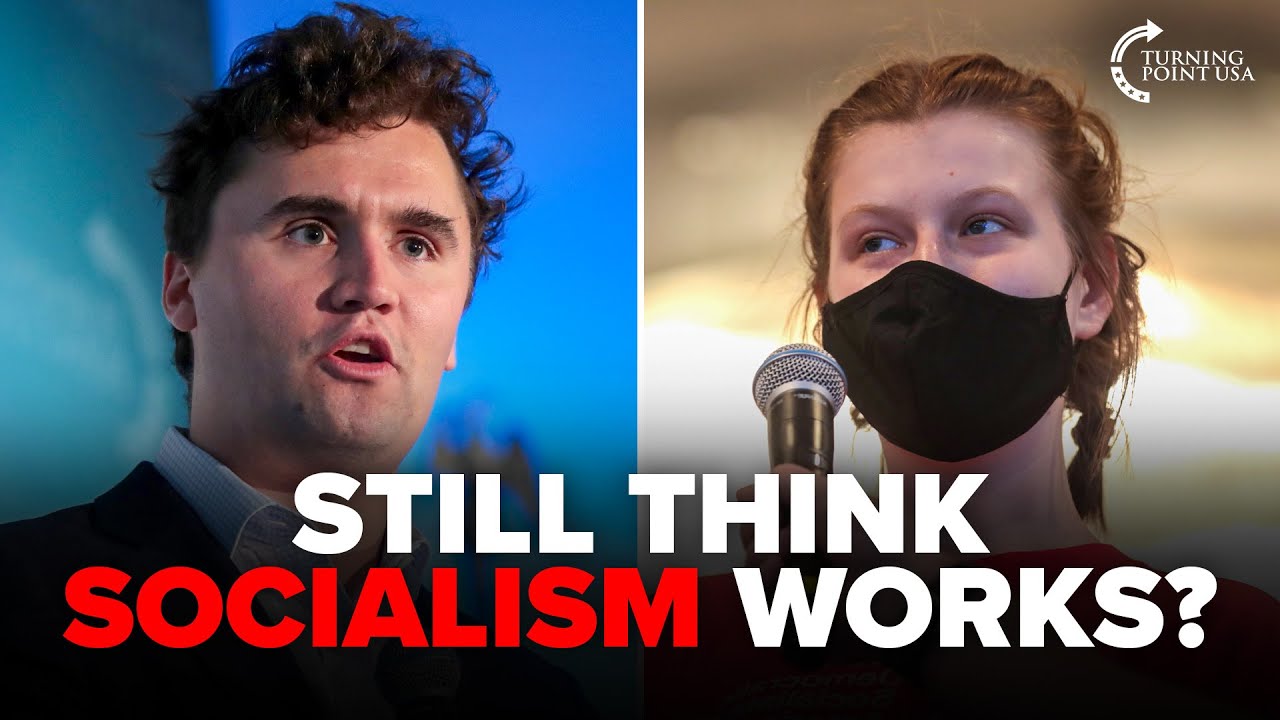
Charlie Kirk Debates College Student on Socialism, Taxation, and What Makes America Pro-American
Charlie Kirk engages in a debate with a college student who claims socialism is inherently part of America. The conversation explores the definition of socialism, the role of taxation in a free society, and where the line between necessary government services and socialist confiscation exists. Kirk argues that socialism involves unreasonable confiscation of private property, while moderate taxation for essential services like military and police represents a fundamentally different principle. The exchange highlights the intellectual challenge of defining socialism in practice and whether taxation itself constitutes a socialist policy.
Defining Socialism Versus American Economic Principles
The debate begins with a student agreeing that socialism is un-American, prompting Charlie Kirk to define what makes something pro-American. Kirk explains that socialism fundamentally involves government confiscation of private property and tends toward rule by the few, despite claiming to represent the many. In contrast, the American economic tradition centers on private property rights, markets with proper restraint, entrepreneurship, the ability to flourish, trade, and the creation of new products.
Kirk argues that socialism disincentivizes these foundational American principles. He contends that socialism is built largely on envy and greed, and that the rank-and-file supporters of socialism fail to realize it actually creates an oligarchy rather than the strong middle class they claim to want.
The Taxation Challenge: Where Does Socialism Begin?
The student challenges Kirk by asking if he believes in taxes, attempting to frame taxation itself as a form of property confiscation. Kirk responds that he ideally supports a 10% tax rate across the board. When pressed on whether this constitutes government confiscation of private property through force, Kirk acknowledges he supports "a moderate form of something I hate" in order to fund necessary government services like the military, police, firefighters, and EMTs.
The student, identifying as an anarchist, argues that any form of government taxation is essentially socialism. This leads to a semantic debate about whether all taxation equals socialism, with the student pushing Kirk to define exactly where the line between acceptable taxation and socialism exists.
Distinguishing Between Necessary Services and Socialist Confiscation
Kirk refines his definition, stating that socialism involves the "unreasonable confiscation of private property" and the elimination of private property altogether. He argues that a 10% tax for essential services is fundamentally different from socialism, though he acknowledges one can be a "gateway drug" to the other. Both socialism and communism, he notes, are "garden varieties of Marxism," with socialism serving as a precursor to communism.
The conversation touches on public schools, which Kirk notes were started by John Dewey approximately 100 years ago. He suggests they should ideally be more community-based and volunteer-driven, though he acknowledges the current reality of government schools in American society.
The Spectrum of Socialism: Florida Versus California
To illustrate his point about degrees of socialism, Kirk contrasts Florida and California. He describes Florida as more free and California as more socialist, creating a spectrum rather than a binary choice. Florida has no state income tax and no corporate income tax, while California imposes significantly higher tax burdens. Kirk calculates that a top income earner in California pays approximately 15% state tax in addition to a 38% federal income tax rate, totaling 53%—meaning the government owns a majority of that person's labor.
The student challenges this by pointing out that if Florida is part of America and America is socialist (as the student claims), then Florida must also be socialist. Kirk pushes back, arguing that while the federal government may be moving in a socialist direction, Florida provides "at least some gasp of liberty and freedom" that California does not.
The Hidden Tax of Inflation
Kirk introduces another dimension to the taxation debate by discussing inflation as a form of hidden taxation. When the government borrows $2 trillion per year that it does not have, he argues, everyone becomes "10% poorer every single year." This represents a form of taxation that affects all Americans regardless of their state of residence.
Historical Context: America Before Income Tax
As the debate concludes, Kirk challenges the student's claim that taxation has always been part of America by noting that the United States did not have an income tax until 1917. He suggests the government was funded through tariffs before that time, undermining the argument that current levels of taxation are inherent to the American system.
Kirk's final point emphasizes that not every form of government constitutes socialism. There exists a spectrum between small government with essential services and Soviet-style communism, and it's intellectually sloppy to claim that wanting a police force, border patrol, and clean streets makes one a socialist. The key distinction lies in the extent and purpose of government confiscation of property, not merely its existence.